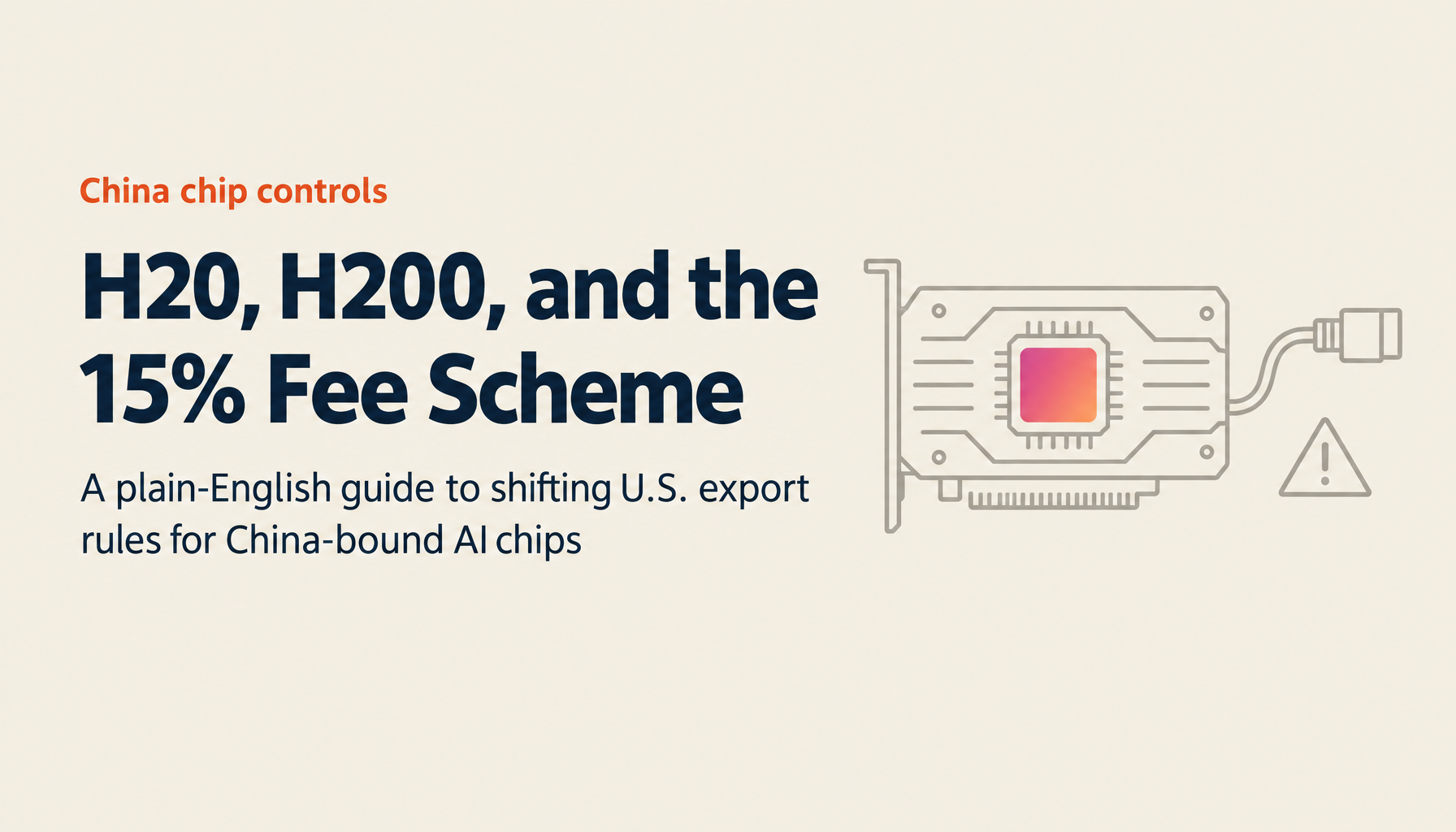
Hello, this is Ryuta Hamamoto from TIMEWELL. As of May 2026, the U.S.–China AI semiconductor control picture looks very different from six months earlier. NVIDIA’s H20 swung from ban to restart to production pause discussions. Higher-performance H200 and AMD’s MI325X became conditionally shippable to China. The condition: pay 15% of China sales to the U.S. government. That scheme is unprecedented.
“What is the difference between H20 and H200?” “Is the 15% fee a tariff?” “Should we freeze GPU procurement for our China sites?” I get those three questions constantly. Below I answer them at a beginner-friendly level: chip specs, regulatory posture, timeline, the fee scheme, Chinese-side moves, and Japanese company practice. Information is current as of 20 May 2026. Always re-check BIS, METI, CISTEC, and other primary sources.
Three terms first
- TPP (Total Processing Performance): BIS metric for advanced computing chip controls. It aggregates dense compute performance weighted by precision bit-width.
- Performance Density: TPP divided by die area. High density can bring an item into control even if raw TPP looks moderate.
- 15% fee scheme: Trump Administration arrangement requiring NVIDIA and AMD to pay 15% of covered China H20/MI308 sales to the U.S. federal government as a license condition (in operational use from August 2025).
Specs and regulatory posture by chip
NVIDIA Hopper family (H100 / H20 / H200)
| Item | H100 (global) | H20 (China SKU) | H200 (global) |
|---|---|---|---|
| Memory | 80 GB HBM3 | 96 GB HBM3 | 141 GB HBM3e |
| Memory bandwidth | 3.35 TB/s | 4.0 TB/s | 4.8 TB/s |
| FP16 performance | ~1,979 TFLOPS | ~296 TFLOPS | ~1,979 TFLOPS |
| TDP | 700W | 350W | 700W |
| Primary use | Training + inference | Mainly LLM inference | Training + inference, large LLMs |
H20 intentionally cuts compute to roughly 15% of H100 while keeping higher memory capacity and bandwidth. For memory-bound LLM inference it can even beat H100 by 20%+ in some workloads.
H200 is not a China-only chip. It is the global product that became conditionally China-exportable from January 2026, at about 6× H20 compute. AMD mirrors the pattern: MI308 as a downgraded MI300X, MI325X as flagship. The design idea is “keep compute under the line, maximize memory.”
Main BIS thresholds around January 2026 (EAR Part 740.29, ECCN 3A090, etc.):
- AI accelerators with TPP ≥ 4,800, or (TPP ≥ 1,600 and Performance Density ≥ 5.92) need a China license
- Chips with TPP < 21,000 and DRAM bandwidth < 6,500 GB/s fall under case-by-case review (H200 / MI325X class)
- TPP ≥ 21,000 (B200 / Blackwell class) remains presumption of denial
H20 was designed under the original thresholds (license-exception territory) yet was forced into individual licensing in April 2025. Political dynamics enter there.
Replace siloed classification work with AI.
METI's FY2024 data shows 52% of foreign exchange law violations stem from classification errors. Download the TRAFEED product catalog covering features and rollout.
Timeline of China exportability (2022–2026)
| Period | Event |
|---|---|
| Oct 2022 | Biden Administration 10/7 rules; A100/H100 effectively banned |
| Oct 2023 | Tightening (10/17); A800/H800-class derivatives blocked; NVIDIA H20 and AMD MI308 launched |
| Jan 2025 | Biden Administration publishes AI Diffusion Rule near end of term |
| Apr 2025 | Trump Administration requires individual licenses for H20/MI308 to China (de facto ban) |
| Jul 2025 | NVIDIA announces H20 China sales restart (after CEO–President meeting) |
| Aug 2025 | Reports of “15% of China sales to U.S. government” deal; CAC guides major tech firms to refrain from H20 purchases |
| Dec 2025 | President Trump signals H200/MI325X China export permission (fee reported at 25%) |
| 15 Jan 2026 | BIS final rule (FR 2026-00789) moves H200/MI325X from presumption of denial to case-by-case |
| Jan–Feb 2026 | ~10 firms including Alibaba, Tencent, ByteDance obtain purchase approvals (up to 75,000 units each reported) |
| 2026 Q1 | NVIDIA discloses zero H20 China customer revenue; AMD records ~$440M MI308-related inventory write-down |
| From Jan 2026 | Reports that Chinese customs effectively blocked H200 clearance (Nikkei, Reuters) |
H200 moved from “could not sell” toward “can sell conditionally.” H20 moved from “was selling” toward “China revenue near zero.” Do not reverse those vectors. I still see teams mix them up in internal briefings.
Five steps Japanese export-control teams should take now
Step 1: Inventory AI chip procurement and holdings
List H20/H100/H200/MI308/MI300X/MI325X by site. For China-subsidiary plans, run classification and EAR applicability. Cloud indirect use is common even when teams believe they “do not use advanced AI chips.”
Step 2: Confirm ECCN and current China status
ECCN is the five-character BIS classification that starts license analysis. Check current China posture (license required / case-by-case / presumption of denial) using Federal Register, law-firm alerts, and JETRO notes.
Step 3: Run de minimis analysis
For Japanese products incorporating U.S. chips destined for China, compute U.S.-origin value share against de minimis thresholds (generally 25% for China, but advanced AI semiconductors are structured so capture is common).
Step 4: Screen recipients against restricted lists
Check China subsidiaries and counterparties against the Entity List, Unverified List, and METI Foreign End User List. List placement is a regulatory designation, not a moral judgment on the company. Officer and shareholder changes can flip status, so monitor periodically.
Step 5: Build internal escalation and monitoring
Route new China-export cases to export control at intake. Monitor BIS rules, CAC guidance, and customs practice as a process, not as individual heroics.
TIMEWELL’s TRAFEED is an export-control AI agent designed for this multi-axis work: METI-aligned classification, automated screening against U.S. Entity List and METI foreign user lists, and multilingual due diligence. Teams use it when they need fast answers on “BIS license vs FEFTA catch-all.” Details: TRAFEED — visualize risk in seconds.
Structure and constitutionality of the 15% fee
The scheme conditions licenses on paying 15% of covered China chip sales to the U.S. federal government (domestic R&D support). Washington Post reporting described an initial 20% ask settling at 15%; H200/MI325X were reported at 25%, but the final rule text does not codify the fee.
It is unusual because it is a direct commercial payment to the federal government, neither ordinary export duty nor a standard license fee. Accounting and receiving-agency practice remain opaque.
Constitutionality is contested. Article I, Section 9 (Export Clause) bars federal taxes on exports; ECRA 50 USC 4815(c) expressly limits fees related to export licenses. Lawfare analyses and Carnegie Endowment’s Peter Harrell, among others, call it effectively an export tax of dubious constitutionality. The government frames it as consideration for a license, not a tax. Standing is hard to establish (NVIDIA and AMD have weak incentives to sue while China market access continues), and as of May 2026 no formal challenge had been filed. Practically, treat litigation as medium-term uncertainty and comply with current rules short-term.
Supporters argue controlled exports with monitoring beat bans and fund domestic semiconductor R&D. Vendors prefer sharing revenue to losing China entirely. Critics fear executive-branch deal-making over discretionary export permissions. The compliance problem is predictability. Frameworks that change after CEO–President meetings shrink planning horizons.
Chinese-side moves and spillover to Japanese companies
CAC guidance and domestic acceleration
On 12 August 2025, reporting said China’s Cyberspace Administration (CAC) convened ByteDance, Alibaba, Tencent, and others and administratively guided restraint on H20 purchases for security reasons, including concern that NVIDIA might have to provide customer-related materials to the U.S. government. Domestic AI chip vendors surged (Cambricon 1H 2025 revenue reported up 40×+ YoY). Huawei Ascend became a major alternative product line in that market shift. From January 2026, customs blocking of H200 was reported even after roughly 10 firms secured approvals for up to 75,000 units. U.S. approval is not Chinese delivery.
Three Japanese-company scenarios
U.S. EAR applies to re-exports of U.S. items/technology via third countries (including Japan):
- Japan HQ buys U.S. AI chips and transfers them to a China subsidiary → BIS license; FEFTA catch-all may also apply
- Japanese products embedding U.S. chips exported to China → de minimis analysis
- U.S. persons involved in China-side chip use → person-based controls (EAR 744.6) can apply
Using H20/H200-class cloud compute as an end user is not automatically a controlled “export,” but vendor selection criteria still need risk assessment.
Japanese FEFTA / economic security context
METI continues comprehensive and specific bulk licenses and updates security trade control guidance; CISTEC runs EAR briefings. Combined with the Economic Security Promotion Act, AI-chip rules will keep fragmenting. FEFTA catch-all can require licenses for unlisted items when military end-use diversion risk exists under Japanese rules. Dual EAR and FEFTA compliance is normal.
FAQ
Q1. How do H20 and H200 differ under the rules?
H20 is a reduced-performance China SKU; H200 is the global flagship. H20 was designed under thresholds then forced into individual licensing (April 2025). H200 sat above thresholds (presumption of denial) then moved to case-by-case (January 2026)—opposite directions.
Q2. Is the 15% fee like a Japanese tariff?
Formally no—it is a license-condition payment of a revenue share. Whether it is a “tax” is the U.S. legal dispute. Japan’s export trade control order and customs law have no close analogue.
Q3. Checklist when sending U.S. GPUs to a China subsidiary?
(a) ECCN and current China control level, (b) re-export under de minimis, (c) BIS license need, (d) FEFTA service-transaction / bulk license need, (e) Entity List status of the recipient.
Q4. How severe are penalties?
EAR criminal: up to $1 million or 20 years; civil: up to ~$308,000 per violation (inflation-adjusted) or twice transaction value, plus denial of export privileges (Denied Person List)—business-ending risk.
Latest developments as of July 2026
China-related AI chip controls center on U.S. EAR, but Japan’s economic-security frame is also moving. At the 16th Japan–India annual summit on 2 July 2026, both sides issued a joint declaration on semiconductors, critical minerals (rare earths), clean energy, ICT, and pharmaceuticals with roughly ¥2 trillion of investment indicated (Japan–India summit press conference (Prime Minister’s Office, 1 July 2026)). Diversifying semiconductor supply among partners can help manage AI-chip geopolitics. Export-control teams should plan procurement on U.S.–China dual axes plus trusted-partner supply redesign. See Japan–India summit and economic security.
If you want to improve export-control operations or classification efficiency, review the TRAFEED service catalog (PDF) or contact us.
Summary
From the 2022 10/7 rules to 2026, China-related AI semiconductor controls changed almost completely. The Trump Administration partly unwound Biden-era bans into a 15% revenue-share model. China accelerated localization and used customs to constrain delivery. Front-line teams must track U.S. EAR, FEFTA catch-all, and Chinese import practice together.
Japanese companies need structures that survive multiple scenarios (procurement plans, site layout, and intra-group transfers) rather than firefighting each rule change. AI infrastructure lead times are long. Misreading the rules costs years. Discretionary schemes like the 15% fee are hard to forecast, but understanding the structure leaves room for calm decisions instead of overreaction.
If I had to start Monday morning with one action, it would be inventorying which H20, H200, MI308, and MI325X units you hold or plan to buy by site, then checking current China license posture for each ECCN.
Practical five steps again:
- Step 1: Inventory AI chip procurement and holdings
- Step 2: Confirm ECCN and current regulatory status
- Step 3: Run de minimis analysis
- Step 4: Screen recipients against Entity List and related lists
- Step 5: Build internal rules and monitoring
Related reading: AI export regulation 2026, China export risk 2026, EAR affiliate rule risk, Dual-use technology diversion risk.
TRAFEED — visualize risk in seconds / Book a 30-minute consultation
References
- BIS Press Release: Department of Commerce Revises License Review Policy for Semiconductors Exported to China — https://www.bis.gov/press-release/department-commerce-revises-license-review-policy-semiconductors-exported-china
- Federal Register: Revision to License Review Policy for Advanced Computing Commodities (FR 2026-00789, effective 15 Jan 2026) — https://www.federalregister.gov/documents/2026/01/15/2026-00789/revision-to-license-review-policy-for-advanced-computing-commodities
- EAR Part 740.29 License Exception LPP — https://www.bis.gov/regulations/ear/part-740/section-740.29/license-exception-low-processing-performance-lpp
- CRS R48642 Advanced Semiconductors and U.S.-China Strategic Competition — https://www.congress.gov/crs-product/R48642
- Morgan Lewis: BIS Revises Export Review Policy for Advanced AI Chips — https://www.morganlewis.com/pubs/2026/01/bis-revises-export-review-policy-for-advanced-ai-chips-destined-for-china-and-macau
- Covington & Burling: U.S. Commerce Department Revises License Review Policy — https://www.cov.com/en/news-and-insights/insights/2026/01/us-commerce-department-revises-license-review-policy-for-exports-of-certain-advanced-computing-commodities-to-china-and-macau
- Lawfare: Trump's Illegal AI Chip Export Controls and Who Can Challenge Them — https://www.lawfaremedia.org/article/trump-s-illegal-ai-chip-export-controls--and-who-can-challenge-them
- Washington Post: Nvidia, AMD strike deal to share 15% of China chip revenue (10 Aug 2025) — https://www.washingtonpost.com/technology/2025/08/10/nvidia-amd-china-chips-deal-trump/
- CNBC: Trump approves Nvidia H200 China AI chips with 25% deal (14 Jan 2026) — https://www.cnbc.com/2026/01/14/trump-nvidia-h200-china-ai-chips.html
- Al Jazeera: China raises concerns over Nvidia's H20 chips with local firms — https://www.aljazeera.com/economy/2025/8/12/china-raises-concerns-over-nvidias-h20-chips-with-local-firms-report
- Nikkei: China customs reportedly holds Nvidia H200 imports — https://www.nikkei.com/article/DGXZQOGN1508E0V10C26A1000000/
- JETRO Security Trade Control Quick Guide (Jan 2024) — https://www.jetro.go.jp/ext_images/world/security_trade_control/pdf/guide/202401_v2.pdf
- CISTEC EAR overview — https://www.cistec.or.jp/service/keizai_anzenhosho/us/ear.html
- AMD 10-K / earnings materials (MI308 inventory) — https://www.sec.gov/Archives/edgar/data/0000002488/000000248826000014/amdq425earningsslidesfin.htm
- NVIDIA 8-K (April 2025 H20 license notice) — https://www.sec.gov/Archives/edgar/data/1045810/000104581025000082/nvda-20250409.htm