Hello, this is Ryuta Hamamoto from TIMEWELL.
Japan's National Intelligence Bureau began operating on July 31, 2026. Headlines called it the birth of a Japanese intelligence agency. Open the statute, though, and the picture shifts. Nothing was built from scratch. An existing organization, the Cabinet Intelligence and Research Office, was lifted into a higher position in law.
The main event has not happened yet. On August 5, the LDP's Intelligence Strategy Headquarters published a second set of recommendations titled "Strengthening Japan's Information Defense Capability: Protecting an Open Society from Hidden Operations."1 The outline of the bills that will reach the Diet is in that document. A Foreign Interference Prevention Act. A Foreign Intelligence Collection Act. And parliamentary oversight of both.
If you handle export controls or counterparty screening, this is not somebody else's problem. I will get to why in the second half.
It was a promotion, not a founding
Getting July 31 right matters, because misreading it distorts everything that follows.
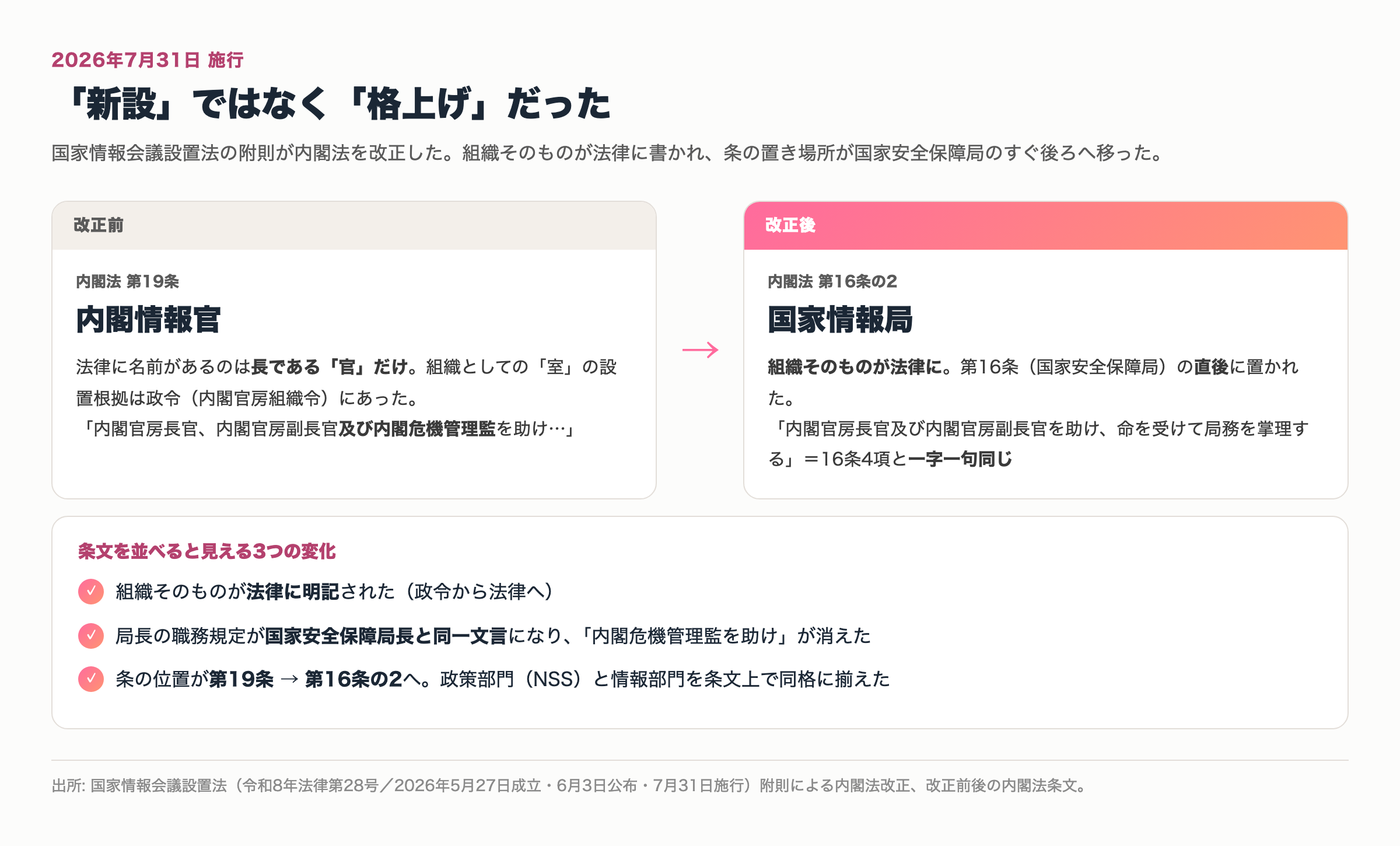
The governing statute is the National Intelligence Council Establishment Act (Act No. 28 of 2026). The House of Councillors passed it on May 27, 2026, it was promulgated on June 3, and it took effect on July 31.2 The body of the act creates a cabinet-level National Intelligence Council. But the provision with the most practical weight sits in the supplementary provisions, which amended the Cabinet Act.
Here is the old Article 19:
One Cabinet Intelligence Director shall be placed in the Cabinet Secretariat. (2) The Cabinet Intelligence Director shall assist the Chief Cabinet Secretary, the Deputy Chief Cabinet Secretaries and the Deputy Chief Cabinet Secretary for Crisis Management, and shall administer the affairs concerning the protection of specially designated secrets… and the affairs listed in Article 12(2)(vi).
That is a provision about one official. No organization appears. The Cabinet Intelligence and Research Office existed under a cabinet order, not a statute, so the only name written into law was the director's.
The new Article 16-2 reads:
The National Intelligence Bureau shall be placed in the Cabinet Secretariat. … (3) A Director-General of the National Intelligence Bureau shall be placed in the Bureau. (4) The Director-General shall assist the Chief Cabinet Secretary and the Deputy Chief Cabinet Secretaries, and shall administer the affairs of the Bureau under orders.
Three things changed. The organization itself is now in statute. The Director-General's job description is word-for-word identical to Article 16(4), which governs the Secretary General of the National Security Secretariat, and the old phrase "and the Deputy Chief Cabinet Secretary for Crisis Management" is gone. And the article moved from 19 to 16-2, directly behind the National Security Secretariat. Where a provision sits in a statute quietly signals where the organization sits in government.
So the amendment aligned the policy-side command post and the intelligence-side command post at the same rank. The coalition agreement signed on October 20, 2025 between the Liberal Democratic Party and Nippon Ishin no Kai says exactly that: the Bureau and its Director-General shall be equal in standing to the National Security Secretariat and its Secretary General, so that the policy function and the intelligence function sit on the same level in the security domain.3
One more provision, quieter but decisive. Article 7 of the establishment act:
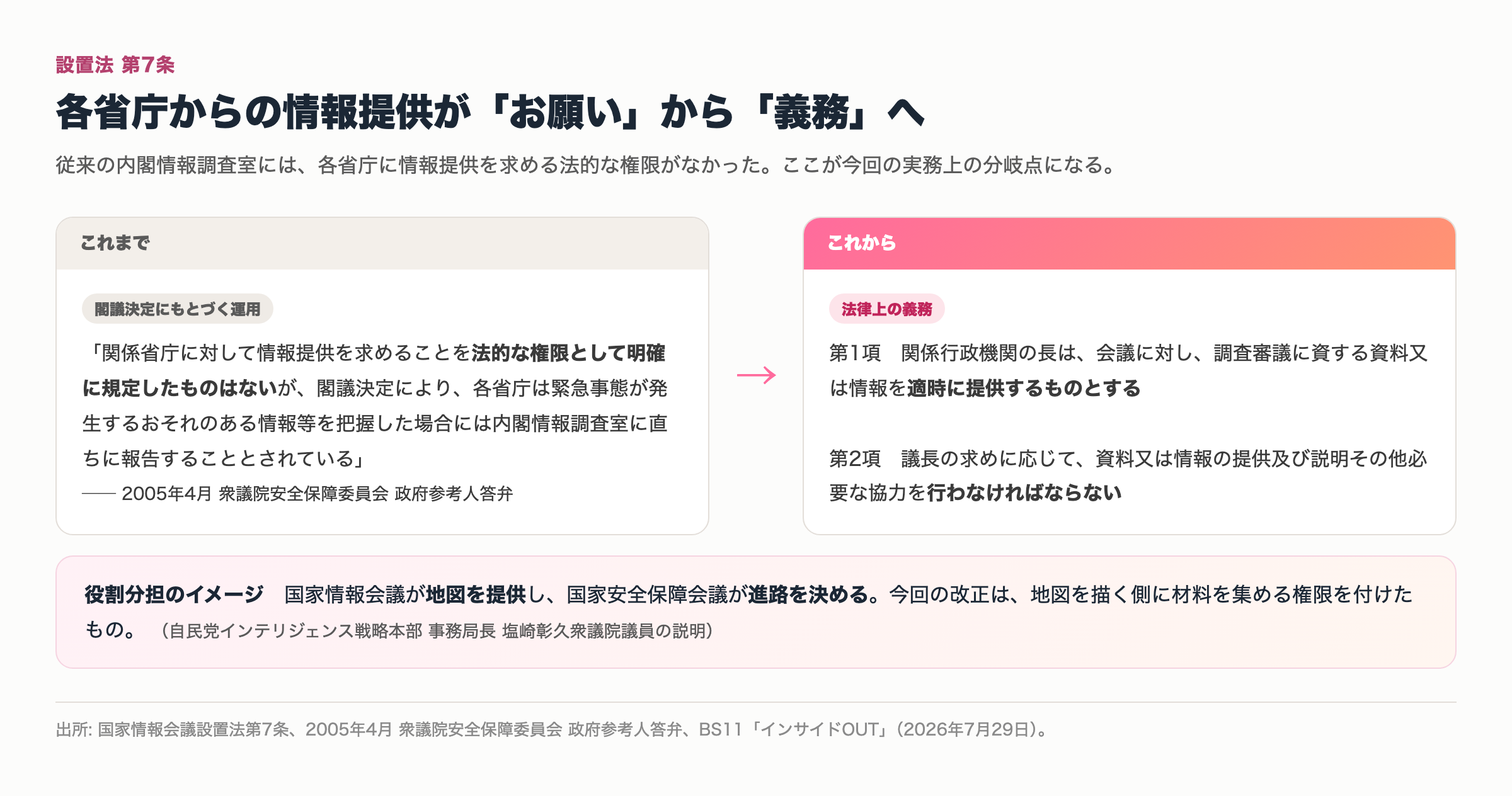
The Chief Cabinet Secretary and the heads of relevant administrative organs shall, as prescribed by the Council, provide the Council in a timely manner with materials or information… that contribute to its deliberations. (2) In addition to the preceding paragraph, the Chief Cabinet Secretary and the heads of relevant administrative organs shall, in response to a request from the Chair, provide the Council with materials or information and explanations, and extend such other cooperation as is necessary.
Why does that matter? Because the Cabinet Intelligence and Research Office had no legal authority to demand information from ministries. In an April 2005 session of the House of Representatives Committee on Security, a government witness stated that there was no clearly established legal authority to require relevant ministries to provide information, and that ministries reported to the Office under a cabinet decision when they detected signs of an emergency.4 A request has become a duty.
Ken Kotani, professor at Nihon University, put it plainly on a BS11 program aired July 29: until now, ministries were asked to send things up on a best-efforts basis, and from now on cooperation can be required by law where necessary.5 On the same program, Akihisa Shiozaki, a member of the House of Representatives who serves as executive director of the LDP's Intelligence Strategy Headquarters, described the division of labor between the two councils this way: the National Intelligence Council supplies the map, and the National Security Council chooses the route. The mapmaker finally has a way to demand the survey data.
This kind of promotion has happened before, incidentally. The lineage runs from the 1952 Research Office of the Prime Minister's Secretariat, to the Cabinet Research Office in 1957, to the Cabinet Intelligence and Research Office in 1986, and in 2001 the head of that office was elevated to Cabinet Intelligence Director.6 This is the second promotion in twenty-five years, not a founding. Staff and capability did not change overnight. For how the Bureau was structured at launch, see my piece on the Bureau and industrial espionage.
If you want a quick read on whether your own export control setup can absorb regulatory change like this, the three-minute export compliance check is a fast way to locate yourself before reading on.
Replace siloed classification work with AI.
METI's FY2024 data shows 52% of foreign exchange law violations stem from classification errors. Download the TRAFEED product catalog covering features and rollout.
Why now: a report about parts moving out of one Tokyo office
Before the policy detail, the event that pushed all of this forward.
On July 12, 2026, The New York Times published an investigation titled "How Putin Turned Japan Into a Den of Spies."7 It described a little-known directorate of Russia's GRU procuring dual-use electronic components and machine tools from a base in Tokyo. The central figure was described as operating under cover as an employee at the Tokyo office of the Russian airline Aeroflot. Rather than shipping goods straight to Russia, the network was reported to route them through third countries that still trade with Moscow, including Vietnam, China, Sri Lanka, and Uzbekistan. Eleven days later, the paper reported that the individual had left Japan.8
To be careful: this is reporting, not a finding confirmed by Japanese authorities. Nothing here establishes criminal conduct by any person or company.
Even so, it clearly landed. Shiozaki said on the program that if the reporting were accurate it would be an extremely serious matter, and noted the long-standing gap between Japan's counterintelligence framework and those abroad, where conduct that is illegal elsewhere often cannot even be prosecuted here.
Kotani's account was more operational. Russians posted to the embassy under diplomatic cover are watched by the police and the Public Security Intelligence Agency. Someone residing under a private-sector job title is far harder to spot. And even when identified, Japan has no statute criminalizing espionage as such, so, in his words, you cannot arrest someone simply for being a spy. Any action has to come through something else, such as smuggling or a foreign exchange law violation. Surveillance still relies largely on physical tailing, which he said consumes five to ten officers per target.
Here is where export control teams stop being spectators. Ukrainian government estimates cited in the reporting put Japanese-made components in roughly 90 percent of Russian missiles and drones.7 I want to be precise about what that does and does not mean. It does not mean Japanese manufacturers did something wrong. Goods sold legitimately for civilian use pass through several tiers of traders, the stated end use is falsified, and they end up in weapons. From the seller's side that path is close to invisible. The manufacturer is the deceived party, which is exactly why verifying who your counterparty actually is has to be a system rather than a habit. I unpacked that structure in this article on diversion and red flags.
Deterrence, collection, oversight: the three pillars from August 5
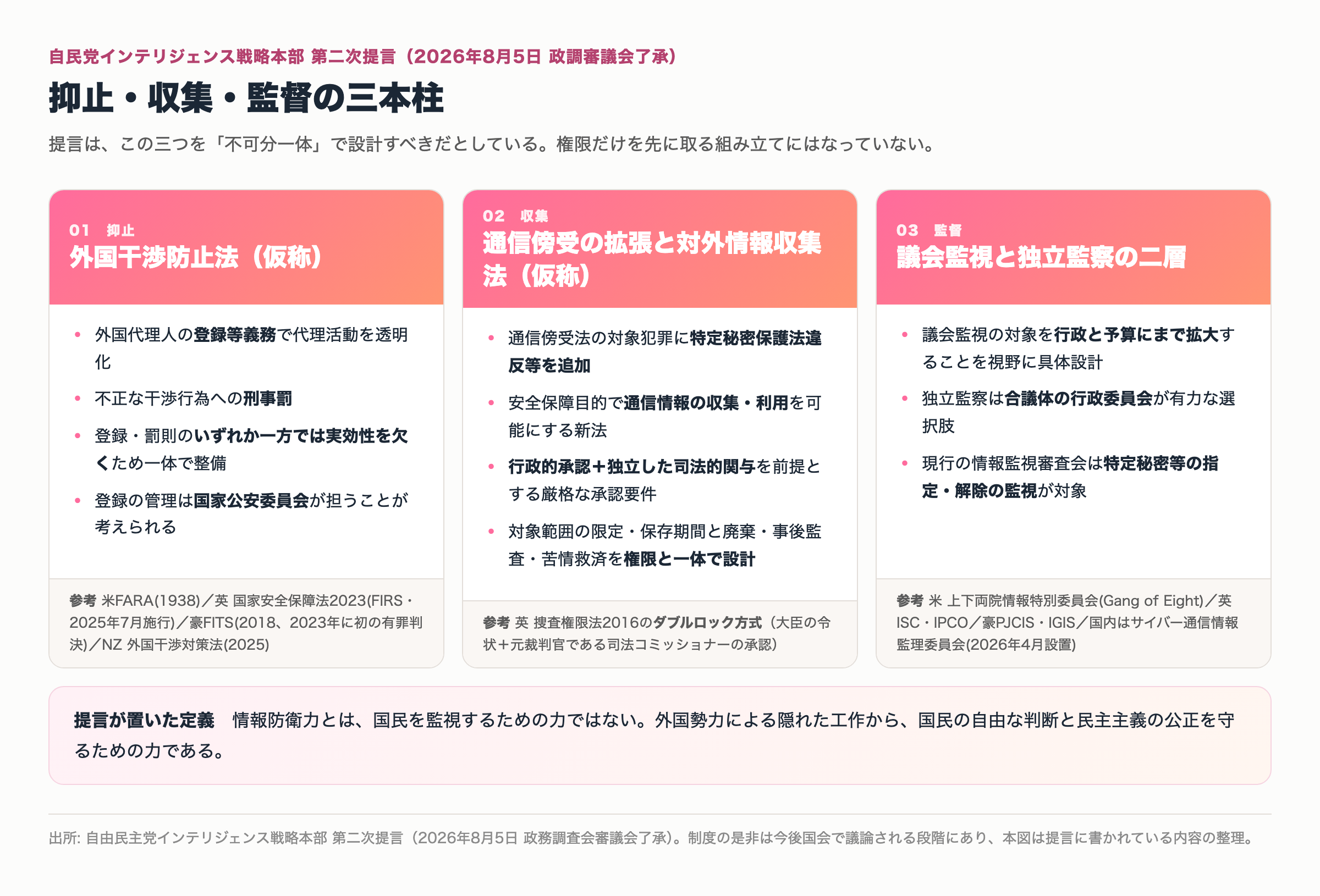
The second set of recommendations cleared the LDP's Policy Research Council on August 5. Takayuki Kobayashi, chair of the Policy Research Council, heads the task force; Shiozaki serves as executive director.
The document opens by defining its terms:
Information defense capability is not a power for surveilling the public. It is the power to protect citizens' free judgment and the fairness of democracy from hidden operations by foreign powers.1
From there, three pillars, described as inseparable.
Pillar one is deterrence, and its core is the Foreign Interference Prevention Act (working title). It has two floors: a registration duty for foreign agents that makes proxy activity visible, and criminal penalties for improper interference. Why both? Because, the proposal argues, other countries have learned that registration or penalties alone lack bite. Registration would be managed by the National Public Safety Commission, chosen for neutrality and enforceability. The comparative references are the US FARA (1938), the UK National Security Act 2023 with its FIRS registration scheme and foreign interference offence (in force July 2025), Australia's FITS and foreign interference offence (2018, with the first conviction under the interference offence in 2023), and New Zealand's foreign interference legislation (2025).
Registration sounds like asking spies to identify themselves, which is not the idea at all. Shiozaki's explanation is the clearest I have heard. A foreign agent registration law is not limited to spies; a group doing entirely legitimate lobbying is also required to register in those countries. Register, and lobby openly, and nothing about it is unlawful. Do the same work without registering, and the question becomes why. The design makes lawful activity visible so that the avoidance of visibility stands out.
Pillar two is collection, with two legal measures. One is adding offences to the list covered by the Communications Interception Act, including violations of the Act on the Protection of Specially Designated Secrets and of the proposed Foreign Interference Prevention Act. The other is a Foreign Intelligence Collection Act (working title) permitting the collection and use of communications intelligence for security purposes, to clarify the activities of foreign agencies. Amending the existing Active Cyber Defense legislation and enacting a new statute are both on the table.
This is where the real argument will be. Article 21(2) of Japan's Constitution prohibits violating the secrecy of communications, and current interception is limited to criminal investigation under a court warrant. What the proposal sets out is a strict authorization requirement built on executive approval plus independent judicial involvement, calibrated to the target and the situation. The reference point is the double lock under the UK Investigatory Powers Act 2016, where a minister issues the warrant and a Judicial Commissioner, a former judge, approves it separately. Scope limits, retention and deletion, independent post hoc audit, and a complaints procedure are all to be designed together with the power itself.
Shiozaki made the same point on air, noting that even abroad, administrative interception is not a warrantless free-for-all, and that strict procedural safeguards and public oversight are preconditions. Whether Japan should do this at all will be fought out in the Diet. But at the proposal stage, at least, the drafters did not try to take the power first and design the controls later.
Pillar three is oversight, in two layers: parliamentary and independent. The United States has intelligence committees in both chambers, with the most sensitive material limited to the Gang of Eight. The United Kingdom has the Intelligence and Security Committee of Parliament; Australia has the Parliamentary Joint Committee on Intelligence and Security. Alongside those sit independent inspectors: the UK's IPCO, Australia's Inspector-General of Intelligence and Security, and the US inspectors general, all of which examine individual operations rather than only budgets.
What about Japan? Both chambers of the Diet have Review Boards on Oversight of Intelligence, but their remit covers the designation and declassification of specially designated secrets and critical economic security information, and the conduct of security clearance assessments. They do not directly oversee intelligence operations. The proposal concedes this and commits the task force to design something broader, extending oversight to administration and budget. For independent inspection, it points to the Cyber Communications Information Oversight Commission established in April 2026 under the Active Cyber Defense law as a promising model. Japan already has one working example of the form.
From where I sit, working on export controls and counterparty screening, the moment deterrence and collection move, the demands landing on companies change too. Policy and operations run into each other, and this connects directly to the economic security work covered on the TRAFEED service page.
HUMINT, SIGINT, GEOINT, OSINT: four ways of seeing
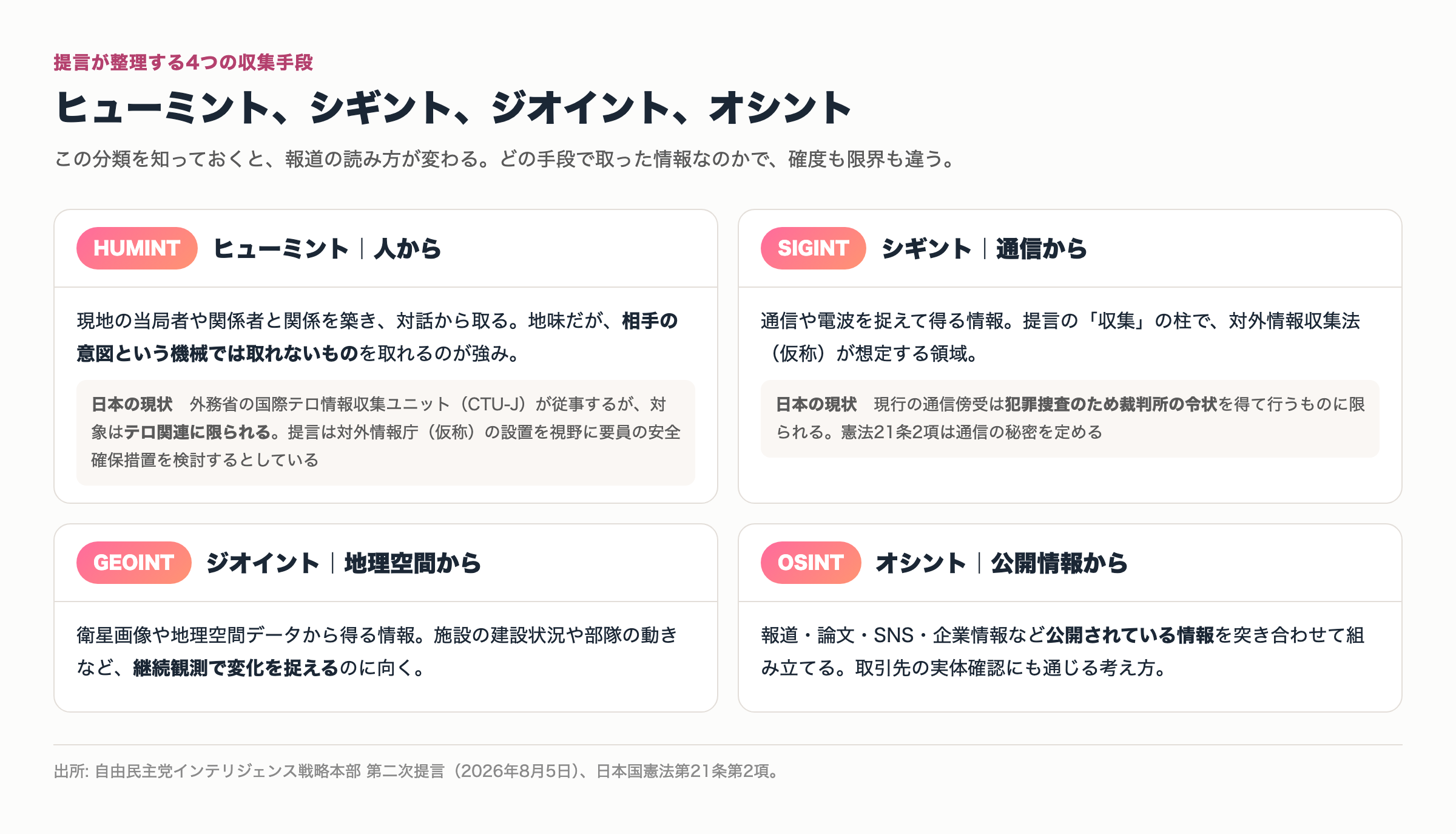
A little more detail on collection, because the proposal sorts intelligence into four disciplines and knowing them changes how you read the news.
HUMINT is information obtained through people. You build relationships with officials and insiders and learn things through conversation. It is unglamorous, and it is the only way to get at intent, which no machine picks up. In Japan, the Counter Terrorism Unit-Japan at the Ministry of Foreign Affairs collects abroad, but only on terrorism. The proposal calls for measures to protect officers, with a future foreign intelligence agency in view.
That agency, provisionally named, was promised in the coalition agreement by the end of fiscal 2027. On structure, the proposal treats an independent external bureau under the supervision of the Foreign Minister as a strong option: independent from the policy side while still able to use diplomatic assets. The UK's SIS and Australia's ASIS both sit under foreign ministers while retaining operational independence.
Building the box is not the same as making it work. Kotani noted that CTU-J's job is essentially to receive information from local security services rather than to penetrate organizations, and that unless cover identities, communications interception, and protection for sources are resolved, a new agency would end up operating as an extension of CTU-J. He put the timeline to real capability at a decade. Shiozaki, recalling a visit to CIA headquarters, described the wall of stars for officers killed in service, and how some stars have no name beside them because those officers cannot be identified even after death. The further you go, the more you have to protect.
SIGINT covers the collection and analysis of communications, radio, and electronic signals. Of the four, the proposal puts it first. The earlier March recommendations quoted intelligence officers from partner countries saying that HUMINT only works when strong SIGINT is behind it, and that SIGINT narrows the picture while HUMINT fills the last gaps.9 The Foreign Intelligence Collection Act is the legal scaffolding for that capability.
GEOINT is geospatial information from satellite and aerial imagery. Japan's Cabinet Satellite Intelligence Center operates the information gathering satellites, with a ten-satellite constellation targeted by fiscal 2029, and the proposal calls for more analysts and round-the-clock operations. Worth noting where the money has gone: in the fiscal 2026 budget, the Cabinet Intelligence and Research Office proper had roughly 3.84 billion yen while the Satellite Center had roughly 62.23 billion, about sixteen times more.6 Japan's intelligence investment has been overwhelmingly weighted toward eyes.
OSINT draws on open material, from social media and news to research institute reports. It used to be treated as supplementary. Generative AI and large-scale data analysis changed that. Because influence operations and disinformation leave most of their traces in public space, the proposal treats OSINT as central to early detection and attribution, and proposes a split: government keeps analysis tied to policy judgment, fusion with sensitive material, and tasking, while bulk collection, monitoring, and deep language, regional, and technical expertise go to outside specialists. The phrase used was an open OSINT base that does not stay sealed inside government.
Looking at the four together, what strikes me is the imbalance. Japan has invested heavily in eyes and left the legal foundation for signals and people nearly blank. This proposal is aimed squarely at that blank.
Eighty years of absence, and why oversight is the precondition
Japan did once have foreign intelligence organizations, run by the army, the navy, and the foreign ministry. They were dismantled after 1945, and for eighty years no system existed to train and deploy intelligence officers as a matter of national policy. What is happening now is an attempt to refill that space.
The memory of the prewar period is also why caution is warranted, and people say so. Fujio Ogino, professor emeritus at Otaru University of Commerce, warns that laws such as the Military Secrets Protection Act functioned as criteria for ideological screening of the population, and that this history should be remembered.6 Kotani takes the other view, arguing that the legislation under discussion targets foreign intelligence services and carries no real risk of reproducing the repression carried out by the prewar special police and military police. Both positions rest on primary evidence. Neither can simply be waved away.
Which is why I think everything rides on whether oversight actually bites. Shiozaki said as much: transparency and accountability are secured through parliamentary and independent inspection, and that oversight is a precondition for all the capability building, not an afterthought. Grant the power first and design the controls later, and the order is wrong.
There is also a design homework assignment already on the books. When the Diet Act was amended in 2014 to establish the intelligence oversight review boards, a supplementary provision stated that if an administrative organ whose purpose is collecting overseas information is established, the manner of Diet oversight of that organ shall be examined and necessary measures taken.6 Build the foreign intelligence agency, and that provision comes due. Japan wrote itself the assignment twelve years ago.
Capacity is a worry too. Michio Ezaki, specially appointed professor at Reitaku University, notes that the Bureau's workload now stretches from serving as the Council's secretariat to designing the future foreign intelligence agency, while its authorized headcount grew by 29 people, and asks whether that is survivable.6 Jun Yanagi of the Japan Institute of International Affairs argues that the promotion itself matters less than the grant of information access, and that without expanding the analyst corps the Bureau will drown in a flood of incoming material. Once the structure is built, what remains is always people.
What companies can start on now
Three concrete shifts, if the pillars become law.
First, prepare for foreign agent registration. Public relations, government affairs, research, and consulting performed in Japan under contract with a foreign government or entity could fall inside the scope. This is not only about firms doing espionage. Ordinary PR agencies, think tanks, and law firms are the ones that will need to explain who the counterparty is and where the money comes from. Pull your overseas client contracts and check whether you can identify the ultimate principal. You can start that today.
Second, sharpen your view of diversion. What the July reporting illustrated is that when a trader in a third country falsifies the end use, the exporter cannot see the final user. Stronger deterrence and collection also mean authorities will more often question specific transactions using information they hold. Records showing that you verified ownership and substance, and how you reasoned when a red flag appeared, become considerably more valuable. TRAFEED, which we build, puts its weight on preserving that reasoning as a record, but tool or no tool, the point is being able to explain later why you cleared a transaction.
Third, manage the people who touch sensitive information. The Act on the Protection and Utilization of Critical Economic Security Information, in force since May 2025, brought security clearance assessments to private-sector personnel handling government information. As intelligence-related flows grow after the Bureau's launch, more companies will meet that regime through public procurement or joint research. I mapped the surrounding framework in this overview of Japan's espionage-related legislation.
Three milestones are worth watching: the government's expert panel, the National Intelligence Strategy that the Council is expected to publish, and whether a Foreign Interference Prevention bill appears in the next ordinary Diet session. Shiozaki said he wants something that explains, as far as possible, what priorities Japan as a whole is pursuing, rather than leaving each agency to publish its own white paper. Kotani noted that other countries are watching this closely. Allies and adversaries alike will read how specific Japan is willing to be.
Reviewing how your contracts and transactions look from the outside is cheaper now than after the rules harden. If you are working through export control or counterparty screening, get in touch and we can think it through together.
Footnotes
-
LDP Intelligence Strategy Headquarters, "Strengthening Japan's Information Defense Capability: Protecting an Open Society from Hidden Operations" (August 5, 2026). Summary / Full text / Party announcement, in Japanese ↩ ↩2
-
National Intelligence Council Establishment Act (Act No. 28 of 2026) and the Cabinet Act (Act No. 5 of 1947), e-Gov. Prime Minister Takaichi's remarks on passage are on the Cabinet Public Relations site (May 27, 2026). Translations of statutory text here are mine ↩
-
"Liberal Democratic Party and Nippon Ishin no Kai Coalition Agreement" (October 20, 2025), as compiled in the House of Councillors research paper cited in note 6 ↩
-
House of Representatives Committee on Security, minutes No. 6, p. 12 (April 8, 2005), quoted in the House of Councillors research paper cited in note 6 ↩
-
BS11 "Inside OUT," broadcast July 29, 2026, featuring Akihisa Shiozaki MP and Professor Ken Kotani. Program archive, in Japanese ↩
-
Shigeshi Kakinuma and Kentaro Kawamura, "The Current State and Future Direction of Cabinet Intelligence Arrangements," Keizai no Prism No. 252 (Research Office, House of Councillors, March 26, 2026). PDF, in Japanese ↩ ↩2 ↩3 ↩4 ↩5
-
The New York Times, "How Putin Turned Japan Into a Den of Spies" (July 12, 2026) ↩ ↩2
-
The New York Times, "A Russian Spy, Suddenly Cast Into the Spotlight, Flees Japan" (July 23, 2026) ↩
-
LDP Policy Research Council Intelligence Strategy Headquarters, "Recommendations on Fundamentally Strengthening Japan's Intelligence Capability" (March 3, 2026). PDF, in Japanese ↩