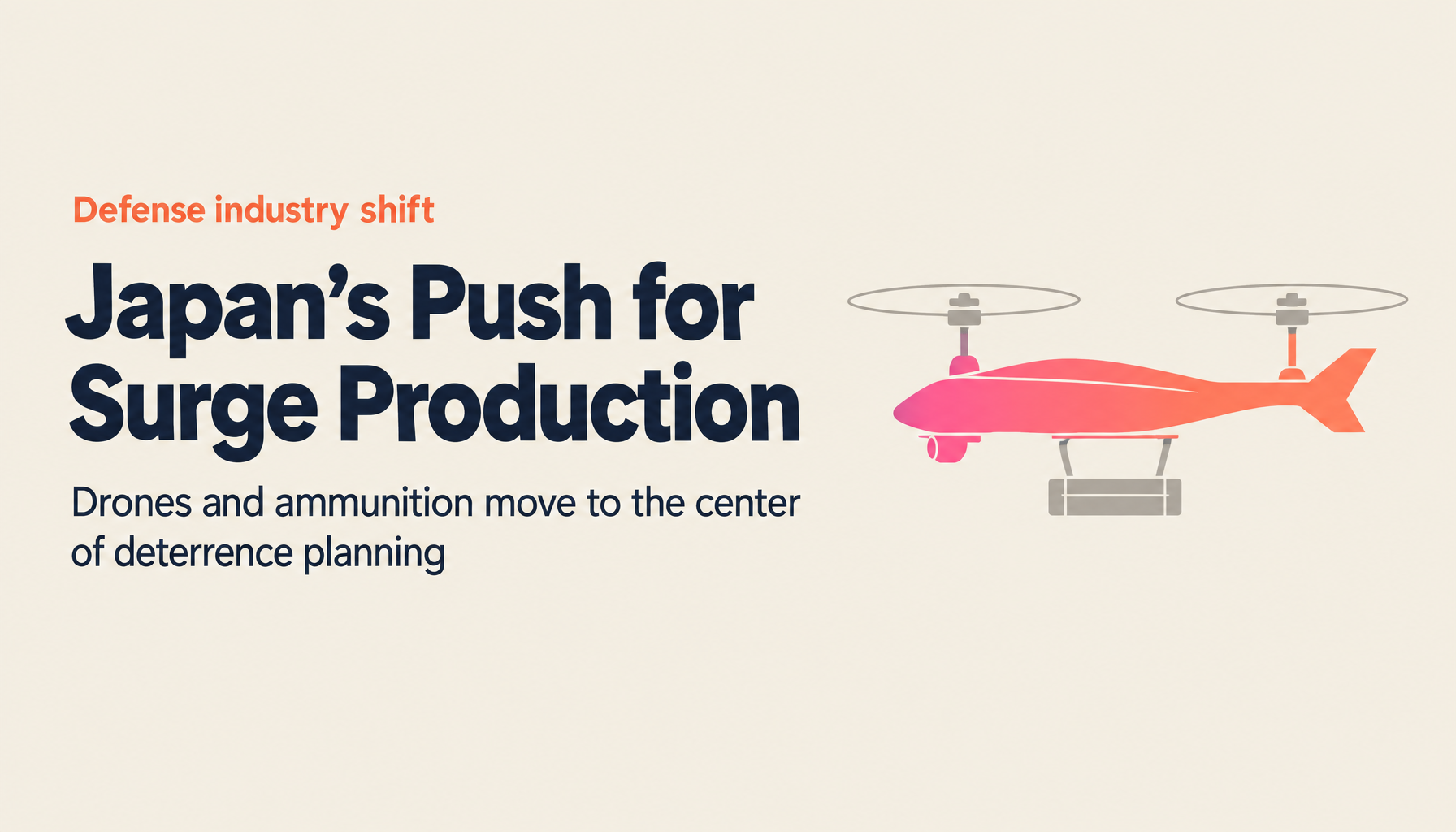
Hello, this is Ryuta Hamamoto from TIMEWELL. On 11 September 2026, it was reported that Japan's Ministry of Defense is considering a new scheme to subsidise companies' capital investment, and a revision of the Defence Production Base Strengthening Act, so that drones and ammunition can be produced in surge quantities during a contingency1. Read on its own, the story looks like one more defence budget headline. Follow the source documents and you find a fairly fundamental shift in how Japan thinks about defence.
The overview of the FY2027 budget request the ministry published on 31 August carries the phrase "production capacity is deterrence"2. Not the number of missiles or ships, but the ability to make what is needed, when it is needed, is itself treated as deterrence. Behind this lies the reality shown by nearly four years of war in Ukraine. Cheap drones are consumed by the millions each year and ammunition far faster than anyone planned, and the depth of the industrial base that makes those consumables decides whether a country can keep fighting. This piece confirms what the 11 September report actually refers to using the budget request and the Basic Policy, then walks through the change in fighting that Ukraine revealed, the dependence on Chinese-made drones that hold more than 70 percent of the world market, a Japan-China spending comparison using SIPRI and National People's Congress figures, and finally the components and export control work that a domestic surge capability will require.
For the record, I broadly support this direction. Keeping the ability to defend the country with domestically made equipment matters for Japan's technological strength, not only for defence. At the same time, companies entering the defence supply chain will find export control unavoidable. If you want to check where your own control system stands first, our export compliance self-check is a quick inventory.
What is on the table: checking the budget request and the Basic Policy
First, the primary sources behind the report. The Nikkei article of 11 September is paywalled, so I will not quote it, but the FY2027 budget request overview the ministry published on 31 August contains the items the report describes2.
The section on "strengthening the defence production and technology base" has four new pillars. The first is "support for securing sustained response capability", which will "newly create a support scheme for defence-related companies in order to build a production base that can support sustained response capability, including strengthening surge production capacity according to circumstances". That is the investment subsidy in the report. The second is "acquisition of production facilities for equipment (GOCO)", which will "newly create a scheme to acquire production facilities for critical equipment for which civilian demand cannot be expected and stable supply is difficult to secure, and entrust their management to private companies, so as to secure the production base stably and over the long term". The state owns the plant; a private company runs it. The third is "equity investment in defence industry restructuring projects", and the fourth is "establishment of a new corporation with guaranteed state involvement". All four are line-item requests without amounts, to be worked out in the year-end budget process2.
At the level of overall government policy, the foundation is the Basic Policy on Economic and Fiscal Management and Reform 2026, adopted by the Cabinet on 21 July. Page 17 says the government will "strengthen efforts to secure sustained response capability and, to support it, with a review of the Defence Production Base Strengthening Act in scope, consider state involvement through GOCO and similar arrangements for critical equipment whose stable supply is difficult, and strengthening surge production capacity on the premise of peacetime use in civilian products and equipment transfers", and continues: "to promote these in an integrated way, advance consideration of establishing a corporation with guaranteed state involvement"3. The "law revision under consideration" in the 11 September report is best read as the ministry turning this Cabinet-approved language into an actual scheme. I covered the defence chapter of the Basic Policy 2026 in what the Basic Policy 2026 set out for defence build-up.
It helps to know what the current Act has done. It was enacted in June 2023 and took effect on 1 October 2023. According to the Acquisition, Technology and Logistics Agency's explanatory material, when the Minister of Defense certifies a company's plan for securing stable production of equipment, the state pays the necessary costs directly. The four pillars of support are supply-chain resilience, manufacturing process efficiency, cybersecurity and business succession, and suppliers as well as prime contractors can be certified4. A provision under which the state acquires a production facility and entrusts its management to an operator when no other measure will do is, in fact, already in the current Act4.
So what is new about the revision now being considered? As I read it, the shift is the state paying for "surge capacity that has no peacetime demand". The current measures support the stable continued production of equipment the Self-Defense Forces already buy. Materials that METI and the Ministry of Defense submitted to the defence industry working group of the Growth Strategy Council in February 2026 state the problem plainly: "the current production base is optimised for the current demand of the ministry and the SDF, and its ability to respond to surge demand according to circumstances is a challenge" and "production headroom for equipment transfers overseas is insufficient"5. Production capacity that is only needed in a contingency cannot be justified by peacetime orders, so private companies cannot invest in it. The state fills that gap. That is what "subsidising investment for surge production" means.
The nature of fighting has changed: Ukraine in numbers
Why surge capacity, and why now? The answer is in Ukraine. The METI and MOD material distils the lessons into three. First, the importance of production in a long war: "in nearly four years of fighting, Ukraine has consumed ammunition and guided weapons in large quantities", and in Western countries where investment in the defence industry had been weak, production capacity became strained and "the vulnerability of the defence production base was exposed". Second, a way of fighting built on dual-use technologies such as unmanned systems and space: "both Ukraine and Russia deploy cheap drones in large numbers and gain advantage through the asymmetric approach of destroying the enemy's expensive assets cheaply", incorporating front-line upgrade needs "in an extremely short time (two to three weeks)". Third, supply-chain risks that have become real5.
The numbers show the scale. According to the year-end summary published by Ukraine's Ministry of Defence on 27 December 2025, the Ukrainian military received "a record 3 million FPV drones" in 2025, "nearly 1,000 interceptor drone systems" were being supplied to combat units every day, and more than 15,000 ground robotic systems were delivered6. In April 2026 the ministry was reported to have said Ukraine produced more than four million drones in 2025 and was aiming for more than seven million in 20267. When the Japanese working group material writes that "both sides use cheap drones as consumables on the scale of millions of units"5, this is the reality it refers to.
Honestly, when I first saw those figures, I felt the word "weapon" had changed meaning. A world in which missiles costing hundreds of millions of yen apiece are carefully husbanded and a world in which drones costing a few hundred thousand yen are used up by the thousands every day need entirely different industries. The former is built by a few highly skilled companies over long periods; the latter is built by repurposing civilian mass-production lines and component supply chains as they are. Ukraine converted civilian production lines and research facilities to defence use and built rapid mass production, the same material notes5. Behind Japan's new slogan that "production capacity is deterrence" is the recognition that the country lacks a domestic base that can fight in that second world.
The ministry's budget request points the same way. Its unmanned assets section declares the aim of using "unmanned assets to intercept enemy drones cheaply and also as a counterstrike capability" and of transforming into "the organisation that makes the best use of unmanned assets in the world", requesting 36.3 billion yen for small attack UAVs, 7.6 billion yen for interceptor UAVs and 292.2 billion yen for 17 MQ-9B long-endurance UAVs, and setting out a plan to counter drone swarm attacks with a combination of guided missiles, cannon and lasers2. On interceptor drones, I earlier covered the Toshiba and Prodrone partnership on a domestic interceptor drone. When the buyer's posture changes, the structure of the makers changes too.
Replace siloed classification work with AI.
METI's FY2024 data shows 52% of foreign exchange law violations stem from classification errors. Download the TRAFEED product catalog covering features and rollout.
More than 70 percent of the world drone market is Chinese-made: what dependence means
Once you say drones must be made in large numbers and made domestically, the dependence on Chinese-made products cannot be avoided. I will stick carefully to the facts here.
The METI and MOD material gives the world market shares for civilian unmanned aircraft in 2023, from Drone Industry Insights data: DJI (China) 72.7 percent, Parrot (France) 0.9 percent and Skydio (United States) 0.7 percent, and summarises that "in the civilian sector, products of a specific country hold more than 70 percent of the world unmanned aircraft market, and the risk of supply disruption is increasing"5. China is the world's largest producer of civilian drones, and that in itself is the result of its industrial competitiveness. The question is what can happen downstream of that dependence.
The same material gives two examples of supply disruption. One: in autumn 2024, the US company Skydio was hit by Chinese government sanctions that cut off its battery supply, and announced it did not expect to have a supplier until the following spring. The other: DJI postponed US sales of the newest model it announced in May 2025, and retail inventories of earlier models also ran dry5. The first was a government measure and the second a company's sales decision; they differ in nature. But both produced the same outcome: one day, components or airframes are simply unavailable. On 31 July 2024, China's Ministry of Commerce and other agencies adjusted export control measures on drone-related items under Announcement No. 31, effective 1 September 20248. Japanese companies should assume that drones and their components are now handled as national export control items. For how to read the Chinese side of the system, see China's countermeasures against the US and its tightening of drone export control.
I do not think this dependence should be turned into a story about China being at fault. Many countries, Japan included, chose cheap, capable products, and the market concentrated in one company as a result. That is the outcome of market rationality. The question is whether it is acceptable to leave the supply of consumables used in a contingency in the hands of companies and a government in a country with which relations are tense. That is a security question, not an economic one, and I read the government's framing of "more than 70 percent from a specific country" as precisely an attempt to keep the two apart.
As a response, the material says the government will "use the Fund for Securing Stable Supply to support investment in mass-production facilities for airframes and critical components", listing batteries, flight controllers, motors and video transmission modules5. The public-private investment roadmap adopted by the Japan Growth Strategy Headquarters on 21 July is candid about the starting point: "domestically made small unmanned aircraft have so far been unable to win demand from either the public or private sector, and a full-scale mass-production system, including components and software, is not in place; unit prices also tend to be high", and "many of the critical components needed for production depend on supply from a specific country". It sets a target of securing "the supply of 80,000 airframes and critical components by 2030" in the civilian sector and using that base for defence, with public and private investment of 0.4 trillion yen through fiscal 20409. Making drones domestically does not mean assembling airframes in Japan; it means having companies that can mass-produce these components in Japan. And every one of them is a dual-use item used in both civilian and defence products. The government's "winning path" is a cycle in which defence procurement strengthens competitiveness in civilian markets while the scale of civilian markets strengthens a production base that can be turned to defence5.
Comparing Japanese and Chinese defence spending, mindful of exchange rates and estimates
You hear it said that the gap in military strength with China is "more than ten times". Let me check against primary sources and international estimates.
Japan's defence budget for FY2026 is a record 8.8093 trillion yen. Incidentally, the year after Japan set its previous record of 4.9414 trillion yen in FY1997, China's defence spending overtook Japan's on a purchasing-power-parity basis in FY19985. The FY2027 request books roughly 9 trillion yen on an expenditure basis and 8 trillion on a contract basis for projects under the current Defense Buildup Program alone, with items that depend on the revision of the three security documents held as separate line-item requests2.
At the National People's Congress that opened on 5 March 2026, China set its 2026 defence budget (central government) at 1.9095 trillion yuan, up 7.0 percent, the fifth consecutive year of growth around 7 percent10. Converted to yen that is roughly 43 trillion, but exchange rates move the figure a great deal and countries differ in what spending sits outside the published budget, so simple comparison of headline budgets has limits.
The Stockholm International Peace Research Institute (SIPRI), which estimates every country's spending by the same method, published its fact sheet in April 2026. Military expenditure in 2025 was an estimated 336 billion dollars for China, up 7.4 percent, and 62.2 billion dollars for Japan, up 9.7 percent. China's is about 5.4 times Japan's. China ranks second in the world and Japan tenth; as a share of GDP, China is an estimated 1.7 percent and Japan 1.4 percent. Japan's 1.4 percent is its highest since 1958, and China has increased spending for 31 consecutive years, the longest streak in SIPRI's database11.
| Item | Japan | China |
|---|---|---|
| 2026 initial budget (own currency) | 8.8093 trillion yen (FY2026) | 1.9095 trillion yuan (+7.0%) |
| 2025 military expenditure (SIPRI estimate) | $62.2 billion | about $336 billion |
| Change 2024–25 (SIPRI) | +9.7% | +7.4% |
| Share of GDP (SIPRI, 2025) | 1.4% | about 1.7% |
| World rank (SIPRI, 2025) | 10th | 2nd |
Not ten to one, then, but a gap of more than five to one is not something Japan can close in yen terms however much it budgets. That is exactly why the centre of gravity of policy is shifting away from a contest of spending and toward the depth of an industry that can keep producing consumables at home, and toward the asymmetric approach of countering expensive enemy assets with cheap unmanned systems. That is the second way to read "production capacity is deterrence".
Building a domestic surge capability: what companies will be asked to do
Finally, the view from the company side. The defence supply chain is wide. According to the ATLA material, about 1,100 companies are involved in the F-2 fighter, about 1,300 in the Type 10 tank and about 8,300 in a destroyer4. Building a domestic surge capability for drones and ammunition means new companies, above all those with civilian mass-production skills, entering this base.
In its May 2026 proposal, Keidanren observed that the domestic production system of defence-related companies is "in a state where supply, capital investment and staffing cannot keep up", and that "where a surge production system is needed, there are challenges that cannot be resolved in a short period"; it called for procurement "on a quantity basis" rather than adjusting quantities to fit budgets. On GOCO it asked that the arrangement be "limited to items for which peacetime demand is small and private investment unrealistic, with government control and involvement kept to a minimum" and considered carefully12. Industry welcoming state involvement while asking that it stop short of the core of corporate management is a position any practitioner will recognise. The ministry's reported plan to notify companies in advance of procurement quantities for ammunition, unmanned aircraft and other equipment from FY202713 answers this demand for predictability.
The point I most want to stress for companies is export control. The drone components the government lists, batteries, motors, flight controllers and video transmission modules, all circulate as civilian goods, yet depending on specification they can fall under the list controls or catch-all controls of the Foreign Exchange and Foreign Trade Act. The government's cycle of honing mass-production through defence demand and selling into civilian markets abroad assumes, in reverse, that companies keep verifying who their overseas counterparties are and what the end use is. Screening overseas co-development partners and component export destinations, and controlling technology provision to foreign-national engineers (deemed exports), is the work involved. For companies that have only ever served civilian markets, it will be new. Our TRAFEED supports classification and counterparty screening with AI, reflecting published regulatory lists the same day and visualising concern levels in minutes. On the premise that the final determination remains with your export control officer, think of it as a tool for turning the gathering of decision material into a repeatable process.
One more thing: domestic component production goes hand in hand with supply-chain visibility. Where do the parts in your product come from, which country, which company? The ATLA material lists five risks, components of concern, processes of concern, foreign regulation, foreign funding and business withdrawal, and the Act gives the state a survey mechanism to grasp supply-chain risk directly4. Companies receiving surge-production subsidies will be expected to respond to that visibility too.
Closing: from a race of spending to a race of the ability to keep producing
The 11 September report, in one line, is a slice of a policy shift toward "holding, at state expense in peacetime, the production capacity needed in a contingency". The budget request lines up four pillars, a surge-capacity support scheme, GOCO, restructuring equity and a new corporation, and the Basic Policy 2026 states that a review of the Defence Production Base Strengthening Act is in scope. Behind it stand the change in fighting revealed in Ukraine, where more than four million drones a year are built and consumed, and a drone supply structure in which one country's company holds more than 70 percent of the world market.
What to take away: defence spending differs by about five to one between Japan and China, and it is not a race Japan wins in yen. So the centre of gravity is moving to the depth of an industry that keeps producing consumables at home and to asymmetric fighting with cheap unmanned systems. Domestic drone production means mass-producing dual-use components such as batteries and motors in Japan, not assembling airframes. And the companies entering that base face the practical work of export control: classification, counterparty screening and control of deemed exports.
Holding the means to defend the country, made at home. I support that direction, and what sustains it in the end is manufacturing on the ground and the strength of its export control. If you think your products or components could enter the defence supply chain, or you want to put counterparty screening and technology-transfer control in order now, reach out through our consultation form. We will listen to your situation first and work out priorities together.
References
Footnotes
-
Subsidies for capital investment to surge drone and ammunition production in a contingency; Ministry of Defense considers law revision (press, paywalled; reachable from Nikkei's "defence equipment" topic page) — Nikkei — 11 September 2026 (Japanese) ↩
-
Budget for the Transformation of Defense Capability: Overview of the FY2027 Budget Request — Ministry of Defense, Japan — 31 August 2026 (Japanese) ↩ ↩2 ↩3 ↩4 ↩5
-
Basic Policy on Economic and Fiscal Management and Reform 2026 — Cabinet Office — Cabinet decision of 21 July 2026 (Japanese) ↩
-
Introduction to the scheme under which necessary costs are paid by the state upon certification of a plan for securing stable production of equipment (Defence Production Base Strengthening Act) — Acquisition, Technology and Logistics Agency — November 2025 edition (Japanese) ↩ ↩2 ↩3 ↩4
-
Secretariat briefing material, 1st meeting of the Defence Industry Working Group, Japan Growth Strategy Council — METI and Ministry of Defense — February 2026 (Japanese) ↩ ↩2 ↩3 ↩4 ↩5 ↩6 ↩7 ↩8 ↩9
-
$45 billion from partners, over 3 million strike drones, more Ukrainian weapons: key Ministry of Defence highlights — Ministry of Defence of Ukraine — 27 December 2025 ↩
-
Ukraine Eyes Drone Production Topping 7 Million Units (reporting the Ukrainian MoD's 21 April announcement) — Aviation Week — 21 April 2026 ↩
-
Announcement No. 31 of 2024 of the Ministry of Commerce, General Administration of Customs and Equipment Development Department of the Central Military Commission on optimising and adjusting export control measures on unmanned aerial vehicles — Ministry of Commerce, China — 31 July 2024, effective 1 September 2024 (Chinese) ↩
-
Public-Private Investment Roadmap for "Key Products and Technologies" in the 17 Strategic Fields (Defence Industry: Small Unmanned Aircraft) — Japan Growth Strategy Headquarters — 21 July 2026 (Japanese) ↩
-
Growth target lowered for the first time in three years to 4.5–5.0 percent; defence spending up 7.0 percent as China's NPC opens (press) — Jiji Press — 5 March 2026 (Japanese) ↩
-
Trends in World Military Expenditure, 2025 (SIPRI Fact Sheet) — Stockholm International Peace Research Institute — April 2026 ↩
-
Toward a fundamental strengthening of the defence production and technology base — Keidanren — 19 May 2026 (Japanese) ↩
-
Ministry of Defense to notify companies in advance of procurement quantities for ammunition and other equipment, encouraging investment (press, paywalled) — Nikkei — August 2026 (Japanese) ↩