Hello, this is Ryuta Hamamoto from TIMEWELL. Spend enough time in export control and you notice how much of the work is matching. Match the counterparty against a list. Match the item against a control list. If nothing hits, ship it. The shape of that job has not changed much in decades.
That premise may be moving. Reading through the U.S. State Department's Pax Silica initiative, and the funding notice for something called the Silicon Highway, I came away thinking the centre of gravity is shifting. What is being built is not a longer list of prohibited things. It is a way to give trusted cargo a verifiable identity up front, and move it faster because of that.
Japan is a signatory to this framework, and almost nobody here is talking about it. Let me walk through what is actually on the record.
What Pax Silica is: 24 signatories and five target domains
Start with the shape of the thing. According to the State Department fact sheet, Pax Silica was launched in December 2025 by Under Secretary for Economic Affairs Jacob Helberg as the Department's flagship effort on AI and supply chain security1. Its stated aim is to build a new economic security consensus among allies and trusted partners, spanning what the Department names as five domains: critical minerals, energy inputs, advanced manufacturing, semiconductors, and AI and technology infrastructure1.
The second summit, held in Washington, D.C. on 25 and 26 June 2026, widened it considerably. Ten additional partners signed the Pax Silica Declaration, bringing the total to 24 signatories. The new ones were Argentina, Chile, Costa Rica, El Salvador, the European Union, Germany, Greece, Kazakhstan, the Netherlands, and Panama. They joined Australia, Finland, India, Israel, Japan, Norway, Qatar, the Republic of Korea, Singapore, Sweden, the Philippines, the United Arab Emirates, the United Kingdom, and the United States1.
At the same summit, 35 countries including Japan signed a separate Joint Statement on AI Opportunity, aligning on a pro-growth, pro-innovation regulatory approach to AI1.
Taiwan's position is handled differently. Taiwan is not a signatory to the Declaration, but the Department records that it endorsed the Declaration's principles through a Joint Statement on the Pax Silica Declaration and U.S.-Taiwan Economic Security Cooperation1. When you sit at the centre of semiconductor supply, a form is found.
The Silicon Highway: $50 million for cargo that can prove who it is
Things got concrete in August 2026. On 12 August, the Department announced it had published a funding opportunity for the Pax Silica AI Assistance Project2.
Working with Congress, the Department seeks to commit up to $50 million in foreign assistance funding to develop an AI supply chain credentialing and provenance platform that expedites shipping of semiconductors, AI infrastructure, critical minerals, and related products2. It would begin as a pilot with Panama's ports and customs authorities, expanding to other Pax Silica countries if that succeeds. The platform is envisioned to integrate with existing customs, port operator, and shipper tracking systems2.
The funding notice itself is where the phrase in this article's title appears:
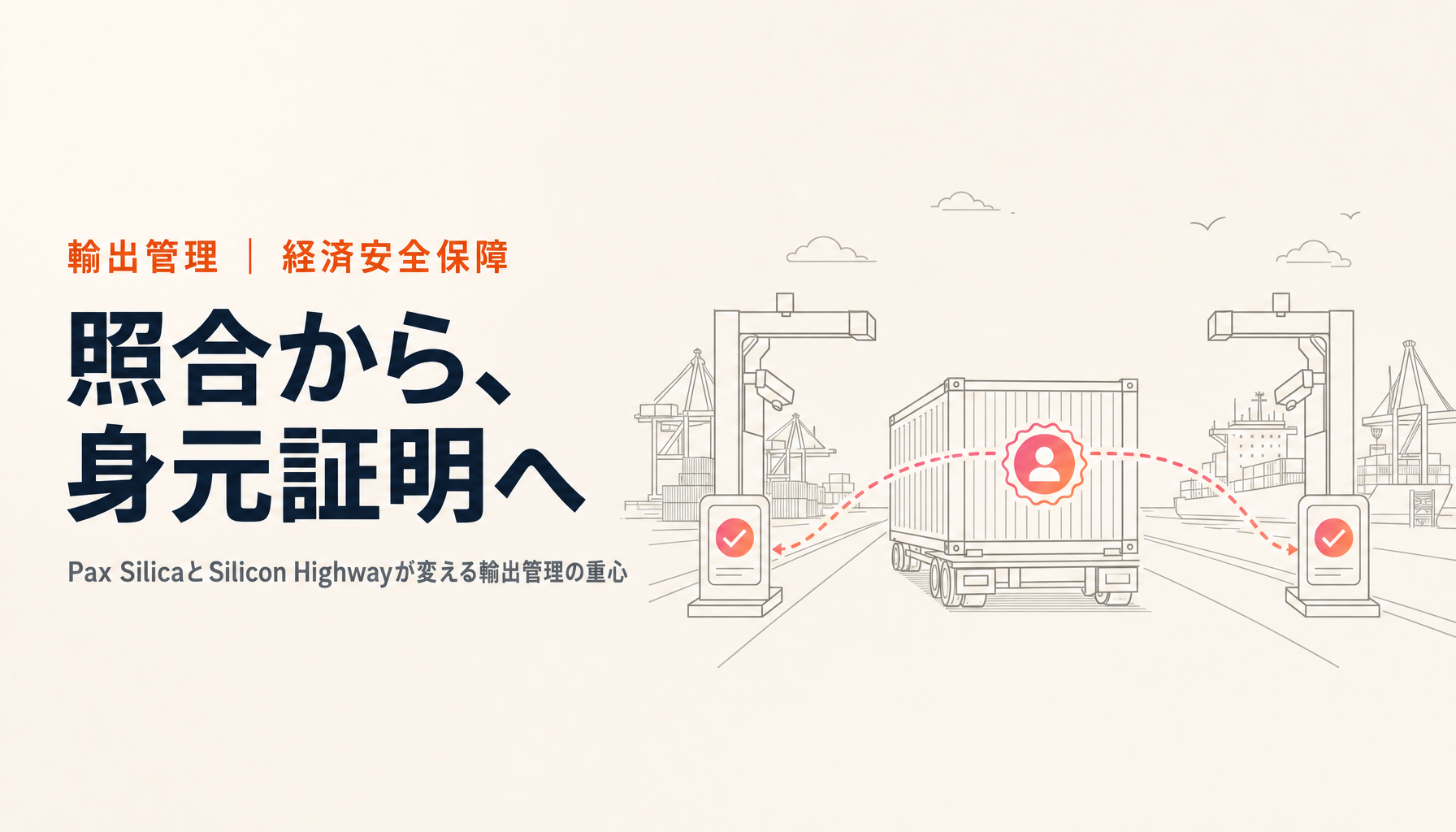
This NOFO seeks to fund the establishment of a Silicon Highway: a digital-physical corridor that accelerates logistics and compliance operations among partner countries with cryptographic cargo verification, AI-expedited risk assessment, and pre-approved expedited processing early in the supply chain3.
Translated into operational terms: attach a cryptographically verifiable credential to cargo, let an AI score its risk, and let shipments that cleared vetting upstream move quickly through the port. Those who prove trustworthiness in advance get preferential treatment.
The terms of the competition say something too. Posted 7 August 2026, closing 20 August. Ceiling $50 million, floor $1 million, three awards expected3. Thirteen days from posting to deadline, and the Department's own announcement states the deadline is firm and will not be extended2. Urgency shows up in a calendar before it shows up in a policy paper.
Replace siloed classification work with AI.
METI's FY2024 data shows 52% of foreign exchange law violations stem from classification errors. Download the TRAFEED product catalog covering features and rollout.
Screening, then ownership, then provenance
Here is the argument. I read this as the third stage in how export control works.
Stage one is matching names. The Entity List, the Military End User list, the SDN list. Check whether your counterparty appears. For decades this was the core of the discipline, and mechanically it is simple: you know what you are comparing against.
Stage two is unpicking ownership. The U.S. Affiliates Rule, commonly called the BIS 50% rule, sits here. Subsidiaries and affiliates in which listed entities hold 50% or more are treated as subject to the same controls even when their own names appear nowhere. So looking at the name is no longer enough; you have to trace who owns your counterparty, and where the stake cannot be confirmed there is a red flag provision that stops the transaction. I covered the mechanics in the complete guide to the BIS 50% rule. This is the stage where the workload exploded.
Stage three is proving provenance. This is what the Silicon Highway aims at. Not who the counterparty is, nor who owns them, but where this specific product and this specific shipment came from and what route it travelled, demonstrated in a verifiable form. That is how I read "cryptographic cargo verification."
| Stage | The question | The mechanism |
|---|---|---|
| Screening | Who is the counterparty? | Matching against exclusion lists |
| Ownership | Who owns the counterparty? | Tracing capital structure, identifying UBOs |
| Provenance | Where did this cargo come from? | Verifiable credentials and pre-vetting |
The decisive difference is that the polarity flips. Stages one and two run on exclusion lists: if you are not on one, you pass. Stage three runs on a trust list: only those who can prove it move quickly. The first is a game of demonstrating that nothing applies to you. The second is a game of demonstrating who you are. They demand very different capabilities.
The Silicon Highway is still only a funding notice, and the Panama pilot has not started. There is no guarantee it works as envisioned. But the size of the money and the tightness of the calendar tell you which way this is being pushed.
"You can't have it both ways": choosing a bloc
There is a political layer here too.
Press reporting in August 2026 described an internal State Department draft telling signatories of the AI Opportunity Statement that they could not simultaneously join a competing framework led by China and still count as trusted partners. The flashpoint named was Kazakhstan, a new Pax Silica signatory that also belongs to the Chinese-led framework. I want to be careful: this was reported as an internal draft, not published policy, so I am not treating it as settled.
What is on the record is that a comparable international body was launched on the Chinese side in July 2025 and is reported to be headquartered in Shanghai, and that Pax Silica expanded to 24 signatories in June 20261.
I am not going to score which government is right. The operational implication is what matters: supply chain trust may come to depend not only on technical verification but on which framework your country belongs to. If something like the Silicon Highway is implemented and only operators in participating economies receive expedited processing, that is a trade advantage in all but name. Routes through countries outside the framework get comparatively slower.
Japan is a signatory. That is not a disadvantage. But being a signatory country and being registered as a trusted operator are two different things.
What Japanese and other exporters should do now
Honestly, nothing changes tomorrow. The Silicon Highway is at the funding stage and scoped to cargo moving through Panama. This is not a fire drill.
That said, three things are worth starting.
First, get to a state where you can explain the origin of your own products and materials. Country of origin, supplier, and the ownership structure behind that supplier. Hold this as a record in normal times rather than something you reconstruct when asked. If you are already mapping supplier ownership for BIS 50% rule readiness, that work is the foundation for stage three. Shape the records so you do not have to do the same investigation twice.
Second, think about the unit of traceability. Proof may be demanded per shipment rather than per company. If your controls stop at the counterparty level, check whether you can push them down to the shipment level. In many cases this connects to quality and lot management systems you already run.
Third, follow primary sources. This area is easy to misread if you only track summaries. Every fact in this article came from State Department releases and the funding notice itself. Primary material on these programmes is usually public.
If you want to check where your own export control operation sits, screening only or already tracing ownership, our export control check is a free place to start. Ongoing supplier ownership mapping is what TRAFEED is built for.
Closing: a world where the ones who can prove it move first
To summarise. Pax Silica is a U.S. State Department framework for AI and supply chain security launched in December 2025, with 24 signatories as of June 2026, Japan included1. The Silicon Highway, the project put out for competition within it, would combine cryptographic cargo verification, AI risk assessment, and upstream pre-vetting to move trusted cargo faster23. Up to $50 million, starting with a Panama pilot.
Export control moved from matching names, to tracing ownership, and is now heading toward proving provenance. When the polarity flips from "pass if not listed" to "move fast if proven," compliance stops being a cost centre and becomes a question of speed. The cargo belonging to companies that prepared their proof leaves port first.
It is still a concept. No need to over-react. But the gap between companies that can explain where their products came from and companies that cannot is going to widen. Start by checking whether ownership and origin records for your main suppliers can actually be reconstructed.
If you want to talk through what that would take, get in touch and we can work through your situation together.
References
Facts in this article rest on U.S. Department of State publications and the federal funding notice. Only the passage on bloc alignment comes from press reporting, and that is flagged as such in the text.
Footnotes
-
Outcomes of the Second Pax Silica Summit (Fact Sheet) — U.S. Department of State — 26 June 2026 ↩ ↩2 ↩3 ↩4 ↩5 ↩6 ↩7
-
Pax Silica AI Assistance Project NOFO (Media Note) — U.S. Department of State — 12 August 2026 ↩ ↩2 ↩3 ↩4 ↩5
-
Pax Silica Artificial Intelligence Assistance Project (Opportunity Number DFOP0019193, Bureau of Economic and Business Affairs, posted 7 August 2026, closing 20 August 2026) ↩ ↩2 ↩3