Hello, this is Hamamoto from TIMEWELL.
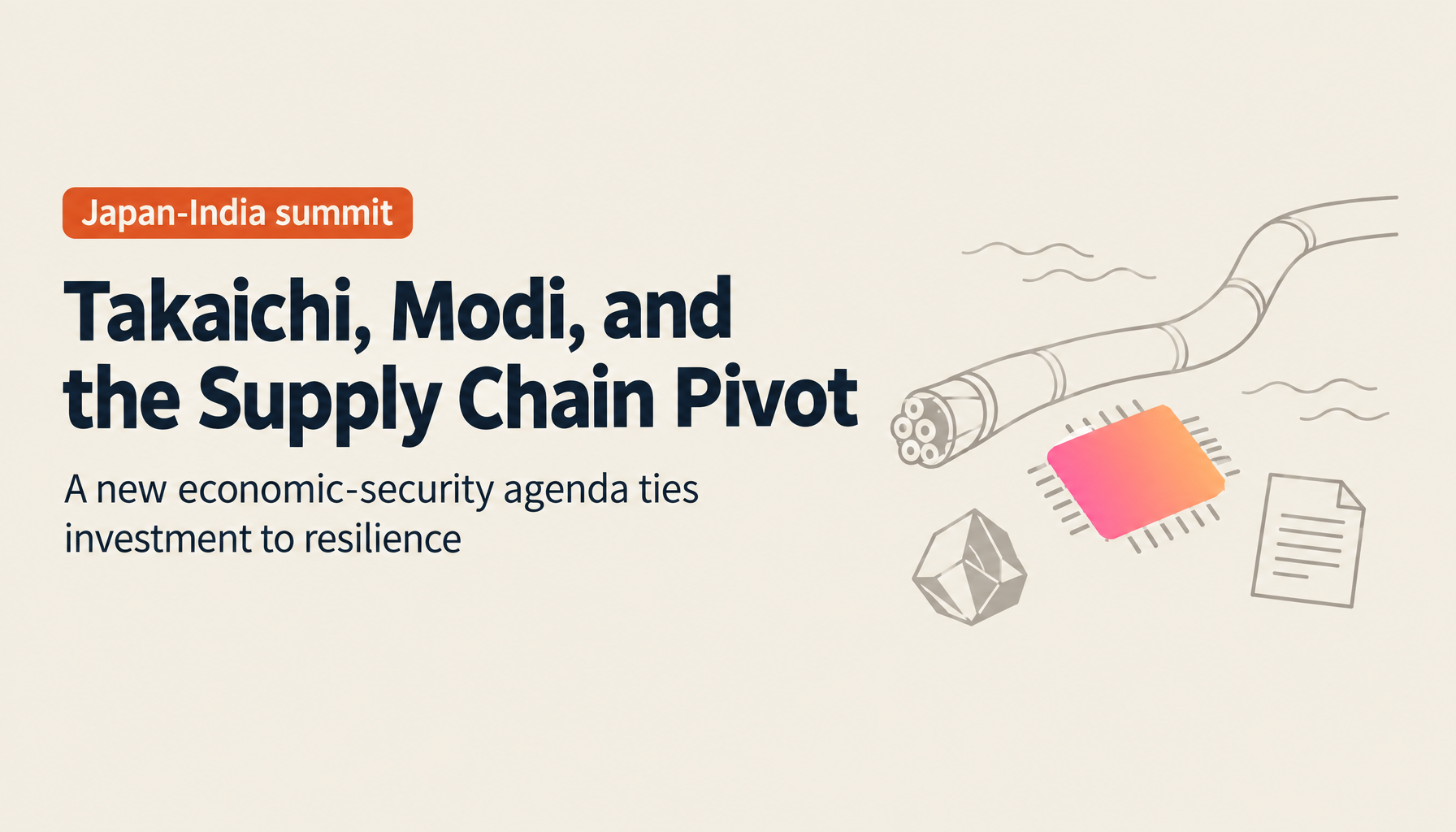
Since the start of 2026, economic security cooperation between Japan and India has taken a step forward, from the stage of declarations to the stage of practical work. The foundation was the Japan-India Economic Security Initiative, launched at the August 2025 summit, and in May 2026 two meetings that gave it concrete form were held in quick succession. One was the second Japan-India Economic Security Dialogue, held in New Delhi on May 11. The other was a critical minerals cooperation framework announced at the Quad (Japan, the United States, Australia, and India) foreign ministers' meeting, also in May.
Economic security is one of those terms that is hard to pin down even when you hear it on the news. Put plainly, it is the work of arranging things so that critical goods, the kind that underpin daily life and industry, such as the minerals essential to semiconductors and batteries, cannot be cut off by an emergency or political friction. It is the same as cooking without salt: nothing comes together without it. If such goods are halted by a single country's decision, entire industries grind to a stop. That is why the underlying idea is not to rely on a single country for procurement, but to spread it out, and to pool technology and capital with partners you can trust. Because I look at this field from the front lines of export controls, I will also lay out how the further Japan-India cooperation advances, the heavier the procedures become on the corporate side.
The two 2026 meetings and the 2025 agreement that laid the groundwork
To put things in order, let me first confirm the foundation. On August 29, 2025, at the 15th India-Japan Annual Summit held in Tokyo, the two leaders launched the Japan-India Economic Security Initiative.1 It names the resilience of critical-goods supply chains as a priority and issued a fact sheet bringing together concrete industry-academia-government measures. The summit also moved the investment story forward. The target of JPY 5 trillion in five years, set in 2022, was achieved in three years, and a new target of JPY 10 trillion in private investment in India over the next ten years was set out.12
The agreement is not limited to goods. In the technology and digital domains, the two sides launched the Japan-India Digital Partnership 2.0 and the Japan-India AI Cooperation Initiative (JAI), confirming that they would broaden the scope of cooperation around semiconductors and AI.12 On the security side, they revised the 2008 Japan-India Joint Declaration on Security Cooperation, and on the human-resources side they unveiled the Japan-India Talent Exchange Initiative so that highly skilled Indians who study in Japan can also contribute to India's development.123 Looking back, I see this summit as the blueprint for the moves of 2026. The four pillars of goods, technology, talent, and security are each fleshed out one by one in the dialogues that follow.
Here let me touch on a gap in tone between the reporting and the primary sources. As of August 2025, there was reporting that more than 100 MOUs (memoranda of understanding) had been signed in fields such as semiconductors, space, and clean energy.4 However, I was unable to confirm that total figure in the government's primary documents within the scope of this article's research. Large numbers catch the eye, but such a "count" is not the same as the volume of confirmed commitments, so I will proceed without asserting a specific figure.
What was confirmed at the second Japan-India Economic Security Dialogue
On May 11, 2026, the second Japan-India Economic Security Dialogue was held in New Delhi. This meeting serves as the framework for overseeing the progress of the initiative launched at the previous year's summit. There were three co-chairs: on the Indian side, Foreign Secretary Vikram Misri; on the Japanese side, Vice-Minister for Foreign Affairs Takehiro Funakoshi and Vice-Minister for International Affairs at the Ministry of Economy, Trade and Industry Takehiko Matsuo.56 Economic security is a theme that straddles both diplomacy and industrial policy, so the structure in which both the foreign affairs and the economy-and-industry sides sat at the Japanese table captures the nature of this field well.
Five fields were discussed: critical minerals, semiconductors, ICT (covering AI and telecommunications), clean energy, and pharmaceuticals.56 What I want to highlight is the substance of the agreement. The two sides agreed that closer public-private collaboration is needed in order to protect their economic interests, and they placed the aim of that collaboration in building resilient supply chains.567 You can sense the recognition that this is not something governments can complete on their own, and that it is meaningless unless the companies that actually move goods and technology on the ground are brought in. In fact, ahead of this dialogue, the Confederation of Indian Industry (CII) and Keidanren held a private-sector dialogue on March 26, 2026, and their recommendations were reportedly valued at this intergovernmental dialogue.56
From the Indian side, a wide range of ministries took part, including the National Security Council Secretariat, the Ministry of Mines, the Ministry of New and Renewable Energy, the Ministry of Electronics and Information Technology, the Ministry of Heavy Industries, the Department of Telecommunications, the Department of Pharmaceuticals, the Department of Atomic Energy, and the Department for Promotion of Industry and Internal Trade (DPIIT).6 The very fact that so many agencies sat at a single table shows that economic security is a cross-cutting theme that no single ministry can handle alone. After the dialogue, a separate dialogue between the Foreign Secretary and the Vice-Minister for Foreign Affairs was held in succession, reportedly taking up defense and security, trade and investment, technology and innovation, and regional and international affairs.5 Note that, in the announcement of this second dialogue, I was unable to confirm any specific reference to India's export control regime (SCOMET), which I discuss later.
Replace siloed classification work with AI.
METI's FY2024 data shows 52% of foreign exchange law violations stem from classification errors. Download the TRAFEED product catalog covering features and rollout.
The multilateral layer of the Quad Critical Minerals Initiative Framework
In parallel with the bilateral Japan-India moves, in May 2026 critical minerals cooperation also came to the fore within the multilateral Quad (Japan, the United States, Australia, and India) framework. The Quad is a cooperation framework among Japan, the United States, Australia, and India, and in recent years its presence has grown not only in security but also in economic and technological topics. At the foreign ministers' meeting held in New Delhi on May 26, 2026, India's External Affairs Minister Jaishankar hosted, with Japan's Foreign Minister Toshimitsu Motegi, Australia's Foreign Minister Wong, and U.S. Secretary of State Rubio attending. The attendees and the facts of the meeting can also be confirmed in the announcement by Japan's Ministry of Foreign Affairs.89
Several documents were issued at this meeting, but from an export control standpoint the most important is the Quad Critical Minerals Initiative Framework. According to the U.S. Department of State, the framework covers everything from extraction to processing and recycling, and aims to mobilize up to USD 20 billion across the public and private sectors.9 The key is that processing is deliberately included. Beyond simply digging ore out of the ground, the question of who holds the capacity to refine it into usable material sits at the center of today's competition over critical minerals. If the place of extraction and the place of refining differ, you end up depending on whoever took the lead in refining. That, as I read it, is exactly why extraction, processing, and recycling are being treated as a single whole.
The framework also writes in regulatory coordination. It lines up sharing good practices on permitting, developing tools to screen critical mineral transactions that threaten security, technical cooperation on geological mapping and resource assessment, and even consideration of coordinated measures against non-market policies and unfair trade practices.9 Recovery from electronic waste and scrap, investment in recycling technology, and the construction of recovery networks were also included.9 Let me add one note here to avoid a misunderstanding. Some reporting explains these moves in terms of China's roughly 90 percent share of refining and reducing dependence on China, but the original text of the framework published by the U.S. Department of State contains no direct reference to China. While it is natural to read the framework as having China in mind, that is the interpretation of the media, not a fact stated in the document, and I think it is honest to keep the two separate.9 On the Japanese side, the primary source, the Ministry of Foreign Affairs, has also announced that the critical minerals initiative framework was issued at this foreign ministers' meeting, and I have confirmed the facts together with the U.S. Department of State's announcement and the report of an analytical institution.810
Separating reporting-based interpretation from confirmed facts
What can be called "hard facts" up to this point are the holding of the second dialogue on May 11, 2026, the three co-chairs, the five fields, and the agreement on public-private collaboration; likewise the announcement of the Quad critical minerals framework in May and the scale of up to USD 20 billion; and the launch of the Economic Security Initiative in August 2025 along with the ten-year, JPY 10 trillion investment target. All of these can be backed up by government primary sources, or by public broadcasters and wire-service reporting. On the other hand, there is no shortage of material that should be received as reporting or analysis. To keep this article free of exaggeration, let me draw that line clearly.
Take, for example, the concrete picture of semiconductor cooperation. The vision of a division of labor in which Japan handles manufacturing equipment and photoresist while India supplies design talent, or concepts such as joint ventures in third countries, are inferences from analytical articles. They were not recorded as specific project names, figures, or MOUs in the official announcement of the May 11 dialogue. The figure of "more than 100 MOUs" I mentioned earlier is also based on trade-press reporting, and the total could not be confirmed in government primary documents. Things that could be verified in the Ministry of Foreign Affairs' announcement, such as the lineup of ministers who attended the meeting, I treat as fact; things that cannot be verified, I separate out as reporting. I believe that not writing about such unconfirmed parts as if they were settled is the minimum etiquette when dealing with a field like export controls.
There is one more piece of background worth keeping in mind: India's own export control regime. India has an export control system for dual-use items known as SCOMET, and in recent years the controlled items and the operation of certifications have been shifting. However, within the scope of this article's research, I could not confirm any description referring to SCOMET in the official announcements of the May 11 dialogue or the Quad critical minerals framework. Because there is practical value for Japanese companies in knowing the counterpart country's system when exchanging goods and technology with India, please also refer to the article that lays out India's export regulations for the regulatory environment around exports to India. The completion of a cooperation framework and the easing of front-line procedures are separate matters; if anything, as transactions increase, so do the occasions on which you must step through the rules.
The more goods and technology move, the heavier export controls become
This is the point I most want to convey to companies in this whole sequence of developments. Japan-India and Quad cooperation works in the direction of advancing what is known as supply-chain diversification, not concentrating procurement in a single country. It sounds good, but an increase in the number of countries you procure from or supply to means an equal expansion in the scope of export controls. Procedures you had set up for a single country now have to be run in parallel for as many countries as there are partners. The more substantial the cooperation framework becomes, the heavier the management burden on the ground actually grows.
Concretely, three areas of work get heavier all at once. The first is classification, the work of determining whether the items you handle fall under Japan's control lists. The second is responding to catch-all controls, which prepares for cases where even items not on a list become controlled depending on their end-use or the recipient. The third is customer screening, which verifies that the counterpart company or end-user does not appear on a sanctions list or a list of concern. The more critical minerals, semiconductors, AI-related technology, and the talent that handles them move between Japan and India, the more you end up repeating these determinations item by item and transaction by transaction. As technical personnel travel back and forth more, the question of whether a technology transfer amounts to a deemed export is added on top. To use the cooking analogy again, it is like having to recheck, every time a dish is added to the menu, whether that ingredient is safe and to whom it will be served.
Handling this cross-cutting work by manpower alone is, realistically, a fairly heavy burden. The control lists of multiple countries are revised frequently, and you have to trace the ownership relationships of counterpart companies. The export control AI agent we provide, TRAFEED, is used precisely to reduce the burden of this classification, dual-use determination, and cross-referencing against sanctions lists and lists of concern. It is exactly when Japan-India cooperation takes concrete form and exchanges of goods and technology increase that a mechanism for running these determinations continuously proves its worth. Setting up your regime only after the framework is in place is too late; it is faster in the end to build the footing before transactions start moving.
What export control teams should prepare now
Finally, let me organize what this article has been able to confirm and the moves the front line can make. Japan-India economic security in 2026 has advanced on the foundation of the initiative launched at the August 2025 summit, through two concrete developments in May: the second dialogue and the Quad critical minerals framework. The cooperation fields of critical minerals, semiconductors, ICT, clean energy, and pharmaceuticals are all areas contiguous with export controls. At the same time, I confirmed that talk of "reducing dependence on China," the count of MOUs, and the picture of a semiconductor division of labor remain at the stage of reporting and analysis. Reading facts and interpretation separately is, I think, the shortest path to avoiding both excessive expectations and excessive anxiety.
As a practical matter for companies, the first thing you can tackle is taking inventory of your own operations. Identify, once, where the items and technologies you ship, or might ship in the future, to India and other Quad countries fall on the control lists. Check whether your screening flow for trading partners and end-users, your procedures for confirming deemed exports tied to the travel of technical personnel, and the wording of your contracts have kept up with the current system. Inspecting these points now, rather than scrambling to review them after the news has moved, makes it easier to act when the cooperation framework actually translates into real transactions.
The occasions when your own judgment alone cannot settle which category your handled items fall into, and how to design the internal determination flow, will surely increase. We accept consultations on the operation of dual-use determination, classification, and customer screening through our individual consultation. The more goods and technology move between Japan and India, the heavier export controls become. Getting a firm grasp of the regulatory issues in advance is the preparation that keeps your future transactions from being halted.
If you are reviewing export-control operations or classification workflows, download the TRAFEED product catalog (PDF) or contact us.
References
Footnotes
-
Japan-India Summit Meeting and Working Dinner (Summary) — Prime Minister's Office of Japan (English) — August 29, 2025 ↩ ↩2 ↩3 ↩4
-
Japan-India summit sets target of JPY 10 trillion in private investment in India over the next ten years — JETRO Business Brief — September 2025 ↩ ↩2 ↩3
-
15th India-Japan Annual Summit Joint Statement: Partnership for Security and Prosperity of our Next Generation — Prime Minister's Office of India (PMO India) — August 29, 2025 ↩
-
Japan and India set up a cooperation framework for critical goods, including semiconductors and minerals, under economic security — The Nikkei — August 19, 2025 ↩
-
2nd India-Japan Economic Security Dialogue — Ministry of External Affairs of India (MEA, full-text mirror on globalsecurity.org) — May 11, 2026 ↩ ↩2 ↩3 ↩4 ↩5
-
India and Japan hold second Economic Security Dialogue with focus on resilient supply chains — DD News (public broadcaster of India) — May 11, 2026 ↩ ↩2 ↩3 ↩4 ↩5
-
Japan, India Agree to Further Economic Security Ties — Nippon.com (Jiji Press) — May 11, 2026 ↩
-
Quad Foreign Ministers' Meeting — Ministry of Foreign Affairs of Japan — May 26, 2026 ↩ ↩2
-
Quad Critical Minerals Initiative Framework Among the United States, Japan, Australia, and India — U.S. Department of State (full-text mirror on globalsecurity.org) — May 26, 2026 ↩ ↩2 ↩3 ↩4 ↩5
-
Takeaways from the Quad Foreign Ministers' Meeting — Stimson Center (analysis) — May 2026 ↩