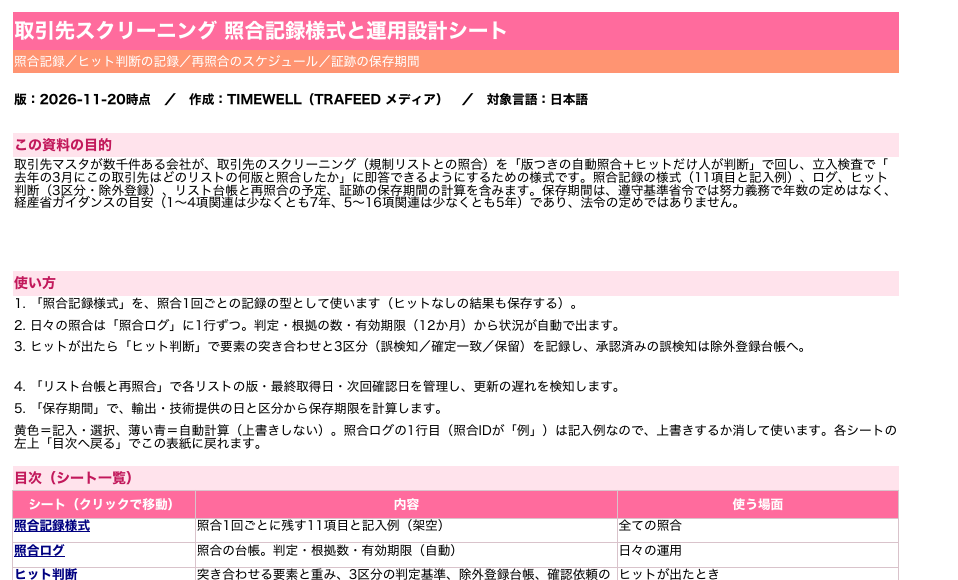
Screening Record Templates and Operations Design Sheet (editable Excel)
Screening record templates, a screening log, hit-adjudication records, a list ledger with re-screening schedule and retention rules (Japanese only).
Get the fileYou can download it after a short form (Japanese).
Hello, this is Ryuta Hamamoto from TIMEWELL.
Picture the export control officer at a large manufacturer with about 4,000 counterparties in its master data. Every time a list is updated, someone pastes it into a spreadsheet and compares it against the counterparty names. Hits arrive by the dozen each month. Each one gets investigated, judged a false positive, approved by email and saved to a folder. The next month, the same counterparty hits the same listed entry again. The earlier decision is buried somewhere deep in a predecessor's folder.
The company's internal compliance program (CP) is in place. Even so, the day-to-day work runs on one person's experience and stamina. If a METI inspector on an on-site inspection asked, "Last March, which list, and which version of it, did you screen this counterparty against?", could you answer on the spot?
This article answers one question only: how to design an operation that screens thousands of counterparties a year, covers all of them, leaves an audit trail and stays efficient. Group-company governance and what to do on the day a rule changes are left to other articles.
The conclusion first
- At a scale of thousands, people should not look at every record. Screen automatically against versioned lists and have people judge only the hits.
- Record each false positive in fixed fields, with the matching elements and the grounds, and build the process so the same hit is never judged twice.
- Keeping documents is a best-effort obligation, and the provision gives no number of years. METI's guidance indicates at least seven years for rows 1 to 4 and at least five years for rows 5 to 16, counted from the date of export or provision of technology. For transactions within reach of U.S. law, aligning with OFAC's ten years is the safe choice.
The facts in this article were checked as of 20 November 2026 against e-Gov Laws, the original texts of METI's notice on the End User List (29 September 2025) and of its "Security Export Control Guidance [Introductory Edition]" version 3.0, the Federal Register, the U.S. Electronic Code of Federal Regulations (eCFR), and the original text of METI's Q&A (Catch-all 4, 8 and 9). What we could not confirm is collected at the end under "What we have not confirmed." Decisions on individual transactions belong to your company's export control officer.
1. What is mandatory, and what is only recommended
Before designing the operation, separate obligations from recommendations. Mix the two up and you either inflate costs with an operation heavier than it needs to be, or you end up missing records you actually need.
In Japanese export control, the provision that bears on checking counterparties is the Export Compliance Standards under Article 55-10 of the Foreign Exchange and Foreign Trade Act (FEFTA, 外為法). Exporters must export in accordance with these standards (FEFTA Article 55-10(4)). Their content is set out in Article 1 of the Ministerial Ordinance on Export Compliance Standards (METI Ordinance No. 60 of 2009)12.
Businesses that export list-controlled goods as a business (exporters of specified critical goods, etc.) carry the additional requirements in Article 1, item 2 (i) to (nu). (The ordinance labels its sub-items with Japanese kana, イ, ロ, ハ, ニ and so on. I write them as (i), (ro), (ha), (ni), (ho), (he), (to), (chi), (ri), (nu).) Here are the parts that concern counterparty checks and records, in the ordinance's own terms.
| Provision | Content | Status |
|---|---|---|
| Ordinance Article 1, item 1 (i) | Appoint an officer responsible for classification confirmation | Obligation |
| Ordinance Article 1, item 1 (ro) | Keep people engaged in exports informed of the latest laws and give them guidance | Obligation |
| Ordinance Article 1, item 2 (ni) | Set procedures for confirming end use and end users and the like, and carry out the confirmation according to those procedures. Where information needed for the confirmation is obtained from someone other than the end user, also set procedures that make that information more reliable, and follow them | Obligation |
| Ordinance Article 1, item 2 (ho) | At shipment, confirm that the goods in the documents are the same as the goods actually shipped | Obligation |
| Ordinance Article 1, item 2 (he) | Endeavor to set up an audit system and procedures for regular audits, and carry them out | Best-effort obligation |
| Ordinance Article 1, item 2 (to) | Endeavor to provide training | Best-effort obligation |
| Ordinance Article 1, item 2 (chi) | Endeavor to set up a system and procedures for guiding subsidiaries, and do so regularly | Best-effort obligation |
| Ordinance Article 1, item 2 (ri) | Endeavor to keep documents, drawings and electronic records relating to export work for an appropriate period (METI's guidance gives guide periods; see below) | Best-effort obligation |
| Ordinance Article 1, item 2 (nu) | On a violation, or where there is a risk of one, report promptly to the Minister of Economy, Trade and Industry and take measures to prevent recurrence | Obligation |
Item 2 (i) to (nu) applies to businesses that export list-controlled goods (specified critical goods, etc.) as a business, among others. However, Article 4 disapplies item 2 (i) to (ri) for persons whose only business is transactions designated by the Minister of Economy, Trade and Industry under Article 17(8) of the Foreign Exchange Order, or exports that fall under the cases listed in Article 4(1) of the Export Trade Control Order (the reporting and recurrence-prevention requirement in (nu) still applies)1. METI's Introductory Guidance likewise frames these as the standards for "exporters handling list-controlled goods and technology," with item 9 on its list being document retention3. Check first which group your company is in.
Three points that matter for designing the operation follow from this.
First, it is an obligation to "set procedures for confirming end use and end users and carry out the confirmation according to those procedures" (item 2 (ni)). Put the counterparty-check procedure in writing and carry it out as written. The record is your evidence that you followed the procedure. No wording mandates the record itself, but you cannot explain that your checks followed the procedure without one.
Second, retention is a best-effort obligation, and the provision gives no number of years (item 2 (ri)). It says only "an appropriate period." We searched FEFTA, the Export Trade Control Order and the Export Trade Control Regulations and found no provision setting a retention period for export control documents4. The guide figures come not from a provision but from METI's Introductory Guidance. As explained below, it gives at least seven years for rows 1 to 4 and at least five years for rows 5 to 16, counted from the date the goods are exported or the technology is provided3.
Third, we could not find any provision that requires continuous rescreening of every record. Audits (item 2 (he)) are a best-effort obligation with no set frequency. Ongoing screening is not a form the law demands. It is your own design for making end-use and end-user checks actually work.
So is screening against the End User List mandatory? Here I will stick to the wording of METI's notice. The notice "On the 'End User List'" (ref. 20250922 Bōkyoku No. 1, 29 September 2025, applying from 9 October 2025) says that anyone who has obtained the list "must confirm," under the provisions of ministerial ordinances and public notices, whether the name of the end user of the goods, or of the person who will use the technology, appears on the list. This applies when exporting goods in row 16 of Appended Table 1 of the Export Trade Control Order (the catch-all row) to the regions specified for that row, or when providing technology in row 16 of the Appended Table of the Foreign Exchange Order. If the name appears, a license from the Minister of Economy, Trade and Industry is required, except where it is clear from the end use and from the form and terms of the transaction that the goods or technology will not be used for developing weapons of mass destruction, conventional weapons and the like5.
In other words, for exports and technology transfers subject to catch-all controls, checking the list is not "just a reference." It is a check grounded in ordinances and public notices. On the other hand, when the list was first published in 2002, it was positioned as "a reference material for exporters' voluntary export control." A company that is not on the list can still meet the end-user requirement because of what its documents or communications reveal (METI's Q&A, catch-all item 8)5. Build list screening into your procedure for confirming end use and end users. Note too that the listing of an entity is a regulatory classification based on the categories of concern the list publishes (weapons of mass destruction and the like, and conventional weapons). It is not a judgment on the merits of that entity. For details, see our explainer on the End User List (in Japanese).
What the notice requires is confirming the listing at the time of the transaction. Neither the notice nor the ordinance says you must rescreen every counterparty each time the list is amended. The Introductory Guidance does say, though, that when the End User List is revised, the latest list must be used in end-user checks. A design that screens against the latest version at the time of the transaction (the validity conditions in section 2) follows that expectation.
What about U.S. lists? Japanese law imposes no obligation to screen against the Entity List or the SDN List. U.S. law does, however, reach transactions involving the reexport of U.S.-origin items, or involving U.S. persons or the U.S. financial system. This is the same position as in our article on customer due diligence in practice.
It also helps to see how far the penalties sit from screening. A breach of the compliance standards carries no direct criminal penalty in itself. First come guidance and advice from the Minister (Article 55-11), then a recommendation and an order (Article 55-12). Only a breach of that order triggers the penalty in Article 71, item 11 (imprisonment of up to six months or a fine of up to ¥500,000)2. By contrast, if a missed hit leads you to export without a license, the issue is no longer the compliance standards. It becomes unlicensed export under FEFTA Article 69-7 (imprisonment of up to seven years, a fine of up to ¥20 million, or both; for the categories involving nuclear weapons and the like, paragraph (2) raises this to up to ten years and ¥30 million). Screening operations exist to prevent the second kind of problem.
To sum up:
| Item | Status | Basis |
|---|---|---|
| Setting and carrying out procedures for end-use and end-user checks | Obligation (when exporting list-controlled goods as a business) | Ordinance Article 1, item 2 (ni) |
| Checking whether a party is on the End User List | For catch-all (row 16) exports and technology transfers, you must check whether the end user's name is listed, using the latest version. Frequency and method are your own design | METI notice (29 September 2025), Introductory Guidance |
| Screening against U.S., EU, UK and UN lists | Not an obligation under Japanese law. Becomes necessary depending on the actual transaction | Governing law of the transaction, extraterritorial reach of U.S. law, etc. |
| Keeping records | Best-effort obligation. No years in the provision. METI's guidance: at least 7 years (rows 1 to 4) and 5 years (rows 5 to 16) | Ordinance Article 1, item 2 (ri); Introductory Guidance |
| Continuous rescreening of every record | No legal requirement found. Your own design | (No applicable provision) |
| Regular audits | Best-effort obligation | Ordinance Article 1, item 2 (he) |
Building the screening machinery (workflow, list register, name matching)
Once the line between mandatory and recommended is drawn, build the screening machinery. It has three parts: a workflow that fixes who screens when, a list register that keeps the lists you screen against current, and name-matching rules that reconcile different spellings of the same party. Lose any one of them and you can't explain a "no hit," even if the other two are working.
2. Designing the workflow in five stages
At a scale of thousands, "checking everyone, every time, to the same depth" falls apart. Let machines do the screening and bring people in only where a judgment is needed. Build that division of labor in five stages.
| Stage | Trigger | What to do | Who | What to keep |
|---|---|---|---|---|
| 1 Initial review | New counterparty registration, or a transaction with a new destination or end use | Collect basic information, screen against all lists, confirm end use and end user | Sales (input), export control staff (decision) | Screening record, supporting documents, decision |
| 2 Transaction-time screening | Just before an order, a shipment or a provision of technology | Check whether the screening result is still valid; rescreen if not | System (automatic); staff handle exceptions only | Shipment decision log |
| 3 Ongoing monitoring | List updates, changes to counterparty information | Rescreen the full master against the update delta | System (automatic), list manager | Rescreening record, version of the delta |
| 4 Hit handling | When a hit occurs | Check the matching elements, decide, hold the shipment | Export control staff, officer | Decision record |
| 5 Periodic review | Once a year | Inventory every record, clean up dormant counterparties, test the rules | Officer, internal audit | Inventory record, metrics |
The heart of the design is stage 2.
Give each screening result "validity conditions"
Under METI's Q&A, a license is required if the objective requirements are met before export, and information learned only after export does not make that export illegal. Our explainer sets it out the same way6. What counts, then, is "what you could have known at the time of shipment or provision of technology." A single screening at master registration cannot account for the situation at the time of a shipment six months later.
So give each screening result validity conditions. Treat the screening as valid only while all three of the following hold. If any one fails, rescreen automatically before shipment.
- The versions of all the lists used are the same as the current latest versions
- The counterparty's basic information (name, address, ownership) has not changed since the screening
- No more than an internally set period (12 months, for example) has passed since the screening
With this design, nobody has to review every record by hand when a list update comes out. The system applies only the difference against the updated version to the full master and sends counterparties whose validity conditions fail to rescreening. People look only at the new hits.
What to collect at the initial review, and how far to go
Decide the input fields for the initial review by working backwards from what name matching and the audit trail will need later. If all you receive is a name, you have nothing to compare when a hit comes up, and every hit turns into extra investigation.
- Full legal name (original language) and English name
- Address (registered address and the address of the actual business premises)
- Identifiers (the corporate number for Japanese companies; for overseas companies, a registration number, LEI, D-U-N-S number or whatever can be obtained)
- Ownership (main shareholders and percentages, parent company, and the source and date of confirmation)
- Business description, plus the end use and end user in this transaction (the name of the ultimate end user, if it is someone else)
- Other parties in the commercial chain (distributors, trading companies, freight forwarders)
That last item, "other parties in the commercial chain," is the one people forget. Check that you are not screening only your contracting party. When you confirm end use and end users, the contracting party is not necessarily the ultimate end user. If your sales team knows who the ultimate end user is, that knowledge is treated as known to the company. As material for the check, the way of recording end users at the legal-entity level in our explainer on METI's Q&A on end-user checks (in Japanese) is a useful reference.
Use "full" and "delta" monitoring for different jobs
Ongoing monitoring comes in two forms.
| Method | Content | Suits |
|---|---|---|
| Delta screening | Screen only the additions and changes in the lists against the full master | Keeping up with daily or weekly list updates |
| Full rescreening | Screen the full master against the latest version of every list | Annual inventory, after changing matching rules, after reviewing thresholds |
Delta screening is light and can run every day. But when you change your name-matching rules or thresholds, past counterparties need the new rules applied to them, and that calls for full rescreening. Think of the annual full rescreening as an inventory that doubles as a test of your rules.
3. Build a list register and give someone ownership of updates
Screening across thousands of records can be flawless and still be worthless if the lists you compare against are out of date. Keep a "list register" that sets, for each list, where it comes from, how its version is recorded, how often it is checked, and who is responsible.
The table below is an example register. It is based on what we confirmed on 22 November 2026 (21 November for the Entity List and the Foreign User List) from each body's official pages and distribution files7, and on the table of listing counts in METI's Introductory Guidance3. The frequencies and owners are our design proposals, not legal requirements.
| List | Source | What to record as the version | Check frequency (proposal) | Owner (proposal) |
|---|---|---|---|---|
| End User List | METI's security export control pages | Promulgation and application dates of the amendment, number of listed entities (notice of 29 September 2025, applying from 9 October, 835 entities in total) | Look at the top date on the amendments page every morning and record weekly; immediately when amended (some amendments have taken effect five days after promulgation; see our article on tracking the Japan, EU, UK and UN lists weekly) | List manager |
| Ministry of Finance asset-freeze list | Ministry of Finance's economic sanctions pages | The "as of [date]" date (given in the Japanese era calendar) | Weekly; whenever the government announces sanctions | List manager |
| Entity List, Unverified List, Denied Persons List, etc. | U.S. Commerce Department (BIS), Federal Register, Consolidated Screening List | Federal Register publication date and citation; date and time the CSL was retrieved | CSL: daily delta. Federal Register: weekly | System (automatic); officer checks the Federal Register |
| SDN and non-SDN lists | U.S. Treasury (OFAC) | OFAC update date, identifier of the retrieved file | Daily delta | System (automatic) |
| EU financial sanctions consolidated list | European Commission | File generation date, and the latest publication date of the regulations attached to the entries (a recent generation date does not guarantee the latest designations are in) | Weekly; immediately when a new package is adopted | List manager |
| UK Sanctions List | UK government | Update date | Weekly | List manager |
| UN Security Council Consolidated List | UN Security Council | File generation date | Weekly | List manager |
| Rule changes (BIS Federal Register rules, METI amendment information, etc.) | Federal Register, METI | Federal Register citation, promulgation date, effective date | Weekly | Officer |
There is a reason the last row is in the table. A rule can change how a list works even when the contents of the list stay the same. The suspension of BIS's 50% rule is an example: it did not change the contents of the Entity List, it changed how the list reaches affiliates of listed entities. Keep list intake and rule tracking as separate jobs with separate owners.
Also build in a way to detect delayed updates. A simple rule is enough: "If more than a set number of days has passed since a list was last retrieved, notify the export control officer." Your screening can work perfectly, but if list intake stalls, you will keep producing "no hit" results against an old version.
Set tracking targets in time. For example:
- From confirming a list update to finishing delta rescreening of the full master: within one business day
- First-level decision on a new hit: within two business days
- Reporting a confirmed match or a hold to the officer: the same day
These figures are examples. Work backwards from your transaction frequency and shipping lead times so that decisions are always made before goods ship.
4. Write name matching down as rules
The single biggest driver of screening accuracy is name matching (名寄せ: reconciling variant spellings of the same party and deciding whether two records are the same entity). Leave it to memory and intuition and the result changes with whoever is on duty. Put the rules in a table, and have the system and the people use the same one.
Name-matching rules table
| Element | Examples of variation | Rule | Caution |
|---|---|---|---|
| Legal form | 株式会社, (株), Co., Ltd., Corp., Inc., GmbH, 有限公司, 股份有限公司, ООО | Strip it from the comparison string and keep it as a separate attribute (type of legal form) | Different entities can share a name with different legal forms. Keep the legal form as one input for deciding identity |
| Full-width and half-width characters, upper and lower case | ABC, ABC, abc | Convert full-width to half-width and letters to upper case before comparing | Always keep the original notation |
| Symbols, spaces, abbreviation marks | & and "and", periods, hyphens, runs of spaces | Remove symbols and collapse spaces to one. Replace & with "and" | Strip too many symbols and different names turn into the same string |
| Abbreviations and common names | Three- or four-letter initialisms | Keep them in an alias table. A match on an abbreviation alone is not grounds for confirming a match | Abbreviations easily collide with unrelated companies |
| Former names, mergers, changes of trade name | Former company names, former brand names | Keep former names and change dates as history, and screen against both old and new | A listed entity may still appear under its former name |
| Japanese notation | Long vowel marks present or absent, ヴ vs ブ, old and variant kanji (髙 and 高, etc.) | Build a mapping table to unify variant characters. Compare katakana both with and without long vowel marks | For personal and company names, keep the original notation so that unifying variants does not erase the person's own spelling |
| Chinese notation | Simplified vs traditional characters (华 and 華, 电 and 電), pinyin spelling, English names that are not literal translations of the original | Use a simplified-to-traditional conversion table, and keep the original-language name, the pinyin and the English name in separate fields | English names often do not match the registered name. Make the final check with the original-language name and identifiers |
| Russian and other Cyrillic notation | Transliteration variants (Yu, Iu, ju; different renderings of ий) | Accept multiple transliteration schemes when matching. Keep the original spelling as well | Transliteration schemes differ from list to list. Check against the original and identifiers such as the taxpayer number |
| Arabic-language names | Muhammad, Mohammed, Mohamed; the articles Al- and El- | Run comparisons both with and without the article | For individuals, the order of patronymics and titles varies |
| Address | Country name forms, city spellings, how street numbers are written | Normalize countries to country codes and cities to standard spellings | Listed addresses can be incomplete. An address mismatch alone is not grounds for a false positive |
| Same name, different company | Separate legal entities with the same name | Tell them apart by identifier, address, year of establishment and business | Even a 100% name match can be a different legal entity |
A few concrete identifiers. Japanese companies have a 13-digit corporate number. Companies in mainland China have an 18-character Unified Social Credit Code. For-profit businesses in Taiwan have an 8-digit Unified Business Number (統一編號). Russian legal entities have a taxpayer identification number (INN, ИНН) and a primary state registration number (OGRN, ОГРН). Internationally, there is the 20-character LEI and the 9-digit D-U-N-S number. If you hold the counterparty's identifiers, you can make the final check without being thrown off by name variations.
Fix the order of matching
Name matching goes through these steps in order.
- Identifier match (corporate number, LEI, etc.)
- Exact match on the normalized name
- Match against aliases and former names
- Fuzzy match (candidates at or above a set score, based on edit distance or phonetic similarity)
OFAC's search tool sets the Minimum Name Score to 100 by default; lower it to 50 and it returns names that are only half similar. In our guide to sanctions lists, I suggested, as a personal view, starting at around 80 to 85 and raising it only when there are too many candidates7. There is no single right number. Measure the balance between misses and false positives on your own data and decide from there. How to do that is covered under metrics in section 6.
"Consolidate each counterparty into one record"
At large companies, the same counterparty is registered under different codes by each business unit and each subsidiary. Screen the data as it is and that counterparty produces the same hit as many times as it is registered. The decision is repeated just as many times.
Make the legal entity (the parent master record) the unit of screening, and link each business unit's registration to that parent record. Keep decision records on the parent record. This connects to governance across the group, too. Here I stop at the unit of screening and recording; group governance is left to another article.
METI's Q&A also treats the legal entity as the basic unit for end users. If another business unit of the same legal entity develops conventional weapons or the like, the end-user requirement is met. Where the direct counterparty is the end user, the activities of group companies that are separate legal entities do not, as such, change that analysis8. A parent master built on legal entities fits this approach.
Affiliates and the 50% rule
BIS's 50% rule (the Affiliates Rule) extends restrictions to affiliates owned 50% or more by a company on the Entity List or similar lists. The rule took effect on 29 September 2025 and has been suspended since 10 November 2025. On 9 November 2026, BIS published a rule in the Federal Register extending the suspension to 10 January 2027 (91 FR 70789), effective the same day9.
For operations design, split it like this.
| Item | During the suspension (until 10 January 2027) | Preparing for the rule to come back |
|---|---|---|
| The listed company itself on the Entity List | Restrictions apply. Screen as usual | No change |
| Affiliates of a listed company (owned 50% or more) | The 50% rule is suspended. End-use and end-user checks are still needed separately | Hold ownership fields (shareholders, percentages, source, date confirmed) in the counterparty master |
| Identifying candidate affiliates | Keep them flagged as candidates, for reference | Be able to re-evaluate all candidates at once on the day the rule comes back |
| OFAC's 50% rule | A separate regime from BIS's suspension. In effect | The aggregation approach is covered in another article |
The suspension runs to 10 January 2027. What happens after that (another extension, the rule coming back, withdrawal or amendment) was unknown as of 20 November 2026. We have not confirmed any transition measures if it comes back, either. As a system, two things let you move whichever way it goes: hold the ownership data, and switch the rule's status with a single flag. For the rule's background and how to prepare for the end of the suspension, see our complete guide to the BIS 50% rule.
One more thing. Back ownership percentages not only with the counterparty's own declaration but with the source and date of confirmation from registries or public documents. Ownership changes, and a percentage with no confirmation date is weak evidence in an audit.
Replace siloed classification work with AI.
METI's FY2024 data shows 52% of foreign exchange law violations stem from classification errors. Download the TRAFEED product catalog covering features and rollout.
Judging hits and leaving an audit trail (false positives, evidence, metrics)
Once the machinery is running, how you handle and record hits decides how heavy the work gets. Close false positives against fixed criteria, and never judge the same hit twice. Keep evidence for every screening that lets you reconstruct the situation at that moment. And tune the operation with monthly metrics. With all three in place, you can answer the inspector's "Last March, which list, and which version of it, did you screen this counterparty against?"
5. Handle false positives with decision criteria and records
Screen thousands of records and most of your hits will be false positives. How you close them decides both the quality and the efficiency of the operation. Close hits mechanically and you miss things. Investigate every one in depth and your staff burn out.
Elements to compare, and how much each one weighs
| Element | Compared against | Weight of a match |
|---|---|---|
| Identifiers (corporate number, Unified Social Credit Code, LEI, a vessel's IMO number, etc.) | Registry information, official registrations | Very strong. On its own, grounds for confirming a match |
| Address (normalized) | Registered address, invoices, contracts | Strong |
| Year of establishment, representative, business | Registry information, official website | Moderate |
| Country or region | Registration information | Moderate. A mismatch is one ground for a false positive, but not enough on its own |
| Match on an alias or former name | Alias field in the list data | Moderate |
| Name match score | Screening tool | Weak. Only the entry point to a hit |
A word of caution on country or region. A different country of location is a ground for a false positive, but don't close a hit on that alone. An entity in another country belonging to the same corporate group can be connected to both the listed party and your counterparty. Use country as one input to the decision, and never select or reject counterparties on country or nationality alone. Keep in mind the premise, too, that a listing is a regulatory classification for export control purposes, not a judgment on the merits of the company.
Use three decision categories
| Decision | Example conditions | Shipments, etc. |
|---|---|---|
| False positive | One or more strong elements do not match and there is nothing in common beyond a similar name; or two or more moderate elements do not match. In addition, at least two independent grounds other than the name can be recorded | May continue. Record it with validity conditions |
| Confirmed match, or strong suspicion | The identifier or address matches; or the names match and the strong elements (identifier, address) cannot show that it is a different party | Stop shipment and technology provision. Report to the officer the same day. Decide whether a license is needed |
| Hold | The listed data is incomplete and no decision can be made; waiting for the counterparty's answer | Stop shipment and technology provision. Set a deadline for the answer |
Having "hold" as one of the decisions is what makes this work. Close what you cannot decide as a false positive and let it through, and you have a miss. Leave holds sitting and shipments stay stopped. Always give a hold a deadline and a named person for the next step.
What comes after a confirmed match is outside the scope of this article. The End User List notice provides that, where an end user is on the list, a license is required except where it is clear from the end use and the form and terms of the transaction that the goods will not be used to develop weapons and the like. Whether it is "clear" is for the exporter to decide, including whether the type of concern for the goods matches the list's category of concern. The Introductory Guidance flags, as a point needing caution and consultation, checking whether the "end uses of concern" in its examples of high-risk goods match the list's categories of concern (nuclear weapons, biological weapons, chemical weapons and missiles)5. Decisions specific to the list are left to our explainer on the End User List and our explainer on the "clearly" (akiraka) guideline (both in Japanese).
Fields and a sample entry for false-positive records
Records need the same fields every time, and they need to be short to write. Long free-text entries are unreadable later. Use these fields as the template.
| Field | Content |
|---|---|
| Screening ID | Unique number |
| Counterparty ID (parent master) | The unit of screening |
| Screening date and time, and trigger | New registration, pre-shipment, list update, annual inventory, etc. |
| Lists screened and versions | Name and version of every list (date, number of entries) |
| Names entered and match score setting | Original-language and English names, the value set |
| Hit details | List name, listed name, listed entry ID, listed country, remarks |
| Elements compared | Match or mismatch for each of identifier, address, year of establishment, country and business |
| Decision | False positive, confirmed match, hold |
| Grounds | At least two independent grounds other than the name |
| Decided by, approved by | Names and dates. Decision and approval by different people |
| Re-evaluation conditions | Change in the listed entry, change in counterparty information, expiry |
Here is a sample entry. All company names, numbers and dates are fictitious.
| Field | Sample entry (fictitious) |
|---|---|
| Screening ID | SC-2026-11-0412 |
| Counterparty ID | C-018342 (Aoba Precision Trading Co., Ltd.) |
| Screening date and time, and trigger | 2026-11-20 09:12, new registration |
| Lists screened and versions | End User List (notice of 2025-09-29, applying from 2025-10-09; 835 entities), CSL (retrieved 2026-11-20), OFAC SDN (updated 2026-11-19), and others |
| Names entered and match score | 青葉精密貿易株式会社, Aoba Precision Trading Co., Ltd., score 80 |
| Hit details | End User List, listed name "Aoba Precision Equipment Co., Ltd.", listed country: Country X |
| Elements compared | Identifier: the counterparty has a corporate number; none for the listed entity. Address: no match. Country: no match (Japan vs Country X). Business: trading; the listed entity is a manufacturer |
| Decision | False positive |
| Grounds | (1) Registry information confirms the counterparty's address and year of establishment, which do not match the listed entity. (2) The counterparty's official website and financial statements show no ownership link or overlapping officers with the listed entity. (3) A written confirmation from the counterparty states that it has no relationship with the listed entity |
| Decided by, approved by | Staff member A (2026-11-20), Officer B (2026-11-20) |
| Re-evaluation conditions | Amendment of the End User List, or a change in the counterparty's name, address or ownership. Expires after 12 months at most |
Never judge the same hit twice
The costliest part of handling false positives is the same hit coming back again and again. So keep approved false positives as "suppression entries." The unit of suppression is the combination of counterparty ID and listed entry ID. Record the list version in force when the suppression was registered as one of its fields.
If the same combination comes up in the next delta screening, process it automatically as suppressed. If the listed entry's content (name, address, remarks) changes, invalidate the suppression and send it back for a fresh decision. Do the same when the counterparty's basic information changes. And give suppressions an expiry date as well.
The last point matters more than it looks. A suppression is a decision made on what was known at the time. Make it permanent and it will never be revisited, even after its premises have changed.
Template: a confirmation request to a counterparty
Sometimes you need to contact the counterparty to check a hit. Below is a template, written for Japanese business practice. Before using it as it is, have it reviewed by your legal department and your export control officer. Being on a list is a regulatory classification and does not mean the company has done anything wrong, so take care that the wording does not read as suspicion of the recipient.
Subject: Request to confirm transaction details (confirmation of your registered information)

[Company name]
Attention: [Person in charge]

Thank you for your continued business.
As part of our internal trade control procedures, we periodically
review the registered information of our business partners.

We would be grateful if you could answer the following points
in writing.

1. Your company's full legal name (in the original language), address,
   and corporate number or company registration number
2. Your main shareholders and their percentages (including whether the
   holdings are direct or indirect)
3. The ultimate user of the products in this transaction, and the
   purpose of use
4. Whether you plan to resell or transfer the products in this
   transaction to a third party

We would appreciate your reply by [date].
If you have any questions, please contact us at the address below.

[Name], Export Control Department, [Company name]
Keep the questions to information about the company as a legal entity and the end use of the transaction. Do not ask about the nationality or origin of individual staff.
6. Audit trails, what to show in an audit, and metrics
Even a well-run screening can't be explained in an audit if you can't reconstruct the situation at the time. Build the evidence side in this order: decide the fields to keep and the retention periods first, then check the operation with the three things you show in an audit and the monthly metrics.
What to keep as evidence
Keep records in a form that lets you reconstruct "the situation at that time" later. Save the following for every screening run.
| Field | Why | Notes |
|---|---|---|
| Screening date and time | To establish the order relative to the shipment | Include the time zone |
| Counterparty ID, names entered (original and English) | To reproduce what was screened | Even if the master changes later, save the values at the time of screening |
| The lists screened and their versions | To explain which version produced a "no hit" result | Version identification (date, number of entries, source) |
| Screening settings | Match score, whether aliases were used | History when rules change |
| Screening results (every hit) | To reproduce what the decision was about | Save "no hit" as a result too |
| Decision and grounds | To explain the decision | Links to the supporting documents |
| Decided by, approved by, dates | Accountability | Decision and approval by different people |
| Linked transactions (orders, shipments, technology provision) | The link between screening and transaction | Log of validity-condition checks for each shipment |
| Change history | Tamper prevention | Append; do not overwrite |
Please don't skip saving "no hit" results. Screening runs that produce no hits rarely leave a record. Yet the question an on-site inspection asks is, "How do you prove that you screened and there was no hit?"
How to set retention periods
Here is what we were able to confirm about retention periods.
| Basis | Content | Status |
|---|---|---|
| Ordinance Article 1, item 2 (ri) | Endeavor to keep documents relating to export work for an appropriate period | Japanese law (ordinance). Best-effort obligation. No number of years |
| METI "Security Export Control Guidance [Introductory Edition]" version 3.0 (March 2026), "Document management" | Counted from the date of export of the goods or provision of the technology: at least 7 years for items related to arms and weapons of mass destruction and the like (rows 1 to 4 of Appended Table 1 of the Export Trade Control Order and of the Appended Table of the Foreign Exchange Order); at least 5 years for items related to conventional weapons and others (rows 5 to 16) | METI guidance. Not a statutory provision |
| Same guidance (pledges at hiring, etc.) | Records of checking whether employees and others fall within the specific categories should preferably be kept appropriately, whatever the outcome, for as long as provision of controlled technology is expected | METI guidance, phrased as "preferable" |
| FEFTA, Export Trade Control Order, Export Trade Control Regulations | No provision setting a retention period for export control documents within the scope we searched | Japanese law, within the scope we checked |
| EAR, 15 CFR 762.6 | Keep records required by the EAR for five years from the relevant starting point, such as the export | Transactions within reach of U.S. law |
| OFAC, 31 CFR 501.601 | Keep records of transactions subject to the sanctions regulations available for examination for at least 10 years from the date of the transaction | Transactions within reach of U.S. law |
The "export-related documents" that METI's guidance lists for retention are the whole series of documents from the inquiry through shipment and loading, or provision of the technology. They include documents obtained from the counterparty (contracts, purchase orders and the like), documents from internal review procedures (classification, and transaction review documents including end-use and end-user checks), and export customs documents. Counterparty screening records most naturally belong to the second group, "transaction review documents including end-use and end-user checks."
We checked the EAR and OFAC provisions on eCFR10.
FEFTA does contain retention requirements, but in other contexts. Financial institutions must keep customer identification records for seven years (Article 18-3(2)), and there is a retention requirement for books and documents relating to capital transaction reports (Article 55-3(5)). Neither concerns export control documents. If you hear that "FEFTA says seven years," ask which provision is meant4. Seven years is not a FEFTA provision. It is the period METI's guidance gives for items related to arms and weapons of mass destruction (rows 1 to 4).
For setting your internal retention periods, this is the approach we find practical. It is our view, not a requirement.
Start by using the years in METI's guidance as the floor: at least seven years for rows 1 to 4 and at least five years for rows 5 to 16, from the date of export or provision of technology. Align each screening record with the longer period among the transactions linked to it. If tracking rows is hard, a flat seven years is also a reasonable design. If you have transactions within reach of U.S. law, use ten years as the baseline to match the OFAC regulations (longer than the EAR's five). For documents subject to other retention requirements, such as customs law, align with the longer of those periods. For example, a person who exports goods as a business must keep customs-related books and documents for five years from the day after the date of the export permit under Article 94(2) of the Customs Act and Article 83(8) of its Enforcement Order11 (this article has not checked the periods under tax law or company law).
Watch the starting point, too. The guidance's periods run "from the date of export or provision of technology." For records produced by ongoing monitoring, set the retention deadline to count from the date of the last linked transaction. And store electronic data in a format that can still be read after more than ten years and that lets you restore list versions.
Another of our articles, the on-site inspection preparation checklist, has a table that puts transaction review records and End User List screening records at "seven years or more, in principle." That wording follows the seven years in METI's guidance (rows 1 to 4) and standard practice. This article's table adds the point that the minimum for rows 5 to 16 is five years.
Three things to show in an audit
METI conducts on-site compliance inspections under FEFTA Article 68. Refusing, obstructing or evading an inspection, or failing to answer questions or giving false answers, is subject to the penalties in Article 71, items 12 and 13 (imprisonment of up to six months or a fine of up to ¥500,000)2. Whether it is an internal audit or an outside check, what you need to show comes down to three things.
- Procedure and practice match. Do the screening frequency, list coverage and decision-makers set in your rules match the actual logs? The classic gap is rules that say "weekly" and logs that show "monthly." As our article on on-site inspections also points out, gaps between the CP and actual practice are among the most common findings.
- Any one case can be traced from start to finish. Pick a single shipment at random and you can trace the screening date, list version, whether there was a hit, the decision-maker, the grounds and the approval within a few minutes.
- Exceptions and open items are under control. Backlogged holds, exception approvals, expired suppressions and delays in list intake are listed, with records of how they were fixed.
The third point is the one people miss. A record of finding and fixing deviations is better evidence that the operation works than a display of flawless operation.
Example metrics
Keep metrics to tune the operation, not to look good. Produce these monthly.
| Metric | Definition | How to read it |
|---|---|---|
| Screenings | Number of screenings run in the month (counted separately for initial, transaction-time, delta and full) | Workload |
| Hits, hit rate | Number of screenings with hits; hits divided by the number of counterparties screened | Too low: the bar for treating a name as a match (the match score threshold) may be too strict, and real hits may be slipping through. Too high: the bar may be too loose, and the workload balloons |
| False-positive rate | False positives divided by hits | If high, there is room to revisit the name-matching rules and suppressions |
| Confirmed matches and holds | Counts, and what happened next (license applications, transactions stopped, etc.) | The real risk count. Use it in reporting to the officer |
| Processing time | Business days from hit detection to final decision (median and longest) | Compare with shipping lead times |
| Hold backlog | Holds still open past their deadline | An early sign of shipments staying stopped |
| Tracking time | Time from confirming a list update to finishing delta rescreening of the full master | Compare with the target in the list register |
| Exception approvals | Number of exceptions to the normal procedure approved for urgent transactions and the like | Spot exceptions becoming routine |
Here is a fictitious monthly report. The numbers are for illustration and are not benchmarks.
| Metric | This month (fictitious) |
|---|---|
| Counterparty master | 4,000 |
| Delta screenings (total runs) | 12,000 |
| Hits | 36 |
| False positives | 33 (false-positive rate 92%) |
| Confirmed matches | 1 |
| Holds | 2 (0 past deadline) |
| Processing time | Median 1 business day, longest 4 business days |
| Tracking time | Average 0.5 business days |
| Exception approvals | 1 |
A high false-positive rate is not a problem in itself. It is partly the result of designing the operation to avoid misses. What deserves attention is a false-positive rate that moves compared with the previous month, and confirmed matches that sit at zero for a long time. The latter can mean the operation is healthy. It can also mean the bar for treating a name as a match (the match score threshold) is too strict, and real hits are slipping through.
To check, I recommend a monthly "detection test." Enter the published names of listed entities into the screening system as test counterparties, vary the spelling patterns (different legal forms, upper and lower case, transliteration variants), and confirm that they are detected correctly. Do it entirely inside the system; nothing is sent outside. If they are not detected, there is a hole in your name-matching rules or your threshold.
What to look for in screening tools
Whether you build screening in-house or use an off-the-shelf product, check the following. This is not a recommendation of any particular product.
| Perspective | What to check |
|---|---|
| List versions | Are the versions of all lists recorded with every screening? Can delays in list intake be detected? |
| Explainability | Can you see on screen and in the output "why it was judged a match" (which fields were similar, and how similar)? |
| Delta rescreening | Can list-update deltas be applied automatically to the full master? |
| Suppressions | Can approved false positives be managed by combination and expiry date? Do they go back for a fresh decision when the listed entry changes? |
| Languages and scripts | Can it handle original-language notation and transliteration for Chinese, Russian, Arabic and so on? |
| Record keeping | Is history kept on an append-only basis? Is the output format usable in an audit? Can the storage location and retention period be set? |
| Integration | Does it connect to the counterparty master and to order and shipping systems, so validity conditions can be checked before shipment? |
| Human judgment | Is it designed for people to make and record the final decision, rather than automatically confirming "no issue"? |
The last point is the one I would not compromise on. A tool produces material for a decision. The final decision is made by your company's export control officer.
7. Roles, exceptions for urgent transactions, and the first 30 and 90 days
Even with the machinery and the records in place, if it's unclear who decides what, the work drifts back to depending on one person's experience and stamina. The last step is to draw the lines between roles, design the exception for urgent transactions, and set the order for getting started.
Roles
When an operation comes to depend on particular individuals, the cause is usually fuzzy boundaries between roles. Use the table below to settle who does what.
| Role | Does | Does not |
|---|---|---|
| Sales and purchasing | Enter counterparty information, understand the end use and the ultimate end user, request confirmations from counterparties | Decide on hits. Make the final call on continuing a transaction |
| Export control staff | First-level decisions on hits, gathering grounds, preparing decision records | Approve confirmed matches. Approve exceptions |
| List manager | Run the list register, confirm intake, deal with update delays | Decide on individual hits |
| Export control officer (overall officer, classification officer) | Approve false positives, decide on confirmed matches, decide whether a license application is needed, approve exceptions, report to METI | Day-to-day first-level decisions |
| Legal | Wording of notices to counterparties, contract clauses, consultation on doubtful points | Export control decisions |
| IT | Operate the screening system, keep logs, manage access rights and backups | The content of decisions |
| Internal audit | Annual operational review, tracing sample cases, reviewing metrics | Day-to-day operation |
Route every false-positive approval to the officer and, at a scale of thousands, things jam. Layer approvals by risk. For example, false positives in low-risk countries or regions with mismatches in several strong elements could be approved on a second check by export control staff, with everything else going to the officer. Write that line into your rules.
Exceptions for urgent transactions
A production line at an overseas plant is down, and replacement parts need to ship today. Urgent transactions like this really happen. A rule that allows no exceptions won't be followed on the shop floor; it will be quietly worked around. Design exceptions as a procedure instead.
What an exception may relax is the time and depth of the procedure. The screening itself is never skipped.
| Item | Normal | Urgent transaction |
|---|---|---|
| Screening | Automatic screening against all lists | Same. Cannot be skipped |
| On a hit | Hold. Stop shipment | Same. If there is a hit, the exception does not apply |
| Additional investigation | Every item of the initial review | Kept to a minimum; the rest done afterwards |
| Approval | Normal approval layers | Individual approval by the officer |
| Follow-up | Not needed | Complete the full review by the next business day and record the result |
Always record exceptions. Below is a template for an exception approval request. Have it reviewed by legal and the export control officer before use.
Exception approval request

Requested at: [date] [time]
Requested by: [name], [department]
Counterparty: [name] (counterparty ID: [ID])
Transaction: [details] (item, quantity, destination, planned shipment
  date and time)
Reason for urgency: [details] (safety of life, equipment shutdown,
  impact of a delivery delay, etc.)

Automatic screening result: no hit (screened at: [date and time];
  list versions: [versions])
Steps to be skipped: [details] (which parts of the additional
  investigation in the initial review)
Steps to be completed afterwards, and deadline: [details]
  (by [time] on the next business day)

Approved by: [name], Export Control Officer
Approved at: [date and time]
Follow-up review completed on, and result: [details]
Add the number of exception approvals to the monthly metrics. If exceptions keep rising, the normal procedure does not fit the shop floor. The exception count works as an indicator of problems in how the procedure is designed.
The first 30 and 90 days
You don't need to build everything at once. Work in this order and you will see results early.
| Period | What to do | What you end up with |
|---|---|---|
| First 30 days | Take stock of the current state: write out which lists you screen against, how often, which fields you record and where you store them. Build the list register (the table above). Fix the false-positive record template and use it from new decisions onward | List register, record template, list of current issues |
| Days 31 to 60 | Document the name-matching rules table. Decide the parent master (legal-entity) policy. Decide the validity conditions for screening results. Decide retention periods and formats and reflect them in your rules | Name-matching rules, validity conditions, draft amendment of the retention rules |
| Days 61 to 90 | Start running delta rescreening and pre-shipment validity checks. Introduce suppressions. Produce monthly metrics and set a baseline. Run the first detection test. Put the exception procedure into your rules | Monthly metrics, detection test results, exception procedure |
| After 90 days | Annual full rescreening and inventory. Trace sample cases in internal audit. Adjust the rules based on metric trends | Record of the annual operational review |
The key move is to start using the record template for new decisions within the first 30 days. Try to tidy up every past record first and you will stall. Start by keeping future records in a fixed format.
Common misconceptions and mistakes
"If they're not on a list, there's no problem." METI's Q&A says that even a party not on the End User List can meet the end-user requirement because of what documents or communications reveal (catch-all item 8)5. Screening is the starting point of the check, not the end of it.
"Every hit means stopping the transaction." Even for a party on the End User List, there is no immediate ban. The notice does, however, require a license except where it is clear from the end use and transaction terms that the goods will not be used to develop weapons and the like. Check the end use and the transaction terms, then decide whether a license application is needed. Hold the shipment until you can decide.
"The tool screened it, so the audit trail is complete." Screening results alone are not enough. Which version of which list, when it was screened, who decided and on what grounds: only with all of that do you have an audit trail.
"Judge each false positive from scratch every time." Without suppressions, your staff's time disappears into repeating the same decisions, and predecessors' decisions don't carry over.
"One screening at master registration is enough." What counts is what you could have known at the time of shipment or provision of technology. List updates and changes in counterparty information call for rescreening.
"The names match, so it's a confirmed match." Different companies with the same name really exist. Check identifiers and addresses.
"Japanese law requires screening against U.S. lists." We could not find any such obligation in Japanese law. Whether you need it depends on whether U.S. law reaches the transaction.
"Seven-year retention is set by law." The compliance standards ordinance says only "endeavor to keep for an appropriate period" and sets no number of years. Seven years is the period METI's guidance gives as "at least" for documents related to rows 1 to 4 (at least five years for rows 5 to 16). Read it as a guide within a best-effort obligation, not as a statutory provision.
"Select counterparties by country or nationality." The country of location is one input for deciding whether rules apply. Do not select counterparties or individuals on country or nationality alone. Nor does this article recommend treating foreign employees or international students as a risk. The system looks at residence, relationships and the end use of the transaction.
"In an emergency, skip the screening." What you relax is the depth of the investigation and the approval route. The screening is never skipped.
What we have not confirmed, and the limits of this article
The following had not been confirmed as of 20 November 2026.
First, parts of METI's original texts. We have not directly checked the End User List itself (the list of entities) or the text of METI's circular on CPs under the Export Compliance Standards. For the number of listed entities, we checked the Introductory Guidance's table of listing counts (amended 9 October 2025: 15 countries and regions, 835 entities in total). METI's Q&A content (Catch-all 4, 8 and 9) was checked against the originals on 19 November 2026, when we wrote our Q&A explainers, and rechecked against METI's pages on 21 November (all last updated 15 October 2025). The scope of the End User List notice's "must confirm" with respect to row 16 (catch-all) of Appended Table 1 of the Export Trade Control Order is presented in the notice's own words. This article does not decide whether any particular transaction falls under row 16 or involves list-controlled goods.
There are also gaps in what we checked on retention and recordkeeping. On other Japanese laws, we searched FEFTA, the Export Trade Control Order, the Export Trade Control Regulations and the compliance standards ordinance. We checked the retention requirement under customs law (Article 94(2) of the Customs Act and Article 83(8) of its Enforcement Order, five years)11. We have not checked the requirements under tax law or company law. On U.S. law, we checked the texts of EAR §762.6 and OFAC regulation §501.601 on eCFR, but this article does not decide whether U.S. law reaches any particular transaction. Consult U.S. lawyers or other specialists. We have not checked the record retention requirements of EU or UK sanctions regulations either.
We don't know what happens to the BIS 50% rule after 10 January 2027: another extension, a return of the rule, withdrawal or amendment. We have not confirmed transition measures if it comes back, either.
Screening frequencies, match score settings, false-positive criteria, retention periods and metric values are design examples, not legal requirements. Decide them from your own transactions and measured data. This article also does not consider how Japan's Act on the Protection of Personal Information applies when screening the names of individuals such as company officers. Check with your legal department.
This article provides general information. Make decisions on individual transactions with your export control officer and, where needed, specialists, or by consulting METI's Security Export Licensing Division.
What to read next
- Customer due diligence (end-user screening) in practice: the whole procedure, from screening to direct confirmation
- Sanctions lists explained: five families of lists: where each list comes from and its latest updates
- The complete guide to the BIS 50% rule: the extended suspension and how to prepare for its end
- A 30-item checklist for preparing for on-site inspections: checking your records and operations
- The End User List explained (METI Q&A) (in Japanese): the list's status, and when a license application is needed
- Tracking Entity List and SDN updates weekly: Federal Register, OFAC and CSL diffs, and what to do on the day a listing appears
- Japan's Export Compliance Standards explained: the full picture of Article 1 of the ordinance
- Entity List vs MEU List vs SDN List: why name matching is hard, in more detail
TIMEWELL's TRAFEED is an export control AI agent that uses AI to support counterparty screening and the management of its records. If you'd like to talk it through, contact us here.
Footnotes
-
Ministerial Ordinance on Export Compliance Standards (METI Ordinance No. 60 of 2009), Articles 1 to 4 (in Japanese). e-Gov Laws (law ID 421M60000400060; current version in force from 9 October 2025). Checked 20 November 2026. https://laws.e-gov.go.jp/law/421M60000400060 ↩ ↩2
-
Foreign Exchange and Foreign Trade Act (Act No. 228 of 1949), Articles 55-10, 55-11, 55-12, 68 and 69-7, and Article 71, items 11 to 13 (in Japanese). e-Gov Laws (law ID 324AC0000000228, version in force from 12 August 2026). Checked 20 November 2026. https://laws.e-gov.go.jp/law/324AC0000000228 ↩ ↩2 ↩3
-
METI, "Security Export Control Guidance [Introductory Edition]," version 3.0 (third edition, March 2026) (in Japanese). https://www.meti.go.jp/policy/anpo/guidance/guidance.pdf . Item 9 of the standards for "exporters handling list-controlled goods and technology" (endeavor to keep export-related documents for an appropriate period); "Document management" in Chapter 4, "Efforts to maintain the system" (table of retention periods); and the table of numbers of listed companies and organizations by country or region for the End User List in Chapter 2 (amended 9 October 2025, 835 in total). Original checked 20 November 2026. ↩ ↩2 ↩3
-
Search of provisions on retention periods. We searched the full texts of FEFTA, the Export Trade Control Order (law ID 324CO0000000378) and the Export Trade Control Regulations (law ID 324M50000400064) for "保存" (retention) and "帳簿" (books), and read the full text of the compliance standards ordinance. The FEFTA provisions on retention are Article 18-3(2) (customer identification records of banks and others, seven years) and Article 55-3(5) (books and documents relating to capital transaction reports); neither concerns export control documents. This is the scope we checked on 20 November 2026 and does not cover other laws. ↩ ↩2
-
METI Trade and Economic Security Bureau, "On the 'End User List'" (ref. 20250922 Bōkyoku No. 1, 29 September 2025, applying from 9 October 2025), p. 2 (in Japanese). https://www.meti.go.jp/policy/anpo/20250929_2.pdf . Original checked 20 November 2026. The 2002 publication ("Publication of the End User List," March 2002) and its positioning as a reference material for voluntary export control were also checked in the original. The passage on matching categories of concern against the examples of high-risk goods is in Chapter 2 of the "Security Export Control Guidance [Introductory Edition]" version 3.0 (March 2026). The content of METI's Q&A is from METI, "Catch-all, 8: Q&A on the End User List, examples of goods of concern and the 'clear' guidelines" (in Japanese; last updated 15 October 2025), https://www.meti.go.jp/policy/anpo/qanda/qanda19.html; we checked the original on 19 November 2026 when writing our Q&A explainer and rechecked it against METI's page on 21 November (Q2). Explainer: /columns/meti-qa-foreign-user-list-explained (in Japanese). ↩ ↩2 ↩3 ↩4
-
METI, "Catch-all, 4: Questions on customer requirements in general" (in Japanese; last updated 15 October 2025), https://www.meti.go.jp/policy/anpo/qanda/qanda15.html (the part on the objective requirements); we checked the original on 19 November 2026 when writing our Q&A explainer and rechecked it against METI's page on 21 November (Q2 and Q3). Explainer: /columns/meti-qa-catchall-objective-requirement (in Japanese). That explainer notes that this Q&A says nothing about how long or how documents should be kept. ↩
-
Our guide to five families of sanctions lists (/en/columns/sanctions-lists-complete-guide): the table of results checked against each body's official pages and distribution files on 22 November 2026 (21 November for the Entity List and the Foreign User List; section "Latest update dates for each list"), and the passage on the minimum name score in OFAC Sanctions List Search. We confirmed on 21 November 2026, on OFAC's search page (https://sanctionssearch.ofac.treas.gov/), that the Minimum Name Score field starts at 100 and can be lowered to 50. ↩ ↩2
-
METI, "Catch-all, 9: Questions on the new conventional weapons catch-all system" (in Japanese; last updated 15 October 2025), https://www.meti.go.jp/policy/anpo/qanda/qanda20.html, Q8, Q9 and Q10; we checked the original on 19 November 2026 when writing our Q&A explainer and rechecked it against METI's page on 21 November. Explainer: /columns/meti-qa-conventional-catchall-end-use-end-user (in Japanese). ↩
-
Bureau of Industry and Security, "Extension of the Suspension of Expansion of End-User Controls for Affiliates of Certain Listed Entities," 91 FR 70789 (published 9 November 2026, effective the same day, document number 2026-22793). Checked 20 November 2026 via the Federal Register API (federalregister.gov). The original rule is 90 FR 47201 and the suspension rule is 90 FR 50857. ↩
-
Electronic Code of Federal Regulations (eCFR). 15 CFR 762.6 (Period of retention: records required by the EAR are kept for five years) and 31 CFR 501.601 (Records and recordkeeping requirements: at least 10 years from the date of the transaction; the current text as amended by 89 FR 74834). Checked 20 November 2026. ↩
-
Customs Act, Article 94 (keeping books), paragraph 2 and Order for Enforcement of the Customs Act, Article 83, paragraph 8 (in Japanese). e-Gov Laws Search (Digital Agency). Accessed 20 November 2026. ↩ ↩2