Hello, this is Ryuta Hamamoto from TIMEWELL.
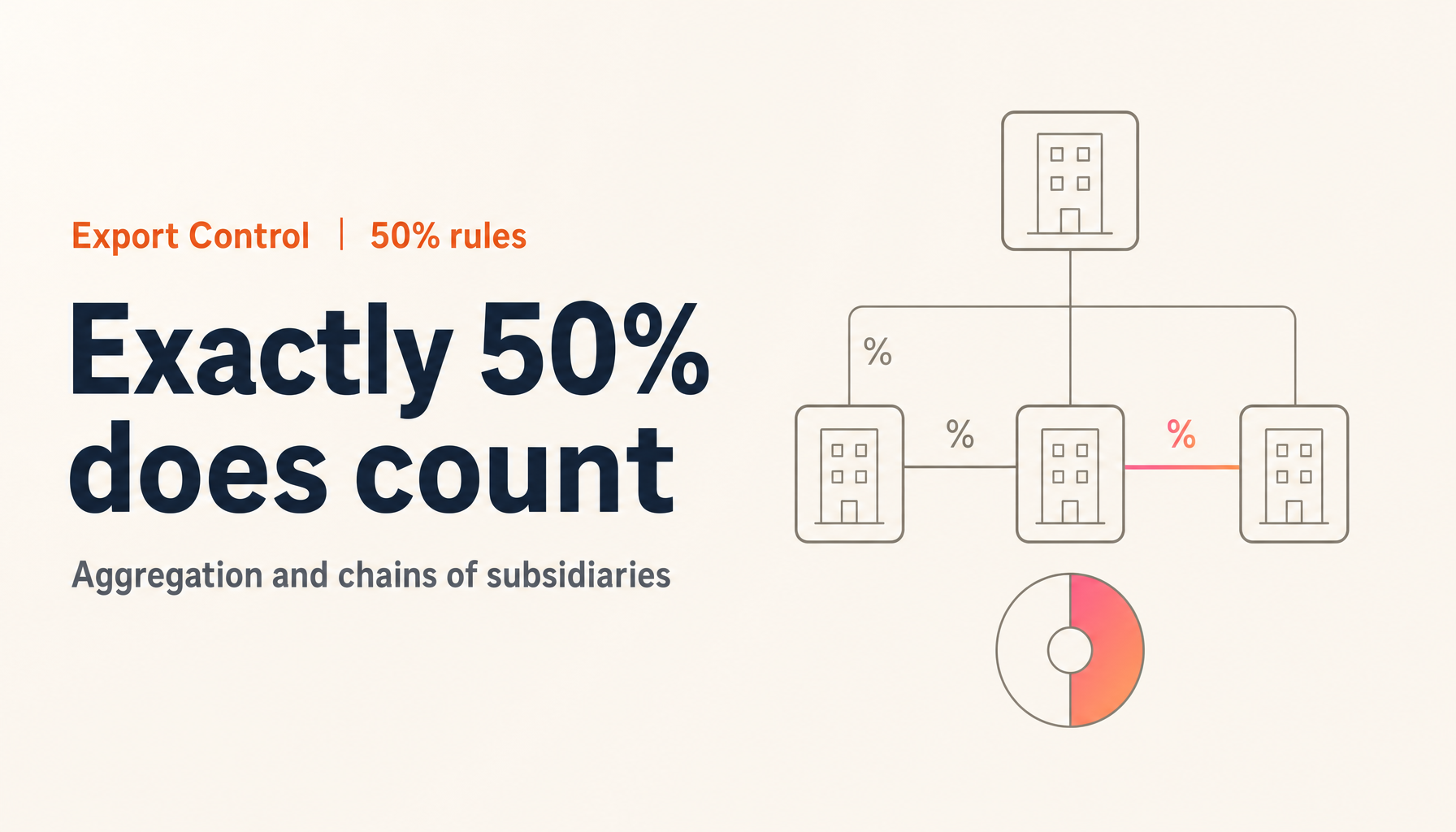
"The 50% rule" comes up constantly in export control and sanctions checks. A few questions, though, leave people stuck. If the stake is exactly 50%, is the company covered? I understand 51%, but what about 50%? If listed parties split a company between them, are the stakes added up? And once you reach grandchild and great-grandchild companies, how do you count?
This article answers those questions from the rule text of the US Commerce Department's BIS 50% rule (the Affiliates Rule) and the Treasury Department's OFAC 50% rule, using the numbered examples in OFAC's FAQs. The BIS rule currently has a stay that ends in November 2026, and I cover where that stands. Everything here was checked on 19 and 20 October 2026.
Four answers first
| Question | Answer |
|---|---|
| Is exactly 50% covered? | Yes. BIS says "at least 50 percent," and OFAC says "50 percent or more" |
| Are several owners' stakes added together? | Yes. The breakdown does not matter |
| How are grandchild and great-grandchild companies counted? | If the intermediate company is owned 50% or more, the stake it holds is counted in full, not diluted by multiplication. If the intermediate stake is below 50%, OFAC does not count what lies beyond it |
| What if the party only has control, with under 50%? | OFAC does not treat the company as covered automatically under the 50% rule. It does warn that the company may be designated or face enforcement in future, and asks for caution |
Now let me check each one against the text.
"50% or more": 51% is not required
The BIS rule treats a foreign entity as subject to the same restrictions as a listed party when it is owned "directly or indirectly, individually or in the aggregate, 50 percent or more" by a party on the Entity List, the MEU List, or a specified SDN. The summary of the interim final rule published in the Federal Register on 30 September 2025 says that an entity "at least 50 percent owned" by Entity List parties "will itself automatically be subject to Entity List restrictions."1
OFAC works the same way. Its FAQ says that an entity is blocked when blocked persons own 50 percent or more of it.2 Reaching 50% is enough. You do not need 51%.
The BIS rule text has an example with exactly 50%. In Application example 1 it says that "Company D is owned 50 percent by Company C" and concludes that Company D is covered. (Company C is not on a list, but it is subject to restrictions because of its ownership.)1 The text supports reading exactly 50% as covered.
Replace siloed classification work with AI.
METI's FY2024 data shows 52% of foreign exchange law violations stem from classification errors. Download the TRAFEED product catalog covering features and rollout.
Several stakes are added together
Splitting the ownership does not take a company out of scope. You add the stakes.
OFAC's FAQ example is a company A in which blocked person X holds 25% and blocked person Y holds another 25%. In the aggregate that is 50%, so company A is blocked. Stakes held by persons blocked under different sanctions programs are counted together.3
The BIS rule text has an application example with the same logic. Company A is on the Entity List and holds 35% of Company C. Company B is also on the Entity List and holds 15% of Company C. Company C is owned 50 percent or more in the aggregate by listed parties, so it is subject to the requirements that apply to the listed owners. Where the two sets of requirements differ in strictness, the more restrictive one, here Company A's, applies to any transaction in which Company C is a party. The rule also says that "the breakdown of the percentages adding up to 50 percent or more does not matter," and adds that if Company B held 35% and Company A held 15%, Company A's requirements would still apply.1
In practice, checking only the largest shareholder is not enough. You have to run every shareholder against the lists.
How grandchildren and great-grandchildren are counted
This is where most questions come up: how do you count when stakes form a chain? OFAC's FAQ 401 has five numbered examples.4
| Example | Ownership structure | Result |
|---|---|---|
| 1 | X owns 50% of A, and A owns 50% of B | X is treated as indirectly owning 50% of B, so B is covered |
| 2 | X owns 50% of A and 50% of B. A and B each own 25% of C | X's indirect stake in C is 25% + 25% = 50%, so C is covered |
| 3 | X owns 50% of A and 10% of B. A owns 40% of B | X's stake in B is 10% direct plus 40% indirect = 50%, so B is covered |
| 4 | X owns 50% of A and 25% of B. A and B each own 25% of C | B is below 50%, so the stake through B is not counted. X's indirect stake in C is only the 25% through A, so C is not covered |
| 5 | X owns 25% of A and 25% of B. A and B each own 50% of C | Neither A nor B reaches 50%, so neither is covered. C is therefore not covered either |
Two rules can be read from this table.
First, if the intermediate company is owned 50% or more, the stake it holds is counted in full. In example 2, X owns 50% of A. The 25% that A holds in C is not diluted by multiplication to 12.5% for X. It counts as 25% of indirect ownership by X. This matches the point that even if the company at the top of the chain holds exactly 50%, the stake further down is treated as 100% of that link.
Second, if the intermediate company is below 50%, what lies beyond it is not counted. Examples 4 and 5 show this. If the intermediate company is not covered, the stakes it holds in companies further down are not counted.
The BIS rule text also has an example of a chain. In the same application example 1, Company C is owned 50 percent or more in the aggregate by Companies A and B and is covered. Company D is owned 50 percent by C. C is not on a list but is restricted because of its ownership. The text says Company D, 50% owned by that C, is subject to the same restrictions.1 That is an example of the chain of ownership reaching one level further.
As to whether BIS counts the same way as OFAC, the rule text says, "Similar to OFAC, BIS in this IFR is applying the 50 percent rule."1 However, I could not find in the BIS application examples one that deals with an intermediate company below 50%, like OFAC's examples 4 and 5. Until that is confirmed, I think it is safer to read the BIS rule more broadly than OFAC's.
Under 50%, and "control": not covered does not mean no caution needed
There is a common misunderstanding here: "under 50%, I can deal with them," or "if they do not hold 50%, it does not matter." That is not safe to say.
OFAC's FAQ 398 asks whether an entity that a blocked person controls is blocked under the 50% rule, and answers no. The 50% rule deals only with ownership, not control. If the blocked person does not own 50% or more, the entity is not automatically blocked under the 50% rule, even if the blocked person controls it.5
The same FAQ also says other things. OFAC may designate the entity under a different criterion. An unblocked entity in which a blocked person holds a significant stake, or which a blocked person controls by means other than majority ownership, may become the subject of future designation or enforcement. OFAC therefore asks for caution when dealing with such entities.5
The BIS rule takes a similar view. It lists significant minority ownership below 50% and close ties such as overlapping board membership as red flags of diversion risk. It also adds a new Red Flag 29 for cases where the ownership percentage is unknown: an exporter that knows a foreign entity has listed owners has an affirmative duty to determine the percentage, and if it cannot, it is expected to obtain a BIS license where one would be required under the listed owner's requirements.1
The rule also says that the Entity List and similar requirements are enforceable on a strict liability basis. Knowledge is a factor in calculating penalties when a violation occurs.1 This is not a structure in which not knowing is enough.
BIS and OFAC: the same "50%," different effects
| Item | BIS (the EAR Affiliates Rule) | OFAC |
|---|---|---|
| What is covered | Foreign entities owned 50% or more by Entity List, MEU List or specified SDN parties | Entities owned 50% or more by blocked persons |
| Result | The same license requirements as the listed party apply | Treated as blocked property; dealings generally prohibited |
| Aggregation | Yes (breakdown does not matter) | Yes |
| Chains | Application example covers a company 50% owned by a restricted company | If the intermediate stake is 50% or more, the stake further down counts in full; below 50%, it does not |
| Under 50%, control | Red flags and Supplement No. 8 ask for caution | Not covered automatically; warns of future designation or enforcement and asks for caution |
| Status (20 October 2026) | Stayed by a Federal Register rule until 9 November 2026 | In force |
OFAC's rule is in force now. The BIS rule is stayed, but when the date arrives it returns automatically unless there is a further rule.
Where the BIS stay stands (20 October 2026)
The BIS Affiliates Rule took effect on 29 September 2025. Its effect was then stayed from 10 November 2025, and the stay runs to 9 November 2026.6 It is a "stay," and the amended text remains. When the date comes, unless there is a further rule, the rule's effect returns on 10 November 2026.
The US and China announced in September 2026 that they would extend the arrangement to 10 January 2027. But as of 20 October, I could not find that BIS has put an extension into the Federal Register. I searched for BIS-related documents published since 1 October and found none. The background is in The US-China November 10 Deadlines.
Without a legal document confirming the extension, the safe assumption in practice is that the rule returns on 10 November, so finish checking your counterparties' ownership before then. Being on a list is a regulatory classification, not a judgment about the company.
How to check a counterparty's ownership
The final judgment belongs to your export control officer. As a procedure, here are six steps.
- Write out the counterparty's shareholders layer by layer. Not only direct shareholders, but their shareholders too.
- Write each layer's stake as a number. Percentages, not "a major shareholder."
- Add up stakes that the same party holds through different routes. As in OFAC examples 2 and 3, stakes can come together from different routes.
- Follow the chain only through layers of 50% or more. If an intermediate company is owned 50% or more, count the stake beyond it in full. Under OFAC's counting, a layer below 50% does not carry the chain forward, but note it as a point for caution.
- If you cannot find the percentage, do not move on. What BIS's Red Flag 29 asks is that you determine the ownership percentage. If you cannot, consider whether a license is required.
- Record what you checked and when. The rule's status changes with deadlines and stays. Keep a record of what you confirmed as of which date.
Tracing ownership from a counterparty's name and calculating aggregated stakes takes a long time by hand. To see where your data breaks off, try one company with the BIS 50% Rule quick check (free, no registration). For the wider picture of the Affiliates Rule, see also What is the EAR Affiliates Rule?.
Summary
Exactly 50% counts, under both BIS and OFAC. Several stakes are added together. In a chain, if an intermediate company is owned 50% or more, the stake beyond it counts in full. If the intermediate stake is below 50%, OFAC does not count what lies beyond it. But "under 50%" and "control" are not to be read as "not covered." They are to be read as "caution needed."
What I would watch most in practice is the sense that "unless it is 51%, we are fine" or "the top company's stake is thin, so we are fine." In the examples in the rule, a stake of exactly 50%, and chains two or three levels deep, are covered.
The BIS stay runs to 9 November 2026. With no legal document confirming an extension, the best preparation is to be in a position to decide quickly when the rule comes back. When checking counterparties' ownership and screening against lists gets beyond what people can do by hand, that is the range TRAFEED is built to handle, including keeping the reasoning behind each decision on record. The final judgment remains with your export control officer. If you are not sure your current setup is enough, please reach out through our consultation form.
References
Footnotes
-
Expansion of End-User Controls To Cover Affiliates of Certain Listed Entities (90 FR 47201), interim final rule — Bureau of Industry and Security (BIS), US Department of Commerce — 30 September 2025 ↩ ↩2 ↩3 ↩4 ↩5 ↩6 ↩7
-
OFAC FAQ 399 (50 percent rule) — US Department of the Treasury, OFAC ↩
-
OFAC FAQs 399 and 402 (aggregate ownership) — US Department of the Treasury, OFAC ↩
-
OFAC FAQ 401 (definition of indirect ownership and examples 1 to 5) — US Department of the Treasury, OFAC ↩
-
OFAC FAQ 398 (ownership and control) — US Department of the Treasury, OFAC — 11 August 2020 ↩ ↩2
-
One Year Suspension of Expansion of End-User Controls for Affiliates of Certain Listed Entities (90 FR 50857) — BIS — 12 November 2025 ↩