Hello, this is Ryuta Hamamoto from TIMEWELL.
There's a question that lands on the screening team almost every Monday: "Did anything change on the U.S. lists last week?" Answering it properly means checking three places, the Federal Register, OFAC's Recent Actions page, and the Consolidated Screening List (CSL), and then running whatever changed against your own customer master. With a few dozen counterparties you can eyeball it. With a few thousand, you need a fixed order and a fixed record, or the weekly check quietly turns into a test of one person's stamina.
I'll use a fictional trading company, "Company B" (about 3,000 counterparties, two screening analysts, and one export control officer), to lay out a weekly routine for tracking the Entity List and the SDN List. The counts in the last section are real. I pulled them from the Federal Register API and OFAC's Recent Actions in November 2026.
Short answer
- U.S. list changes come from three places: BIS rules in the Federal Register, OFAC's Recent Actions, and the CSL. The Federal Register (including public inspection) and OFAC's own page are the fast, authoritative sources. The CSL is the easiest thing to screen against, but it does not tell you effective dates or conditions.
- Let systems watch every day. Have a person review the original sources once a week, on a fixed day, in a fixed order, and close out the record.
- Run the diff both ways: this week's list changes against every counterparty, and this week's new or changed counterparties against the full lists.
- On the day a counterparty turns up on a list, finish four things that day: hold shipments, report, check whether a license is needed, and record it.
I checked the facts on November 20, 2026, against the Federal Register, OFAC, trade.gov, and the eCFR. Anything I could not confirm is listed at the end. A listing is a regulatory designation under U.S. law, not a judgment about the company. This piece covers the screening procedure only.
Where changes come from, and which source is fastest
The same listing surfaces on different days, with different detail, depending on where you look. That's worth sorting out first.
The Entity List changes through BIS rules in the Federal Register
The Entity List is maintained by the Commerce Department's Bureau of Industry and Security (BIS) and sits in Supplement No. 4 to Part 744 of the Export Administration Regulations (EAR). Additions, removals, and changes to addresses or aliases all arrive as BIS rules in the Federal Register that rewrite that supplement. Under 15 CFR 744.11, when a listed entity is a party to the transaction, a license is required, to the extent specified on the Entity List, to export, reexport, or transfer (in-country) any item subject to the EAR. License exceptions cannot be used unless the entry authorizes them1. The list can also name addresses that present a high diversion risk, which is why address changes matter for screening.
Paragraph (b) of the same section, which sets the criteria, notes that the risk can stem from circumstances outside an entity's own control, such as a host government not cooperating with end-use checks1. The rule's own wording tells you a listing is a designation, not a verdict on the company.
One trap: the effective date and the publication date are not always the same. The two Entity List rules published on Monday, August 24, 2026 (91 FR 54657 and 91 FR 54658) both say in their DATES section that they took effect on August 21, 2026. According to the Federal Register API, both were filed for public inspection at 8:45 a.m. Eastern on August 212. Public inspection is the stage where a document is made public before it appears in the Federal Register. So these rules took effect the day they hit public inspection, three days (across a weekend) before publication. If you log only the publication date, your record is three days off.
OFAC's Recent Actions is where SDN changes appear first
The SDN List is the list of individuals and entities designated by Treasury's Office of Foreign Assets Control (OFAC). Designations and removals are posted on OFAC's Recent Actions page under the date they happen3. OFAC also publishes a "Notice of OFAC Sanctions Action" in the Federal Register, but that comes later. The notice published on November 18, 2026 (91 FR 74281) says in its DATES section that the action was issued on November 13, 2026. The notice published on November 10 (91 FR 72614) covered an action from April 15, 20264. The Federal Register is not where you find out first.
The CSL is a screening tool, not the official record
The CSL combines 13 lists, four from Commerce, two from State, and seven from Treasury. trade.gov offers a search engine, CSV and JSON files, and an API, all updated automatically every day at 5:00 a.m. Eastern5.
The same trade.gov page makes two points worth taking seriously. It is each federal agency's responsibility to provide updated files for the CSL to stay current. And if a party appears to match, the user must check the official publication in the Federal Register and the agencies' official lists before taking further action5. A CSL row does not carry an effective date or a savings clause.
| Source | What it shows | Speed | Weak spot | How to use it weekly |
|---|---|---|---|---|
| Federal Register (BIS rules) | Entity List additions, removals, and changes; effective dates; savings clauses | Sometimes readable on public inspection days before publication; the effective date can precede publication | No way to match names against 3,000 counterparties | The authoritative source for dates and conditions |
| OFAC Recent Actions | SDN designations, removals, and updates; general licenses; FAQs | Same day as the action | One day's post can mix several programs | The first place to see SDN changes |
| Federal Register (OFAC notices) | Notices of SDN designations | Days to months after the action | Slow | Backup for the record |
| CSL | Names, aliases, and addresses across 13 lists | Updated daily at 5:00 a.m. Eastern | No effective dates or conditions | Input for matching against your customer master |
My recommendation is a two-layer setup: screen against the CSL, and confirm "from when, under what conditions" in the Federal Register and on OFAC's site. The CSL alone can't tell you effective dates. The Federal Register alone gives you no practical way to match 3,000 names.
The weekly routine: day, owner, order, record
Here's how Company B runs it. The starting point is that daily watching belongs to systems. Pulling the CSL file every morning and matching the diff against every counterparty is a job for software. In my piece on what to do the day U.S. rules change, I suggested assigning someone to scan BIS rules in the Federal Register every day. The weekly review doesn't replace that daily glance. It's how you confirm a full week against the original sources and close the record.
| When | Owner | What to check | What to record |
|---|---|---|---|
| Every morning (automated) | System | Pull the CSL file and match the diff from the previous day's version against the full customer master | Retrieval time, row count, diff count, any hits |
| Every morning (10 min) | List owner (two people, rotating) | BIS rules in the Federal Register (today's publications and public inspection), OFAC Recent Actions from the previous day | One line: anything or nothing |
| Monday 9:00 to 9:40 | List owner | For the previous Monday through Sunday: Federal Register API (BIS and OFAC), OFAC Recent Actions, CSL diff totals | Top half of the weekly check sheet |
| Monday 9:40 to 11:00 | Screening analyst | First-pass review of diff hits, and results for counterparties added or changed this week | Decision records |
| Monday 15:00 | Export control officer | Decisions on confirmed matches and holds; sign-off on the weekly sheet | Sign-off time |
Monday works because it lets you treat the previous Monday through Sunday as one block. The day itself doesn't matter. What matters is checking the same scope on the same day every week. Once the boundaries drift, some days end up checked by nobody. Decide on holidays too. November 23, 2026 is a Japanese national holiday (Labor Thanksgiving Day), so Company B runs that week's review on Tuesday the 24th, with the same scope.
The order is the Federal Register API, then OFAC's Recent Actions, then the CSL diff, then matching against the customer master, then sign-off. Reading the originals first means that when you look at a CSL diff, you already know which rule it came from and when it took effect. Do it the other way around and you end up hunting through the Federal Register for every diff line.
The Federal Register API lets you pull BIS documents by publication date with a URL like the one below. For OFAC, change the agencies value to foreign-assets-control-office. Results include the title, document number, citation, publication date, and effective date (effective_on). Public inspection documents come from a separate endpoint (public-inspection-documents)6.
https://www.federalregister.gov/api/v1/documents.json?conditions[agencies][]=industry-and-security-bureau&conditions[publication_date][gte]=2026-11-16&conditions[publication_date][lte]=2026-11-22
Listing documents through the API misses less than clicking through pages by hand. We pull the same sources weekly ourselves.
Diff matching against your customer master
The idea is simple. Compare last week's list with this week's, pull out only the rows that changed, and run them against every counterparty. You don't need to rescreen all 3,000 counterparties against every list every week.
To do that, save the CSL file each week with its retrieval time. The CSL files include a "source" column showing which agency list each row comes from, along with names, aliases, and addresses5. The unit of comparison is one row. A row missing from last week's version is new; a row missing from this week's is removed; a row whose name, aliases, addresses, or license requirement changed is an update.
| Type of change | What to look at | How to match it | What happens next |
|---|---|---|---|
| New listing | Name, aliases, address, country, the Federal Register citation | Match against every counterparty's names, aliases, and addresses, including distributors, carriers, and end users in the chain | Hits go to first-pass review; confirm the effective date in the Federal Register |
| Removal | The removal rule; whether the same party remains on another list | Find counterparties you previously held or stopped because of this entry | Never resume automatically. Confirm the removal in the original and let the officer decide |
| Address added or removed | Which addresses were added or dropped | Find past decisions (matches and false positives alike) that relied on an address match | Send decisions whose basis changed back for review |
| Alias added | The new alias | Match against all counterparty names and aliases | Treat like a new listing |
| License requirement or review policy changed | That row in Supplement No. 4 | Counterparties doing business with that listed entity | Re-check whether a license is needed |
Don't forget the other direction. Counterparties added to the master this week, and those whose name, address, or ownership changed, get matched against the full lists, not just the diff. The lists may not have moved, but if the counterparty did, the result can change.
A removal doesn't mean you can automatically resume business. The same party may still be on the SDN List or another list. At Company B (fictional), a removal in the diff triggers a list of past cases stopped because of that entry, and the officer decides on each one individually.
In my piece on designing counterparty screening operations, I described suppressing approved false positives by the pair of counterparty ID and list entry ID, and invalidating the suppression when the entry's content changes. The weekly diff is how you catch "the entry's content changed." When an address or alias changes, send every suppression tied to that entry back for review. Use the same name-matching rules from that piece every week, too. If the rules shift week to week, you can't compare results.
Here's one week at Company B, as a fictional example.
| Item | Count (fictional) |
|---|---|
| One week of CSL diffs (31 new, 9 removed, 6 address or alias changes) | 46 |
| Hits between the diff and the customer master | 4 (3 false positives, 1 on hold) |
| Counterparties added or changed this week (matched against the full lists) | 27, no hits |
Out of 46 changes, a person has to decide on four. Machines do the matching; people step in only where judgment is needed. At a few thousand counterparties, that division of labor is the only thing that scales.
Replace siloed classification work with AI.
METI's FY2024 data shows 52% of foreign exchange law violations stem from classification errors. Download the TRAFEED product catalog covering features and rollout.
The day a listing hits a counterparty
Say the diff turns up a confirmed match or a strong possible match. Four things happen that day. The timings are Company B's design, not regulatory requirements.
| Step | Action | Owner | Target | Record |
|---|---|---|---|---|
| 1 | Hold shipments, technology transfers, and quotes | Screening analyst (block it in the shipping system) | Within 1 hour of discovery | List of held cases and the time |
| 2 | Report to the export control officer and management | Screening analyst | Same day | Time and content of the report |
| 3 | Check whether a license is needed | Export control officer (with legal or U.S. counsel as needed) | Initial call the same day; set a deadline for the conclusion | Federal Register citation, the Supplement No. 4 entry, the decision |
| 4 | Record, and prepare any message to the counterparty | Screening analyst, legal | Same day to next business day | Decision record, draft message |
The hold comes before the analysis. The outcome you most want to avoid is a shipment going out while you're still working out whether a license is required. A hold can be lifted once the decision is made.
What you check depends on the list. For the Entity List, look at the license requirement and review policy in that entry, plus the rule's effective date and any savings clause. This is also where you confirm whether the item is subject to the EAR (U.S.-origin items, foreign-made items incorporating U.S.-origin parts, items produced from U.S. technology, and so on). For the SDN List, OFAC's rules prohibit dealings by U.S. persons and block property, so look at whether U.S. persons, U.S. dollar payments, or U.S. financial institutions are involved. Japanese law has no provision requiring companies to screen against the Entity List or the SDN List. Whether U.S. law reaches a transaction depends on the facts, which is the same position I take in my piece on end-user screening and customer due diligence.
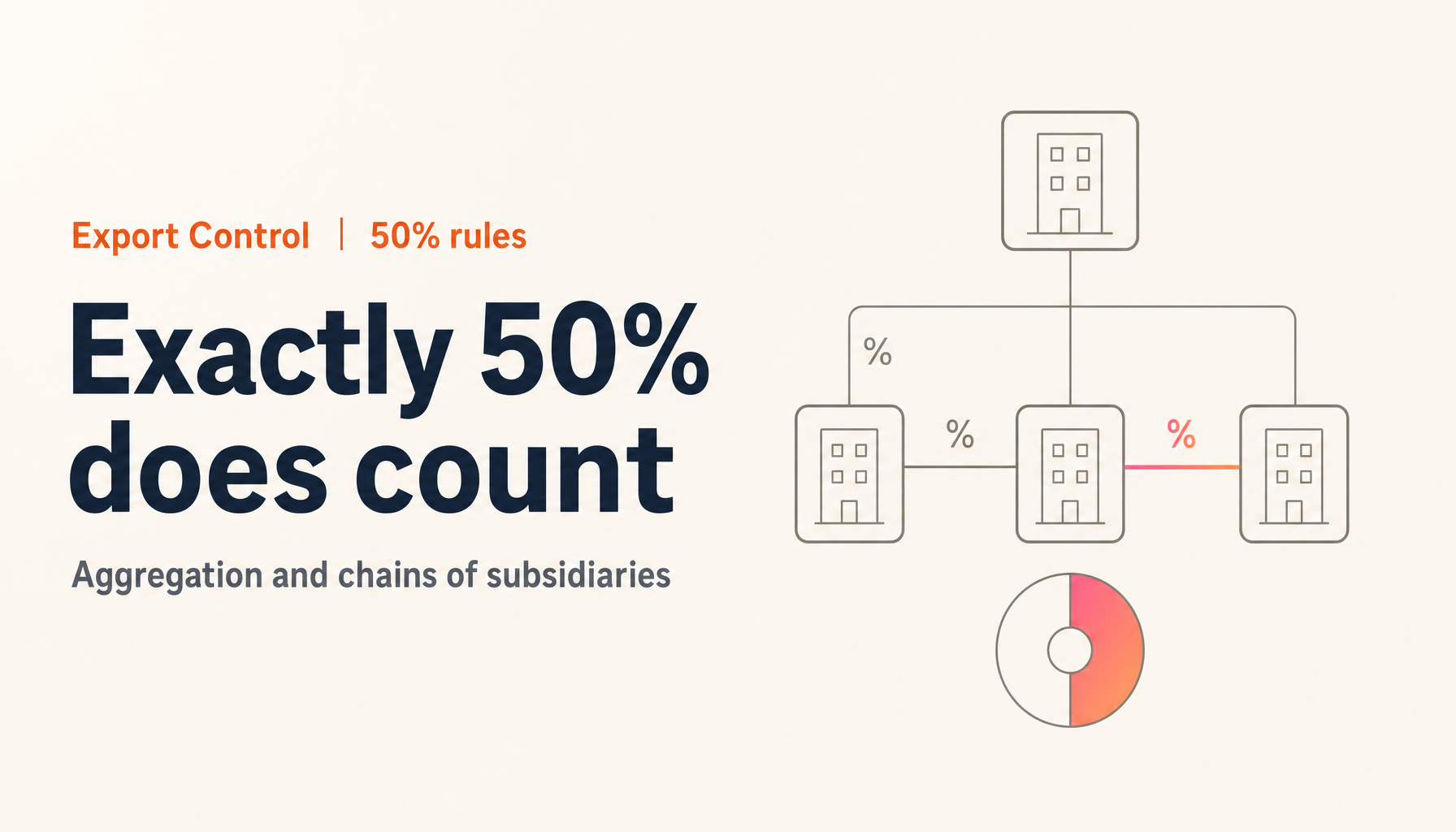
Check the 50 percent rules here as well. OFAC treats entities owned 50 percent or more, individually or in aggregate, by SDNs as blocked even if they are not named7. The BIS Affiliates Rule sits in the text as 15 CFR 744.11(a)(1), but as the eCFR note says, it is suspended until January 10, 2027 (91 FR 70789)1. During the suspension, restrictions on the named entities themselves remain in force. I walk through the math in how to count ownership under the BIS and OFAC 50 percent rules.
Keep the same-day report short and separate facts from open questions. Here's a template. Have your legal team and export control officer review it before use.
Template (same-day report to the export control officer) In today's diff review, we confirmed that counterparty [name] (ID [ ]) was added to the U.S. [ ] list. The basis is [ ] FR [ ] (published [date], effective [date]). Name and address both match, and we have classified it as a confirmed match. We put two scheduled shipments and one quote on hold at [time] today. We are checking whether a license is required, including whether the items are subject to the EAR, and will conclude by [date]. A listing is a regulatory designation under U.S. law and is not a judgment about the company. We will contact them only after legal has reviewed the wording.
When you contact the counterparty, avoid wording that reads as an accusation. What you need is basic corporate information and the purpose of the transaction. The operations design piece includes a sample request.
What to record: date checked, version, result, decision-maker
Record what didn't change as well as what did. The only way to show later that "we checked last week and nothing changed" is the record.
Company B's weekly check sheet has the fields below. The Federal Register and OFAC rows reflect actual publications as of November 21, 2026; the CSL and matching figures and the names are fictional.
| Field | Example |
|---|---|
| Date checked, checked by | November 24, 2026 (Tuesday; the 23rd was a holiday), list owner C |
| Period covered | November 16 (Monday) to 22 (Sunday), 2026 |
| Federal Register (BIS) | 1 document. 91 FR 74970 (published and effective November 19; on public inspection November 16). No change to Supplement No. 4 |
| Federal Register (OFAC) | 2 documents. 91 FR 73638 (November 16), 91 FR 74281 (November 18; action of November 13) |
| OFAC Recent Actions | 3 days (November 18, 19 and 20) |
| CSL | Retrieval time, row count, file identifier (hash) |
| Diff and matching results | 46 changes, 4 hits: 3 false positives, 1 on hold |
| Reviewer, approver | Screening analyst D, export control officer E (both November 24) |
| Open items | 1 hold (response due December 1) |
The field that matters most is the version you looked at: the citation and document number for the Federal Register, the posting date for OFAC, the retrieval time and row count for the CSL. If you also keep the CSL file itself, you can later show that a given name was not on that day's version.
How long to keep it depends on the transactions it supports. Where U.S. law applies, EAR records are kept for five years (15 CFR 762.6), and records of transactions subject to OFAC's regulations for at least ten years from the transaction date (31 CFR 501.601). I cover how to set retention alongside Japan's METI guidance in the retention section of the operations design piece8. Keeping the weekly sheet for the longest period that applies to any linked transaction saves you from having to decide case by case.
Then and now: counting November 2026
Finally, the real numbers.
For "then," think of the stretch when Entity List additions came one after another. In December 2024, 140 entities were added in one rule (89 FR 96830), and more additions followed in September and October 20257. The eCFR amendment history shows new versions of Supplement No. 4 on September 16, September 30, October 9, and November 12, 20259.
2026 has been quiet by comparison. From January 1 to November 20, BIS published 14 rules in the Federal Register, and only two, both on August 24, carry "Entity List" in the title. One removed an entity in Turkey; the other removed two addresses for an entity located in Hong Kong. There were no additions62.
So can you skip the weekly review? November's numbers say no.
| Period | Federal Register (BIS) | Federal Register (OFAC) | OFAC Recent Actions |
|---|---|---|---|
| November 1 to 20, 2026 | 4 (2 rules, 2 notices) | 13 (9 sanctions action notices, 4 general license publications) | 8 days |
| Of which November 16 to 20 | 1 | 2 | 3 days |
In the week of November 16, BIS published one interim final rule on remote access to advanced semiconductors (91 FR 74970). It doesn't change the Entity List, but it includes end-use controls in Part 744. On November 9, BIS also published the rule extending the Affiliates Rule suspension (91 FR 70789)6. Even when the list's contents don't change, rules that change how the lists work keep coming.
OFAC posted actions on three days that week alone: counter terrorism designations on the 18th; counter narcotics and cyber-related designations plus a general license and FAQ updates on the 19th; and Iran-related designations and Cuba FAQs on the 20th. Earlier in November there were Iran-related, cyber-related, and Cuba-related postings3. The SDN List moves almost every week.
What the counting shows is that even in a quiet year for the Entity List, a weekly review is never wasted. Even in a week that looks empty, a record saying "checked, no change" is itself the deliverable.
What I could not confirm
I have not measured how many hours it takes for a Federal Register or OFAC change to show up in the CSL. trade.gov states the daily 5:00 a.m. update and the agencies' responsibility, but not the lag. My read on how far OFAC's Federal Register notices lag the action is based only on the November notices.
The case where the effective date equals the public inspection date rests on the two August 24, 2026 rules. The November 19 rule went on public inspection on November 16 and took effect on publication, November 19, so check the DATES section of each rule. The eCFR history also shows a new version of Supplement No. 4 on July 16, 2026, and I have not confirmed what changed.
On sources: on November 21, 2026 I checked the EAR recordkeeping rule (§762.6) and OFAC recordkeeping rule (§501.601) against the eCFR text (version as of November 18, 2026), OFAC's 50 percent rule against OFAC FAQ 399, and the Entity List additions of December 2024 and September and October 2025 against the abstracts in the Federal Register API.
This piece does not decide whether the EAR or OFAC's rules reach any particular transaction. Ask U.S. counsel. What happens to the BIS Affiliates Rule after January 10, 2027 is unknown. Company B's operations, timings, and diff and match counts are fictional design examples.
A listing is a regulatory designation under U.S. law and is not a judgment about the company. I also don't recommend screening counterparties by nationality or country alone.
Further reading
- Designing counterparty screening operations: name-matching rules, false positive records, retention
- What to do the day U.S. export rules change: reading the Federal Register and sorting the impact
- End-user screening and customer due diligence: from list matching to direct confirmation
- Entity List, MEU List, and SDN List compared: who runs each list and what it does
- The five sanctions-list systems: where to get each list and how often it changes
- The BIS 50 percent rule (Affiliates Rule): the suspension extension and how to prepare
If you'd like to turn U.S. list diff matching and weekly records into a system, TRAFEED is happy to talk it through (contact us). A template screening procedure is available in the five sanctions-list systems screening procedure.
Footnotes
-
15 CFR 744.11 (License requirements that apply to entities acting or at significant risk of acting contrary to the national security or foreign policy interests of the United States), paragraphs (a) and (b), and the section's Effective Date Note ((a)(1) stayed by 90 FR 50857 and further stayed until January 10, 2027 by 91 FR 70789). eCFR, version as of November 18, 2026. Retrieved November 20, 2026. https://www.ecfr.gov/current/title-15/subtitle-B/chapter-VII/subchapter-C/part-744/section-744.11 ↩ ↩2 ↩3
-
BIS, "Removal From the Entity List" (91 FR 54657, document 2026-17230) and "Revisions to the Entity List" (91 FR 54658, document 2026-17231). Published August 24, 2026; DATES: "This rule is effective August 21, 2026." Public inspection filing time (filed_at): 8:45 a.m. EDT, August 21, 2026. Confirmed via the Federal Register API (documents and public-inspection-documents) on November 20, 2026. https://www.federalregister.gov/documents/2026/08/24/2026-17230/removal-from-the-entity-list ↩ ↩2
-
OFAC, "Recent Actions." Postings from November 1 to 20, 2026 (November 4, 5, 6, 9, 13, 18, 19, and 20), checked November 21, 2026. https://ofac.treasury.gov/recent-actions ↩ ↩2
-
OFAC, "Notice of OFAC Sanctions Action" (91 FR 74281, document 2026-23456, published November 18, 2026; DATES: "This action was issued on November 13, 2026.") and the same (91 FR 72614, document 2026-22864, published November 10, 2026; DATES: "This action was issued on April 15, 2026."). Confirmed via the Federal Register API on November 20, 2026. ↩
-
International Trade Administration, "Consolidated Screening List" (Key Considerations, Updates, CSL Downloadable Files, and Key Sources sections; four Commerce, two State, and seven Treasury lists; updated automatically every day at 5:00 a.m. EST/EDT). Checked November 20, 2026. https://www.trade.gov/consolidated-screening-list ↩ ↩2 ↩3
-
Federal Register API (federalregister.gov). Bureau of Industry and Security (industry-and-security-bureau): 14 rules from January 1 to November 20, 2026, and 4 documents from November 1 to 20, 2026. Office of Foreign Assets Control (foreign-assets-control-office): 13 documents in the same November period. For 91 FR 74970 (document 2026-23529), public inspection filing time was 4:15 p.m. EST on November 16, 2026; published and effective November 19. Retrieved November 20, 2026. https://www.federalregister.gov/developers/documentation/api/v1 ↩ ↩2 ↩3
-
On OFAC's 50 percent rule: OFAC Frequently Asked Questions 399, which explains that OFAC's revised guidance of August 13, 2014 applies the rule to entities owned 50 percent or more in the aggregate by one or more blocked persons. https://ofac.treasury.gov/faqs/399 . On the Entity List additions, the abstracts in the Federal Register API: 89 FR 96830 (published December 5, 2024; 140 entities added), 90 FR 44496 (published September 16, 2025; 32 entities added) and 90 FR 48193 (published October 9, 2025; 29 entries, 26 entities and 3 addresses, added). All confirmed November 21, 2026. Our overview is in "The five sanctions-list systems" (/en/columns/sanctions-lists-complete-guide). ↩ ↩2
-
15 CFR 762.6 ((a) Five year retention period) and 31 CFR 501.601 (at least 10 years after the date of the transaction), confirmed in the eCFR (version as of November 18, 2026) on November 21, 2026. How to set retention alongside METI's guidance is covered in the retention section of our article "Designing counterparty screening operations" (/en/columns/counterparty-screening-operations-design). ↩
-
eCFR amendment history (versioner API, title 15, part 744), version dates for Supplement No. 4 to Part 744—Entity List. Retrieved November 20, 2026. https://www.ecfr.gov/current/title-15/subtitle-B/chapter-VII/subchapter-C/part-744/appendix-Supplement%20No.%204%20to%20Part%20744 ↩