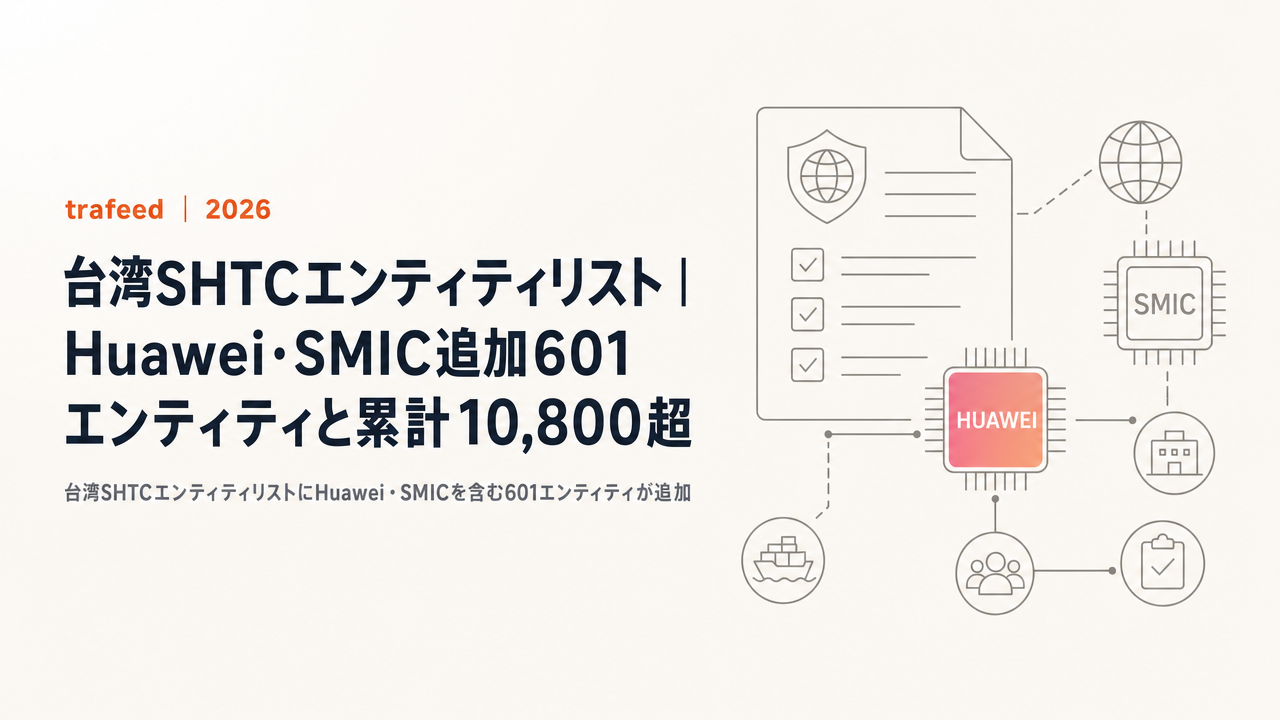
Hello, this is Ryuta Hamamoto from TIMEWELL. Semiconductor and electronics compliance teams keep asking: “Is it true Huawei’s Japan entity is on Taiwan’s list?” Yes. Taiwan’s International Trade Administration (ITA) under the Ministry of Economic Affairs added 601 entities including Huawei and SMIC to the SHTC Entity List in June 2025, then 279 more in September. Two further updates in 2026 pushed the cumulative list past 11,480 — larger in scale than the U.S. BIS Entity List.
I wrote this for officers who know Japan’s FEFTA but not Taiwan’s system. Below I map SHTC structure, the Huawei/SMIC addition timeline, and five practical steps. It is neutral regulatory analysis: list placement is a licensing status under Taiwan law, not a moral judgment about any company’s products or people.
Asia six-country export-control overview: A one-page comparison of the governing law, competent authority, strategic-goods list, catch-all and regime membership for Korea, Taiwan, China, India, Thailand and Indonesia, together with a common self-check (Taiwan and Indonesia are covered at framework level). When you need to explain Taiwan's SHTC regime alongside Japan's FEFTA and the US BIS lists, it works as-is for an internal briefing or for sharing with overseas sites. Listings and classifications are regulatory designations, not judgments about any company or country. → Download the Asia 6-Country Export-Control Overview (2026) (Free. Your company name and work email address are required.)
What you will learn
- What the Taiwan SHTC Entity List is, and how it differs from the U.S. BIS Entity List
- Why 601 entities including Huawei and SMIC were added in June 2025, and the Sophgo / TSMC facts as publicly reported
- How Huawei overseas affiliates (Japan, Russia, Germany, etc.) being listed affects Japanese trade
- Criminal penalties (up to 5 years / NT$3M) and Restricted Region aggravation
- Five steps and common misconceptions
Three terms first
| Term | Plain meaning |
|---|---|
| SHTC | Strategic High-Tech Commodities. Taiwan’s controlled dual-use/strategic goods umbrella (semiconductors, comms, crypto, dual-use chemicals, etc.). |
| ITA | International Trade Administration, MOEA. Taiwan’s licensing authority (reorganized from BOFT in Sep 2023). Rough METI Security Export Control counterpart. |
| Restricted Regions | Regions under stricter SHTC treatment (e.g., Iran, Iraq, North Korea, mainland China, Sudan, Syria). Violations toward these destinations more often face criminal treatment. |
Checkpoint: SHTC = Taiwan strategic goods; ITA = the agency; Restricted Regions = higher-penalty destinations.
Structure of the SHTC Entity List
Legal basis
Foreign Trade Act Articles 13 and 27; implementing Regulations Governing the Export and Import of Strategic High-Tech Commodities. ITA has run the program since 1994, designed to align with multilateral regimes such as Wassenaar.
| Item | Content |
|---|---|
| Statute | Foreign Trade Act Arts. 13 & 27 |
| Rules | SHTC export/import regulations |
| Authority | ITA, MOEA |
| Program start | 1994 |
| Cumulative scale | 10,800+ entities (as of Sep 2025) |
Three layers of SHTC control
- Export Control List (ECL): dual-use, common military, North Korea-sensitive, Iran-sensitive item lists
- Catch-all: unlisted items still licensed if WMD end-use/end-user concern arises
- Import certificate (IIC / WAC) items: import-side management
The Entity List strengthens catch-all practice: named parties require a prior license for covered exports.
vs U.S. BIS Entity List
| Point | U.S. BIS Entity List | Taiwan SHTC Entity List |
|---|---|---|
| Authority | BIS | ITA, MOEA |
| Legal basis | ECRA / EAR Part 744 Supp. 4 | Foreign Trade Act + SHTC regulations |
| Scale (Sep 2025) | Thousands of entities | 10,800+ |
| Effect | EAR licensing (often presumption of denial, etc.) | Prior license required for listed parties |
| Catch-all | MEU / military end-use rules | Dual-use determination framework |
| Penalties | Civil/criminal (IEEPA track) | Admin + criminal (up to 5 years / NT$3M) |
Taiwan’s larger scale reflects UN and U.S. sanctions incorporation plus Taiwan-unique designations, ships, and front companies. Not a 1:1 map of the BIS list. Huawei and SMIC appear on both. Treat the rest as separate rosters.
Official Taiwan framing is sovereign export-control capacity, not formal subordination to U.S. rules, even where outcomes increasingly align.
Checkpoint: SHTC Entity List is Taiwan’s own list, separate from BIS, and larger.
Replace siloed classification work with AI.
METI's FY2024 data shows 52% of foreign exchange law violations stem from classification errors. Download the TRAFEED product catalog covering features and rollout.
10 June 2025: 601 entities including Huawei and SMIC
Official announcement
ITA announced on 15 June 2025 that 601 entities were added as of 10 June for “non-proliferation and other national-security concerns.”
| Item | Content |
|---|---|
| List update | 10 June 2025 |
| Public announcement | 15 June 2025 |
| Authority | ITA, MOEA |
| Additions | 601 |
| Main locations | Russia, Pakistan, Iran, Myanmar, mainland China |
| Stated reasons | Non-proliferation / national security |
Representative listed parties
- Huawei Technologies Co., Ltd. (mainland China parent)
- Huawei overseas affiliates (Japan, Russia, Germany, and others; listed as separate entities)
- SMIC (Semiconductor Manufacturing International Corp.)
- Various entities/persons in Russia, Pakistan, Iran, Myanmar, and mainland China
List placement means license-before-export under Taiwan SHTC rules. It is a regulatory status, not a statement about product quality or commercial legitimacy.
Trigger context: Sophgo / TSMC (as reported)
The batch addition was not random. Public reporting through late 2024–early 2025 described concerns that mainland China design firm Sophgo may have acted as a front, with AI chips associated with Huawei designs manufactured at TSMC under Sophgo’s name. TSMC reportedly self-disclosed to U.S. authorities. Press coverage in April 2025 discussed potential BIS penalty exposure on the order of up to $1 billion (reporting-stage estimates, not a final assessed fine). Those figures are media estimates, not a completed adjudication against every named party.
From Taipei’s perspective, Taiwan semiconductor suppliers faced third-country front-company manufacturing risk for listed parties. Adding Huawei and SMIC directly to the SHTC Entity List is best read as closing a domestic licensing gap so Taiwan suppliers stop such trades at the license stage. Again: regulatory status, not a verdict on commercial legitimacy.
Checkpoint: The 601-entity batch was a systemic response after Sophgo-related facts became public, aimed at protecting Taiwan supplier compliance.
Huawei overseas affiliates are also listed
Huawei Japan among listed entities
The June 2025 batch individually lists Huawei Japan, Huawei Russia, Huawei Germany, and other overseas affiliates, addressing potential fronting and bypass via sales/R&D sites as a licensing design.
| Case | Taiwan SHTC application |
|---|---|
| Taiwan company → Huawei mainland parent | Prior license required; Restricted Region aggravation possible |
| Taiwan company → Huawei Japan | Prior license required (listed party) |
| Japanese company ↔ Huawei Japan (no Taiwan goods) | Outside direct SHTC scope (still check EAR / Japanese FEFTA) |
| Japanese company ↔ Huawei Japan (Taiwan-origin components) | Taiwan rules may affect upstream Taiwan suppliers |
Pure Japan-to-Japan trade with Huawei Japan is not directly a Taiwan SHTC export. If products contain Taiwan-origin components (semiconductors, glass substrates, certain chemicals), Taiwan suppliers may demand end-user disclosures and assurances before they can license.
Restricted Regions raise penalty stakes
Mainland Huawei and SMIC sit in Restricted Regions (mainland China among others). Violations toward Restricted Regions more often face criminal treatment under Taiwan practice: up to 5 years / NT$3M.
Checkpoint: Huawei Japan/Russia/Germany affiliates are listed. Japan-to-Japan trade is not automatically Taiwan-regulated, but Taiwan-component supply chains can still feel it.
18 September 2025: +279 entities; cumulative 10,800+
| Item | Content |
|---|---|
| Announcement | 18 September 2025 |
| Added | 279 |
| Removed | 7 |
| Main locations | Pakistan, Iran, mainland China |
| Reasons | National security / non-proliferation |
| Alignment inputs | UN Security Council and U.S. sanctions updates |
| Cumulative scale | 10,800+ |
Country-by-country detail is limited in public secondary sources; for screening, use ITA’s official SHTC Entity List PDF.
Taiwan’s style is batch updates every few months, not only case-by-case like BIS. Japanese programs need near-real-time SHTC follow, not semi-annual reviews.
Application process and penalties
Five-step Taiwan exporter process
- Exporter registration with ITA (often hours online)
- Item classification (formal ITA determination NT$2,000 per request since Jan 2024)
- End-user check against Entity List and stated end use
- License application when required
- Export only after license issuance
Japanese companies rarely file with ITA directly, but will increasingly supply end-user and end-use data to Taiwan suppliers running this process. That data request is the first place many HQ teams notice Taiwan rules.
Penalties (administrative + criminal)
| Type | Content |
|---|---|
| Administrative | Fines NT$60,000–3,000,000; 1 month–1 year suspension of import/export privileges; registration cancellation |
| Criminal | Up to 5 years and/or fine up to NT$3M (Foreign Trade Act Art. 27) |
| Aggravation | Restricted Region destinations more often handled criminally |
NT$3M is roughly ¥14 million (FX-dependent). Unlicensed exports toward mainland Huawei or SMIC as Restricted Region entities carry realistic criminal risk under Taiwan practice. Non-Restricted Region listed affiliates (for example Huawei Japan) still require licenses and face administrative sanctions if unlicensed.
Four impacts on Japanese companies
1. TSMC supplier operational load
Japanese equipment and materials suppliers to TSMC (Tokyo Electron, SCREEN, Shin-Etsu, SUMCO, and others) must incorporate checks that TSMC’s ultimate end users are not SHTC-listed. TSMC’s own blocks help, but information-sharing workload rises.
2. Huawei Japan trading decisions
Taiwan SHTC does not directly regulate pure Japanese-domestic trade with Huawei Japan. Effects appear when:
- Products use Taiwan-origin components and Taiwan suppliers require “not for Huawei Japan” style assurances
- Global corporate policy treats SHTC hits as screening fields
3. Stacking with U.S. EAR
Huawei and SMIC are also on the U.S. BIS Entity List. U.S.-origin content/technology can trigger EAR reexport alongside Taiwan SHTC. Dual compliance cost. Re-audit FDPR exposure too.
4. Global program redesign
Most Japanese programs center on BIS Entity List, EU sanctions, and FEFTA classification. Adding a 10,800+ Taiwan list, and tracking designation sources (Taiwan-unique / UN-reflected / U.S.-reflected), is now part of serious global design.
Five practical steps
Step 1: Confirm whether products are SHTC-relevant
Map Taiwan-bound exports and Taiwan-sourced reexports against SHTC categories (equipment, materials, crypto, comms, certain chemicals). When unsure, ask Taiwan suppliers to seek formal ITA determinations (NT$2,000).
Step 2: Integrate the SHTC Entity List into counterparty databases
At 10,800+ names, use CSV/API auto-update. OpenSanctions and other third-party datasets can help.
Step 3: Unified multi-list screening
Bundle Taiwan SHTC with BIS Entity List, SDN, EU, UK HMT, and Japanese FEFTA targets. Keep designation-source metadata for end-user explanations.
Step 4: Protocols with Taiwan suppliers
Who answers “who is the end user / what is the end use?” with what approval path: write it down. TSMC-facing deals may need contract-level terms as TSMC compliance tightens.
Step 5: Annual training and audit cadence
June and September 2025 showed batch-update rhythm. Put Taiwan regulatory refresh into annual training and internal audit; update policy on each major amendment.
FAQ
Q1. Must Japanese companies screen the Taiwan SHTC Entity List?
No direct Taiwan Foreign Trade Act duty if you are not the Taiwan exporter. But if you buy from Taiwan suppliers or foundry at TSMC, suppliers will demand end-user data. Practically, global programs should include SHTC.
Q2. What about trading with Huawei’s Japan subsidiary?
From a Taiwan supplier’s view, Huawei Japan is listed. Prior license required for Taiwan-origin exports. Pure Japan-to-Japan trade is outside direct SHTC scope, but Taiwan-origin components may reintroduce Taiwan rules upstream. Check EAR and Japanese FEFTA separately.
Q3. Is the list identical to the U.S. BIS Entity List?
No. Scale and granularity differ. Overlap exists (e.g., Huawei, SMIC); treat others as separate rosters.
Q4. How severe are criminal penalties?
Up to 5 years and/or NT$3M (~¥14M), plus administrative suspension/cancellation. Restricted Region destinations (mainland China, Iran, North Korea, etc.) more often go criminal.
Q5. Where is Taiwan export control heading?
Toward continued sovereign non-proliferation and national-security controls. Outcomes often align with U.S. direction, but official framing remains sovereign capacity building, not “U.S. followership.”
2026 updates: cumulative total passes 11,480
The list is not a static document. It is amended roughly three times a year, and 2026 has already seen two rounds.
| Date | Change | Jurisdictions involved |
|---|---|---|
| April 2026 | +67 entities, −8 removed | Russia, Haiti, Turkey, mainland China, UAE |
| June 2026 | +265 entities, −13 removed | Iran, Russia, Mexico, Turkey, mainland China, UAE |
After the June 2026 update the cumulative total passed 11,480 (ITA update, June 2026 / April 2026).
One detail gets missed often: entries are removed as well as added. Both 2026 updates included deletions. Screening against a spreadsheet you downloaded a few months ago does not only miss the new designations — it can also stop a counterparty that has since been delisted, which costs you business rather than protecting it.
The list itself is published on Taiwan's open data platform and refreshed twice daily, at noon and 5pm. Getting the data has never been the hard part. Screening every new counterparty against the current version, and keeping the record that you did, is.
Latest developments as of July 2026
Semiconductor-chain export controls now interlock with bilateral economic-security cooperation. The Japan–India summit on 2 July 2026 advanced ~¥2 trillion investment language across semiconductors, rare earths, clean energy, ICT (subsea cables), and pharmaceuticals (Prime Minister’s Office of Japan, July 2026). If Taiwan/U.S. lists are “defensive blocks,” trusted-partner supply frameworks are “offensive network building.” As of July 2026 they still look separate, but Japanese practice should put SHTC screening and supply-chain redesign on one map. See Japan–India Summit 2026 and economic security.
If you want to improve export-control operations or classification efficiency, review the TRAFEED service catalog (PDF) or contact us.
Key takeaways
Taiwan SHTC Entity List is ITA-run and exceeds 11,480 entities as of June 2026. Separate from the U.S. BIS Entity List. On 10 June 2025, 601 entities including Huawei and SMIC were added; public context includes the Sophgo / TSMC facts as reported. Huawei overseas affiliates in Japan, Russia, Germany, and elsewhere are individually listed. On 18 September 2025, +279 more. Two 2026 rounds followed (April: +67/−8, June: +265/−13), taking the cumulative total past 11,480.
Penalties: up to 5 years + NT$3M. Restricted Region violations more often go criminal. Japanese steps: SHTC item check, list integration, global roster management, Taiwan supplier protocols, annual training.
Do not treat Taiwan as “just an extension of U.S. rules.” Taiwan-unique designations and UN-reflected entries will be missed if you only watch BIS. I keep saying that because it is the most expensive shortcut I still see in program design.
Related reading
- Huawei Ascend 910B export-violation risk
- Entity List / MEU List / SDN List comparison
- BIS Affiliates Rule (50% rule) complete guide
- End-user screening and customer due diligence
If manual screening of 10,800+ names is unrealistic
Bundling BIS, EU, UK HMT, Japanese FEFTA, and Taiwan SHTC is beyond a small team alone. Honestly, manual screening at 10,800+ names is not a realistic Monday plan.
TRAFEED is an AI agent on a 200M+ knowledge graph of papers, patents, researchers, corporations, and restricted lists. It integrates U.S., EU, Taiwan, and Japan screening and visualizes ownership chains (including overseas affiliates and front-company links) in seconds, on AWS Tokyo Region servers.
See TRAFEED features Book a 30-minute consultation
References
Taiwan government
U.S. government
Reporting (June 2025 Huawei/SMIC)
- Focus Taiwan 16 Jun 2025; CNBC 16 Jun 2025; Bloomberg 14 Jun 2025; JETRO; Digitimes; Export Compliance Daily
Reporting (September 2025 +279)
- WorldECR; Global Sanctions; EC Compliance
Analysis
- The Diplomat (Jul 2025; Oct 2025); SSRN Ching-Fu Lin & Han-Wei Liu; Lexology
Sophgo / TSMC context (reporting)
- The Register 8 Apr 2025; TechCrunch 9 Apr 2025; NBC News
Datasets
- OpenSanctions Taiwan SHTC Entity List
- Trademo SHTC Entity List data