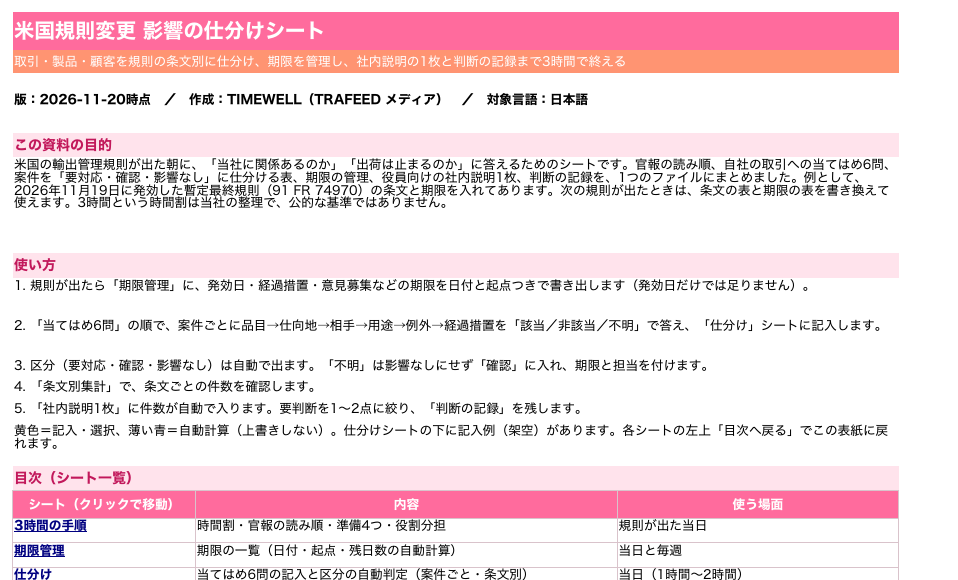
US Rule-Change Impact Triage Sheet (editable Excel)
A sheet to finish deadline tracking, six applicability questions, case triage, an executive one-pager and a decision record within three hours of a new US rule. The second edition (November 22, 2026) also includes a Section 743.10 monthly report log with automatic due dates, a decision table for foreign-made semiconductor manufacturing equipment (SME FDP rule and Footnote 5) and an inventory sheet for the 0.1% China-origin content threshold of MOFCOM Announcement No. 61 of 2025, whose status after the suspension expired remains unannounced (Japanese only).
Get the fileYou can download it after a short form (Japanese).
Hello, this is Ryuta Hamamoto from TIMEWELL.
Picture this morning. You get to the office and find a chat message from the sales rep who handles one of your customers: "Looks like a new U.S. rule is out. Will our shipments stop?" Social media is full of breaking-news posts, and an executive has messaged you: "Does this affect us? Give me one line before this afternoon's meeting." In front of you is the rule as published in the Federal Register, about 30 pages of it. You have a lot of items, counterparties and sites. There is no way to read it all.
This article is the procedure for that morning. It covers the order in which to read the Federal Register, applying the rule to your own transactions, triaging the impact, a one-page internal briefing and the decision record, broken down into steps you can finish in three hours. Along the way, I use the procedure to actually read the interim final rule that took effect on 19 November 2026 (91 FR 74970). The facts were checked against the version published in the Federal Register.
The conclusion first
- On the first day of a rule change, the job is not to "understand everything." It is to confirm in the Federal Register "what, from when, and for whom," and to sort your transactions into "action required," "check" and "no impact."
- Read in this order: SUMMARY, DATES, Savings Clause, the preamble headings, then the provisions that affect you. Assume there is more than one deadline, and pick them all up.
- Fit the internal briefing on one page: three lines for executives, the number of affected cases, the deadlines and one or two decisions needed. Always state what has not been confirmed.
This article does not assess any particular country or company. The country groups and headquarters-location criteria in the rule are regulatory categories, not judgments on the merits of any company or person. It is written on the premise that you do not judge people or counterparties by nationality or origin, but by the criteria in the text (location, ultimate parent, end use).
The three-hour timetable, and what to prepare beforehand
First, the overall timetable. The three-hour target is something we built from the flow of real work; it is not an official standard. Adjust the length of each block to the number of transactions you have.
| Time | Block | What to do | Output |
|---|---|---|---|
| 0:00 to 0:40 | Hour 0: Read the Federal Register | Get the published version, check SUMMARY, DATES and the Savings Clause, see how the preamble is organized | A three-line "what, from when, for whom" note; a list of deadlines |
| 0:40 to 1:40 | Hour 1: Map the rule to your transactions | Check your transactions in order: item, destination, counterparty, end use, then exceptions and the savings clause | Mapping results (yes, no or unknown for each case) |
| 1:40 to 2:30 | Hour 2: Triage | Fill in the triage sheet and sort cases into action required, check and no impact | Triage sheet, list of action-required cases |
| 2:30 to 3:00 | Hour 3: Brief and record | Prepare the one-page internal briefing and the decision record | One-page briefing, decision record |
Whether you can run this timetable is decided before the rule ever comes out. There are four things to prepare.
First, keep an inventory of your transactions that you can pull up at any time: items (model numbers and ECCNs), main destinations, main counterparties, and what each site handles. If you start collecting this after the rule is published, three hours won't be enough.
Second, decide where you will watch the Federal Register. Assign someone to check the list of rules on federalregister.gov, filtered to BIS, every day. BIS press releases are a useful signal, but as we will see, they don't necessarily tell you the whole rule.
Third, decide who decides and who approves. For example, staff do the triage on the day, and the officer approves holding "action required" shipments. A later section sums this up in a table.
Fourth, have the triage sheet and the internal briefing template ready in advance. The tables and templates in this article can serve as your starting point.
First half: read the Federal Register and map it to your transactions (0:00 to 1:40)
The first hour and 40 minutes split into 40 minutes of reading and an hour of mapping. Reading produces the three-line "what, from when, for whom" note and the list of deadlines. Mapping produces a yes, no or unknown for every case. Move on to triage before you have both, and you won't be able to write down the basis for each category later.
Hour 0: Read the Federal Register (0:00 to 0:40)
The first 40 minutes are for grasping the rule's skeleton, not for diving into the detail of the text.
Confirm the version, and record when you retrieved it
First, pin down exactly what you are reading. The Federal Register has a "public inspection" version, released before publication, and the published version. The wording can differ between the two. One of our own earlier articles had passages written from the public inspection text1. For this rule, we rechecked everything against the published version.
Two working rules. Base your decision on the published version. And write the retrieval date and time, along with the Federal Register citation (here, "91 FR 74970, document number 2026-23529"), on the first line of your note. That way, nobody is stuck later trying to explain which version the decision was based on.
The four places to read first
The rule is long, so fix the order in which you read it.
| Order | Where to read | What it tells you | What happens if you skip it |
|---|---|---|---|
| 1 | SUMMARY | The rule's purpose and the skeleton of what changes | You judge it irrelevant from the headline topic alone |
| 2 | DATES | Effective date and comment due date | You mix up the deadlines |
| 3 | Savings Clause | How far transactions already under way before the effective date can be handled as before | You mishandle goods in transit |
| 4 | Preamble headings | How the rule is organized; lets you pick only the sections that concern you | You try to read everything and run out of time |
Also check the type of rule in the ACTION line, which comes before DATES. This time it read "Interim final rule." An interim final rule takes effect without waiting for public comment. In other words, it is in force from today, and its content may change later depending on the comments. Reading it as "comments are still open, so we're only at the preparation stage" is a mistake.
Use the preamble's structure as a table of contents
A Federal Register rule divides its preamble (Supplementary Information) into sections. This rule was organized as follows.
- I. Background
- II. License Requirements and Review Policy
- III. End-Use Restrictions
- IV. Rescinded Provisions of the AI Diffusion Rule
- V. Amendments to the Presumptions Faced by Front-End Fabricators and OSAT Companies
- VI. Conforming Changes
- Savings Clause
From the section headings alone you can make a first guess: "What concerns us is II and III, plus V if we're on the chipmaking side." Each section of the preamble also explains which part of the regulatory text it changed. Use the preamble as your map before you read the provisions themselves.
Pick up every deadline
Once you've read DATES and the Savings Clause, write all the deadlines down in one place. A rule change has more deadlines than just the effective date. Here are the dates you can pick up from this rule.
| Date | What happens | Source |
|---|---|---|
| 19 November 2026 | Effective. Also the starting point of the period covered by reporting and notification | DATES, §743.10(d), §744.24(e) |
| 21 December 2026 | Savings clause: deadline for completing items that were in transit | Savings Clause |
| 31 December 2026 | The conditions for authorized IC designers change | Note 1 to 3A090.a |
| First business day of each month | Monthly report, if you use the exclusion for U.S.-headquartered companies | §743.10(d) |
| 90 days from the effective date | Grace period for data centers that, before this rule's publication, were providing significant volumes of compute to companies headquartered in D:5 or Macau, to obtain a license if they want to continue (by our count, 17 February 2027). The preamble gives the same 90 days to operators providing access for commercial recommender systems | Preamble I and III.B, §744.24(b)(3) |
| 19 January 2027 | Comment deadline | DATES |
If the only date you put in the diary is the effective date, you will miss 21 December and the monthly reports. Record each deadline with both its date and its starting point (so many days from the effective date, or monthly).
The output of these 40 minutes is a three-line note. For example:
Template (note; rewrite it based on what you confirm in the text)
- What: a new end-use control on advanced semiconductors for data centers, added license requirements for five countries, amended presumptions for foundries and OSATs, and rescission of what remained of the AI Diffusion Rule.
- From when: effective 19 November 2026. Savings clause until 21 December. Comments until 19 January 2027.
- For whom: anyone handling the covered ECCNs (3A090, 4A090 and others), suppliers to data centers, and foundries and OSATs.
Hour 1: Map the rule to your transactions (0:40 to 1:40)
With the skeleton in hand, check your transactions against the text. What matters most here is the order of mapping. Fix the order, and conclusions are less likely to vary from one person to the next.
The six questions
Ask these in order, for each case (or group of items). Answer each with one of three: "yes," "no" or "unknown."
| Order | Question | What to look at | When the answer is no or unknown |
|---|---|---|---|
| 1 | Is the item one of the ECCNs the text names? | The list of covered ECCNs in the regulatory text; your classification records | If the item hasn't been classified, "unknown." Classify it first |
| 2 | Is the destination one of the countries or country groups in the text? | Countries listed by name; country groups (D:1, D:4, D:5, A:5, A:6, etc.) | The destination should almost never be "unknown." Confirm the final destination |
| 3 | Does the counterparty have the attributes in the text? | Headquarters location, location of the ultimate parent's headquarters, the designer's location | If you can't trace the ownership, "unknown" |
| 4 | Is the end use one of those in the text? | Whether it's for a data center, and who the computing capacity is provided to | If you can't confirm the end use, "unknown" |
| 5 | Can an exception or exclusion be used? | License exceptions; the exclusion for U.S.-headquartered companies and its conditions (reporting, etc.) | If you don't have the setup to meet the conditions (reporting, etc.), treat it as "cannot be used" |
| 6 | Does the savings clause apply? | Savings Clause | If the in-transit requirements aren't met, "does not apply" |
Items first, counterparty and end use next, exceptions and the savings clause last. Start from the exceptions and your conclusion gets pulled toward "it's fine, there's a savings clause."
Decide in advance how to treat "unknown"
The most common answer in mapping is neither "yes" nor "no" but "unknown." You don't know who the counterparty's ultimate parent is. You haven't been able to ask about the end use. Decide in advance how these "unknowns" will be handled.
In our approach, "unknown" never becomes "no impact." It goes into the "check" category in the next section, with a deadline and an owner. That way you avoid both leaving things unknown and stopping things merely because they are unknown. Where the text makes "knowledge" a requirement, the fact that information doesn't come back when you ask for it can itself raise the risk. This rule says so explicitly: a data center that does not provide the information needed for the check is treated as a red flag, and you are presumed to have "knowledge" until it is resolved2.
Three things that are easy to miss in mapping
First, missing what has disappeared. A rule doesn't only add new obligations; it can also take away existing license exceptions and procedures. This rule removes License Exceptions AIA and LPP (§740.27 and §740.29), the Data Center VEU, and ECCN 4E091 (model weights), among other things. Check whether your internal rules and shipping checklists still assume exceptions that have been removed.
Second, you are not always "the exporter." Note 1 in this rule (to §744.24(a)(1)) provides that the prohibition applies regardless of whether the person holding the item was a party to the original transaction. If you hold the items yourself, for resale or maintenance, the way you read the text changes too.
Third, look at Japan's Foreign Exchange and Foreign Trade Act (FEFTA, 外為法) at the same time. Whether a U.S. rule applies and whether a Japanese license is needed are separate decisions. The Japanese side is outside the scope of this article; check it with your internal officer and specialists, and with the Ministry of Economy, Trade and Industry (METI) as needed.
Replace siloed classification work with AI.
METI's FY2024 data shows 52% of foreign exchange law violations stem from classification errors. Download the TRAFEED product catalog covering features and rollout.
Second half: triage the impact, then brief and record (1:40 to 3:00)
The last hour and 20 minutes split into 50 minutes for moving the mapping results onto the triage sheet and 30 minutes for the one-page briefing and the decision record. Count the rows on the sheet and you have the numbers for the briefing. The basis you write in the briefing is the basis that goes into the record. So don't treat these as three separate jobs. Build them from one sheet, in that order, and you'll finish on time.
Hour 2: Triage the impact (1:40 to 2:30)
Move the mapping results onto the triage sheet. This sheet is the foundation for both the internal briefing and the record.
Columns of the impact triage sheet
The fewer the columns, the faster people fill them in. I recommend the following as the minimum set.
| Column | Content | Tip |
|---|---|---|
| Case ID | Identifier of the transaction, contract or quote | Reuse your existing control numbers |
| Item | Model number, ECCN | Note the version of the classification record too |
| Destination | Final destination | The final destination, not a transit point |
| Counterparty | Direct counterparty, ultimate end user, ultimate parent | Write "unknown" for anything you don't know |
| Site | Your responsible site, overseas subsidiary | Split rows if handling differs by site |
| Mapping | Results of the six questions | Note the question numbers |
| Category | Action required, check, no impact | Decide using the criteria below |
| Basis | Provision number and a one-line reason | Always fill this in, even for "no impact" |
| Deadline | Date of the next action | Write a date. "Soon" is not allowed |
| Owner | Person taking the next action | An individual's name, not a department |
| Response | Hold, ask, apply for a license, continue, etc. | Write it as a verb |
Criteria for the three categories
Write the criteria for each category down in advance. If they shift from person to person, executives stop trusting your numbers.
| Category | Criteria | Next action | Deadline guide |
|---|---|---|---|
| Action required | The item, destination, counterparty and end use meet the text's conditions, or probably do, and there is a shipment, contract or quote in progress | Hold the shipment or contract, and decide whether a license is needed and whether an exclusion can be used | Hold decision the same day; conclusion within a week |
| Check | An "unknown" remains in the mapping; or the case relates to a rule that is waiting on a deadline | Ask the counterparty, and move the case to "action required" or "no impact" within the deadline | Ask the same day; set answer deadlines case by case |
| No impact | You can say, with a basis, that the item is out of scope or that the destination, end use or counterparty falls outside the conditions | Write a one-line basis and record it | Record only |
The test for "no impact" is not "probably fine" but "can be stated with a basis." If you can't write the basis in one line, put the case back into "check." "Check" is also the category most likely to grow and most likely to be forgotten. Always give a "check" case a deadline and an owner.
Sample entries (fictitious)
To show the format, here are some fictitious sample entries. They are not real companies or transactions.
| Case ID | Item | Destination | Counterparty | Site | Category | Basis | Deadline | Owner | Response |
|---|---|---|---|---|---|---|---|---|---|
| A-001 | GPU server (classified as ECCN 4A090) | Singapore | Local distributor (end user being confirmed) | Japan head office | Action required | Five-country license requirement (§742.6(a)(6)(iii)(A)(1)). Whether the exclusion for U.S.-headquartered companies can be used is unconfirmed | 11/20 | [Name] | Hold the shipment and confirm where the end user is headquartered |
| A-002 | Server for a GPU cloud | Data center in Japan | Cloud operator (its customers include overseas companies) | Japan head office | Check | Who the "computing capacity is provided to" under §744.24(a)(1) is unknown | 11/27 | [Name] | Ask about customers' headquarters locations and expected aggregate TPP |
| A-003 | General-purpose industrial equipment | South Korea | Existing customer | Japan head office | No impact | Not a covered ECCN (classification record version attached) | Record only | [Name] | Continue |
Only three rows, but with this format the numbers for the executive report (one action required, one check, one no impact) come straight out.
Roles
Split the roles so that no one person decides everything.
| Role | Who | Work on the day |
|---|---|---|
| Checking the Federal Register | Export control staff | Getting the published version, the list of deadlines, the three-line note |
| Mapping | Export control staff, with sales and procurement staff | The six questions for each case; gathering counterparty information |
| Approving the triage | Export control officer | Holding "action required" shipments; final approval of categories |
| Internal briefing | Export control officer | Reviewing and delivering the one-page briefing |
| Record | Export control staff | Preparing and saving the decision record |
| Consulting legal and specialists | As directed by the officer | Checking points where interpretations differ |
Bring sales and procurement staff in from the mapping stage. In most cases it is the sales side, not the export control department, that knows the counterparty's ultimate parent and the end use. The procedure for checking counterparties is set out in detail in customer due diligence (end-user screening) in practice.
Hour 3: The one-page briefing and the decision record (2:30 to 3:00)
Use the last 30 minutes to finish the briefing and the record. You can build both from almost the same content.
Outline of the one-page internal briefing
Fit it on one A4 page. It has six parts.
- Three lines for executives (the conclusion, the biggest impact, the decision needed)
- Number of affected cases and the breakdown (counts of action required, check and no impact)
- Main impacts (the top two or three)
- Deadlines (dates and starting points)
- Decisions needed (narrowed to one or two)
- What has not been confirmed
Executives read only the top three lines and the decisions needed. The rest sits there as backing you can produce when asked.
Template (one-page internal briefing; replace the figures and items with your own results, and have it reviewed by legal and specialists)
Report on the impact of a rule change: U.S. BIS interim final rule of 19 November 2026 (91 FR 74970) Prepared by [name], Export Control Section; prepared at [time] on 20 November 2026; basis: the published Federal Register version
- Conclusion (three lines)
- Of our transactions, we have so far put [number] shipments on hold; [number] are being checked and [number] have no impact.
- The biggest impact is on [item group] for [destination or customer]. Shipments are on hold until we confirm the counterparty's ultimate parent.
- We need your decision today on how to handle [matter].
Breakdown: action required, [number]; check, [number]; no impact, [number] (details in version [number] of the triage sheet)
Main impacts
- [Item], for [destination], via [company]: may meet the conditions of [provision]; we will confirm with the counterparty by [date].
Deadlines: 21 December 2026 (savings clause for goods in transit), 19 January 2027 (comment deadline; the content may change), first business day of each month (monthly report, only if we use the exclusion)
Decisions needed: (1) Whether to stop new quotes for [destination] until confirmation is obtained. (2) Whether to set up the capability to file monthly reports.
Not yet confirmed: treatment under Japan's FEFTA, METI's view, and operational details from BIS (FAQs and the like) have not been confirmed as of [date]. We will update this as soon as they are.
The heart of this template is the third line: "We need your decision today." If a report stops at "sharing information," executives don't know what they are supposed to decide. Narrow the decisions needed down to one or two.
Fields of the decision record
Build the record while you prepare the briefing. When an audit or a counterparty's inquiry comes later, you need to be able to show when the decision was made, who made it and on what basis.
| Field | Content |
|---|---|
| Rule | Federal Register citation, document number, publication date, effective date, the version retrieved and when |
| Date and time of decision | When the decision was made, and when it was updated |
| Decided by, approved by | Names and titles |
| Scope | The items, destinations, counterparties and sites the decision covers |
| Conclusion | Counts of action required, check and no impact, and the main conclusions |
| Basis | Provision numbers, the relevant parts of the preamble, the reasons for the decision |
| Assumptions | Facts the decision rests on (classification record versions, answers from counterparties, etc.) |
| Unconfirmed items | What has not been confirmed, and when you plan to confirm it |
| Next review date | A date aligned with the comment deadline or confirmation deadlines |
| Attachments | Version of the triage sheet, the one-page briefing, a copy of the Federal Register text you retrieved |
The U.S. Export Administration Regulations (EAR) set recordkeeping requirements (Part 762). This rule also adds the new §744.24 to the records covered by §762.22. Set your internal retention periods in your own rules, looking at both the Japanese and the U.S. requirements.
Worked example: reading the 19 November 2026 interim final rule with this procedure
Now let's apply the procedure to the interim final rule that took effect on 19 November 2026, "Addressing Remote Access to Advanced Semiconductors" (91 FR 74970, document number 2026-23529). The facts in the text were checked against the published Federal Register version. Two of our other articles cover the same rule: one on the reported TSMC and Samsung shipment pause and the new BIS rule, which reads the foundry and OSAT provisions, and one on GPU cloud and export controls, which covers the data center provisions. This section stays consistent with both and focuses on what the rule looks like when you read it as a procedure.
Hour 0: Read the Federal Register
SUMMARY gives you the skeleton. The rule does four main things. First, it creates a new license requirement for overseas data centers that provide large volumes of compute to companies headquartered in a D:5 country or Macau (including where the ultimate parent is headquartered there). Second, it adds license requirements for advanced semiconductors destined for Indonesia, Malaysia, Singapore, Thailand and Brazil. Third, it narrows the range within which foundries and OSATs can rebut the presumption that an IC "is 3A090.a." Fourth, it rescinds what remained of the AI Diffusion Rule.
DATES gives the effective date as 19 November 2026 and the comment deadline as 19 January 2027. The ACTION line reads "Interim final rule," so it is already in effect.
The Savings Clause is short. Items that lost License Exception or NLR eligibility because of this rule, and that were en route aboard a carrier to a port of export on 19 November pursuant to actual orders, may proceed under the previous eligibility if the export is completed by 21 December 2026. It covers only "items that were in transit." New shipments made on or after 19 November cannot use it.
Now set BIS's press release (dated 16 November) against the rule. The text of the press release that we checked speaks of preventing diversion through remote access via third-country data centers, and does not mention foundries or designers3. The regulatory text, however, has a section on foundries and OSATs (preamble V) and a provision (§744.23(a)(3)(i)(C)). Start from the press release and someone on the chipmaking side could easily conclude the rule has nothing to do with them. That is why the first thing you read is the original Federal Register text.
Hour 1: Mapping
Apply the six questions to this rule.
| Question | Where to check in this rule |
|---|---|
| 1 Item | Covers ECCNs 3A001.z, 3A090 (except 3A090.c), 4A003.z, 4A004.z, 4A005.z, 4A090 and related software and technology, 5A002.z and others (§742.6(a)(6)(iii)(A), §744.24(a)(1)) |
| 2 Destination | Indonesia, Malaysia, Singapore, Brazil, Thailand (§742.6(a)(6)(iii)(A)(1)). D:1, D:4, D:5 (excluding A:5 and A:6) and the United Arab Emirates ((A)(2) of the same section; for the UAE there is an exclusion for approved entities) |
| 3 Counterparty | For the five countries, shipments to an ultimate consignee or end user headquartered in the United States (including where the ultimate parent is headquartered there) are excluded, on condition of monthly reporting (§743.10). The data center provision concerns companies headquartered in D:5 or Macau (including by ultimate parent) |
| 4 End use | Where a data center provides compute exceeding 12,000,000 aggregate TPP to or for companies headquartered in D:5 or Macau (§744.24(a)(1)). Where several data centers are connected, the capacity is added together (linked data centers) |
| 5 Exceptions | Where the access is solely for commercial recommender systems, excluded on condition of submitting information (§744.24(b)(2)). License exceptions generally cannot be used (§744.24(b)(1)) |
| 6 Savings clause | Items in transit, until 21 December 2026. Existing data centers have a 90-day grace period from the effective date (preamble, §744.24(b)(3)) |
The table brings out three points that matter for triage.
First, the exclusion for the five countries comes bundled with monthly reporting. If you use the exclusion, you must report information on each transaction to BIS (the names, addresses and phone numbers of the parties, the ultimate parents, the destination, the paragraph-level ECCN, the product name and SKU, the product's TPP, the quantity and the date) by the first business day of the month following the transaction (§743.10). Transactions on or after the effective date of 19 November 2026 are covered, so reports on November transactions are due on the first business day of December. Read "excluded" as "nothing to do" and you will miss this reporting.
Second, the notification in §744.24(e). Even when you ship without a license (because at that point you did not know it was for a prohibited end use), the exporter must inform the recipient that a license will be required if the data center's use later changes, and that the recipient must follow the know-your-customer guidance. In practice, that means work to add this notification to contracts, shipping documents and notices to recipients.
Third, de minimis and the FDPR. Note 2 to §744.24(a)(1) provides that you cannot rely on the de minimis provisions where you have "knowledge" of a prohibited end use. Section IV.D of the preamble says §734.9(h) is unchanged, keeps the worldwide destination scope of the advanced computing FDPR, and describes its application as expansive. It also gives an example in which jurisdiction continues after a 3A090 IC made abroad is incorporated into a GPU board or a server. We have not been able to confirm how this rule applies to individual transactions by Japanese companies; more on that in a later section. The structure of the FDPR is set out in our explainer on the FDPR (foreign direct product rule).
Hour 2: Triage
From the mapping results, here is how triage might go. All of these are fictitious transaction types, and real decisions need the specific facts and a check of the text.
| Transaction type (fictitious) | Mapping result | Category |
|---|---|---|
| Shipping 4A090 servers to a distributor in Singapore (end user being confirmed) | Item covered; the destination is one of the five countries. Whether the exclusion for U.S.-headquartered companies can be used is unknown, because the end user's headquarters is unknown | Action required (hold the shipment and confirm the end user) |
| Supplying GPUs to a data center operator in Japan whose customers include overseas companies, details unknown | Item covered; the destination is Japan (not one of the five countries). Whether the end-use provision (§744.24) applies is unknown, because the customers' headquarters and the aggregate TPP are unknown | Check (ask the operator; look for red flags) |
| Contract foundry manufacturing for design-company customers | Whether the presumption can be rebutted depends on the designer's location and the location of its ultimate parent's headquarters. Details in preamble V and Note 1 to 3A090.a | Check (confirm the designer's attributes and track the savings clause dates) |
| Exporting general-purpose industrial equipment | Not a covered ECCN | No impact (attach the classification record) |
Even under the same rule, different items land in different categories.
The 50% rule
In the same month as this rule, there is another rule with a deadline attached. BIS's final rule extending the suspension of its 50% rule (the Affiliates Rule) to 10 January 2027 (91 FR 70789) was published in the Federal Register on 9 November 2026 and took effect the same day4.
In the procedure, this is the kind of rule you put in "check" and manage by deadline. While the suspension lasts, nothing changes, but what happens after 10 January 2027 is not known at this point. Put a row in the triage sheet with a deadline: "Before 10 January 2027, confirm ownership stakes in subsidiaries and affiliates and their relationship with listed parties." The owner is whoever looks after counterparties' ownership. How the rule works and how to calculate the 50% are covered in our complete guide to the BIS 50% rule and our article on how the suspension was extended.
One thing to watch: this rule's criterion, "where the ultimate parent is headquartered," is a different yardstick from the 50% rule's "ownership of 50% or more." In our approach, when you apply both rules to the same counterparty, you share the ownership research but reach separate conclusions. Trace a counterparty's ownership once and you can use it for both. The location-based test set out in the 31 May 2026 guidance is covered in our article on the D:5 headquarters guidance.
Hour 3: Explaining simultaneous Japanese, U.S. and Chinese rules to executives on one page
Regulatory moves don't stop at the United States. An announcement from Japan's METI and an announcement from China's Ministry of Commerce can land in the same week. Prepare separate materials for each country and executives lose the overall picture. Put the countries side by side in one table.
Template (a one-page table covering simultaneous Japanese, U.S. and Chinese rules; fill the facts column only with what you have confirmed, and have it reviewed by legal and specialists)
| Country or region | What happened (facts) | Confirmation status | Impact on us | Deadlines | Decision needed |
|---|---|---|---|---|---|
| United States | 19 November 2026: BIS interim final rule took effect (91 FR 74970). 9 November: suspension of the 50% rule extended to 10 January 2027 (91 FR 70789) | Confirmed in the published Federal Register version | Action required: [number]; check: [number] | 12/21, 1/10, 1/19, first business day of each month | Whether to stop new quotes for the five countries |
| Japan | METI announcement (enter whether there is one) | As of 20 November 2026, we have not confirmed any METI view on this rule | Being checked | Set after an announcement | None (awaiting an announcement) |
| China | Ministry of Commerce announcements. The suspension of Announcements No. 61 and No. 62 and others under Announcement No. 70 of 2025 reached its end date, 10 November 2026; no announcement changing that date has been issued. In its 28 September explanation (item 8), the Ministry said both sides agreed to extend the U.S.-China joint arrangement to 10 January 2027. Announcement No. 72 of 2025, which suspended the measures on gallium and other items toward the U.S. (item 2 of Announcement No. 46 of 2024), runs to 27 November 2026. For the measures toward Japan (such as Announcement No. 1 of 6 January 2026), see our explainer; for the history of the suspensions, see our rare-earth map | Announcements and the explanation checked in the Ministry's originals. The latest entries in the 2026 announcement list are No. 56 and No. 57 of 6 November (checked 21 November) | ○ items sourced from or resold out of China to check | 27 November (end of No. 72). Check the announcement list weekly until then | None (decide when an announcement appears) |
Four points on writing it as one page.
First, put the countries in the same columns. Executives can compare them easily and won't be left wondering which country a line is about.
Second, keep facts, confirmation status and impact on you in separate columns. Mix facts and your own reading in the same sentence and corrections get hard later.
Third, write neutrally. Do not put judgments on the merits of any country's policy in the table. Write only what the rules say and how they affect you. Words that evaluate governments or companies cloud executives' judgment.
Fourth, narrow the decisions needed down to one. Ask for a decision on each of three countries and executives can't set priorities. Shape it so you can say, "Across all of these countries' rules, there is one thing we need you to decide this time."
For the Japan and China rows, it is fine to write "not confirmed" if you haven't confirmed anything. Writing that down, with a planned confirmation date, earns more trust than leaving the row out.
Common misconceptions and mistakes
Nine mistakes really do happen in the first response to a rule change: three in how you read, two about deadlines, three in triage and recording, and one in how you look at counterparties.
The first reading mistake is starting from a press release or a social media summary. As we saw, a press release doesn't necessarily convey the whole rule. In our check, this press release did not mention foundries or designers. Start from the preamble headings of the original text. The second is stopping at the public inspection version. The wording can change in the published version, so base your decision on the published version. The third is judging "not relevant" from the headline topic alone. It is easy to picture someone on the chipmaking side hearing "data centers," deciding it has nothing to do with them, and missing preamble section V. Look at all the section headings before you decide.
On deadlines, the first mistake is assuming the effective date is the only one. This rule alone has several: 21 December, 31 December, 90 days, 19 January and the first business day of each month. The second is reading "there's a savings clause, so we're fine." This Savings Clause is limited to items in transit on 19 November. New shipments are not covered.
In triage and recording, the first mistake is not writing down the basis for "no impact." You won't be able to explain it later, and an audit will treat it as no better than not having checked. Leaving "check" cases alone is the same kind of mistake: a "check" with no deadline and no owner effectively becomes "no impact." Then there's deciding alone. Final approval of the triage belongs to the officer. If a decision rests only on one person's memory and interpretation, it can't be explained later.
The last one is judging counterparties by nationality or origin. The text's criteria are location, the ultimate parent's headquarters and end use. Selecting counterparties or people by nationality or origin is neither the purpose of the rule nor what we recommend. Mechanically turning down a company just because it comes from a particular country means stopping transactions that don't meet the text's criteria, which creates a different risk.
What we have not confirmed, and the limits of this article
Here is what we had not confirmed as of 20 November 2026, when this article was written.
First is how the FDPR and de minimis apply to individual transactions by Japanese companies. Section IV.D of the preamble makes no change to the advanced computing FDPR (§734.9(h)), while keeping its worldwide destination scope and describing its application as expansive. Note 2 to §744.24(a)(1) sets out where de minimis cannot be relied on. But we have not been able to confirm which transactions by Japanese companies this rule reaches, or how. For individual decisions, consult your internal officer and specialists who know U.S. law.
On the Japanese side, we have not confirmed an official METI view. Nor have we confirmed how providing GPU computing resources is treated under FEFTA.
Some points in the text and its operation are still open. We could not confirm, in the text we read, which license review policy applies to the new §744.23(a)(3)(i)(C) on foundries and OSATs. For license applications under §744.24, the text says case-by-case review. Points that BIS FAQs or guidance may fill in, such as how "knowledge" is applied and what "significant volume" means, have not been confirmed either. The numerical threshold in the text is 12,000,000 aggregate TPP. And an interim final rule can change depending on the comments it receives.
On dates, the exact end of the 90 days is not settled. The preamble and the text say "within 90 days of the effective date." The date of 17 February 2027 is our own calculation, so check the actual deadline against BIS announcements or with specialists. No information has been published so far on what happens to the 50% rule suspension after 10 January 2027.
The three-hour timetable and the category criteria in this article are one example that we put together from the flow of real work, not an official standard. Change them to fit the scale of your transactions and your organization. The templates are written so you can use them as they are, but always have them reviewed by legal and specialists first. This article is a general summary of information, not a decision on any individual transaction. When the rules change, we will update this article too.
What to read next
- The reported TSMC and Samsung shipment pause and the new BIS rule: reads the foundry and OSAT provisions of this rule, with the text side by side.
- GPU cloud and export controls: the data center provision (§744.24) and checking counterparties in practice.
- The complete guide to the BIS 50% rule: how to check ownership, and how to calculate the 50%.
- The FDPR (foreign direct product rule) explained: how to think about its reach to Japanese companies.
- BIS guidance on the D:5 headquarters test: the location-based test.
- The U.S.-China AI semiconductor rule calendar: the history so far, and a list of deadlines.
- Tracking Entity List and SDN updates weekly: Federal Register, OFAC and CSL diffs, and what to do on the day a listing appears.
- Customer due diligence (end-user screening) in practice: how to research the cases in your "check" category.
You can use TRAFEED to check counterparties' ownership and to manage the records. To talk it through with us, get in touch here.
Footnotes
-
Our earlier article, "GPU Cloud and Export Controls: Sorting Facts on the New BIS Rule and Reports on a Japanese Company," was first written after checking the provisions in the public inspection text released before publication, and was updated on 20 November 2026 after comparison with the published version. In the published version, we confirmed that the effective date, the 12,000,000 aggregate TPP in §744.24 and the 90-day grace period are the same, and that the comment deadline (DATES) is 19 January 2027. ↩
-
U.S. Department of Commerce, Bureau of Industry and Security (BIS), interim final rule, "Addressing Remote Access to Advanced Semiconductors." Federal Register, document number 2026-23529, 91 FR 74970-74999, RIN 0694-AK50, regulations.gov ID BIS-2026-0628. Published and effective 19 November 2026; comments due by 19 January 2027. https://www.federalregister.gov/documents/2026/11/19/2026-23529/addressing-remote-access-to-advanced-semiconductors . We checked SUMMARY, DATES, preamble sections I to VI, the Savings Clause, §742.6, §743.10, §744.23(a)(3)(i)(C), §744.24 and §762.2 in the original published text on 20 November 2026. ↩ ↩2
-
BIS press release, "BIS Issues Rule Addressing Remote Access to American Super Intelligence Technology" (16 November 2026). https://bis.gov/press-release/bis-issues-rule-addressing-remote-access-american-super-intelligence-technology . We checked the text on the page posted on bis.gov on 20 November 2026 (the full text is short and does not mention foundries, OSATs or designers). ↩
-
BIS, final rule, "Extension of the Suspension of Expansion of End-User Controls for Affiliates of Certain Listed Entities." Federal Register, document number 2026-22793, 91 FR 70789, published and effective 9 November 2026. https://www.federalregister.gov/documents/2026/11/09/2026-22793/extension-of-the-suspension-of-expansion-of-end-user-controls-for-affiliates-of-certain-listed . We confirmed that it extends the suspension to 10 January 2027 through the Federal Register API and our earlier articles (20 November 2026). ↩