Hello, this is Ryuta Hamamoto from TIMEWELL.
Since the end of September, I keep getting the same question from customers and colleagues: "The BIS 50% Rule got pushed back past November, right?" The trigger was the announcement, after US-China talks in late September, that the two sides' temporary trade measures would run to January 10, 2027. The stay of the 50% Rule, formally the Affiliates Rule, is one of the core pieces of that arrangement.
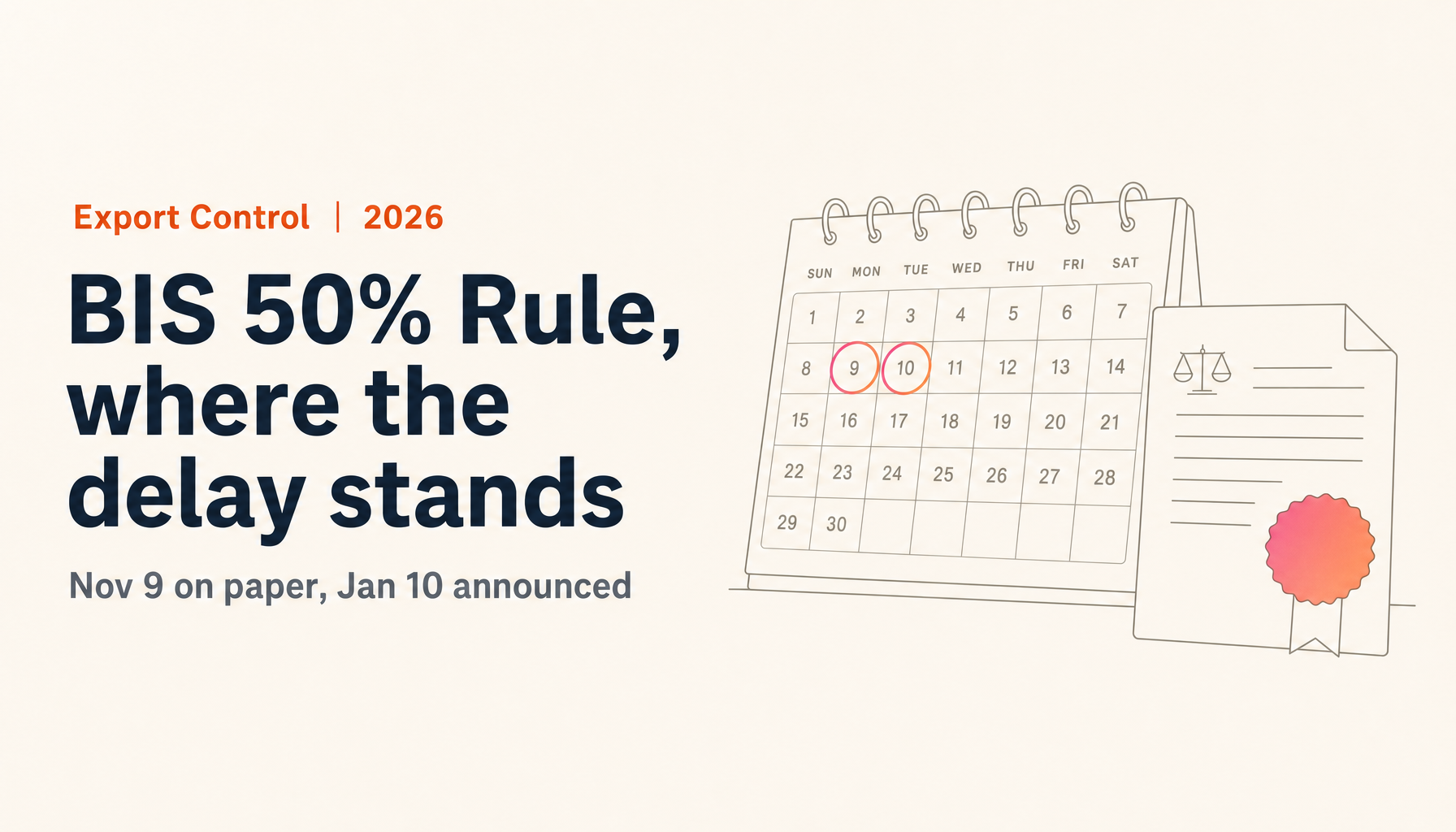
I am wary of answering with a plain yes. As of October 3, 2026, no extension has been published in the Federal Register. On paper, the stay still ends November 9, 2026, and absent further rulemaking the rule returns on November 10. That leaves about five weeks, and whether a Federal Register notice appears in that window is what decides your November.
The mechanics of the rule and the ownership math live in our complete guide to the BIS 50% Rule. This piece stays with the present: what the extension announcement does and does not change, what can happen between November 9 and January 10, 2027, and what an exporter should check now.
A readiness checklist built for either date. It covers what the rule does mechanically, where ownership data typically breaks, and a six-phase preparation list you fill in as you go, written to work whether the rule returns on schedule or the stay is extended. Listing is a regulatory designation, not a judgment of the company. → Download the BIS Affiliates Rule Readiness Checklist (free; company name and work email required)
"It was delayed" is half right: what I could confirm as of October 3
Here is what I could verify, sorted by the kind of source. Separating documents with legal force from political announcements makes the picture much easier to read.
| What | Who and when | Type of source | What it says |
|---|---|---|---|
| End of the stay | BIS, published November 12, 2025 | Federal Register (primary) | Stayed until November 9, 2026, absent a future extension1 |
| Extension rule | BIS | Federal Register (primary) | Not published as of October 3, 2026; nothing from BIS on public inspection for the October 5 issue |
| Current regulatory text | eCFR, as of October 1 | Primary | Notes such as "stayed, effective until Nov. 9, 2026" under §744.112 |
| Busan Agreement extension | Treasury Secretary Bessent, September 23 (US Eastern) | Press report | The arrangement due to end November 10 extended to January 103 |
| Kuala Lumpur arrangement extension | China's Ministry of Commerce, September 28 | Official website (primary) | Extended to January 10, 2027, with talks to continue4 |
| Summit outcome document | The White House, September 25 | Primary | No mention of an extension5 |
The US statement came from Secretary Bessent on Fox News on September 23, after talks with Chinese Vice Premier He Lifeng. NBC News quotes him: "We will extend what we call the 'Busan Agreement' ... that is going to be extended until Jan. 10." I could not find a Treasury document, so treat this one as press-reported.
On the Chinese side, the head of MOFCOM's Department of American and Oceanian Affairs explained the outcome of the talks on the ministry's website on September 28, with item 8 devoted to the extension. The original reads: 中美双方同意在将吉隆坡经贸磋商联合安排延期至2027年1月10日的基础上,继续积极探讨这一事项,旨在达成双方同意的解决方案. My translation: "The two sides agreed, on the basis of extending the Kuala Lumpur economic and trade joint arrangement to January 10, 2027, to continue actively discussing this matter, with the aim of reaching a mutually agreed solution." "Kuala Lumpur joint arrangement" is Beijing's name for what Washington calls the Busan Agreement.
Meanwhile, the White House fact sheet issued on September 25, the day after the third Trump-Xi summit in Washington, says nothing about an extension. JETRO, Japan's trade promotion agency, flagged the same omission6.
So this is how I answer internally and with customers. Not "the delay is decided," but "the US and China have announced an extension to January 10, 2027, and the US legal step, a BIS rule in the Federal Register, is still pending." And the extension is two months long. It does not withdraw the rule.
Replace siloed classification work with AI.
METI's FY2024 data shows 52% of foreign exchange law violations stem from classification errors. Download the TRAFEED product catalog covering features and rollout.
Why a trade deal can pause an export control
Why would trade negotiations stop and restart an export control rule? The history explains it.
On September 29, 2025, BIS put the Affiliates Rule into effect as an interim final rule7. It extends Entity List-style restrictions automatically to companies owned 50% or more by listed parties. An interim final rule takes effect first and collects public comments afterward, which makes it different from a final rule that has gone through notice and comment. It was published on September 30 at 90 FR 47201, with comments due October 29. Earlier versions of this article called it a "final rule"; that was inaccurate, and I have corrected it.
Ten days later, on October 9, China announced a series of new rare earth export controls. On October 30, the two leaders reached a deal in Busan, South Korea. The same day, MOFCOM announced that "the US will suspend for one year the 50% penetration rule for export controls it announced on September 29, and China will suspend for one year the relevant export control measures it announced on October 9"8. The White House fact sheet of November 1 likewise states that the US will suspend the Affiliates Rule for one year starting November 10, 20259.
BIS then released the stay rule for public inspection on November 10 and published it on November 12 (90 FR 50857), effective November 10.
A second correction. Earlier versions of this article said BIS introduced the one-year stay in response to industry complaints that the rule was too broad. The primary sources do not support that. The stay rule itself gives no reason, and the documents that place the stay in context, from the White House and from MOFCOM, both present it as part of the US-China deal. On the comments received, the stay rule says only that they "will be considered for future, subsequent rulemakings." It also says that during the stay BIS will continue to evaluate US national security and foreign policy interests related to non-listed affiliates of listed entities.
Once you see that history, the extension news reads differently. The 50% Rule is a technical control and a bargaining chip at the same time. Whether its date moves depends on how the negotiations go, not on regulatory housekeeping.
Three ways November 9 to January 10 can play out
What follows is my own reading, based on what was public on October 3.
Scenario 1: an extension is published before November 9
If the deal holds, BIS publishes a new rule changing the end date, and the stay runs to around January 10, 2027. I think this is the most likely path. But the details only become clear once the text is out. Does the stay run "until January 9" or "until January 10"? Does it still cover every amendment from the original rule? Does it come with new conditions or transition measures? You will need to read the published text before updating internal deadlines. It is also worth remembering that no US document has yet said, in terms, that the extension covers the Affiliates Rule.
Scenario 2: the Federal Register misses November 9
If no extension appears by the deadline, the 50% Rule legally comes back on November 10. The stay rule calls the stay "the first phase" and provides that in a second phase, from November 10, 2026, the suspended amendments are added back into the EAR indefinitely. How transactions in a gap would be treated if an extension were published afterward has no precedent, and as of October 3 nobody can say with confidence.
A late notice would not be unusual. The 2025 stay was agreed on October 30, and the public inspection copy appeared on the morning of November 10 (8:45 a.m. Eastern), the very day it took effect. That was late evening the same day in Japan. I would plan to watch the Federal Register right up to November 10, US time.
Scenario 3: another extension, a broader deal, or a return around January 10
Even with a published extension, the next milestone is January 10, 2027. MOFCOM's explanation expresses confidence that high-level exchanges before year-end will produce a positive solution on extending further. According to NBC, Secretary Bessent also mentioned both a larger economic package possibly being finalized by January and the current arrangement simply being prolonged. JETRO reports that both leaders intend to attend the APEC leaders' meeting in China in November and the G20 summit in the US in December.
So whether the rule returns on January 10, gets extended again, or is revised depends on talks before year-end. The stay rule's line about considering comments in future rulemakings leaves room for changes to the substance. Still, nothing public today justifies easing off preparation on the hope of a revision.
China's dates: November 10 and November 27
Watching only the US side, it is easy to miss that China's suspensions sit in at least two announcements with different end dates.
The first is MOFCOM and General Administration of Customs Announcement No. 70 of 2025 (November 7, 2025). It suspends Announcements Nos. 55 to 58 (superhard materials, certain rare earth equipment and raw materials, certain medium and heavy rare earths, lithium batteries and synthetic graphite anode materials), No. 61 (rare earth items outside China), and No. 62 (rare earth related technology), "from the date of issue until November 10, 2026"10. A MOFCOM spokesperson said at the April 9, 2026 press conference that this suspension was based on the consensus from the Kuala Lumpur talks11.
The second is MOFCOM Announcement No. 72 of 2025 (November 9, 2025). It suspends paragraph 2 of Announcement No. 46 of 2024, the provision under which dual-use items related to gallium, germanium, antimony, and superhard materials would in principle not be licensed for export to the United States, "from the date of issue until November 27, 2026"12. That date is not November 10.
MOFCOM's September 28 explanation states that the arrangement as a whole runs to January 10, 2027. But as of October 3, I could not find any new announcement extending No. 70 or No. 72, either in MOFCOM's announcement list or on the site of the bureau that handles export control. China is in the same position as the US: the deal has been announced, and the specific legal steps are still to come.
If you source rare earths, battery materials, or gallium from China, put China's November 10 and November 27 in your deadline table next to the US November 9. How the US and Chinese deadlines lined up in the first place is covered in our piece on the November 10 deadlines.
Five things exporters should check now
Here is what I would check in the roughly five weeks to November 9, in order of priority. None of it is wasted whether or not an extension is published.
1. Decide where and how often to check the Federal Register
Watch three places: the public inspection list on federalregister.gov, BIS announcements, and the notes in the eCFR. Public inspection copies usually appear a day or several days before formal publication, so you can read the text early. From November 1, have a named person check every business day. JETRO's news briefs are useful for a quick Japanese-language summary, but always confirm dates in the Federal Register text itself.
2. List every transaction that straddles November 10
That means shipments, but also technology releases and in-country transfers. List the transactions scheduled for November 10 or later whose counterparty ownership you have not yet checked. Put China- and Russia-related counterparties and sensitive items such as semiconductors and telecommunications at the top. Ownership checks take tens of minutes to several hours per company, so with hundreds of counterparties a two-step approach makes sense: finish the high-risk group by November 9 and leave the rest for an extension window if one is published.
3. Name the decision-maker and the procedure
Decide now who will choose, in Scenario 2, whether to hold or file a license for each transaction that has not been determined. If you file, BIS-748P Block 9 should say "Affiliates rule," and you need to explain the diligence performed and why ownership could not be established. Civil penalties for violations can reach USD 374,474 per violation (inflation-adjusted) or twice the transaction value, whichever is greater, and willful violations can bring up to USD 1 million and 20 years' imprisonment per violation13.
4. Record what you checked and when
Keep a note of when you looked, which document you read, and what you decided. Whether an extension appeared, and what date it set, gets fuzzy in hindsight. Store the Federal Register document number and the date you checked alongside your determination records. When a customer asks how you are preparing for the 50% Rule, that record is your answer.
5. Try it on one of your own counterparties
Running a single real counterparty shows you exactly where your ownership data runs out, which makes the workload estimate far more realistic. For a broader gap check of your export control setup, try the free export compliance self-assessment (about three minutes).
When the number of counterparties outgrows what people can check by hand, that is where TRAFEED helps. It screens counterparties against the major control and sanctions lists, investigates capital structures and affiliated networks, and records the supporting sources for each determination. AI screening accuracy of 95% or higher was confirmed in a joint validation with Okayama University (company research). TRAFEED holds Japanese Patent No. 7862062 and is used at more than 20 organizations. Final determinations stay with your export control officer, and the authorities' latest publications govern.
Key takeaways
- In September 2026 the US and China announced that the arrangement containing the 50% Rule stay will run to January 10, 2027 (the US side through the Treasury Secretary's press-reported remarks, the Chinese side on MOFCOM's website)
- In the Federal Register, the stay still ends November 9, 2026, and no extension had been published as of October 3. Absent further rulemaking, the rule returns on November 10
- A published extension adds two months. It is not a withdrawal, and what happens after January 10 depends on talks before year-end
- China's suspensions end November 10 (Announcement No. 70) and November 27 (No. 72), and no extension announcements had been found as of October 3
- Plan to November 9 and use any published extension to finish the remaining counterparties
"It was delayed" sounds like good news. From where I sit, the honest summary is that you now have two possible deadlines instead of one. Whichever turns out to be real, decide in October who makes the calls and how. Leave it until November and you will be waiting on the Federal Register while putting off every decision.
If you are not sure your current setup will make it, get in touch. We will start from how you run things today and map what you can realistically finish by November 9.
Related reading
- What Is the BIS 50% Rule? Stay Deadline, Extension Deal, and Ownership Math
- The US-China November 10 deadlines after the extension announcement
- Why Chinese ownership structures are hard to trace under the BIS 50% Rule
- Entity List, MEU List, and SDN List compared
- What is an ultimate beneficial owner (UBO)?
For an overview of features and onboarding, download the TRAFEED product catalog (PDF).
※ Listing or becoming subject to a control is a regulatory classification, not a judgment about a company. This article reflects primary government sources and press reports confirmed as of October 3, 2026. Dates and scope may change. Treat the authorities' latest publications as authoritative and route final determinations through your export control officer.
※ Revision note (October 3, 2026). Rewritten in full after the US-China extension announcement. Earlier statements that no postponement had been announced, that a "final rule" was published, and that the stay was a response to industry feedback did not match the primary sources and have been corrected. Penalty figures have also been aligned with BIS's published amounts.
Footnotes
-
BIS, "One Year Suspension of Expansion of End-User Controls for Affiliates of Certain Listed Entities," 90 FR 50857 (published November 12, 2025; FR Doc 2025-19846): "The suspension is set to end November 9, 2026, absent a future extension." https://www.govinfo.gov/content/pkg/FR-2025-11-12/pdf/2025-19846.pdf ↩
-
eCFR, 15 CFR Part 744 (as of October 1, 2026). Note under §744.11: "At 90 FR 50857, Nov. 12, 2025, in § 744.11, paragraph (a)(1) was stayed, effective until Nov. 9, 2026." https://www.ecfr.gov/current/title-15/part-744 ↩
-
NBC News, "U.S. and China agree to extend trade truce through Jan. 10, Bessent says" (September 23, 2026, 6:20 p.m. EDT). No Treasury document had been located as of October 3, 2026. https://www.nbcnews.com/business/economy/us-china-extend-trade-truce-trump-rcna599525 ↩
-
MOFCOM, "商务部美大司负责人解读第八轮中美经贸磋商成果" (September 28, 2026), item 8. Translation by the author. https://www.mofcom.gov.cn/syxwfb/art/2026/art_d9ea01824fc44fd8a29f7dc3f8ca9c72.html ↩
-
The White House, "Fact Sheet: President Donald J. Trump Advances a Fair and Reciprocal Relationship with China While Hosting Historic State Visit" (September 25, 2026). https://www.whitehouse.gov/fact-sheets/2026/09/fact-sheet-president-donald-j-trump-advances-a-fair-and-reciprocal-relationship-with-china-while-hosting-historic-state-visit/ ↩
-
JETRO Business Short News, "Trump administration releases fact sheet on third US-China summit; extension of suspended trade measures not mentioned" (September 28, 2026, Japanese). https://www.jetro.go.jp/biznews/2026/09/d7ed2778166c2d3a.html ↩
-
BIS, "Expansion of End-User Controls To Cover Affiliates of Certain Listed Entities," 90 FR 47201 (published September 30, 2025; effective September 29, 2025; FR Doc 2025-19001; interim final rule). https://www.govinfo.gov/content/pkg/FR-2025-09-30/pdf/2025-19001.pdf ↩
-
MOFCOM spokesperson, "商务部新闻发言人就中美吉隆坡经贸磋商联合安排答记者问" (October 30, 2025). Original: "美方将暂停实施其9月29日公布的出口管制50%穿透性规则一年。中方将暂停实施10月9日公布的相关出口管制等措施一年". Translation by the author. https://www.mofcom.gov.cn/syxwfb/art/2025/art_e8453c07ce374814ba65bdb6ff5813c4.html ↩
-
The White House, "Fact Sheet: President Donald J. Trump Strikes Deal on Economic and Trade Relations with China" (November 1, 2025). https://www.whitehouse.gov/fact-sheets/2025/11/fact-sheet-president-donald-j-trump-strikes-deal-on-economic-and-trade-relations-with-china/ ↩
-
MOFCOM and GACC, Announcement No. 70 of 2025 (November 7, 2025, Chinese). https://www.mofcom.gov.cn/zwgk/zcfb/art/2025/art_b1ec77dd3f0d4762952904df7cdaadec.html ↩
-
Xinhua report of the MOFCOM regular press conference (April 9, 2026), reposted on MOFCOM's export control bureau site (Chinese). https://exportcontrol.mofcom.gov.cn/article/gndt/202604/1219.html ↩
-
MOFCOM, Announcement No. 72 of 2025, adjusting implementation of Announcement No. 46 of 2024 (November 9, 2025, Chinese). https://www.mofcom.gov.cn/zwgk/zcfb/art/2025/art_5c68985a6b1a46778e2e8dbff1bb1601.html ↩
-
BIS, "Penalties," and 15 CFR §764.3 and §6.3 (civil penalty maximums are adjusted for inflation each year). https://www.bis.gov/enforcement/penalties ↩