Hello, this is Ryuta Hamamoto from TIMEWELL.
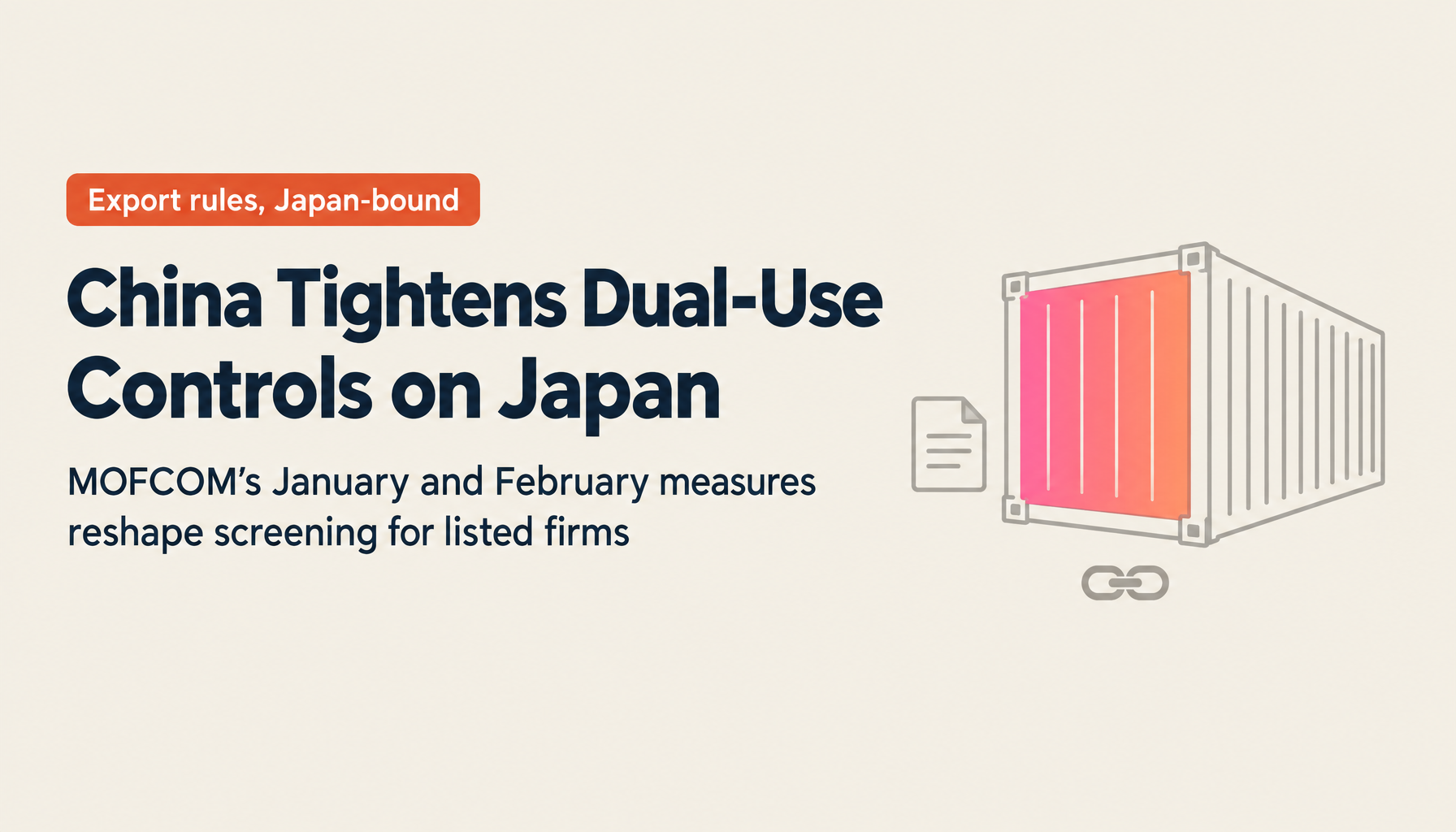
On January 6, 2026, China's Ministry of Commerce (MOFCOM) issued and immediately enforced the "Announcement on Strengthening Export Controls of Dual-Use Items to Japan" (Announcement 2026 No. 1). On February 24, Announcements No. 11 and No. 12 then placed 40 Japanese companies and institutions on the Export Control List (管控名单) and the Watch List (关注名单). List placement is a regulatory designation under Chinese law. It is not, by itself, a judgment on any company's character.
Procurement officers in defense, space, and semiconductors keep asking me what stops, when, and how far. I do not rest this piece on press interpretation. I walk the regime from the primary MOFCOM announcement texts and Japanese public-body summaries (JETRO, CISTEC).
I treat Chinese measures and Japanese security trade control (including METI FEFTA additions of 21 advanced semiconductor items) as parallel security measures. I do not adopt framings that label either side as "retaliation" or "countermeasures."
So that name-spelling variants do not stall your list check: A reference sheet listing all 80 entities on MOFCOM's Control List and Watch List in three renderings — official, Chinese, and English (covering Announcements No. 11, 12, 27 and 28). Listing is a regulatory designation, not a judgment on any company: use it to screen counterparties, or, if your own group is listed, to explain your position internally and to customers. → Download the 80-entity reference sheet (Free. Registration with your company name and work email address is required.)
What You Will Get From This Article
- Formal content and legal basis of MOFCOM Announcements 2026 No. 1, No. 11, and No. 12
- Differences among "military end user," "Control List," and "Watch List"
- How the announcements operate on end-use criteria without an item list
- Scope of the 40 listed entities and third-country reexport controls
- Symmetry with similar U.S.- and EU-bound controls (fact-based comparison)
- Five steps to check now in your own procurement and transactions
Three Terms to Learn First
Before the announcement content, three terms that are often blurred in export-control discussion. With these, press articles become much sharper.
Military End User
Organizations that conduct military activity: armed forces, defense-related government agencies, military-related enterprises. In Japan's case, the Ministry of Defense, the Self-Defense Forces, the Acquisition, Technology and Logistics Agency, and related research institutes are typical. Export control often weights "who uses it" more than "what the item is," so this concept is central.
Control List (管控名单 / Export Control List)
A list published by MOFCOM under the Dual-Use Export Control Regulations to prohibit or restrict exports to specified targets. Listing in principle stops exports of Chinese-origin dual-use items. Ongoing transactions also stop. Again, placement is a regulatory status, not a moral label.
Watch List (关注名单)
A list of targets for which simplified license forms such as general licenses and registration filing are suspended, so that every case requires an individual license application. Additional documents such as written pledges are also required. Accurate reading: not a full embargo, but a large increase in procedural burden.
| Term | Legal effect | In one line |
|---|---|---|
| Military end user | In principle, export ban under the announcement text | "Who you sell to" |
| Control List | Export ban or heavy restriction | Export largely stopped |
| Watch List | Individual license required; pledges required | Individual review |
Note that the "Unreliable Entity List" often heard in the news is a completely separate system. FAQ covers that below.
Overview of Announcement No. 1 (January 6, 2026)
First, the formal information on Announcement No. 1 as the starting point.
| Item | Content |
|---|---|
| Formal title | MOFCOM Announcement 2026 No. 1, "Announcement on Strengthening Export Controls of Dual-Use Items to Japan" |
| Issuing body | Bureau of Industry Security, Ministry of Commerce of the PRC (MOFCOM) |
| Date of publication / effective date | January 6, 2026 (effective from the date of publication; immediate) |
| Legal basis | Export Control Law of the PRC (effective December 2020) / Dual-Use Export Control Regulations (effective December 1, 2024) |
| Stated official purpose | Safeguarding national security and interests; fulfilling non-proliferation and other international obligations |
Three points.
Point 1: No Item List Attached
Unlike the December 3, 2024 U.S.-bound announcement (which explicitly named gallium, germanium, antimony, and similar items), the announcement body has no individual item list. Instead, the end-use / end-user criteria described below are used.
For exporters, that creates a state of "what is in scope is not clear in advance." In practice, every dual-use catalogue item (five-digit ECCN-like codes) must be checked case by case.
Point 2: Three Types of End-Use Criteria
The announcement defines prohibited scope in three types:
- Exports to Japanese military end users (Ministry of Defense, Self-Defense Forces, related institutions)
- Exports for military end use (design, development, production, or use of military equipment)
- Exports for other end uses or end users that may contribute to enhancing Japan's military capability
The third is a catch-all clause that can apply even to civilian firms depending on use. Japan's FEFTA and the U.S. EAR have similar catch-all controls; the concept itself is not unusual in export control.
Point 3: Official Statement That Civilian End Uses Are Unaffected
MOFCOM stated in a January 7, 2026 supplementary explanation that "civilian end uses are not affected" (Global Times reporting). Without an item list, though, exporters must still confirm end use and end user case by case. Longer lead times are hard to avoid.
Replace siloed classification work with AI.
METI's FY2024 data shows 52% of foreign exchange law violations stem from classification errors. Download the TRAFEED product catalog covering features and rollout.
Announcements No. 11 and No. 12 (February 24, 2026)
If Announcement No. 1 set the institutional framework, Announcements No. 11 and No. 12 (about seven weeks later on February 24) locked in concrete target lists.
| List | Announcement | Count | Main targets | Legal effect |
|---|---|---|---|---|
| Export Control List (管控名单) | 2026 No. 11 | 20 entities | Mitsubishi Heavy Industries group, Kawasaki Heavy Industries group, IHI group, JMU group, Fujitsu Defense, NEC Aerospace, and others | Ban on export of Chinese-origin dual-use items (ongoing transactions also stop) |
| Watch List (关注名单) | 2026 No. 12 | 20 entities | TDK, Tokin, Acquisition, Technology and Logistics Agency group, universities and research institutes, and others | Suspension of general licenses; individual applications require pledges and similar |
Examples of listed companies and institutions (partial public set). Again, these names appear as regulatory designations, not as a critique of the entities:
- Mitsubishi Shipbuilding, Mitsubishi Heavy Industries Aero Engines
- Kawasaki Heavy Industries Aerospace
- IHI Aerospace
- Japan Marine United (JMU)
- Fujitsu Defense & National Security
- National Defense Academy of Japan
- Japan Aerospace Exploration Agency (JAXA)
My current operational reading is that group companies and suppliers of listed entities can continue ordinary transactions if they are not themselves listed. Delivery paths of finished goods containing Chinese-origin controlled parts to listed entities, however, raise the reexport issues discussed below.
Industries That May Be Affected
The announcement body has no item list, but industry analysts and law firms, reading the Dual-Use Export Control Regulations annex and past U.S.-bound measures, highlight the following as practical focus areas.
Minerals and Metals
- Rare-earth elements: samarium, dysprosium, terbium, gadolinium, lutetium, yttrium, scandium
- Rare-earth magnets: neodymium magnets, samarium-cobalt magnets
- Tungsten, molybdenum, related alloys
Rare earths partially overlap the existing April 2025 export controls on seven rare-earth elements. Background is organized in China Rare Earth Export Control Map 2025–2026.
Semiconductors and Electronic Components
- High-precision sensors, lasers
- Semiconductor materials and equipment parts that may fall into dual-use
- Telemetry equipment
Aerospace and Marine
- Carbon fiber, specialty alloys
- Marine-engineering-related software
These are industry summaries outside the announcement body. Which items actually require licenses is a case-by-case determination.
Impact on Japanese Companies
I keep hearing "we have nothing to do with defense." Those companies are often the ones hit in unexpected places. Impact paths fall into four patterns.
1. Direct Import Stop
Companies that import dual-use items directly from China for military end-user end uses. This is the clearest Announcement No. 1 target.
2. Suppliers to Listed Entities
Companies that supply parts to the 40 entities on Announcements No. 11 and No. 12. If products delivered to listed entities contain Chinese-origin controlled items, the whole supply chain can stop.
3. Third-Country Reexport Routes
The announcement body expressly covers reexport or transfer of Chinese-origin dual-use items to Japanese targets via third countries. Organizations and individuals in any country or region may be held legally responsible for violations.
For example, a China-to-Vietnam-processing-to-Japan route for Chinese-origin parts also puts the Vietnamese organization within extraterritorial reach. The idea is similar to EAR reexport rules.
4. Longer Lead Times for Civilian Transactions
Even with the official statement that civilian end uses are out of scope, stronger end-use / end-user documentation is expected in practice. "Licenses that used to take two weeks now take more than a month with extra documents" is a realistic range.
Impact Estimates (Reference)
NRI (Nomura Research Institute) estimates put economic loss from rare-earth export controls at about 660 billion yen if continued for three months, and about 2.6 trillion yen if continued for one year (source: NRI Toshihiro Kiuchi column, November 28, 2025).
These are estimates under specific assumptions. Actual impact varies sharply with licensing practice and alternative-sourcing progress. When citing "up to 2.6 trillion yen," keep the assumption conditions attached so the figure does not travel alone.
Symmetry with Similar U.S.- and EU-Bound Controls
Chinese export control has also been strengthened toward the United States and the EU on a similar timeline. Fact-only comparison of formal differences:
| Item | U.S.-bound (December 3, 2024 announcement) | Japan-bound (January 6, 2026 announcement) |
|---|---|---|
| Announcement number | MOFCOM Announcement 2024 No. 46 series | MOFCOM Announcement 2026 No. 1 |
| Legal basis | Export Control Law / Dual-Use Export Control Regulations | Same |
| Targets | U.S. military users and military end uses | Japanese military users, military end uses, and other end uses / end users that may contribute to enhancing military capability |
| Items | Gallium, germanium, antimony, superhard materials, etc. explicitly named | No item list (end-use / end-user criteria only) |
| Extraterritorial reach | Yes (reexport controls) | Yes (reexport controls) |
The formal difference is that the Japan-bound measure drops the "item specificity" of the U.S.-bound measure and makes the catch-all (contribution to enhancing military capability) explicit.
Japanese security trade control (METI / FEFTA) has also moved substantially in recent years. The May 2025 amendment added 21 advanced semiconductor manufacturing equipment items and quantum-computer-related items to the license scope. That is an independent Japanese non-proliferation and security measure, operated as a separate system from China's Japan-bound measures. Whether the two are "countermeasures to each other" or "parallel security measures" depends on each company's business-environment view. I adopt the latter.
Five Practical Steps
For procurement, legal, and export-control teams, this order is realistic.
Step 1: Confirm Whether Your Company or Group Is Listed
First confirm whether your company and domestic/overseas group companies appear among the 40 entities on Announcement No. 11 (Control List) and No. 12 (Watch List). Even without a direct listing, watch name variants for group names and joint-venture names.
Step 2: Inventory Chinese-Origin Dual-Use Procurement
Screen items imported from China that may fall under the Dual-Use Export Control Regulations annex. Rare earths, specialty alloys, specific electronic components, and specific sensors are typical.
Inventory granularity should link supplier name, item name, and end use — not only HS code.
Step 3: Visualize Third-Country Routes
Even without direct China transactions, Chinese-origin items entering via third-country processing sites fall under reexport controls. Match certificates of origin at import with feedstock origin information from suppliers.
Step 4: Build End-Use / End-User Certificate Posture
Even for civilian end uses, documentation load increases. Advance supplier pledge templates, internal end-use determination flows, and organization of technical information needed for license applications.
This is a domain where AI export-control agents help efficiency. TRAFEED is aligned with METI standards and is built to support transaction-flow design that takes both Chinese and Japanese regimes into account.
Step 5: Diversify Sourcing and Consider Alternative Materials
Over the medium term, run in parallel diversification of sources (Australia, the United States, Vietnam, France, and others) and switches to alternative materials. For rare earths, rare-earth-free magnet technologies such as those from Proterial are alternative candidates.
Review inventory strategy as well. Redesign safety-stock levels assuming longer lead times.
Common Misconceptions / FAQ
Questions that come up often, in order of how easily they are misunderstood.
Q1. Will we immediately be unable to procure Chinese rare earths for civilian end use?
A. MOFCOM has officially stated that civilian end uses are not affected. Without an item list in the announcement, however, exporters must confirm end use and end user case by case. The present reading is that longer lead times are highly likely in practice.
Q2. Does Watch List placement mean we cannot procure at all?
A. It is not a full embargo. General licenses and registration filing are suspended; individual license applications are required. The main effect is higher operational load — additional documents such as pledges.
Q3. Are third-country products that incorporate Chinese-origin parts and are imported into Japan in scope?
A. The announcement covers transfer and provision of Chinese-origin dual-use items via third countries. A de minimis threshold (content share) is not explicit in Announcement No. 1, but practice under the 2024 Regulations and later announcements (e.g., the 0.1% standard in 2025 No. 61) may be referenced.
Q4. Are the "Control List" and the "Unreliable Entity List" the same thing?
A. They are separate systems. The Unreliable Entity List is a separate MOFCOM sanctions list that can trigger investment restrictions into China, trade restrictions with China, entry restrictions, and similar. The Japan-bound measures (2026 Nos. 1, 11, and 12) are export-control lists under the Dual-Use Export Control Regulations: different legal basis and effect. Media often blur them. Keep them explicit in internal materials.
Q5. Do the U.S.-bound measures temporarily suspended under a U.S.–China understanding and the Japan-bound measures move together?
A. The U.S.-bound extraterritorial rare-earth measures of October 2025 (Announcement 2025 No. 61) are suspended through November 10, 2026 following U.S.–China talks. The Japan-bound measures (2026 No. 1) are a separate matter; no suspension has been announced. The accurate present reading is that the two are separate, non-linked measures.
Q6. Is list placement permanent?
A. Under the Dual-Use Export Control Regulations, lists can be reviewed and delisting applications can be filed. Listed entities can submit explanations and delisting applications to MOFCOM under the system. Operational track record is still thin, so lead time to delisting is unclear.
Q7. How should we describe the relationship between Chinese and Japanese measures internally?
A. "Parallel security measures" is a measured expression that organizes the facts without over-claiming causation. Japan's FEFTA addition of 21 advanced semiconductor items (effective May 2025) and China's Japan-bound measures stand as systems with their own legal bases and purposes. In internal materials, avoid causal language such as "retaliation" or "countermeasures."
Latest Developments as of July 2026
The Chinese Japan-bound measures organized here have not seen major framework change as of July 2026. On the Japanese side, sourcing diversification has advanced. The 16th Japan–India annual summit on July 2, 2026 produced a joint declaration on economic-security cooperation in five fields: semiconductors, critical minerals (rare earths), clean energy, ICT, and pharmaceuticals, with investment on the order of about 2 trillion yen announced (Japan–India summit joint press release (Prime Minister's Office of Japan, July 1, 2026)). It is natural to read this as part of building alternative supply networks that reduce dependence on Chinese-origin rare earths. It can feed Step 5 of this article (sourcing diversification). Investment takes time to become actual supply, so the near-term priority remains end-use confirmation and preparation for longer lead times. See also the Japan–India summit and economic security.
Summary
If you only do one thing this week, confirm whether your company or group appears on Announcements No. 11 or No. 12, then inventory Chinese-origin dual-use procurement. The rest of the map:
- Announcement No. 1 (January 6, 2026): framework for strengthened dual-use export controls toward Japan. No item list; operated on end-use / end-user criteria
- Announcement No. 11 (February 24, 2026): 20 Japanese companies and institutions on the Control List. Export ban in principle
- Announcement No. 12 (February 24, 2026): 20 Japanese companies and institutions on the Watch List. Individual licensing; pledges required
- Third-country reexport also in scope: Chinese-origin items do not reach targets even via intermediate countries
- Civilian end uses out of scope per the official statement, but longer lead times from documentation are hard to avoid
- Similar controls also exist toward the U.S. and EU. No present confirmation that U.S.-bound and Japan-bound measures are linked
- Chinese and Japanese measures are best organized as parallel security measures
For procurement and export-control officers, list-placement confirmation and supply-chain inventory come first, then end-use / end-user certificate posture.
Related articles:
- May 2026 Update: Complete Guide to China's Export Restrictions Toward Japan
- China Rare Earth Export Control Map 2025–2026
- Basics of China's Export Control Law
- China's Extraterritorial Application: Reexport Controls and Japanese Companies
TIMEWELL's AI export-control agent TRAFEED (TRAFEED service catalog (PDF)) is METI-aligned and multilingual, and supports transaction-flow design that takes both Chinese and Japanese export-control regimes into account.
If you need to check supply-chain risk, inventory Chinese-origin procurement routes, or organize transactions involving listed entities, contact us for an individual consultation. Service details are on the TRAFEED product page.
References
Primary Sources (Chinese Government)
- MOFCOM Announcement 2026 No. 1 full text: https://www.mofcom.gov.cn/zwgk/zcfb/art/2026/art_8990fedae8fa462eb02cc9bae5034e91.html
- Same (Export License Bureau mirror): http://xkzj.mofcom.gov.cn/tzgg/art/2026/art_a775cdf7657842f691b721fd4f0490fb.html
Secondary Sources (Japanese Public Bodies and Law Firms)
- JETRO, "China Strengthens Dual-Use Export Controls Toward Japan" (January 2026): https://www.jetro.go.jp/biznews/2026/01/daa0760fd28a2226.html
- JETRO, "China Places 40 Japanese Companies and Organizations on Export Control List and Watch List" (February 2026): https://www.jetro.go.jp/biznews/2026/02/e4f19a798abdc080.html
- CISTEC flash (February 25, 2026): https://www.cistec.or.jp/service/keizai_anzenhosho/china/data/20260225.pdf
- CISTEC comparison materials with U.S.-bound measures: https://www.cistec.or.jp/service/keizai_anzenhosho/china/data/20241203.pdf
- Anderson Mori & Tomotsune China Legal Update (March 2, 2026): https://www.amt-law.com/asset/pdf/bulletins7_pdf/CPG_260302.pdf
- TMI Associates emergency commentary: https://www.tmi.gr.jp/eyes/blog/2026/18033.html
- METI, "FEFTA Security Trade Control Amendments (Critical and Emerging Items, etc.)," May 2025: https://www.meti.go.jp/policy/anpo/law_document/20250328_ristshiryou.pdf
Secondary Sources (Chinese and International)
- People's Daily English edition: https://en.people.cn/n3/2026/0107/c90000-20411016.html
- Global Times (MOFCOM statement that civilian end uses are unaffected): https://www.globaltimes.cn/page/202601/1352654.shtml
- Greenberg Traurig commentary: https://www.gtlaw.com/en/insights/2026/2/china-imposes-escalated-export-controls-on-dual-use-items-to-japan
Estimates and Impact Analysis
- NRI Toshihiro Kiuchi column (November 28, 2025): https://www.nri.com/jp/media/column/kiuchi/20251128_2.html
- JRIFE, "China's Rare-Earth Export Controls Toward Japan" (January 2026): https://jrife.or.jp/wp-content/uploads/2026/01/JRIFE20260107.pdf
![China Adds 10 US Entities to Its Control List: MOFCOM Announcement No. 23 [2026] and the "Any Country or Region" Prohibition](/images/columns/china-announcement-23-us-entities-rare-earth-2026/cover.en.png)
![China Adds 14 EU Entities to Its Export Control List: Reading MOFCOM Announcement No. 30 [2026] in the Original](/images/columns/china-mofcom-announcement-30-2026-eu-entities/cover.en.png)
![China's Reporting Regime for Strategic-Mineral Export Control Violations: MOFCOM Announcement No. 26 [2026] in the Original](/images/columns/china-export-control-whistleblower-system-2026/cover.en.png)