Hello, this is Ryuta Hamamoto from TIMEWELL. The question export-control teams ask me most often right now is: "U.S., China, and EU rules all moved at once. Where do we start?"
I assume a reader who understands Japan's Foreign Exchange and Foreign Trade Act but is new to U.S.–China–EU export controls. Below I line up the three regimes as functionally parallel systems and walk through the reality that a single transaction can require all three determinations.
What you will learn
- Why the U.S. Affiliates Rule, China MOFCOM Notices 61/62, and EU Delegated Regulation 2025/2003 are described as “simultaneous activation”
- What “extraterritorial application,” “50% rule,” and “U.S.–China dilemma” mean
- A realistic one-transaction scenario that hits all three regimes — and where the labor goes
- Why China’s 0.1% de minimis is far stricter than the U.S. 25% threshold
- Integrated screening and the problems TRAFEED (TRAFEED service catalog (PDF)) is built to solve
Three terms to understand first
Before comparing the three regimes, lock in shared vocabulary. Export-control literature treats these as obvious. First-time readers often do not.
Extraterritorial application
The idea that a country's law can reach transactions that occur outside its territory. Japan's Foreign Exchange and Foreign Trade Act primarily regulates exports from Japan. The U.S. EAR goes further, applying to foreign products that contain a threshold of U.S. content and to foreign products made with U.S. equipment. Historically, the United States has been the most aggressive user of extraterritorial export controls.
From 2025 into 2026, China also formally codified extraterritorial reach for the first time, and the EU, by expanding its item list, in practice affects many foreign transactions. The larger picture: three major economic blocs moved in the same period toward projecting rules beyond their borders.
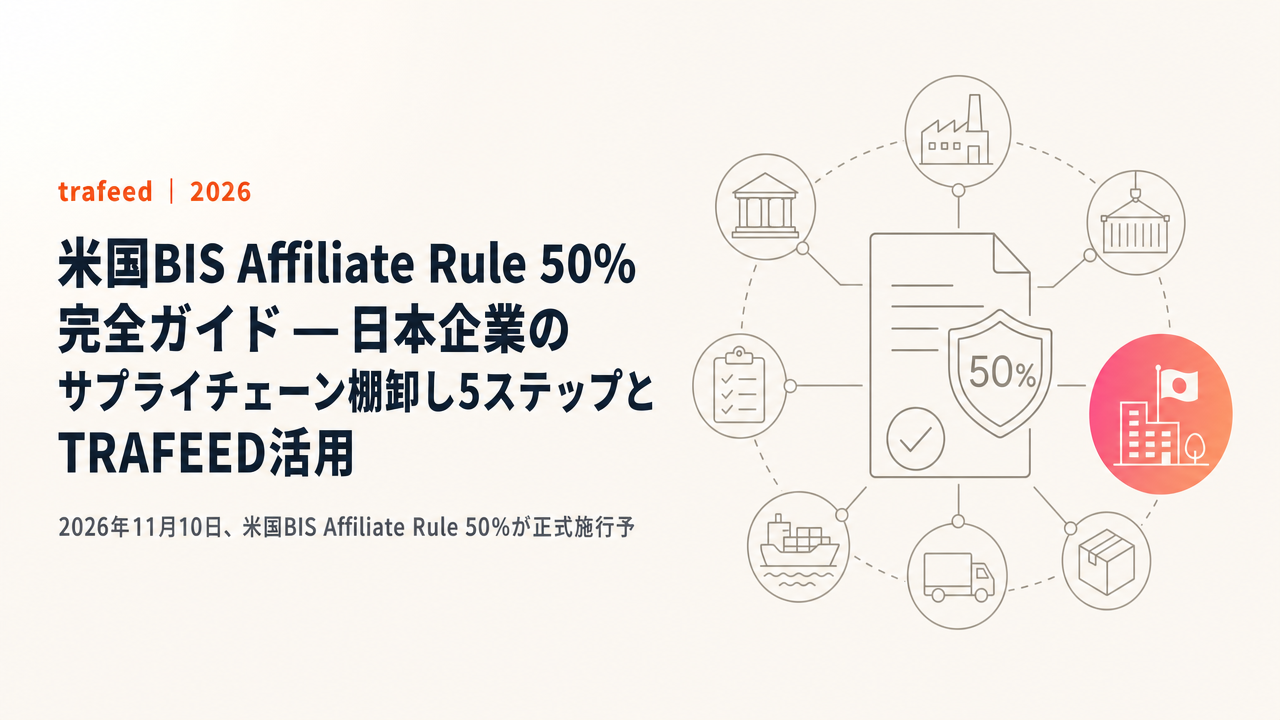
The 50% rule
A mechanism that automatically brings subsidiaries and affiliates that a listed company owns, directly or indirectly, at 50% or more under the same controls as the listed parent. Counterparties that do not appear on a list by name can still be covered if ownership is traced upstream. List placement itself is a regulatory designation, not a moral judgment on the parent or the affiliate.
OFAC long used this idea in sanctions. In September 2025, U.S. BIS imported it into export controls as the Affiliates Rule; China MOFCOM then introduced a parallel structure in Notices 61/62. OECD research has suggested that ownership-chain compliance can take three to five times the effort of legacy name screening. That is a material operational impact.
The U.S.–China dilemma
A bind in which stopping China-bound business to comply with U.S. rules may breach Chinese blocking measures (anti–foreign sanctions law and rules countering "unjustified extraterritorial jurisdiction"), and the reverse can produce U.S. end-use violations.
China's April 2026 promulgation of rules countering "unjustified extraterritorial jurisdiction" institutionalized this bind. Companies now need internal governance that assumes compliance with either side can create exposure on the other.
Structural comparison of the three regimes
View each column as three answers to the same questions; structural symmetry becomes clearer.
| Item | U.S. Affiliates Rule | China MOFCOM 61/62 | EU 2025/2003 |
|---|---|---|---|
| Authority | BIS (Commerce) | MOFCOM | European Commission |
| Published | 2025/9/29 | 2025/10/9 | 2025/11/14 |
| Effective | 2025/9/29 | 2025/11/8 | 2025/11/15 |
| Status (as of May 2026) | Suspended 2025/11/10–2026/11/9 (reapplication scheduled 2026/11/10) | Suspended 2025/11/10–2026/11/9 (reapplication scheduled 2026/11/10) | In force |
| Extraterritorial logic | 50% ownership + FDPR + de minimis (25%) | 50% ownership + extraterritorial reach + de minimis (0.1%) | Direct application of expanded item list |
| Core coverage | Entity List / MEU / SDN-related; semiconductors, AI, etc. | Rare earths, magnetic materials, cemented carbides, batteries, related tech | Quantum, semiconductor manufacturing equipment, advanced bio, materials, space |
| 50% rule | Yes (direct/indirect, aggregation) | Yes (direct/indirect) | No |
| Red-flag concept | Red Flag 29 (BIS risk signals) | Risk assessment report submission duties | Broad catch-all (license possible even for non-listed items if military end-use or end-user concerns exist) |
| Liability on violation | Strict liability (intent not required) | Administrative penalties + export privilege suspension + possible criminal penalties | Criminal and administrative penalties under member-state law |
※ Terminology notes:
- FDPR (Foreign Direct Product Rule): U.S. rules that reach foreign products made with U.S. technology or equipment
- ECCN (Export Control Classification Number): U.S. dual-use classification; the EU also uses its own 500-series ECCNs
- Red Flag 29: BIS’s 29-item checklist of transaction risk signals
- Catch-all controls: licensing requirements that can apply even when an item is not on a control list, based on end-use or end-user concerns
How extraterritorial logics differ
“Extraterritorial application” is not one technique.
- FDPR (U.S.): extends U.S. law to foreign products made with U.S. tech/equipment (finished-product basis)
- De minimis (U.S. and China): if foreign products contain above a threshold of origin-country content, origin-country law applies. U.S.: 25%. China: 0.1%
- 50% rule (U.S. and China): ownership treats entities as effectively the same company — OFAC-style logic extended to export control
- Annex I expansion (EU): neither of the above; broadens the control list itself — a classical method
The EU avoids the “extraterritorial” label, but a thicker list in quantum components and semiconductor manufacturing equipment newly pulls many Japanese company deals into licensing. Means differ; economic-security objectives converge.
Replace siloed classification work with AI.
METI's FY2024 data shows 52% of foreign exchange law violations stem from classification errors. Download the TRAFEED product catalog covering features and rollout.
Designed reapplication on the same day: November 10, 2026
Under the U.S.–China trade understanding, both the U.S. Affiliates Rule and China MOFCOM Notices 61/62 entered a one-year suspension from November 2025. Suspension end dates for both are November 10, 2026: a negotiated outcome, not a coincidence.
Absent an extension, U.S. and Chinese 50% rules reapply on the same day. EU 2025/2003 was never suspended, so after November 10, 2026 the baseline is all three regimes active.
| Period | U.S. Affiliates Rule | China MOFCOM 61/62 | EU 2025/2003 |
|---|---|---|---|
| Through 2025/9 | Not in force | Not published | Not in force |
| 2025/9/29–11/9 | In force | Under consideration | Under consideration |
| 2025/11/10–2026/11/9 | Suspended | Suspended | In force |
| 2026/11/10 onward | Reapplied | Reapplied | In force |
Suspension is not a vacation. The Affiliates Rule text was finalized in September 2025; when suspension lifts, application resumes immediately. Ownership research, systems changes, and contract rewrites take about a year. Use the suspension as preparation time.
China's 0.1% de minimis (far stricter than the U.S. 25%)
Among the three regimes, beginners most often miss China's 0.1% de minimis. Relative to the U.S. 25% threshold, the order-of-magnitude difference means the safe mental model is "almost every product is potentially covered."
What 0.1% means
MOFCOM Notices 61/62 require MOFCOM authorization to re-export foreign products that contain Chinese-origin rare earths, magnetic materials, cemented carbides, batteries, and related inputs at more than 0.1% of value.
- On a ¥10 million product, ¥10,000 of Chinese rare earth content triggers coverage
- EV-motor magnets, wind-turbine magnets, smartphone vibration motors almost certainly clear the threshold
- Unless suppliers certify in writing that Chinese rare earths are not used, the conservative call is "possible inclusion"
U.S. 25% de minimis targets products with meaningful U.S. content. China's 0.1% targets even trace inclusion. If 0.1% feels "low and easy to clear," invert that intuition.
BOM-based calculation becomes mandatory
In practice you must walk product bills of materials (BOMs) down to raw-material origin shares. The 17 rare-earth elements appear in neodymium magnets, samarium-cobalt magnets, phosphors, catalysts, specialty steels, and more. Without supplier certificates of origin, calculations do not work.
Many companies prioritize conservative "possible inclusion" calls and run license reviews over perfect precision. You are choosing either better classification logic or higher license-processing capacity, or both.
EU 2025/2003’s “expand Annex I” approach
The EU's structure differs from the U.S. and China. No 50% rule, no 0.1% rule, no formal extraterritorial codification. The EU chose the classical path of expanding the item list (Annex I).
What was added
Delegated Regulation (EU) 2025/2003 fully revises Annex I to Regulation (EU) 2021/821 (the Dual-Use Regulation). It reflects multilateral-regime updates (Wassenaar Arrangement for conventional arms-related dual-use items, Nuclear Suppliers Group, Australia Group, and others) while adding many emerging technologies on an EU-autonomous basis.
Key additions include front-end and inspection semiconductor tools plus quantum and biotech:
- Semiconductor manufacturing equipment: ALD (atomic layer deposition), lithography, EUV pellicles, reticles, SEM, etch tools
- Quantum computing: cryogenic electronics, parametric signal amplifiers, cryogenic cooling systems
- Advanced bio: high-purity peptide synthesis equipment
- Advanced materials and space: certain alloys; space-related manufacturing equipment
EU-autonomous entries receive new 500-series ECCNs. Member states continue domestic implementation work through 2026.
Why Japan is affected without formal extraterritoriality
Many teams assume "no extraterritoriality means HQ in Japan is unaffected." Impacts are still material:
- Direct Japan-to-EU exports of newly listed quantum or semiconductor manufacturing equipment require individual EU licenses
- Re-exports via EU subsidiaries or distributors also run through EU licensing
- Broad catch-all (end-use control) can require licenses for non-listed items when military end-use or end-user concerns exist
The method is classical. The covered fields sit at the center of emerging technology. More Japanese flagship products newly need licenses.
A realistic “three-regime at once” scenario for Japanese companies
Apply all three to one deal. Consider a typical chain: Japanese Company A to U.S. subsidiary B to EU subsidiary C to Chinese customer D.
Assumptions: A manufactures semiconductor inspection equipment. U.S. control boards are 15% of content. EU 2025/2003 Annex I covers the EUV-pellicle inspection unit. End user is independent Chinese foundry D.
| Step | Applicable rules | What the owner must check |
|---|---|---|
| ① A→B (Japan→U.S. sub) | Japan FEFTA / U.S. EAR | Below 25% de minimis → not direct EAR content capture; Japan-side list + catch-all review still required |
| ② B→C (U.S.→EU sub) | U.S. EAR / EU 2025/2003 | U.S. re-export is EAR-covered; after EU receipt, intra-EU moves and third-country re-exports engage 2025/2003 |
| ③ C→D (EU→Chinese customer D) | EU / U.S. Affiliates / China | EU individual license under 2025/2003. If D is a 50% affiliate of an Entity List entity, U.S. permission may be required (from 2026/11). If D is a 50% affiliate of a China-listed controlled entity, China’s 50% rule can also fire on re-export |
| ④ Use at D | China EUC / catch-all | Military end-use concerns can trigger catch-all under EU, U.S., and Japanese law |
Takeaway: even a simple Japan-to-U.S.-to-EU-to-China four-hop chain creates at least six regulatory layers (Japan FEFTA, EAR, EU 2025/2003, Affiliates Rule, China MOFCOM, China list controls). Approving one deal requires "not controlled" or "licensed" under each.
Name screening alone cannot do this. You need parallel ownership tracing, content-ratio calculation, and Annex I technical classification on the same transaction data.
The U.S.–China dilemma as an institutionalized problem
Simultaneous activation is not only "more rules." It is rules that can contradict each other.
Chinese blocking measures
In April 2026 China promulgated rules countering "unjustified extraterritorial jurisdiction." They create a basis for Chinese countermeasures against foreign companies that stop dealing with Chinese entities because of foreign export controls.
A plausible sequence:
- A Japanese company stops business with a Chinese entity that is a 50% affiliate of a U.S. Entity List company under the Affiliates Rule
- Chinese authorities may treat that as following "unjustified extraterritorial jurisdiction"
- Risk of designation under Chinese countermeasures (including listing under Chinese unreliable-entity or related regimes) or measures against China-based assets. Such listing is a regulatory designation, not a moral judgment.
Continuing the deal to respect Chinese blocking measures can create U.S. end-use violations.
Governance that "handles both"
The realistic answer is written internal policy that prioritizes which regime governs which business line, not ad-hoc field decisions.
- Semiconductors / AI: prioritize U.S. rules (license or shrink trade as options)
- Rare earths / materials: prioritize Chinese procedures carefully
- Quantum / advanced materials: build from EU rules outward
Frame this as business-continuity risk allocation, not political signaling.
Why integrated screening is required
By now, most readers conclude that name screening alone cannot run this. U.S. BIS itself states in FAQs that Consolidated Screening List (CSL) checks are insufficient.
Integrated-screening requirements
| Function | Legacy setup | Three-regime setup |
|---|---|---|
| List matching | U.S. EL/MEU/SDN-centric | Cross-match all U.S.–China–EU lists |
| Ownership tracing | Direct counterparty only | Direct and indirect 50% ownership chains |
| Content-ratio calc | U.S. 25% only | U.S. 25% + China 0.1% in parallel |
| Item classification | Domestic list only | EU Annex I + U.S. CCL + Chinese controlled items in parallel |
| Decision history | Spreadsheets | Tamper-resistant logs, audit-ready |
Where AI helps, and where it does not
Strengths:
- Ownership discovery across large end-user candidate sets
- Summarizing risk signals from multilingual news (Chinese, Russian, Arabic, etc.)
- Generating match candidates against Annex I and Chinese lists
- Automatic decision logging
Weaknesses:
- Final ECCN classification judgment
- Resolving residual doubt after Red Flags fire
- Extracting technical requirements from specs and comparing them to control thresholds
Humans must still approve. Best practice: AI for candidate generation, first-pass determination, and logging; humans for final approval.
Five steps during the suspension window
Preparation through November 9, 2026. If I had to pick one step, start with transaction inventory.
Step 1: Inventory transaction data
Aggregate 2–3 years of export deals with (a) destination, (b) counterparty, (c) product category, (d) U.S. content ratio, (e) Chinese rare-earth presence. Which of the three regimes fires is a function of these five fields.
Step 2: Visualize ownership
Trace major counterparties at least to direct owners. Capital structures change quarterly. Bake periodic re-screening into contracts.
Step 3: Build BOM data
Maintain product BOMs and collect raw-material certificates of origin. China's 0.1% analysis cannot start without BOMs.
Step 4: Redesign determination flows
Systematize: name match, ownership trace, content ratios, item classification, license need. Spreadsheets hit a wall after November 2026.
Step 5: Codify U.S.–China dilemma policy
Write business-line priority rules and secure executive approval. Do not leave this to field judgment case by case.
Common misconceptions / FAQ
Q1. Why prepare during suspension? A. Reapplication on November 10, 2026 is already announced. Ownership research, systems work, and contract rewrites take roughly a year.
Q2. If EU 2025/2003 has no extraterritoriality, does HQ in Japan care? A. Direct Japan-to-EU exports of newly listed quantum or semiconductor manufacturing equipment still need EU individual licenses. Re-exports via EU subsidiaries/distributors likewise.
Q3. Could U.S.–China talks extend the suspension again? A. Politically possible. Planning on extension is not rational. Affiliates Rule text was already in force once (September 2025) and remains finalized.
Q4. Is China’s 0.1% rule actually calculable? A. You need BOM-based value conversion for rare earths and magnetic materials, plus supplier certificates of origin. Perfect precision is hard; many firms operate with conservative “possible inclusion” calls.
Q5. Do small Japanese companies need this? A. If you supply large trading houses, overseas subsidiaries, or EMS providers, upstream partners will demand compliance evidence. You need to respond as a supply-chain participant even if you are not the exporter of record.
Q6. What if neither side can be fully satisfied? A. Codify business-line priorities with executive approval. Do not leave each case to the field.
Latest developments as of July 2026
Beyond the three regimes themselves, Japan-side supply-chain responses are moving. The Japan–India summit (Prime Minister’s Office, July 2, 2026) produced a joint economic-security declaration covering semiconductors, critical minerals (rare earths), clean energy, ICT (subsea cables), and pharmaceuticals, with roughly ¥2 trillion in investment framed. Read against China’s 0.1% de minimis on rare earths, this is the other side of the same coin as three-regime compliance. Whether diversified sourcing actually cuts determination workload remains a projection for now. Integrated screening capacity remains necessary. See also Japan–India summit and economic security.
Key takeaways
If you only do one thing before November 10, 2026, inventory two to three years of export deals against the five fields in Step 1. The rest of the map:
- U.S. Affiliates Rule, China MOFCOM 61/62, and EU 2025/2003 took shape in the same period as functionally parallel systems
- U.S. and China are designed to reapply on the same day: November 10, 2026. The EU never paused
- Master "extraterritorial application," "50% rule," and "U.S.–China dilemma" and you understand roughly 80% of the structure
- One deal can require six regulatory layers in parallel. Name screening is not enough
- Urgent need: systemize integrated screening, ownership tracing, and content-ratio calculation
- Best practice: AI for first pass; humans for final approval
Further reading
- Complete guide to the BIS Affiliates Rule (50% rule)
- China rare-earth export controls 2025–2026 map
- EU Dual-Use Regulation 2025/2003 overview
- MATCH Act: U.S.–China semiconductor calendar and Japan impact
If three-regime compliance worries you
The essence is running list matches, ownership chains, content ratios, and item classifications for the U.S., China, and EU in parallel on the same transaction data. Spreadsheets and multi-vendor patchworks are already past their capacity.
TRAFEED provides U.S.–China–EU integrated list screening, automated ownership tracing, and per-deal decision history in one interface, backed by a knowledge graph of over 200 million papers, patents, researchers, companies, and regulatory lists. It runs on AWS Tokyo-region servers in Japan for sensitive data.
Explore TRAFEED features Book a 30-minute consultation
References
U.S. BIS Affiliates Rule
- Federal Register: Expansion of End-User Controls To Cover Affiliates of Certain Listed Entities (2025/09/30)
- BIS Press Release: Department of Commerce Expands Entity List to Cover Affiliates of Listed Entities
- JETRO: BIS FAQ on Affiliates Rule (2025/10)
- JETRO: Affiliates Rule suspended under U.S.–China understanding (2025/11)
China MOFCOM Notices 61 and 62
- CSET (Georgetown): Translation of MOFCOM Notice 2025 No. 61
- JETRO: China announces U.S.–China understanding; pauses export-control measures for one year (2025/10)
- JETRO: China lists 40 Japanese companies and organizations on export-control and watch lists (2026/02)
EU Delegated Regulation 2025/2003
- EUR-Lex: Commission Delegated Regulation (EU) 2025/2003
- EPRS: Dual-use export controls as tools of EU economic security (2025)
- JETRO: EU trade control system
Japan-side context
- METI: Catch-all export control revisions (effective 2025/10)
- METI: FEFTA amendments on critical and emerging items
- JETRO: Geopolitical risk and economic security portal
Law-firm analysis
- White & Case: China imposes extraterritorial jurisdiction and a 50% Rule
- Jones Day: BIS Suspends Affiliates Rule, China Pauses Rare Earth Export Controls
- Morrison Foerster: US-China Trade Agreement: Takeaways for Export and Supply Chain Controls
- Cooley: EU Issues 2025 Update to Dual-Use Control List