This is Ryuta Hamamoto from TIMEWELL.
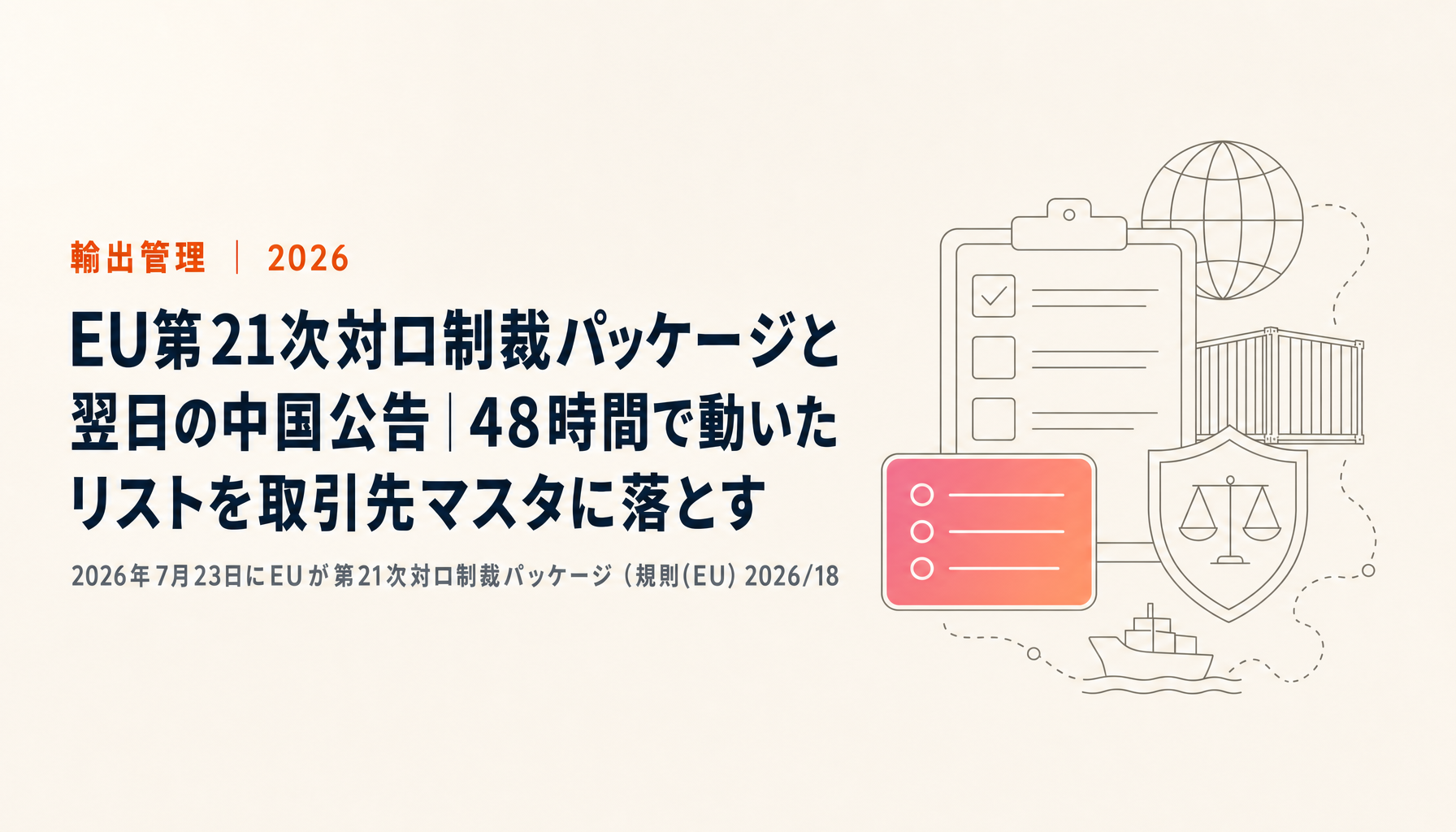
On 23 July 2026 the EU adopted its 21st package of sanctions against Russia. Council Regulation (EU) 2026/1848 was published in the Official Journal the same day and, under Article 2, entered into force the following day, 24 July1. On that same 24 July, at 16:00 China time, China's Ministry of Commerce published Announcement No. 30 [2026], placing 14 entities from eight EU member states on its export control list2. Within 48 hours, lists moved on both sides.
One caveat before anything else. The text of Announcement No. 30 contains no reference to the EU package. The only rationale given is safeguarding national security and interests and fulfilling international obligations such as non-proliferation. So I will not assert that this is a countermeasure. What the originals support is the sequence — the Chinese announcement came the day after EU adoption — and the fact that the same sequence occurred in April.
What I want to work through here is narrower: how you get those 48 hours of list changes into your counterparty master and item master on Monday morning. Read the EU text closely and one thing becomes obvious. These additions were not built on the assumption that you would match them by name. That, to me, is the operational heart of it.
To run five list systems through one procedure: We publish a screening procedure covering five systems — US OFAC/BIS, the EU, the UK, the UN, and Japan's End User List. Each system updates at a different cadence and writes identifiers differently, so the sheet sets out what you check at what frequency, and who decides what when you get a hit. The EU identifiers this article touches on (TRN, BRN, TIN, OGRN and the rest) are handled inside the same procedure. → Download the Five Sanctions-List Systems Screening Procedure (Free. Your company name and work email are required.)
Fixing the sequence first
| Date | What happened | Primary source |
|---|---|---|
| 23 April 2026 | EU adopts the 20th package (Regulation (EU) 2026/506) | Footnote to the 21st package regulation1; European Commission (DG FISMA) timeline3 |
| 24 April 2026, 16:00 | MOFCOM Announcement No. 20 [2026]. Seven EU entities added to the control list | MOFCOM original4 |
| 23 July 2026 | EU adopts and publishes the 21st package (Regulation (EU) 2026/1848) | EUR-Lex original1 |
| 24 July 2026 | The regulation enters into force (Article 2: day after publication) | EUR-Lex original1 |
| 24 July 2026, 16:00 | MOFCOM Announcement No. 30 [2026]. Fourteen EU entities added to the control list | MOFCOM original2 |
The label "21st package" comes from the European Commission's own page (DG FISMA), which records the 23 July measures as the Twenty-first package3. I was not able to retrieve the Council or Commission press releases, so this article contains no quotations from officials or statements. Everything below comes from the articles and annexes of the regulation and from the text of the Chinese announcement.
Annex IV is not an asset-freeze list
Start with the legal effect. Annex IV, which gained 51 entities, is the list referred to in Articles 2(7), 2a(7) and 2b(1) of Regulation (EU) No 833/2014, and the consequence of being listed is an export prohibition, not an asset freeze. Article 2b(1) prohibits selling, supplying, transferring or exporting, directly or indirectly, dual-use goods and technology as well as goods and technology listed in Annex VII, whether or not originating in the Union, to anyone listed in Annex IV5.
Article 2b(1a) is the part that gets missed. The prohibition is not limited to shipments of goods. Technical assistance, brokering and other services; funding and financial assistance; and the licensing, transfer or granting of access to intellectual property rights and trade secrets all fall inside the same perimeter. Equipment sales have stopped but a software licence and maintenance contract continues; drawings and technical guidance still flow. If those arrangements sit outside your transaction register because "they are not sales," that is where to look first. The derogations in Article 2b(1b) are narrow: what is necessary for the urgent prevention or mitigation of an event likely to have a serious and significant impact on human health and safety or the environment, and contracts concluded before 26 February 2022 (with the authorisation request itself required before 1 May 2022)5.
Note also that the EU's published Consolidated list is the list of individuals, groups and organisations subject to EU financial sanctions — a separate instrument from export-prohibition lists such as Annex IV to 833/20146. For the Ukraine-related asset freeze, the operative regulation is Regulation (EU) No 269/2014, whose Article 2 freezes the funds and economic resources of persons listed in its own Annex I7. When a vendor tells you it ingests "the EU sanctions list," ask which one: the asset-freeze side, or the export-prohibition side. I still see screening run on the wrong one. For how the various lists differ in purpose and effect, see our complete guide to sanctions lists and the comparison of the Entity List, MEU List and SDN List.
And here is the caveat that governs the whole article. It is not my editorial softening; it is what the EU legislation says.
The chapeau to Annex IV states that the annex lists military end-users, entities forming part of Russia's military and industrial complex, and entities with commercial or other links to, or otherwise supporting, Russia's defence and security sector. That is a general criterion for the list as a whole; which limb any given entry falls under is not stated. The chapeau then closes with this:
Their inclusion in this Annex does not entail any attribution of responsibility for their actions to the jurisdiction in which they are operating.5
A listing is a regulatory designation. It is not a judgment about the listed company, nor about the country where that company operates. Annex IV also has no grounds column, so the regulation does not state a case-by-case basis for any individual entry — a contrast with the asset-freeze side, where Article 3(2) of Regulation (EU) No 269/2014 requires the grounds for listing to be included in its Annex I7. Accordingly, I name companies below only where a name is needed to illustrate a matching problem, and I make no claims about what any individual entity did.
Where the 51 additions sit, and the circumvention areas the EU named
Recital (5) records that the corresponding CFSP decision adds 51 entities to Annex IV. The additions are entry numbers 922 through 972, and existing entry 581 was replaced. The pre-amendment consolidated Annex IV ran from 1 to 921 with no gaps, so the post-amendment total is 972 entries15.
Classifying each new entry by the address field gives the following (my own count from the original text).
| Location | Entries |
|---|---|
| Russia | 24 |
| Mainland China | 10 |
| Hong Kong | 4 |
| Türkiye | 4 |
| Kyrgyzstan | 3 |
| India | 2 |
| UAE | 2 |
| Kazakhstan | 2 |
Twenty-seven of the 51 sit in third countries other than Russia — a majority. The EU explains its rationale for adding third-country entities in Recital (5): entities in third countries other than Russia that indirectly contribute to Russia's military and technological enhancement, thereby enabling the circumvention of Union restrictive measures or frustrating their purpose, including Union restrictive measures on microelectronics, computer numerical controlled (CNC) machine tools and equipment for semiconductor processing1. Those three named areas are the primary basis for the item-level red flags further down.
I cannot give a reliable jurisdiction split for all 972 entries, because some entries carry addresses in more than one country. The only counts I quote are for the 51 additions, which I was able to count exactly.
Replace siloed classification work with AI.
METI's FY2024 data shows 52% of foreign exchange law violations stem from classification errors. Download the TRAFEED product catalog covering features and rollout.
Name matching will miss. Switch to identifiers
This is the practical core. Every one of the 51 additions carries a registration number1. The supporting metadata is dense too: of the 51, 42 carry a local-language name, 33 a telephone number, 33 a website, 28 an email address and 24 an a.k.a. In other words, the EU built this list on the assumption that names alone will not match.
The labels on those identifiers, however, are anything but uniform. Counting from the original: all 24 Russian entries carry an INN — the taxpayer number that other entries in the annex spell out as "Tax ID/INN" — and three of them also carry an OGRN. Of the 10 mainland China entries, nine are labelled USCC (unified social credit code) and exactly one is labelled USSC. All four Hong Kong entries carry both a BRN and a TRN. The three Kyrgyz entries use a TIN and the two Kazakh entries a BIN. India's entry 956 shows "AAJ-2354 (Trade Register Number)" and 969 shows "33AAAFF7255L1ZC (GST No)"; in the UAE, 962 shows a TRN and 965 "4203387.01 (License No.)"1.
The four Turkish entries were the awkward ones. Entry 970 pairs "26722 (Trade Register Number)" with a TIN. Entry 971 reads "985592 (trade register number (Istanbul Merkez))" — lower case, with the registry office nested in a second set of brackets. Entries 926 and 937 give bare numbers, "145225-5" and "411319-5", with no label at all1. None of these abbreviations, incidentally, is defined anywhere in the regulation or its annexes. The reader is left to infer them.
Nor is the inconsistency new. Go back through the 921 pre-amendment entries and the Chinese unified social credit code appears as "USCC," "UNCC," "China Unified Social Credit Code" and "China, Unified Social Credit Code" — four spellings, to which this package adds "USSC." The Russian INN appears as "Tax ID/INN" 622 times and as "INN" 46 times. Hong Kong company registration numbers appear as "CR No.," "CRN," "CR number," "CR no" and "CR. No."5 Any implementation that trusts the label string as the identifier type will eventually miss.
Two entries made me stop while reading the original. (I name them to illustrate a matching problem; nothing here is a judgment about what either entity did.)
Same address, same phone number, same website — two separate entries. Entry 950, "AAA China Limited," lists "Shenzhen Wanma International Freight Forwarding Co., Ltd." as an a.k.a. and carries registration number 91440300570016397Q (USCC). Entry 951, "Shenzhen Wanma International Freight Forwarding Co., Ltd.," lists "AAA China Limited" as an a.k.a. and carries registration number 91440300MA5GJRFX36 (USCC). The address (Room 1201, Baihuo Plaza West Building, No. 3020 Shennan Road E, 518001 Shenzhen), the phone number (+86 755 82192157) and the website are identical. The registration numbers are not, and the two are listed independently1. Deduplicate by name — "same company, so one record" — and one of those registration numbers drops out of your master.
Romanisation variance is baked into the official list. Entry 955, "Suzhou Goodwill Machinery Equipment Co. Ltd.," carries the a.k.a. entries "Suzhou Gedewei Machinery Equipment Co., Ltd." and "Suzhou Godeway Machinery Equipment Co. Ltd.," with the local-language name 苏州歌得维机械设备有限公司. Goodwill, Gedewei and Godeway all map to the same Chinese name. Entry 946, "Chongqing Giaero Electrical Co. Ltd," carries the a.k.a. "Chongqing Guihang Electrical Appliance Co., Ltd" and the local name 重庆贵航电器有限公司 — Giaero and Guihang are the same company name. And 946 is the entry labelled "(USSC)" mentioned above, whose value (91500107345943637F) is in the standard 18-character unified social credit code format1. The spelling inconsistencies are not only on the side being screened; they are in the official list.
The matching procedure that follows from this is not complicated.
- Take the delta on entry number plus registration number. Names change; registration identifiers rarely do. If your counterparty master has no column for jurisdiction-specific registration numbers — USCC for China, INN for Russia, GST for India — build that column first. It is the single highest-yield change.
- Ingest a.k.a. and local-language names as independent keys. Search only the primary name and you will not find the purchase order raised as "Gedewei" or "Godeway." The same goes for matching on Chinese-character names.
- Do not collapse entries. Where the EU lists two records, as with 950 and 951, keep two.
- Add address, phone, website and email as matching keys. In practice you do get hits where neither the name nor the number matches but the phone number does.
- Normalise label variance. An implementation that treats USCC, USSC, UNCC and "China Unified Social Credit Code" as different identifier types will miss entries like 946. Normalise on the value format instead — 18 characters for a unified social credit code. And make sure bare numbers with no label, as in 926 and 937, do not fall out of an ingestion routine that expects one.
The underlying discipline is covered in end-user screening and customer due diligence and our guide to vetting export counterparties. What this package adds is one step: hold the identifiers.
Designing item-level red flags by channel function
The three areas named in Recital (5) map closely onto the regulation's common high priority items (Annex XL). Annex XL comprises 50 CN codes; representative entries include the following5.
| CN code | Description in the original |
|---|---|
| 8457 10 | Machining centres for working metal |
| 8458 11 / 8458 91 / 8459 61 | Numerically controlled lathes and milling machines |
| 8466 93 | Parts and accessories for machine tools |
| 8486 10 / 8486 20 / 8486 40 | Machines and apparatus for manufacturing semiconductor devices and integrated circuits |
| 8542 31 to 8542 39 | Electronic integrated circuits |
| 8482 10 | Ball bearings |
| 9030 20 / 9030 82 | Oscilloscopes; instruments for measuring semiconductor wafers or devices |
A word from the position of the companies affected. This line-drawing does not mean the items themselves are problematic. Ball bearings under 8482 10 are a general-purpose component in every rotating machine. Annex XLVIII, which only Article 12gb refers to, contains just two codes — 8502 20 (generating sets with spark-ignition internal combustion piston engines) and 8536 50 (other switches) — and both are commodity products5. When a regime draws its line across broad categories, legitimate civilian manufacturers end up inside the verification perimeter. Do not read a listing, or the fact that an item became controlled, as a finding of fault against that company or product. How you frame this matters for the day your own company is on the inside of someone else's category.
With that established, I design red flags by channel function rather than by company. Labelling a given firm a diversion hub has no evidentiary basis and does not help operationally. Instead, decide which function in your own route to market needs an additional record.
- Freight forwarders and customs agents: changes of destination, a mismatch between the ultimate consignee on the bill of lading and the contractual end user, added transit points. This is where record-keeping starts.
- Distributors and dealers: orders where the end-user field is blank or names the distributor itself. For Annex XL items, do not ship until that field is filled.
- Spare parts and after-sales service: machine shipments have stopped but replacement spindles or control boards keep moving. CN 8466 93, parts and accessories for machine tools, is explicitly in Annex XL.
- Software, technical support and licensing: Article 2b(1a) covers the licensing, transfer and granting of access to intellectual property rights and trade secrets. Stopping physical shipments does not settle a live licence agreement; that needs its own assessment.
- Retrofits and upgrade projects: replacing the numerical control unit on an installed machine may be booked as "service," but in substance the item can fall within Annex XL.
For the general logic, see our primer on catch-all controls; for how component diversion to Russia is actually assembled, see export control and component diversion.
What European subsidiaries owe directly: Articles 12g and 12gb
EU regulations tend to read as somebody else's problem. Two articles land directly on the European subsidiaries of Japanese groups — and note that Articles 12g, 12ga and 12gb were not amended by this package. The existing obligations simply continue1.
Article 12g, the No-Russia clause. When selling, supplying, transferring or exporting to a third country other than the partner countries listed in Annex VIII, goods or technology listed in Annexes XI, XX and XXXV, common high priority items listed in Annex XL, or firearms and ammunition listed in Annex I to Regulation (EU) No 258/2012, exporters must — as of 20 March 2024 — contractually prohibit re-exportation to Russia and re-exportation for use in Russia. Paragraph (3) requires adequate remedies for breach; paragraph (4) requires notification to the competent authority once the exporter becomes aware that the counterparty has breached the clause8.
Annex VIII lists eleven jurisdictions: the United States, Japan, the United Kingdom, South Korea, Australia, Canada, New Zealand, Norway, Switzerland, Liechtenstein and Iceland5. So EU exports to Japan sit outside the contractual requirement. That is worth knowing precisely: when an EU counterparty asks to insert a No-Russia clause, you can tell whether the request is a statutory obligation or a commercial practice.
Article 12g(2) surprised me on a close read. Point (a) provides that paragraph (1) shall not apply to the execution of contracts relating to five CNC machine tool codes (8457 10, 8458 11, 8458 91, 8459 61, 8466 93) — and point (a) carries no end date. Point (b), covering contracts concluded before 19 December 2023, is expressly limited to 1 January 2025 or the contract's expiry, whichever is earlier. Point (a) has no such limit. I confirmed the same wording in both the amending act, Regulation (EU) 2024/1745, and the consolidated text8. What I could not obtain is any Commission FAQ or guidance explaining why. So if you intend to rely on that exclusion for a CNC machine tool contract, do not run on the bare wording — confirm it with your competent authority or against Commission guidance.
Article 12gb. Operators dealing in Annex XL or Annex XLVIII goods must (a) take appropriate steps, proportionate to their nature and size, to identify and assess the risks of exportation to Russia and for use in Russia, and ensure those risk assessments are documented and kept up to date; and (b) implement appropriate policies, controls and procedures to mitigate and manage those risks. Application began on 26 December 2024 for Annex XL and 26 May 2025 for Annex XLVIII. Paragraph (3) then requires operators to ensure that any legal person established outside the Union that they own or control, and that sells, supplies, transfers or exports Annex XL or Annex XLVIII goods, implements requirements (a) and (b) as well — on the same commencement dates. Transactions solely within the EU or to Annex VIII partner countries are out of scope. Paragraph (4) does provide an escape: paragraph (3) does not apply where, for reasons it did not cause itself, the operator cannot exercise control over an entity it owns. That is an argument you would have to evidence, though, not one to plan around5.
Depending on group structure, paragraph (3) generates work back at the Japanese parent. The European entity is the addressee, and the chain can extend to sales companies in Asia or the Middle East that the European entity controls. "Documented and kept up to date" is also where audits find the weakest ground. A single risk-assessment spreadsheet last dated three years ago is a genuinely common state of affairs.
Other annexes that moved
The 21st package also inserted new items into Annex VII, the list of goods and technology controlled alongside dual-use items. The notable feature is that the new entries draw their lines on technical criteria rather than product names: radio-frequency equipment and related items for taking over, jamming or exploiting the protocols of UAVs (X.A.III.101 j); self-adhesive sheets, films and tapes with a maximum operating temperature above 413.15 K (140°C) and a minimum operating temperature below 233.15 K (−40°C) and, under ASTM E595 or equivalent standards, TML of 1.0% or less and CVCM of 0.10% or less (X.C.IX.018); nickel powders, metal and alloys of 50% or more nickel by weight (X.C.IX.019); beryllium powders of 50% or more beryllium by weight (X.C.IX.020); and servomotors with a torque-to-weight ratio of 0.16 or above, UAV launch systems, UAV ground support equipment, flight termination systems and related software (X.A.VII.004 to 007 and X.D.VII.003)1. Recital (6) describes the applications: corrosion-resistant coatings in jet engines, propellants and high-performance alloys, aerospace and defence uses for the adhesive films, aviation items specific to UAVs, and flight termination systems for UAVs or missiles1.
Read that as an affected party as well. "Nickel powder of 50% or more by weight" and "adhesive tape with TML of 1.0% or less" are broad categories defined purely by specification. A powder-metallurgy producer or an adhesives manufacturer may well be shipping through a European entity without recognising that its standard product can fall inside them. If your classification records exist only at the product-catalogue level, technical-criteria entries like these are exactly where you get caught out. For how the EU control list is structured, see our primer on Dual-Use Regulation (EU) 2021/821 and the overview of the 2025 control list update.
The rest, in brief1. On the import side, Annex XXI gained copper, nickel, lead and precious-metal ores; zinc oxide and peroxide; chromium oxides and hydroxides; tall oil; fifteen glass headings in the 7001–7020 range (including 7013 table and kitchen glassware and 7009 mirrors); unwrought zinc; and vehicle bodies and motor vehicle parts. On the financial side, Annex XIV gained 33 Russian banks (applying from 13 August 2026); on shipping, Annex XLII gained 41 vessels (entries 652 to 692, from 24 July 2026). Annex XLVII gained two entries in Part A, the ports and locks list — Olya and Vysotsk — and four in Part B, the airports list: Sheremetyevo, Ulyanovsk-Vostochny, Rostov-on-Don Platov and Mineralnye Vody, all applying from 24 July 2026. A new Part D for refineries lists one refinery in Georgia (applying from 25 January 2027). If you move parts by air, look at those airport entries before anything else.
On energy there is a change that touches Japan directly1. Annex XXIX was replaced. In Part A, the exemption for transport by vessel to Japan of Sakhalin-2 crude oil commingled with condensate (CN 2709 00) now runs to 31 March 2028; Recital (10) attributes the extension to energy security concerns. A new Part B of the same annex adds an exemption for transport by vessel of Sakhalin-2 LNG (CN 2711 11 00) to Japan and to South Korea, from 24 July 2026 to 31 March 2028. Since Article 3ra(1) prohibits the purchase, import or transfer of LNG originating in or exported from Russia as of 25 April 2026, the new Article 3ra(5) carves out transport for those destinations only. Whether the Japanese government issued anything in response to this package is something I did not verify, so I make no claim about how it was received in Tokyo.
One drafting point is worth filing away. The new Article 5bc creates a framework for prohibiting transactions with crypto-asset service providers by country, but the corresponding Annex LVII currently contains no country names1. An empty annex is not a reason to disregard the article. A framework placed ahead of its list is a slot that a later amendment can fill.
Reading MOFCOM Announcement No. 30 alongside it
Now the Chinese announcement of the same 24 July. It was issued by MOFCOM's Bureau of Industry Security and Import and Export Control (安全与管制局), cites the Export Control Law of the People's Republic of China and the Regulations on Export Control of Dual-Use Items, and states its purpose as safeguarding national security and interests and fulfilling international obligations such as non-proliferation. It takes effect on the date of publication — immediately2.
There are two measures. The first prohibits export operators from exporting dual-use items to the 14 listed entities and, separately, prohibits organisations and individuals outside China from transferring or providing dual-use items originating in China to those 14 entities, with ongoing related activity to stop immediately. The second allows export operators to apply to MOFCOM where an export is genuinely necessary in special circumstances2.
The second half of the first measure is what reaches Japanese companies. The addressees are not limited to exporters inside China; they include organisations and individuals outside it. The test is therefore not your own nationality but two other questions: is the item Chinese-origin and dual-use, and is the counterparty a listed entity. We work through that extraterritorial structure in the extraterritorial reach of China's Export Control Law, and the full list of 14 entities together with the legal basis and penalty levels in reading Announcement No. 30 in the original. By location, the 14 break down as three in Germany, three in France, two in Italy, two in Poland and one each in the Netherlands, the Czech Republic, Bulgaria and Lithuania2. Research institutions as well as companies are included, which makes it a live issue for university international-partnership offices: a research partner can be placed on some country's list. The same treatment applies here as on the EU side. Listing is a regulatory designation and not a judgment about the listed company or institution.
This "next day" is not a first. Announcement No. 20, published at 16:00 on 24 April 2026, had already placed seven EU entities on the control list, with near-identical wording on the measures, the legal basis and the effective date4. The EU's 20th package was adopted on 23 April13. Looking at MOFCOM's 2026 announcement index, the EU-related items sit alongside a control-list announcement covering ten US entities (No. 23) and, for Japan, a control-list announcement (No. 27) and a watch-list announcement (关注名单, No. 28), each covering 20 entities. The same pairing for Japan had already appeared in February as Announcements No. 11 and No. 129. The reasonable reading is that list administration itself has become routine. Japanese companies are not standing outside a contest between regulators and the regulated; they are participants who are being asked to keep records inside the same set of regimes. On the announcements aimed at Japan, see Announcement No. 1 [2026] in full and restrictions on dual-use exports to Japan.
An eight-step routine for the next 48 hours
None of this requires a new function. It is a question of sequence and of what you write down.
- Ingest the delta. Annex IV: 51 additions (entries 922 to 972) plus one replacement. China: the 14 entities in Announcement No. 30. Both originals carry registration identifiers or full addresses with postal codes, so ingest to that level.
- Match on identifiers. Name-only matching will fail on label variance like 946 and on multi-entry cases like 950 and 951.
- Search a.k.a. and local-language names. Which spelling a purchase order was raised under varies by salesperson. That is the reality.
- Look past the first tier. The Chinese announcement reaches transfers by third parties outside China, and Article 2b covers indirect transfers. A list of direct customers is not enough.
- Redraw the item line. Map Annex XL's 50 CN codes and Annex XLVIII's two against your own HS/CN masters. Do not forget spare parts (8466 93) and software or technical support contracts.
- Refresh the European entity's Article 12gb file. Is the risk assessment documented and current, and have you ensured implementation at non-EU entities you own or control? These Annex IV additions are themselves a reason to update it.
- Decide on live shipments first. The Chinese announcement requires ongoing related activity to stop immediately. Establish the facts, then work through contract performance with legal.
- Put empty annexes and effective dates in the calendar. Annex LVII is currently empty. The Annex XIV banks apply from 13 August; the Georgian refinery from 25 January 2027. Anything with a date attached is already a work instruction.
If you are unsure where your own organisation stands, our free export control self-assessment is a quick way to establish a baseline before you start prioritising.
The reason we ingest regulatory changes from each jurisdiction into TRAFEED and automate matching against counterparty masters is precisely this update pattern. The Official Journal text is in English, the MOFCOM announcement is in Chinese, and the identifier labels differ by jurisdiction — and all three moved inside the same 48 hours. That said, final classification and the decision on whether to transact belong to each company's export control officer. Our job ends at assembling the material for that decision completely, with sources attached.
Summary
- The 21st package is Regulation (EU) 2026/1848: adopted and published on 23 July 2026, in force from 24 July. Annex IV gained 51 entities, taking the total to 972.
- The 51 additions sit in Russia (24) and third countries (27: mainland China 10, Hong Kong 4, Türkiye 4, Kyrgyzstan 3, India 2, UAE 2, Kazakhstan 2). Recital (5) cites circumvention of measures on microelectronics, CNC machine tools and semiconductor processing equipment.
- An Annex IV listing is an export prohibition, not an asset freeze. Article 2b(1a) also captures technical assistance, financial support and IP licensing.
- All 51 additions carry registration identifiers, with 24 a.k.a. entries and 42 local-language names. The labels are inconsistent, though: USCC alongside USSC, and two Turkish entries (926 and 937) with a bare number and no label. Two entries share an address and phone number but differ by registration number (950 and 951), and one name appears as Goodwill, Gedewei and Godeway (955). Name-only matching will miss.
- Articles 12g and 12gb were not amended, and continue as existing obligations. Japan is in Annex VIII, so EU exports to Japan fall outside Article 12g — but Article 12gb reaches European subsidiaries of Japanese groups and the non-EU entities they control.
- On the same 24 July, MOFCOM Announcement No. 30 placed 14 entities from eight EU member states on China's control list, including a prohibition on organisations and individuals outside China transferring or providing Chinese-origin dual-use items to them. The announcement makes no reference to the EU, and intent cannot be read from the original text.
- A listing is a regulatory designation, not a judgment about the listed company or its home country. The chapeau to Annex IV says so itself.
One closing thought. The ball bearings in Annex XL are in every factory. "Nickel powder of 50% or more by weight," newly added to Annex VII, describes ordinary catalogue stock at a materials producer. When a regime draws its line across broad categories, companies making perfectly ordinary civilian products end up inside it. That is true of every jurisdiction's rules, and Japanese companies find themselves in the same position under US regulations, EU regulations and Chinese announcements alike. Which is why the habit of reading these lists as a roster of bad actors is worth dropping. More verification steps are required — adding no meaning beyond that is, in the end, what protects both you and your counterparties.
If you need help mapping your own trade network against these additions, or working out how to approach Article 12gb at a European subsidiary, get in touch with the TRAFEED team.
Sources
Footnotes
-
EUR-Lex, "Council Regulation (EU) 2026/1848 of 23 July 2026 amending Regulation (EU) No 833/2014 concerning restrictive measures in view of Russia's actions destabilising the situation in Ukraine," OJ L, 2026/1848, 23.7.2026 https://eur-lex.europa.eu/legal-content/EN/TXT/HTML/?uri=OJ:L_202601848 ↩ ↩2 ↩3 ↩4 ↩5 ↩6 ↩7 ↩8 ↩9 ↩10 ↩11 ↩12 ↩13 ↩14 ↩15 ↩16 ↩17 ↩18
-
Ministry of Commerce of the People's Republic of China, "商务部公告2026年第30号 公布将14家欧盟实体列入出口管制管控名单," 24 July 2026 https://www.mofcom.gov.cn/zcfb/blgg/gg/2026/art/2026/art_452eed7fd22c431fbd3d7a8b9fad6d93.html ↩ ↩2 ↩3 ↩4 ↩5
-
European Commission (DG FISMA), "Sanctions adopted following Russia's military aggression against Ukraine" (updated 23 July 2026; records the Twenty-first package) https://finance.ec.europa.eu/eu-and-world/sanctions-restrictive-measures/sanctions-adopted-following-russias-military-aggression-against-ukraine_en ↩ ↩2 ↩3
-
Ministry of Commerce of the People's Republic of China, "商务部公告2026年第20号," 24 April 2026 https://www.mofcom.gov.cn/zcfb/blgg/gg/2026/art/2026/art_d909592ea44b40148f244cb233773d4f.html ↩ ↩2
-
EUR-Lex, "Regulation (EU) No 833/2014," consolidated text 02014R0833-20260717: Article 2b, Article 12gb, Annex IV, Annex VIII, Annex XL, Annex XLVIII. Consolidated texts are editorial compilations and are not legally authoritative https://eur-lex.europa.eu/legal-content/EN/TXT/HTML/?uri=CELEX:02014R0833-20260717 ↩ ↩2 ↩3 ↩4 ↩5 ↩6 ↩7 ↩8 ↩9
-
European Commission (DG FISMA), "Overview of sanctions and related tools" (description of the Financial sanctions: Consolidated list) https://finance.ec.europa.eu/eu-and-world/sanctions-restrictive-measures/overview-sanctions-and-related-tools_en ↩
-
EUR-Lex, "Council Regulation (EU) No 269/2014 of 17 March 2014 concerning restrictive measures in respect of actions undermining or threatening the territorial integrity, sovereignty and independence of Ukraine," Article 2 (asset freeze) and Article 3(2) (grounds for listing in Annex I) https://eur-lex.europa.eu/legal-content/EN/TXT/HTML/?uri=CELEX:32014R0269 ↩ ↩2
-
EUR-Lex, "Council Regulation (EU) 2024/1745" (the provision replacing Article 12g of 833/2014) https://eur-lex.europa.eu/legal-content/EN/TXT/HTML/?uri=CELEX:32024R1745 ↩ ↩2
-
Ministry of Commerce of the People's Republic of China, index of 2026 announcements https://www.mofcom.gov.cn/zcfb/blgg/gg/2026/ ↩