Hello, this is Ryuta Hamamoto from TIMEWELL.
Whenever counterparty screening comes up, someone asks which list they are actually supposed to check. The US Entity List, EU sanctions lists, Japan's End User List. Everyone has heard the names; few can tell you the scale of any of them.
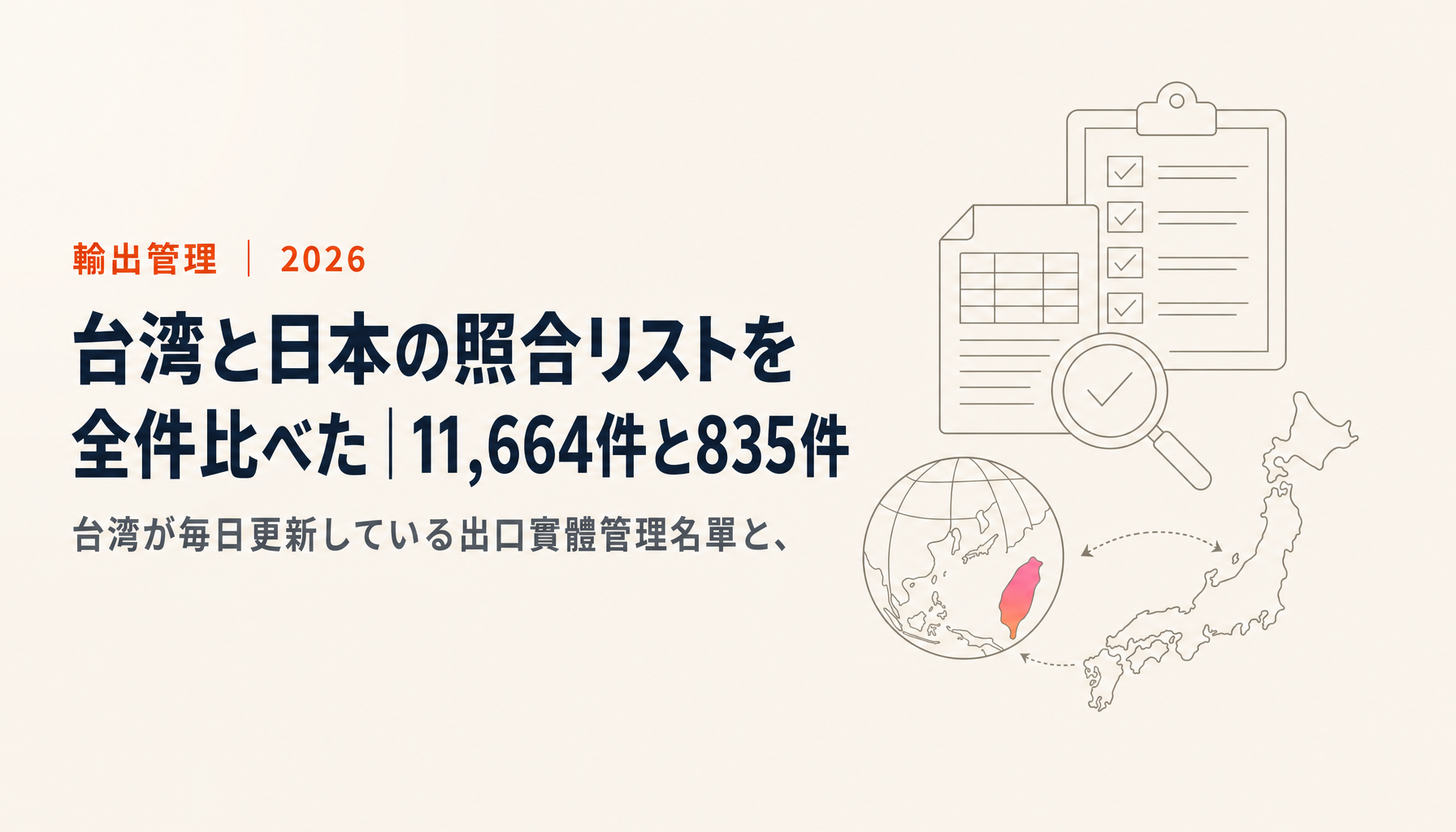
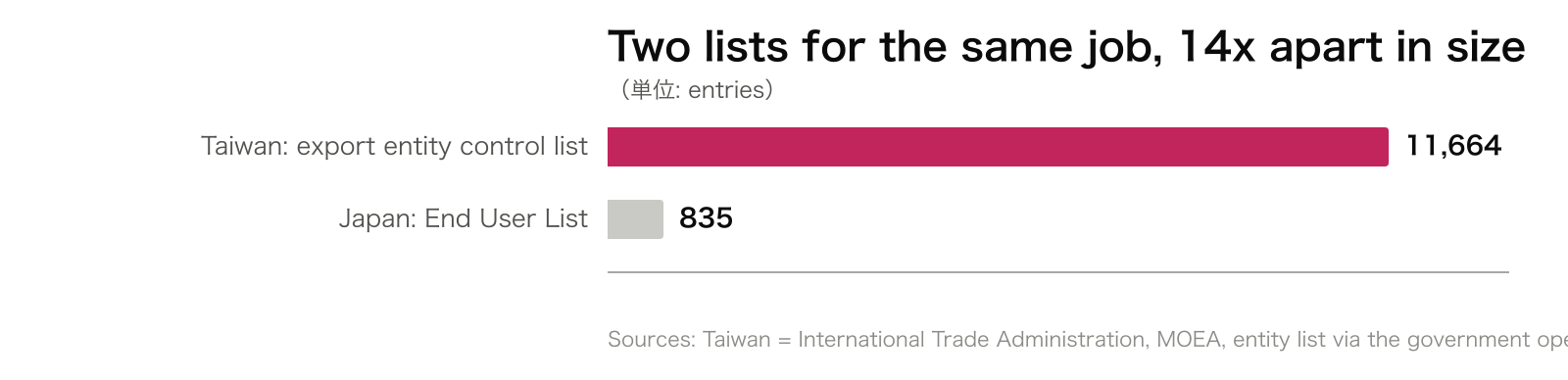
A question from a company operating in Taiwan — what should we be screening against on the Taiwan side? — prompted me to pull both and count. Taiwan 11,664 entries, Japan 835. Roughly 14x apart.
Reading that as "Taiwan is stricter" turned out to be wrong. Counting made it clear that the two countries build lists on fundamentally different premises.
How I counted
For Taiwan, the source is the "export entity control list for strategic high-tech commodities" published by the International Trade Administration of the Ministry of Economic Affairs. It is registered as a dataset on the government open data platform and downloadable directly as CSV, with a stated update frequency of daily. Retrieved on 27 August 2026, it held 11,664 entries across five fields: name, alias, address, passport number and generation date.
For Japan, the source is METI's End User List. The revision of 29 September 2025 brought it to 835 entities across 15 countries and regions (up 87), applied from 9 October 2025. That revision also added entities requiring confirmation in relation to conventional weapons development and transaction circumstances, on top of the existing weapons-of-mass-destruction concerns.
Before counting, the positioning of each matters. Skip it and the comparison does not hold.
Replace siloed classification work with AI.
METI's FY2024 data shows 52% of foreign exchange law violations stem from classification errors. Download the TRAFEED product catalog covering features and rollout.
Not different sizes — different philosophies
Japan first. METI states explicitly that the End User List "is not an embargo list." It provides information on entities whose concerns have not been dispelled, as a reference, to improve the effectiveness of catch-all controls. When a listed entity is the end user, an export licence application is required unless it is clear the goods will not be used for weapons development.
So Japan's list is entities the Japanese government itself has concerns about. 835 entities across 15 countries and regions follows from that purpose.
Now Taiwan. The dataset description says the list helps companies check whether a counterparty is among the high-risk individuals or entities published by the governments of various countries.
Taiwan's list bundles other countries' lists into one and distributes it. It is not a collection of Taiwan-only designations. Hence 11,664 entries.
Once that landed, the 14x stopped meaning what I first assumed. Japan says "here is what we are concerned about"; Taiwan says "here is what regulators worldwide have flagged, go screen against it." Different purposes, so more is not better.
The description goes further, saying screening should happen not only on export and re-export, but also when a controlled overseas customer remits funds to a domestic company, and when providing services relating to a controlled customer's goods. Unless the government has been notified and a licence obtained, all such transactions should stop. That is unusually specific as operational guidance.
To place your own company first, our three-minute export compliance check is a quick way in.
Taiwan's list leans heavily toward Russia
Taiwan's list has an address field, so I classified location by pattern matching.
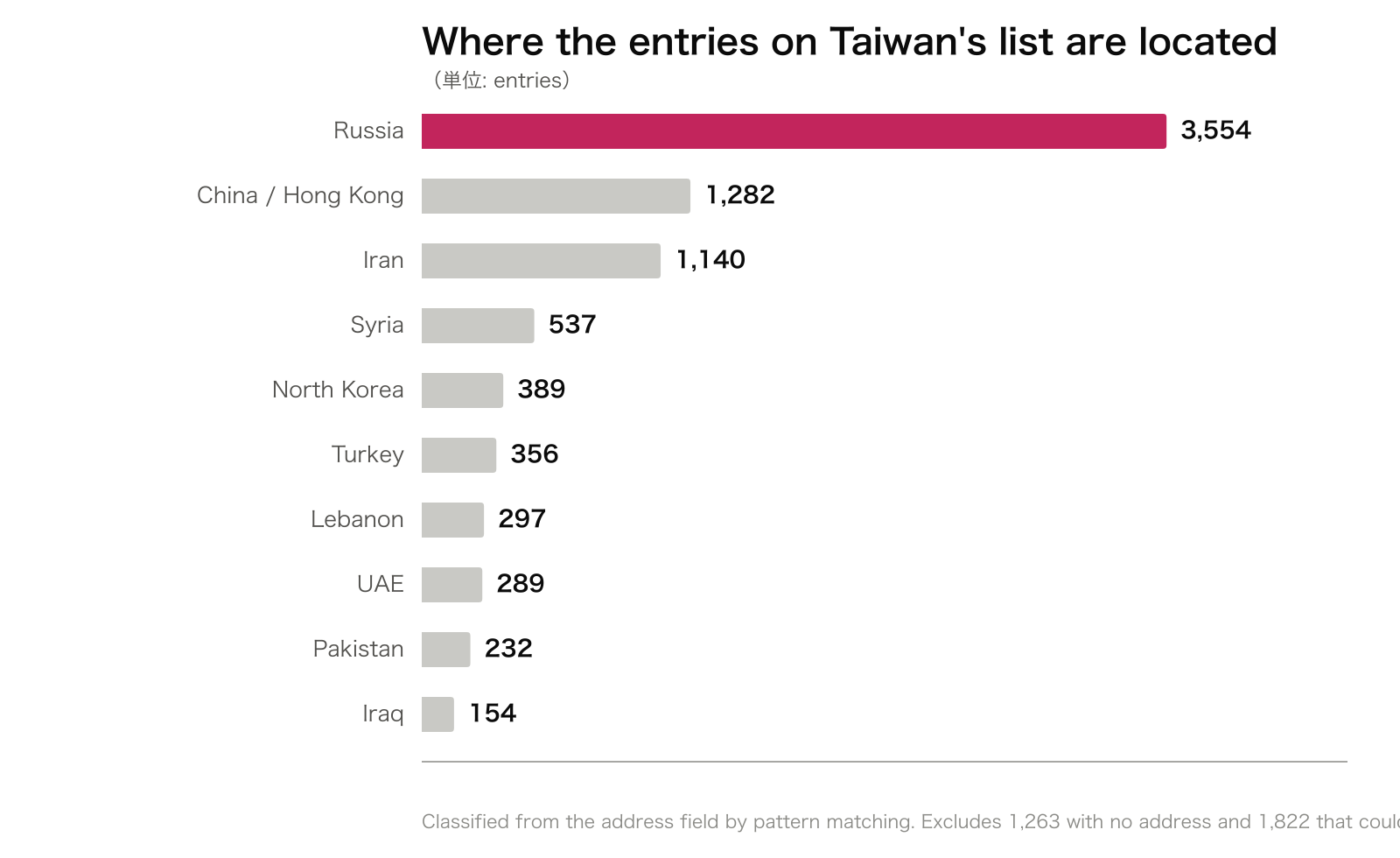
Russia dominates at 3,543 entries, 34% of the 10,401 that carry an address. Then China and Hong Kong at 1,356, Iran 1,127, Syria 548, Turkey 344.
A caveat: this is inferred from address strings by regular expression. 1,263 entries carry no address, and 1,856 could not be attributed to a country. That is 3,119 entries, 27% of the total, unclassified. Read it as a directional picture, not a precise country breakdown.
Even so, Russia's weight is unmistakable. The measures countries have stacked up since 2022 appear here in aggregate. A bundling approach swells whenever any one government designates at volume.
One more point for practitioners. Seventeen entries are located in the United States. That does not mean US companies are being treated as problematic. Related entities of sanctioned parties can hold US addresses. Being on a list is a regulatory designation, not a verdict on a country or a company — the basic discipline for handling this kind of material. Japanese companies can appear on foreign lists too.
Taiwan runs it as a licensing regime, not a reference
There is a further, decisive difference from Japan's list. Taiwan's list is not advisory.
The International Trade Administration's announcement of 1 April 2026 spells out the operation. A domestic company wishing to export to a controlled entity on the list must obtain an export licence in advance. And, in the announcement's own words, customs will assist with border interception. Attempt to export to a listed party without a licence and it will not clear customs.
Where Japan's End User List is framed as a reference that is expressly not an embargo list, with a licence application required when a listed entity is the end user, Taiwan's list defines the scope of a licensing requirement and connects directly to border enforcement. The phrase "list to screen against" covers both, but they are not the same instrument.
The same announcement reveals how the list is built: it draws primarily on the sanctions and control lists of the UN Security Council and friendly nations. That corroborates the scale I counted.
It also quantifies the updates. The 1 April 2026 revision added 67 entities and removed 8, covering Russia, Haiti, Turkey, mainland China, the UAE and others, and stated the cumulative total exceeded 11,414. Against my 11,664 on 27 August, that is roughly 250 added in about five months.
Taiwan's control lists themselves are also moving. On 11 February 2026 the dual-use goods and technology export control list and the general military goods list were amended with immediate effect, reflecting updates to international control lists including the Wassenaar Arrangement. Assume these change on a scale of months, not years.
What practitioners should take away
Watching only Japan's list is not enough. 835 entities are what the Japanese government has flagged. Taiwan's 11,664 means there are a great many parties abroad that Japan's list does not name. Companies with subsidiaries or counterparties in Taiwan carry a separate screening obligation there.
Watching only Taiwan's list is not enough either. The converse holds: because Taiwan's list aggregates other countries' lists, it does not necessarily reflect Japan-specific concerns. Exporting from Japan means consulting the End User List.
Build the update cadence into operations. Taiwan states daily updates; Japan publishes at each revision, most recently 29 September 2025 applied from 9 October. If you are not tracking the vintage of the list you hold, you will keep screening against an old one. In my experience this is the most common failure in practice.
And Japan's addition of conventional weapons-related entity information in this revision is easy to overlook but significant. Beyond the traditional WMD concern, it follows the review of complementary export controls for conventional weapons. The scope of what you must check has widened.
TRAFEED supports classification against METI criteria and counterparty screening. Before any tool, though, the question I would ask is: how many lists are you screening against, and as of what date each? Debating entry counts without an answer to that is not useful.
On what actually goes wrong, my count of six years of METI violation data found the leading cause was "never classified at all". List screening has the same shape: the dangerous state is not knowing there are parties you never screened.
In summary
- Taiwan's export entity control list: 11,664 entries (retrieved 27 August 2026, stated daily updates)
- Japan's End User List: 835 entities across 15 countries and regions (revised 29 September 2025, up 87, applied 9 October)
- Roughly 14x apart — but the lists do different jobs
- Taiwan aggregates lists published by governments worldwide. Japan names entities of its own concern and is a reference, expressly not an embargo list
- Taiwan's entries: Russia 3,543, China/Hong Kong 1,356, Iran 1,127 (inferred from addresses; 27% unclassified)
- Seventeen entries are US-located. Listing is a regulatory designation, not a verdict on the company
- Taiwan's description asks for screening on inbound remittances and when providing services, not only on export
- Taiwan's list is a licensing scope with customs enforcement, not a reference
- Taiwan added 67 and removed 8 entities on 1 April 2026; its control lists were amended on 11 February 2026 with immediate effect
What settled for me is the obvious point that more does not mean stricter. Taiwan has taken on the role of collecting the world's lists and handing them over; Japan narrows and states its own concerns. Both are coherent, and you need both, because each leaves the other's gap open.
If you want help designing screening for a Taiwan operation, or working out how to manage list versions internally, talk to us directly.
Sources: Taiwan — International Trade Administration, MOEA, "Export entity control list for strategic high-tech commodities" (government open data platform dataset 102368; CSV retrieved 27 August 2026). Japan — METI, "Revision of the End User List providing information on entities located in foreign countries and regions requiring confirmation of concerns regarding weapons of mass destruction or conventional weapons development and transaction circumstances" (29 September 2025) https://www.meti.go.jp/press/2025/09/20250929006/20250929006.html