Hello, I'm Hamamoto from TIMEWELL. Today I want to talk about something that many Japanese companies assume is "someone else's problem" — when in fact the fire is already at their doorstep.
Let me start with a hypothetical. One day, your company is hit with a fine of up to $1 million — about 150 million yen. The person in charge is arrested. And your company is prohibited from doing any business with the United States. What would you do?
"That's absurd." "We don't deal directly with the U.S., so it has nothing to do with us."
If that's what you're thinking, you are in serious danger.
On November 10, 2026, a new U.S. export control rule — commonly known as the "EAR Affiliate Rule" — could bring your company to its knees. If your company uses even a single U.S.-made component or piece of software, you could be a target. This is not a scare tactic. It is a crisis that can realistically happen — and it is approaching fast.
The "EAR Affiliate Rule" — What Is This Dangerous New Rule?
First, let me explain the rule itself. The EAR Affiliate Rule is a new provision added to the U.S. Export Administration Regulations (EAR). It was published as an interim final rule by the Bureau of Industry and Security (BIS) of the U.S. Department of Commerce on September 29, 2025.
Until now, the companies and organizations subject to U.S. regulation were only those named on the Entity List or the Military End User List (MEU List). Most companies assumed they were safe as long as they avoided doing business with companies on those lists.
That assumption no longer holds.
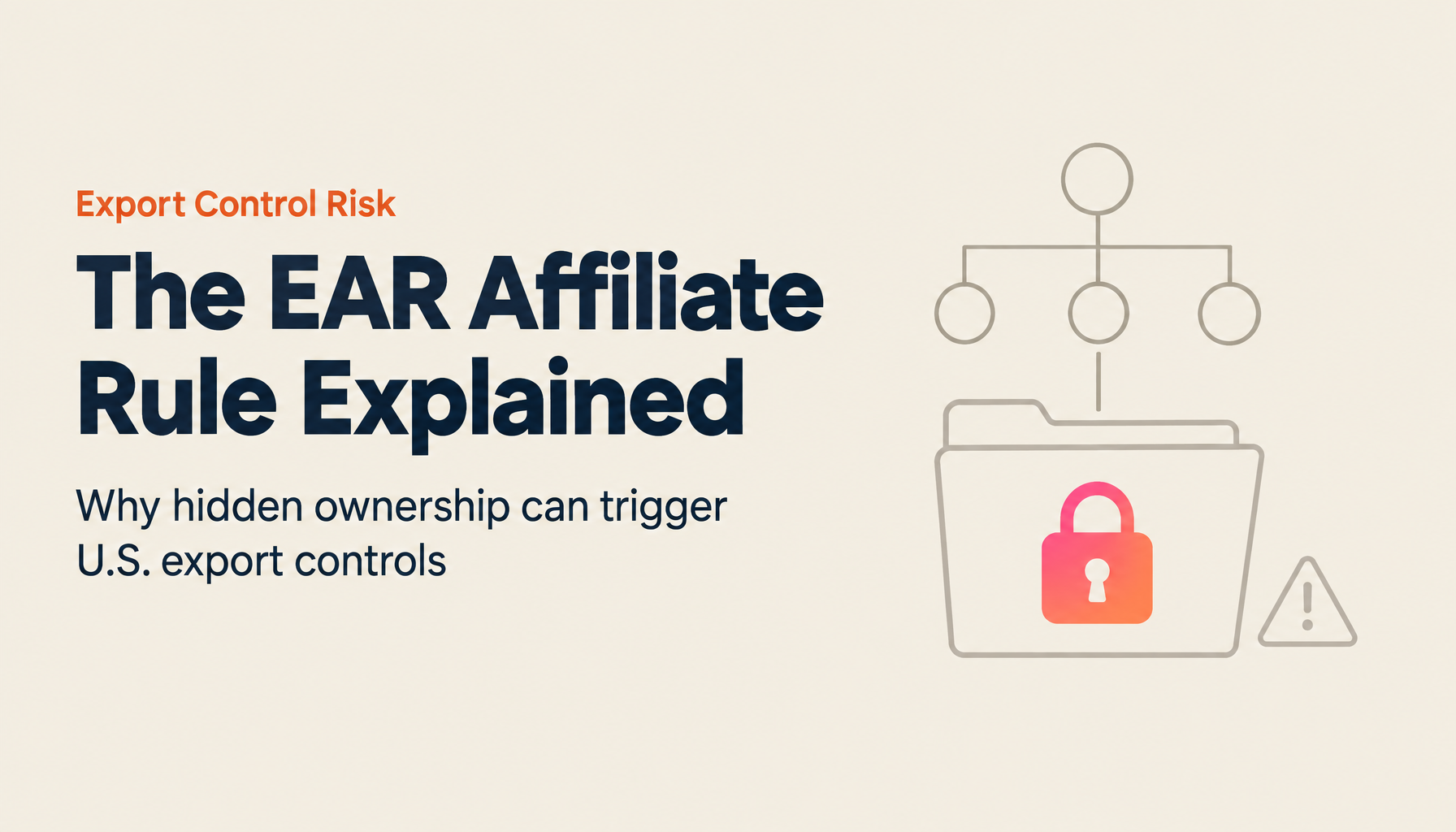
What makes the Affiliate Rule so alarming is that it can transform even an ostensibly clean company — one not on any list — into a "regulated entity" overnight. The mechanism is what is commonly known as the "50% rule."
Subsidiaries and affiliates in which a regulated entity (such as one listed on the Entity List) directly or indirectly owns 50% or more of shares are treated as one and the same as the parent company — and are therefore subject to the same restrictions — even if they are not themselves on any list. Ownership stakes are calculated cumulatively. For example, if a foreign entity is 20% owned by an Entity List company and 30% owned by an MEU List company, the combined 50% brings it within the scope of the rule.
Even if your counterparty is not on any list, if their parent company — or that parent's parent — is a listed entity and the chain of ownership leads to 50% or more control, your counterparty turns out to be a "hidden regulated entity."
The Nightmare Cascade
The horror does not stop there. This rule applies in a chain — a cascade — spreading restrictions across multiple layers of ownership.
For example: Company A is on the Entity List, and Company A owns 50% of Company B. Company B owns 50% of Company C. In this case, B inherits A's restrictions, and C inherits B's restrictions — meaning that C, a grandchild company, is also subject to regulation. BIS's official FAQ explicitly includes this example.
It is now impossible to look only at the surface of your counterparty and conclude they are "safe." You have to peer into the depths of the ownership structure, through multiple layers of control — or you never know when you might step on a mine. That is the era we have entered.
Replace siloed classification work with AI.
METI's FY2024 data shows 52% of foreign exchange law violations stem from classification errors. Download the TRAFEED product catalog covering features and rollout.
Is Your Company at Risk? The "Invisible Threat" Hitting Japanese Companies
"Alright, the rule sounds terrifying. But we don't have overseas subsidiaries and we're not directly transacting with U.S. companies. Surely it still doesn't apply to us?"
That thinking could cost you everything. EAR has a deeply troublesome quality known as "extraterritorial application." Even in domestic transactions within Japan, EAR's reach can extend in the following situations:
| Situation | Example |
|---|---|
| Handling U.S.-origin items | Exporting or re-exporting U.S.-made components or materials as-is |
| Incorporating U.S.-derived technology or software | Exporting a PC with U.S. software installed, or a product manufactured under a U.S. technology license |
| U.S.-origin component percentage exceeds a threshold | When the value of U.S.-origin components in a product exceeds 25% of the total (the de minimis rule) |
In today's global supply chains, how many companies can honestly say that their products are "completely unrelated" to U.S.-derived technology or components? Semiconductors, software, manufacturing equipment — without realizing it, your products may well be subject to "U.S. oversight."
As a side note: in my work helping client companies review their export control frameworks, I regularly encounter scenes where a compliance officer turns pale and says, "Wait — this component is made in the U.S.?" Not knowing is the most dangerous position. I genuinely believe that.
If a company you trust as a good domestic partner turns out to be a grandchild of an overseas Entity List company, and a product incorporating U.S.-made software that you shipped ends up in a regulated country — at that moment, you are complicit in an EAR violation.
What Happens If You Violate — The Worst-Case Scenario
So what actually happens if you violate the EAR Affiliate Rule? This is where things get serious.
The penalties for EAR violations are at a level that cannot be brushed off:
| Type of penalty | Content | What happens |
|---|---|---|
| Criminal penalty | Up to 20 years imprisonment | Company executives and compliance officers could go to prison |
| Fine (criminal) | Up to $1 million (~150 million yen) | A massive fine that could shake the foundations of the business |
| Fine (civil) | Up to ~$370,000 per violation, or twice the transaction value | Fines accumulate with every transaction — the total can become astronomical |
| Loss of export privileges | Banned from all transactions involving U.S. products or technology | A virtual "death sentence" — some companies cannot continue operating |
| Public disclosure | Named publicly worldwide as a violator | Collapse of social credibility; counterparties and customers walk away |
Still think this is an exaggeration?
In 2023, a major storage manufacturer agreed to pay $300 million (approximately 40 billion yen at the time) in a settlement over exports to an entity that was on the Entity List. It was the largest civil penalty ever imposed on a single company at the time. Note that a list designation or an enforcement case is a regulatory classification and a record of enforcement — not a judgment on the merits of the company involved.
In 2025, a major EDA vendor agreed to a resolution of over $140 million in combined criminal and civil terms over exports to entities on the Entity List. This case was notable as the first major enforcement action based on "knew or had reason to know."
Can your company afford to pay amounts like that?
"I Didn't Know" Is Not a Defense — Red Flag 29
Making matters worse is "Red Flag 29," a new warning indicator introduced alongside the Affiliate Rule.
Red Flag 29 states that if you had reason to know that an affiliate of your counterparty might be a listed entity, but failed to investigate, this is treated as equivalent to actually knowing.
"I didn't know." "I didn't realize." These are not valid excuses. Exporters now face an "Affirmative Duty" — a positive obligation to proactively investigate the ownership chain of counterparties and prove they are clean. Entity List and MEU List requirements are enforced on a strict liability basis: even if the violation was not intentional, you can be penalized for it.
What Needs to Be Done, and By When? Schedule and Action Steps
"Okay, I understand it's frightening. So when do I need to act and what exactly should I do?"
This is the critical question. The Affiliate Rule was published on September 29, 2025 and took immediate effect, but a one-year enforcement suspension was applied starting November 10, 2025, as part of U.S.-China trade negotiations. This means a "snapback" — automatic reinstatement — occurs on November 10, 2026.
| Date | Status |
|---|---|
| September 29, 2025 | Interim final rule published; effective immediately |
| November 10, 2025 – November 9, 2026 | One-year enforcement suspension (grace period) |
| November 10, 2026 | Full enforcement resumes (automatic snapback) |
This grace period is time for preparation — not a safe period. The suspension is temporary, not a repeal. Many companies are misunderstanding this critical distinction.
Here is what you should be doing right now. First, audit whether your company's products or technologies include any U.S.-origin items. Second, identify your major counterparties and investigate their ownership structures. Third, add procedures to address the Affiliate Rule to your internal export control program (CP). By summer 2026, you should have selected and implemented a screening tool so that operations are fully running by the November enforcement date.
The problem is that this is harder than it sounds. Investigating the ownership structures of overseas companies is extraordinarily difficult. Public information is limited. Language barriers exist. Unraveling ownership structures involving complex investment funds and trusts is tremendously challenging. To do all of this manually for every counterparty is, frankly, not realistic.
TRAFEED — A Solution
The EAR Affiliate Rule is a slow-moving but certain tsunami of business risk for Japanese companies. In an era of strict liability where "I didn't know" is not a defense, traditional manual-and-person-dependent checking frameworks cannot withstand this wave.
TIMEWELL has developed a solution to address this challenge: our AI export control agent, TRAFEED. We have conducted joint demonstrations with Okayama University and have presented at seminars hosted by the Ministry of Economy, Trade and Industry and the Ministry of Education, Culture, Sports, Science and Technology.
TRAFEED uses a proprietary global corporate information database and AI technology to automate what was previously impossible: analyzing the ownership chain of counterparties. Simply enter a counterparty, and the AI instantly traces the chain of control upward, identifying hidden persons of concern. Risk of triggering the 50% rule is presented clearly as a "concern score" in four levels — S, A, B, and C — along with the information sources behind the rating. Investigations that used to take weeks are completed in seconds.
In preparation for the full enforcement of the Affiliate Rule in November 2026, TRAFEED will fully support functions including ownership chain analysis, Entity List subsidiary checks, and automatic detection of 50%-or-greater ownership relationships.
My personal view is that export control is not just "burdensome compliance work." It is proactive business management — protecting Japan's technology, building corporate credibility, and sustaining global business. But without the tools to support those decisions, companies that want to comply cannot. That is the gap AI can close. That is why we built TRAFEED.
Before it is too late and everything is lost, start by understanding exactly how much risk your company is currently exposed to.
Your company's future depends on the decision you make right now.
For details on TRAFEED, please visit our service page.
For features and rollout, download the TRAFEED product catalog (PDF). To discuss your workflow, contact us.
References
[1] U.S. Department of Commerce, Bureau of Industry and Security, "Expansion of End-User Controls to Cover Affiliates of Certain Listed Entities" (https://www.federalregister.gov/documents/2025/09/30/2025-19001/expansion-of-end-user-controls-to-cover-affiliates-of-certain-listed-entities)
[2] Akasaka International Law and Accounting Office, "New U.S. Export Control Regulations: What Is BIS's 50% Rule (Affiliate Rule)?"
[3] U.S. Department of Commerce, Bureau of Industry and Security, "Enforcement – Penalties" (https://www.bis.gov/enforcement/penalties)
[4] U.S. Department of Commerce, Bureau of Industry and Security, "BIS Imposes $300 Million Penalty Against Seagate for Export Control Violations"
[5] U.S. Department of Justice, "Cadence Design Systems Agrees to Plead Guilty and Pay Over $140 Million for Unlawfully Exporting Semiconductor Design Tools" (https://www.justice.gov/opa/pr/cadence-design-systems-agrees-plead-guilty-and-pay-over-140-million-unlawfully-exporting)
[6] U.S. Department of Commerce, Bureau of Industry and Security, "One-Year Suspension of Expansion of End-User Controls for Affiliates of Certain Listed Entities" (https://www.federalregister.gov/documents/2025/11/12/2025-19846/one-year-suspension-of-expansion-of-end-user-controls-for-affiliates-of-certain-listed-entities)