Hello, this is Ryuta Hamamoto from TIMEWELL.
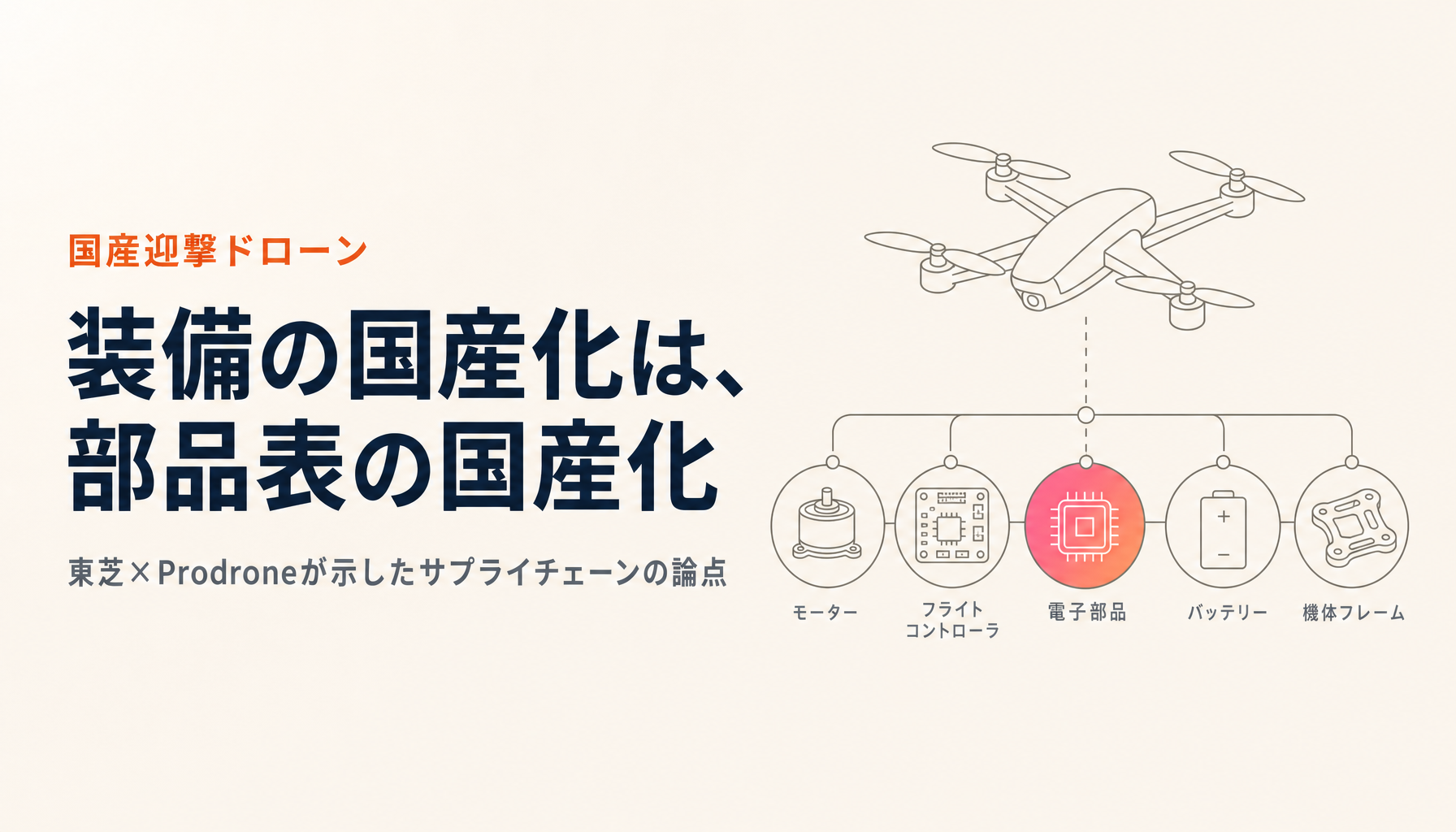
On 31 July 2026, Toshiba and Prodrone announced a technical partnership on a domestically produced interceptor drone for the defense sector12. It will move through the news cycle as a story about Japan's defense industry. What caught my eye was a single line buried in the release:
We will build a supply chain based on domestic parts and establish a stable supply structure.
An announcement about equipment, spending a sentence on procurement. That sentence is where the economic security question actually lives.
First, the facts
This story has circulated in heavily compressed form, and some of those summaries do not match the primary sources. Here is only what the two releases say.
| Item | What the primary sources state |
|---|---|
| Announced | 31 July 2026 |
| Subject | Technical partnership on a domestically produced interceptor drone for defense |
| Context | "The importance of the ability to counter unmanned aircraft used for reconnaissance, attack and similar purposes is rising" |
| Toshiba's role | Radar, air defense and command-and-control expertise. Reliability, quality assurance, regulatory compliance, systems integration |
| Prodrone's role | Airframe design, autonomous flight control and related UAV technology. Development speed and flexibility |
| Supply chain | "We will build a supply chain based on domestic parts and establish a stable supply structure" |
| Cost | "Improved cost competitiveness and mass-producibility through the use of commercial technology in defense" |
Two corrections are worth stating plainly.
This is not an "offensive drone." Both releases say interceptor. An interceptor engages incoming unmanned aircraft. That is the opposite posture from an offensive system, and getting it backwards breaks the premise of any discussion that follows.
Neither release says parts from a specific country will be excluded. The wording is "based on domestic parts," and no country is named anywhere. I have seen summaries reframe this as exclusion of a particular country. That reading is not in the source. This article stays with the original wording.
Padding a claim with facts that are not there ends up costing the claim its credibility. "We will build a supply chain based on domestic parts" is a large enough statement on its own.
Why a defense announcement talks about procurement
"Domestic production" of defense equipment is often pictured as final assembly happening in Japan. In practice, what bites is the bill of materials.
Equipment exists to be used in a contingency. If the parts stop arriving at that moment, the equipment may as well not exist. A supplier that is cheap and fast in peacetime carries no guarantee of being either under stress. So the question shifts from where the thing is assembled to where everything inside it comes from.
Japan's Ministry of Economy, Trade and Industry issued its Economic Security Management Guidelines (First Edition) in January 2026, and in May published a collection of concrete corporate case studies. That framework splits corporate effort into three:
- Securing autonomy — being able to keep supplying regardless of conditions, without depending on a single country or counterparty
- Securing indispensability — holding technology or products that are hard to replace, so others need you
- Strengthening governance — the organization and decision-making that keeps the first two running
Map the announcement onto that and "a supply chain based on domestic parts" is autonomy. Toshiba bringing radar, air defense and command-and-control while Prodrone brings airframe design and autonomous flight is indispensability. Defense and offense are sitting in the same press release.
METI's case collection contains a civilian version of exactly this shape. One company bet on a material that was not yet in practical use, played to its own strengths to compensate for that material's weakness, and built domestic sourcing for the raw input. Production steps that had been lost to offshoring began returning to Japan as a result. Pursuing its own indispensability lifted the autonomy of the wider industry.
Replace siloed classification work with AI.
METI's FY2024 data shows 52% of foreign exchange law violations stem from classification errors. Download the TRAFEED product catalog covering features and rollout.
"Commercial technology" and "mass-producibility," side by side
The other line worth pausing on:
Improved cost competitiveness and mass-producibility through the use of commercial technology in defense
An interceptor drone is, by its nature, a system you need in quantity. You are responding to things that fly at you. Having enough units available when needed matters roughly as much as any single unit's capability.
That explains the presence of commercial technology. Build it purely bespoke for defense and unit cost rises while the production line stays thin. Build on technology already being mass-produced as an industrial drone and you gain on both cost and volume. Prodrone develops and manufactures industrial drones end to end, and mass-produces a multicopter rated to a 20 kg recommended payload2.
And once you assume volume, procurement stops being an abstraction. A prototype can rely on a narrow sourcing route. Production needs suppliers who can reliably deliver quantity. A domestic-parts-first policy showing up next to mass-producibility is not a coincidence.
How far forward is the government
Worth grounding in primary sources as well.
Prodrone states that it received a visit from Defense Minister Koizumi on 20 May 2026, with a discussion followed by a tour of the company (the release itself was published on 22 May)3. The products presented included the PD6B-CAT3, a large drone with a 45 kg maximum takeoff weight; a ground control system using AI agents; the PRODRONE GT-M, capable of 135 km/h; a combined air-and-water drone; the PRODRONE GS120 for survey and inspection; and a counter-drone platform carrying a release mechanism under joint development with Howa Machinery.
As for what the minister said: the Prodrone release carries no direct quotation. The company points to the Ministry of Defense's published record of the extraordinary press conference of 20 May 2026 for that. I am not going to present unverified words as quotations here.
What can be stated is this: a sitting defense minister visited an industrial drone manufacturer in person and was walked through equipment down to the prototype stage. Two months later, a partnership with a major electronics maker was announced. That sequence says something on its own about official interest in the domestic base for unmanned systems.
Prodrone also announced a visit from a State Minister of Economy, Trade and Industry on 22 May, so the company has contact points on both the defense and industrial sides2.
What changes for suppliers
Here is the part that reaches beyond the defense sector.
When a buyer adopts a domestic-parts-first policy, suppliers acquire an obligation to explain. Where is your component made, and where do its inputs and sub-parts come from? "We buy through a trading company, so we don't know" may stop being an acceptable answer.
METI's case collection addresses how hard this is. A manufacturer with many suppliers, after a cyberattack on a supplier leaked technical information, surveyed the security posture of its important suppliers and then supported them through remediation. The detail I would underline is in how the survey was run:
Because the understanding and cooperation of important suppliers is essential to the survey, the company routinely explains the background, including the international situation, to the suppliers' top management.
Not a questionnaire mailed out and collected. The party asking for disclosure carries its own obligation to explain why it is asking.
Investors are watching this level of visibility too. From an institutional investor quoted in the case collection:
A state in which you can see your tier 1 suppliers but not tier 2, tier 3 and beyond is evaluated as a clear risk.
Not seeing is itself the deduction. The further domestic sourcing spreads, the further that pressure propagates down the chain.
What to do about it
Three things you can start on even with no direct line into defense supply.
1. Lay your bill of materials over a map. Which of your components depend on a single country, or a single supplier? Not only tier 1. Start with the ones that stop your business when they stop.
2. Work one step past tier 1, gradually. Ask about their suppliers in the course of ordinary conversation. Trying to systematize it all at once stalls; start with the parts that matter.
3. Get it into a form you can say out loud. Why is your sourcing structured this way, and what alternatives exist? Working that out after an investor asks is too late.
The second and third stop being manual work as the number of counterparties grows. Verifying who you are dealing with, screening against control lists, and keeping up as circumstances change is continuous work. TRAFEED, our export-control AI agent, exists to keep that classification and counterparty screening running. Pricing is by usage rather than per seat, so it can sit where the decisions actually happen — sales, engineering, procurement.
In summary
- On 31 July 2026, Toshiba and Prodrone announced a technical partnership on a domestically produced interceptor drone. A counter-drone system, not an offensive one
- The release says "a supply chain based on domestic parts." Exclusion of any specific country is not stated
- Toshiba covers reliability, quality assurance, regulatory compliance and systems integration; Prodrone covers airframe design and autonomous flight control
- It is framed alongside "cost competitiveness and mass-producibility through commercial technology." Once you assume volume, stable procurement becomes the binding constraint
- On 20 May 2026 the defense minister visited Prodrone and was shown equipment including prototypes
- Suppliers acquire an obligation to explain where their components come from. No visibility past tier 1 is itself scored as a risk by investors
Domestic production sounds like a large abstraction. What actually bites is each line of the bill of materials — and that is not a defense-sector problem. Open your own BOM and mark the lines that depend on a single country. If this piece prompts one round of that, it has done its job.
If you want to work through how to systematize export control and counterparty screening at your company, get in touch.
Footnotes
-
Toshiba Corporation, "Launch of technical collaboration with Prodrone on a domestically produced interceptor drone for the defense sector" (31 July 2026). The division of roles, "we will build a supply chain based on domestic parts and establish a stable supply structure," and "improved cost competitiveness and mass-producibility through the use of commercial technology in defense" are all from this release. https://www.global.toshiba/jp/news/infrastructure/2026/07/news-20260731-01.html ↩
-
Prodrone Co., Ltd. release (31 July 2026). Company details (founded 15 January 2015; headquarters in Tenpaku-ku, Nagoya, Aichi; President and CEO Shunsuke Toya), end-to-end development and production of industrial drones, and the visit by a State Minister of Economy, Trade and Industry (announced 22 May 2026) are from the company's site. https://www.prodrone.com/jp/release/10417/ ↩ ↩2 ↩3
-
Prodrone Co., Ltd., "Defense Minister Koizumi visits Prodrone for discussion and a tour of the company" (published 22 May 2026; visit on 20 May 2026). The list of products presented is from this release. For the press conference itself, the company points to the Ministry of Defense's record of the extraordinary press conference of 20 May 2026. https://www.prodrone.com/jp/release/10371/ ↩