Hello, this is Ryuta Hamamoto from TIMEWELL.
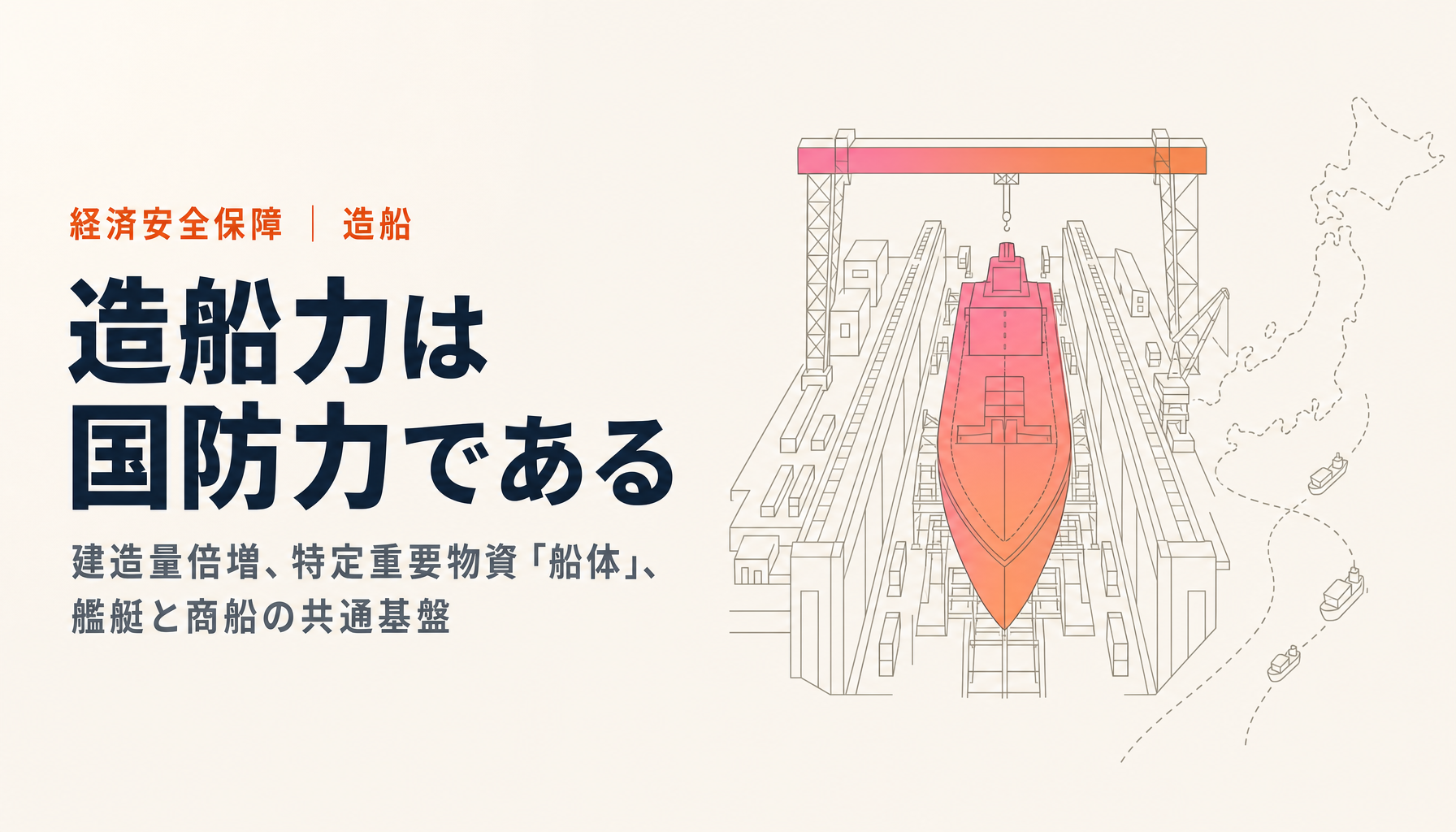
On September 9, 2026, Japan's Liberal Democratic Party published a piece under the headline "Back to the top of the world," framing the revival of shipbuilding capacity as a pillar of economic security.1 It opens with the fact that half the world's ships were once built in Japan, and that the country gave up that position about 30 years ago. Reading it made me want to line up the numbers I had been following for a while. Japan moves 99.5 percent of its trade, by weight, by sea.2 For a country surrounded by ocean, whether it can build ships is not an industrial-policy question. It is a question of whether goods arrive. And the shipyards that build merchant ships are the same places that build and repair destroyers and coast guard cutters.
This article takes the LDP piece as a starting point, checks the measures the government took between December 2025 and September 2026 against the primary documents, and explains, with numbers, why shipbuilding capacity bears directly on both economic security and defense. At the end I give my own view on why this matters to companies that have nothing to do with shipyards. If you first want to check how your own products and transactions sit under export control and economic security rules, use the export compliance self-check.
From half the world's ships to 8 percent of orders
Start with where things stand. Japan overtook Europe to become the world's largest shipbuilder by output in 1956 and held roughly half of the world market until the early 1990s.1 Then Korea rose in the 1990s and China in the 2000s. According to the Ministry of Land, Infrastructure, Transport and Tourism (MLIT), Japan's output fell from 16 million gross tons in 2019 to 9 million in 2024. Its share of world orders, long steady at 15 to 16 percent, dropped to 8 percent in 2024.3
China's numbers run the other way. In 2024 it built about half of the world's tonnage and took more than 70 percent of orders.3 One figure shows the structure on Japan's side. Japanese shipowners order roughly 12 million gross tons a year. Japanese shipyards have been able to build only about 10 million since 2020. In other words, Japanese yards cannot meet Japanese owners' demand. Where did the gap go? Since 2022, orders from Japanese owners to Chinese yards have risen to 30 to 40 percent of the total, up from 10 to 20 percent in the late 2010s.3
MLIT is candid about the causes. Compared with Korean and Chinese yards, Japanese yards are smaller in headcount, site area, and output. Steel and material costs have pushed ship prices up, and capacity has been cut under competitive pressure. Labor shortages are serious in both design and production: the shipbuilding workforce fell from about 90,000 in 2019 to about 70,000 in 2024.4 MLIT also puts the building-cost gap between Japan and China at roughly 20 percent.3
LNG carriers are the symbolic case. Japan was strong in Moss-type carriers with spherical tanks, but the market moved to membrane-type designs that fit tanks to the hull, and Korean yards came to build most of them. Japan has not completed an LNG carrier since 2019. Japanese shipping companies, utilities, and gas companies operate a fleet of about 200 LNG carriers as of the end of 2025, and Japan currently has neither the technology nor the facilities to build their replacements at home.4 A country that imports its energy by sea cannot build the ships that carry it. That is why the government uses the word "autonomy."
Why hulls became a critical good
Japan's Economic Security Promotion Act lets the government designate "critical goods" that are essential to life and economic activity and dangerously dependent on particular countries, then certify and support companies' plans to secure domestic supply. Eleven goods were designated in December 2022, including semiconductors, batteries, and critical minerals, and "ship parts" were on that first list: two-stroke marine engines and their crankshafts, sonar, and propellers, with four-stroke engines added in 2024.5
A cabinet order in December 2025 added hulls. The same order designated ventilators, drones, satellites, and rocket parts, bringing the list to 16 goods.6 Going from parts to hulls looks like a small addition, but it changes the character of the support. Securing engines and propellers means supporting parts makers' capital spending. Securing hulls means supporting the shipyard's own building capacity: dock expansion, cranes, labor-saving and automation equipment. On February 25, 2026, MLIT revised its policy for the category and established the Shipbuilding Revival Fund to back these large investments.5
Approvals began in September 2026. Three plans were approved on September 4 and five more on September 11, eight in all. According to MLIT, the eight plans together represent roughly 900 billion yen of public and private investment, of which the state will cover up to about 311 billion yen.78
| Approved | Applicants | Maximum subsidy (FY2026–2034) |
|---|---|---|
| Sept 4 | Imabari Shipbuilding, Tadotsu Shipbuilding, Steel Hub | approx. 113.8 billion yen |
| Sept 4 | Japan Marine United (JMU), JMU Amtec, Ariake Steel Center | approx. 49.4 billion yen |
| Sept 4 | Namura Shipbuilding, Hakodate Dock | approx. 49.9 billion yen |
| Sept 11 | Mitsubishi Shipbuilding | approx. 40.0 billion yen |
| Sept 11 | Shin Kurushima Dockyard and three group yards | approx. 32.0 billion yen |
| Sept 11 | Kawasaki Heavy Industries | approx. 15.6 billion yen |
| Sept 11 | Oshima Shipbuilding | approx. 6.1 billion yen |
| Sept 11 | Naikai Zosen | approx. 4.3 billion yen |
What stands out is that the number one and number two builders, Imabari and JMU, were each approved under separate plans. In June 2025 Imabari announced it would raise its stake in JMU to 60 percent by buying shares from JFE Holdings and IHI, and after clearing competition reviews it closed the transaction on January 5, 2026.9 Imabari is strong in merchant ships; JMU builds naval and special-purpose vessels. Right after they became one group, both companies' capital plans came under state support.
The law itself also moved. A June 2026 amendment added support for services essential to the supply of critical goods, and new provisions on duties of effort and cooperation requests for securing stable supply.6 The reach of the law now extends beyond the equipment that builds ships to the services that repair them and to the companies along the supply chain. One of the five pillars of the amendment I covered in my article on the Economic Security Promotion Council has taken concrete form here, in shipbuilding.
Replace siloed classification work with AI.
METI's FY2024 data shows 52% of foreign exchange law violations stem from classification errors. Download the TRAFEED product catalog covering features and rollout.
Doubling by 2035: what the roadmap actually promises
The target is plain: 18 million gross tons of output in 2035. That is double the 2024 capacity of 9.07 million, a market of roughly 5 trillion yen.10 The figure was set in the Shipbuilding Revival Roadmap that MLIT and the Cabinet Office adopted on December 26, 2025, and folded into the public-private investment roadmap of the Japan Growth Strategy, approved by the cabinet on July 21, 2026, as one of 17 strategic fields.4 I cover the strategy as a whole in a separate article.
The basis for 18 million tons is not market share. It is the forecast demand of Japanese shipowners.10 The target, in the roadmap's own phrase, is to build Japanese ships in Japan.4 I think that is the right design. This is not about returning to a 50 percent world share. It is about ending the situation where the country cannot meet its own demand.
The roadmap rests on five pillars: strengthening the building base, securing and training people, changing the game through decarbonization, securing stable demand, and working with like-minded countries and the Global South.10 The growth strategy breaks this into three areas. Next-generation ships get 1 trillion yen of public and private investment through fiscal 2034, with an estimated economic effect of 9.7 trillion yen. Ship repair gets 100 billion yen through fiscal 2035. For LNG carriers, on the premise that cargo owners and shipping lines agree to place long-term, stable orders with domestic yards, the aim is a system that can build three to five a year from 2035.4
"Changing the game" means fuel. The government expects zero-emission vessels and other next-generation ships to make up about 60 percent of building demand by 2035. Ammonia- and hydrogen-fueled ships differ from conventional ones in both design and construction method, so the reasoning is that a new playing field opens up, separate from today's market where scale of facilities and headcount decides the outcome.4 I half agree and half hold back. Leading on technology is possible, but next-generation ships take more labor and need highly skilled designers and craftsmen. Where does a country whose shipbuilding workforce has fallen to 70,000 find them? That is the thinnest part of the plan. The roadmap is honest about it, listing foreign workers under the Specified Skilled Worker program and the new training-employment system that starts in April 2027, university-school-company networks, and AI and humanoid robot development as ways to ease the shortage.10
Structurally, the roadmap points toward consolidating domestic building into one to three major groups and integrating design and production systems.10 Imabari's acquisition of JMU is that direction arriving early.
Why shipbuilding capacity is defense capacity
This is where the LDP's "pillar of economic security" becomes, in my reading, defense capacity itself.
The defense-industry chapter of the growth strategy states that Japan's naval vessels are "essentially all built and repaired at domestic shipyards," and that the yards, the supply chain of materials and equipment, and the workforce used for naval vessels "overlap with those for merchant ships."4 In plain terms, the place that builds destroyers and the place that builds merchant ships are not separate industries. Same docks, same subcontractors, same welders. If merchant output halves, the base for building and repairing warships thins at the same rate. Conversely, investment that doubles merchant capacity is investment in the naval base. The government calls this an integrated defense-civilian production and technology base, and says it will use the base strengthened on the civilian side for naval vessels and create a virtuous cycle.4
The numbers make it clearer. Of the vessels repaired at domestic yards in 2024, coastal ships accounted for 82.6 percent, naval vessels 4.7 percent, coast guard vessels 4.8 percent, and ocean-going ships 7.8 percent.4 Naval and coast guard vessels together are about a tenth. The strategy states that these repairs must be done domestically for information-security reasons. The ability to repair ships in a crisis is what sustains operations. The strategy also notes that naval construction is concentrated in a limited number of builders and suppliers, and that the supply chain is weakening as firms exit. Investment in the naval field is about 340 billion yen in the fiscal 2026 budget, and "further investment is expected in connection with the revision of the three strategic documents."4 I follow the debate ahead of that year-end revision in my article on the expert panel.
Sea transport itself is part of defense. Sea transport carries 99.5 percent of Japan's trade, and the Japanese merchant fleet carries 59.8 percent of that. Within the fleet, Japanese-flagged ships fell to 92 in 2007 but recovered to 323 by 2024 after the tonnage tax was introduced. MLIT describes Japanese-flagged ships as the "core of economic security," the vessels that carry the goods needed to sustain daily life in an emergency.2 The capacity to build ships, the capacity to repair them, and a fleet under the national flag: only with all three does an island nation own its supply line.
And 2026 is the year shipbuilding capacity became a currency of alliance. On April 18, aboard the destroyer Kumano in Melbourne, Defense Minister Shinjiro Koizumi and Australian Deputy Prime Minister and Defence Minister Richard Marles witnessed the signing of the contract adopting the upgraded Mogami class as Australia's next general-purpose frigate. Mitsubishi Heavy Industries will build three ships in Nagasaki, with the first delivered in 2029, and the remaining eight will be built in Australia. The two ministers also signed a cooperation memorandum known as the Mogami Memorandum.11 It is Japan's first export of a warship since the war. The growth strategy frames it as strengthening the domestic production base and sustainment capacity, and as contributing to regional deterrence.4 A country that can build can sell; selling keeps the base alive. Japan entering that cycle matters a great deal.
The US, Korea, and China: shipbuilding as an alliance and trade issue
Japan is not moving alone. On April 9, 2025, President Trump signed an executive order titled "Restoring America's Maritime Dominance." It states that the United States builds less than 1 percent of the world's commercial ships and that China builds roughly half.12 In July 2025, South Korea announced a 150 billion dollar framework for investment in US shipbuilding, known as MASGA, as part of its trade agreement with the United States.13
On October 28, 2025, Japan's transport minister Tsuyoshi Kaneko and US Commerce Secretary Howard Lutnick signed a memorandum of cooperation on shipbuilding. It covers expanding building capacity in both countries, promoting investment in the US maritime industrial base, clarifying demand for government and commercial vessels important to economic security, education and training of shipbuilding workers, and joint development of building technology using AI and robotics.14 The Shipbuilding Revival Roadmap's timeline also lists "US cooperation (shipbuilding technology cooperation, expanded warship repair, etc.)," treating repair of US Navy ships in Japan as demand that justifies investment in Japanese repair capacity.10 The US wants an ally to build and repair the ships it can no longer build itself. Japan wants to turn that demand into investment in its own docks and cranes. The interests line up.
Shipbuilding is a trade issue too. On October 14, 2025, the US Trade Representative put into effect fees on Chinese-built ships and ships operated by Chinese carriers calling at US ports. After the US-China summit in November, the measure was suspended for one year from November 10, 2025, so it does not apply until November 9, 2026.15 Where a ship was built is now, on its own, grounds for a trade measure. What happens to that suspension at the Trump-Xi meeting scheduled for September 24 is not someone else's problem for Japanese shipowners and yards.
To be clear, I am not portraying Chinese or Korean shipyards as a threat. The share and order figures are facts, and they are the result of each country's industrial policy and competition. Japan's problem is not that others are strong. It is that Japan cannot meet its own demand.
My view: from protecting shipbuilding capacity to using it
Here is my own opinion, in five parts.
First, the design of the doubling target is right. Eighteen million tons is a forecast of Japanese owners' demand, not a world-share recovery. Narrowing the thing to protect to "the ships Japanese owners order" gives investment a clear order of priority. Roughly 900 billion yen of public and private money is moving into docks, cranes, and automation because of that narrowing.
Second, the thinnest part is people. Equipment can be bought with a fund; welding, bending, and design cannot. The roadmap puts foreign-worker intake and AI robot development in the same paragraph, which I read as a judgment that both are needed to make the deadline. I think shipbuilding is the physical-AI shop floor par excellence. It is an industry where craft knowledge lives as tacit knowledge in drawings and process sheets, and whether that knowledge can be converted into a form AI can handle will decide what the capital investment actually yields. The "making shop-floor knowledge AI-ready" argument in my article on physical AI will be tested in shipyards before anywhere else.
Third, the critical-goods designation is defense; equipment transfer is offense. Shipbuilding capacity survives only with both. The Mogami export gives the domestic naval line continuous work, and that supports the merchant base too. But as transfers grow, companies that handle ship components and technology will find export classification and counterparty checks becoming daily work. That is exactly what our TRAFEED supports.
Fourth, repair is security. Doubling newbuild output gets the attention, but as the strategy honestly notes, repair of Japanese owners' ocean-going ships depends heavily on a particular foreign country, and domestic docks lack the capacity to absorb all of it. In a crisis, the first problem is not that you cannot build; it is that you cannot repair. That repair investment is capped at 100 billion yen, a tenth of newbuild, worries me a little.
Fifth, this reaches companies with no connection to shipyards. With critical goods now numbering 16 and the June 2026 amendment adding services support and cooperation requests, being able to explain which goods and which process stage your company connects to in the supply chain is becoming a condition of doing business. Just as a ship's country of build can trigger a trade measure, knowing which country's companies your counterparties are is the starting point of economic security in practice.
Summary
The shipbuilding revival the LDP put forward in September is not a slogan. Hulls became a critical good in December 2025, the Shipbuilding Revival Fund was created in February 2026, the cabinet approved the 2035 doubling target in July, and in September eight groups' plans were approved and roughly 900 billion yen of public and private investment started to move. Behind it is a country that relies on sea transport for 99.5 percent of its trade, cannot meet even its own owners' demand at home, and has not built a single LNG carrier since 2019.
Shipbuilding capacity is defense capacity because naval and merchant ships are built and repaired in the same yards, by the same subcontractors, with the same people. The 340 billion yen for naval vessels, the Mogami export to Australia, and the Japan-US shipbuilding memorandum all point at thickening the same base.
If you want to sort out how your products and counterparties sit under export controls and the critical-goods framework, talk to us about TRAFEED. More companies than you might think are connected to the sea somewhere in their supply chain, even if they never set foot in a shipyard.
Footnotes
-
Back to the top of the world: reviving shipbuilding capacity as a pillar of economic security (Liberal Democratic Party of Japan, September 9, 2026, in Japanese) ↩ ↩2
-
Maritime Report 2025, Chapter 1: Securing stable international maritime transport (MLIT Maritime Bureau, in Japanese). The 99.5 percent sea-transport figure, the 59.8 percent carried by the Japanese fleet, and the 323 Japanese-flagged ships are from this document ↩ ↩2
-
Current state of the shipbuilding industry and the Shipbuilding Revival Roadmap (MLIT Maritime Bureau, January 2026, in Japanese). The 8 percent order share, China's roughly 50 percent of output and over 70 percent of orders, the gap between Japanese owners' orders and domestic output, the 30 to 40 percent of orders going to China, and the 20 percent cost gap are from this document ↩ ↩2 ↩3 ↩4
-
Japan Growth Strategy, Public-Private Investment Roadmap (Cabinet Secretariat, cabinet decision of July 21, 2026, in Japanese). Shipbuilding (next-generation ships, ship repair, LNG carriers) from p.139; defense industry (naval vessels) from p.84. Output, workforce, investment amounts, repair breakdown, the 200-ship LNG fleet, and the 340 billion yen figure are from this document ↩ ↩2 ↩3 ↩4 ↩5 ↩6 ↩7 ↩8 ↩9 ↩10 ↩11
-
Promoting fundamental strengthening of shipbuilding capacity: policy for securing stable supply of hulls (MLIT, February 25, 2026, in Japanese) ↩ ↩2
-
Supply chain resilience measures under the Economic Security Promotion Act (Cabinet Office, in Japanese). The December 2025 cabinet order, the June 2026 amendment, and the number of approved plans are from this page ↩ ↩2
-
First approval of supply-assurance plans under the Shipbuilding Revival Fund (MLIT, September 4, 2026, in Japanese) ↩
-
Approval of supply-assurance plans under the Shipbuilding Revival Fund (MLIT, September 11, 2026, in Japanese). The roughly 900 billion yen of total investment and the up-to-311-billion-yen subsidy figure are from this release ↩
-
Closing date for the partial transfer of Japan Marine United shares (Imabari Shipbuilding, December 24, 2025, in Japanese) ↩
-
Adoption of the Shipbuilding Revival Roadmap (MLIT, December 26, 2025, in Japanese); roadmap text (PDF). The 9.07 million ton 2024 capacity, five pillars, one-to-three group structure, US cooperation, and the training-employment system are from this document ↩ ↩2 ↩3 ↩4 ↩5 ↩6
-
Summary of the Japan-Australia defense ministers' meeting (Ministry of Defense, April 18, 2026, in Japanese). Contract details are from Mitsubishi Heavy Industries' press release (April 18, 2026) ↩
-
Restoring America's Maritime Dominance (Executive Order 14269, The White House, April 9, 2025) ↩
-
Korea sails into US shipbuilding with $150b MASGA push (The Korea Herald, 2025). As reported ↩
-
Promoting cooperation to expand shipbuilding capacity in Japan and the US: signing of a memorandum of cooperation with the US Department of Commerce (MLIT, October 28, 2025, in Japanese) ↩
-
USTR Suspension of Action in Section 301 Investigation of China's Targeting of the Maritime, Logistics, and Shipbuilding Sectors for Dominance (Office of the US Trade Representative, November 2025) ↩