Hello, this is Ryuta Hamamoto from TIMEWELL.
On 25 August 2026, the director of the CIA landed in Moscow with no advance announcement. Flight tracking data caught it first; the Kremlin confirmed it afterwards. It was John Ratcliffe's first trip to Russia as CIA director, and the highest-level visit by a Trump administration official since January1.
My first reaction was to brace. When an intelligence chief flies quietly into an adversary's capital, it usually means there is something that ordinary diplomatic channels cannot carry. And the reported purpose was not reassuring.
Reading the primary statements alongside the reporting, though, my initial interpretation turned out to be slightly off. This article separates what has been confirmed from what remains journalism, and works out what the trip actually signals. The short version: the focus is not general war, but the territory just below it. And that territory is exactly where export control and supply chain management operate.
If you want to check where your own company stands first, our three-minute export compliance check is a quick way in.
What is confirmed, and what is reporting
Separating these matters. Blur them and the picture goes wrong fast.
What the Kremlin confirmed publicly. At a briefing on 26 August, spokesman Dmitry Peskov acknowledged that Ratcliffe had met his Russian intelligence counterparts2. He stated there was no meeting with President Putin, and that the results were reported to the president immediately. On the substance, he declined to say whether the talks concerned Ukraine, Iran or anything else. On the relationship, he offered that "contacts between intelligence agencies are, in and of themselves, a positive phenomenon", while adding that relations remain in a "profound crisis" and that it was "too early to say" what the visit would change.
What the reporting says. According to the Wall Street Journal, followed by several outlets, the purpose of the trip was to warn Russia not to attack NATO member states3. The context given is a US intelligence assessment that Russia might seek to test NATO's cohesion. Iran also came up, with a warning of additional sanctions if the Strait of Hormuz does not reopen to commercial shipping.
The important qualifier: all of this rests on anonymous sourcing. No US official confirmed it on the record.
And the official position contradicts it. On 26 August, President Trump acknowledged the trip on a radio programme, described it as a "semi-routine" visit, and denied it concerned Iran or Russia testing NATO. He also said something might come of it on Ukraine.
Reporting says warning; the president says routine. How you weigh that is a judgement call, but it does mean you cannot write "a warning was delivered" as established fact. I would rather not blur that, so the qualifiers stay.
Replace siloed classification work with AI.
METI's FY2024 data shows 52% of foreign exchange law violations stem from classification errors. Download the TRAFEED product catalog covering features and rollout.
The assessment is not about conventional war
Here is the part that gets misread most often.
The US intelligence assessment being reported is that President Putin might authorise provocative actions on NATO territory. The examples given are cyberattacks, hybrid operations, and other operations that fall short of conventional military action3.
That sentence made me revise my first reading. What is being described is not tanks crossing a border. It is deliberately ambiguous activity, calibrated so that countries will disagree about whether it even counts as an attack. Damaged undersea cables. Intrusions into power grids. Unmarked units. Interference with elections and infrastructure. The grey zone.
Why aim there? Because NATO's collective defence provision is triggered by armed attack. If an act cannot be firmly classified as one, allies spend their first days arguing over whether Article 5 applies, and the response slows. Testing cohesion means precisely this.
So the reported warning is less "do not start a war" and more "do not push in the space that cannot be called war". That is a more practical problem than a general war, and a nastier one. General war is obvious to everybody. The grey zone is hard to identify even while it is happening.
You could read all this as a sign that world war is close. I could not find primary sourcing to support that, and I am not going to state as fact something I cannot verify. What I could establish is that the assessment being reported stops short of conventional war.
The logistics baseline has already moved
The other subject reportedly raised on the trip, the Strait of Hormuz, is not speculation. It can be checked in numbers.
The sequence: US and Israeli military operations against Iran began in late February 2026, and Iran asserted control over the strait through threats and attacks on commercial shipping. On 19 March the US began an air campaign to reopen it. In April a reopening looked likely under a ceasefire framework, but Iran continued diverting vessels into its territorial waters and striking non-compliant ships, and the US imposed a blockade on shipping to and from Iranian ports4.
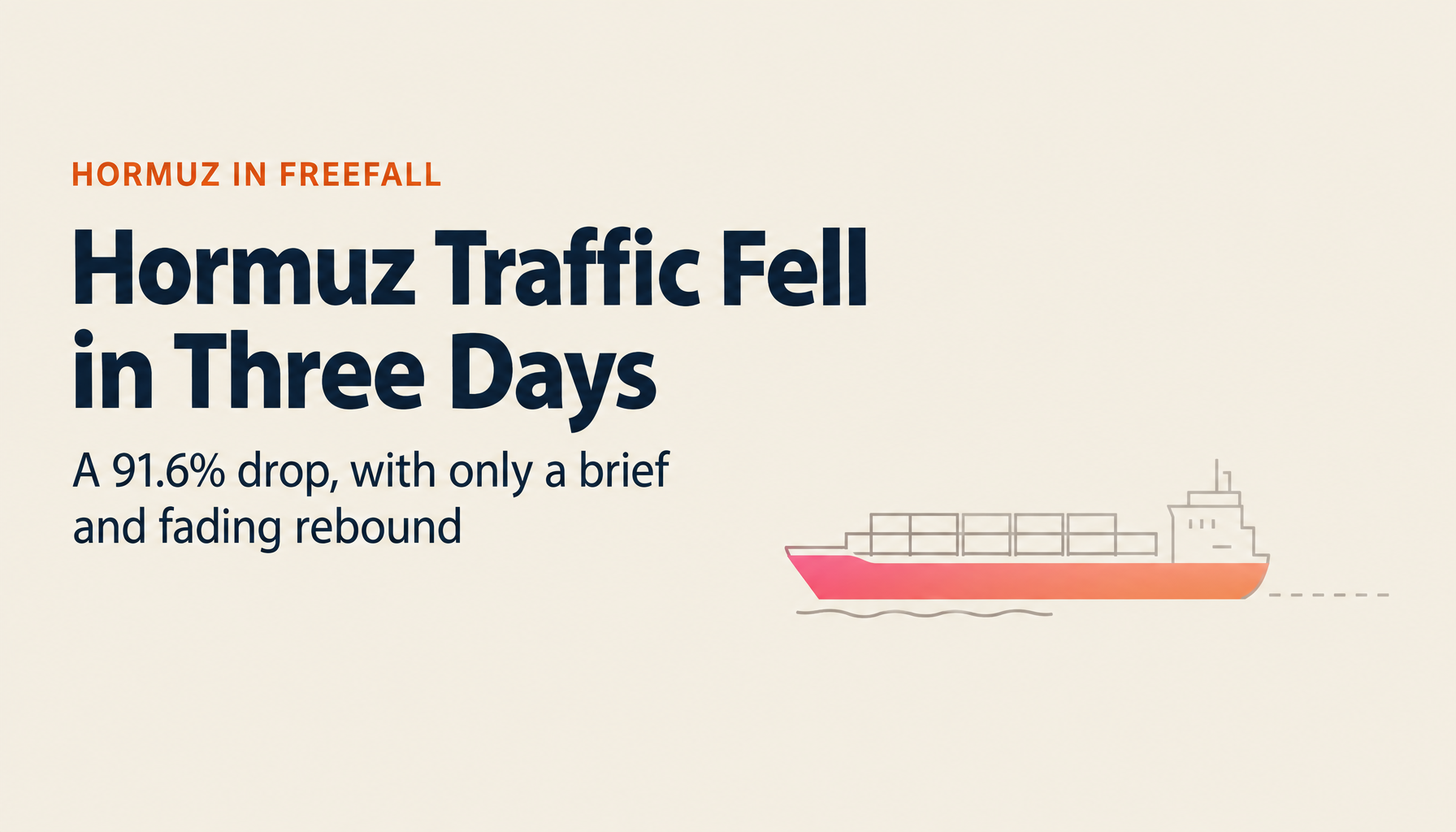
As of August 2026 the effective closure continues. According to a transit tracker, three ships passed through the Strait of Hormuz on 23 August5, against a normal rate of roughly 85 per day. Iran and Oman have announced a temporary joint maritime corridor and a joint mine-clearing framework, but Iran's deputy foreign minister has said the closure stands militarily.
Given how much of Japan's imported crude has historically come through that strait, a closure now measured in months means the planning baseline has been rewritten. That is not a hypothetical as you read this.
Connect that back to the warning. If additional sanctions are the reported next lever on the strait, then screening and classification workload goes up. Not as a war scenario. As next quarter's operations.
"If it is war, export control is beside the point" has it backwards
This part is my own view.
News like this produces a familiar reaction: there is no time for something as slow as export control. I understand it. It was close to my own first reaction.
But if what is being described sits below conventional war, the logic inverts. Grey-zone competition is precisely where export control and supply chain management are the main theatre.
Three reasons.
First, grey-zone action runs through civilian infrastructure and companies, not armies. Undersea cables, power grids, logistics, semiconductors, components. From the attacking side, civilian systems are easier to enter and harder to answer with force. From the defending side, knowing your own counterparties and supply chain is the defence.
Second, sanctions and export controls are what states use instead of war. Degrading an opponent's capability without firing is exactly what this instrument is for. The higher the tension, the more the rules multiply, widen and change.
Third, and most practically: you cannot build the capability after the rules move. Classification processes and counterparty screening take months to stand up. Start after a sanctions announcement and you will be stuck deciding what to do about transactions already in flight.
So I would put it the other way round from the usual reaction: not "war may be coming, so export control is beside the point", but "conflict that cannot be called war keeps going, which is why export control is needed". That view is why we built TRAFEED to support classification against Japan's METI criteria and counterparty screening. Final classification always rests with your own export control officer, and before any tool, the question is whether you can say what you sell and to whom.
On Japan's domestic side, I have covered the expert panel on economic security and the Growth Strategy's 17 sectors and 62 technologies. Japan's three security documents are due for revision before year-end, and how they treat the grey zone will land directly on companies.
In summary
- On 25 August 2026 CIA Director Ratcliffe visited Moscow unannounced, flying from Riga on a US Air Force C-17; the trip surfaced through flight tracking data
- The Kremlin confirmed on 26 August that he met intelligence counterparts. No meeting with Putin. Topics undisclosed
- Peskov called intelligence contacts "a positive phenomenon" while describing relations as being in a "profound crisis", and said it was "too early to say" what would change
- Reporting says the purpose was to warn Russia not to attack NATO members, but this rests on anonymous sourcing
- The reported intelligence assessment concerns cyberattacks and hybrid operations that fall short of conventional military action
- President Trump has publicly called the trip "semi-routine" and denied any Iran or NATO connection
- The Strait of Hormuz remains effectively closed. Three transits on 23 August, against roughly 85 per day normally
What I most want to convey is that the shape of the risk has stopped being "recognisable war". Recognisable is manageable. What is difficult is conflict you cannot confirm is underway, running across private transactions and supply chains.
That also happens to be territory where management can act. What do you sell, under which control classification, to whom. A company that can answer can move when the rules move. A company that cannot, cannot. I think the difference sits entirely there.
If you want to work out how your transactions and technology are treated under export control, talk to us directly.
Footnotes
-
Axios, "CIA director Ratcliffe visits Moscow" (25 August 2026) https://www.axios.com/2026/08/25/cia-director-ratcliffe-visits-moscow ↩
-
TASS, "CIA chief's visit to Russia, Kiev regime's collapse, Armenia situation: Kremlin's briefing" (Kremlin briefing, 26 August 2026) https://tass.com/politics/2177883 , and Al Jazeera, "Kremlin says CIA head met Russian intelligence officials, but not Putin" https://www.aljazeera.com/news/2026/8/26/kremlin-says-cia-head-met-russian-intelligence-officials-but-not-putin ↩
-
CBS News, "CIA Director John Ratcliffe warned Russia not to attack NATO during secretive trip" (following the Wall Street Journal's original report; both rest on anonymous sourcing) https://www.cbsnews.com/news/cia-john-ratcliffe-warned-russia-not-to-attack-nato-moscow-trip/ ↩ ↩2
-
Congressional Research Service, "The Strait of Hormuz: Security Developments and Impacts on Oil, Gas, and Other Commodities" https://www.congress.gov/crs-product/R45281 ↩
-
Strait of Hormuz transit tracker https://straits.live/ ↩