Hello, this is Ryuta Hamamoto from TIMEWELL.
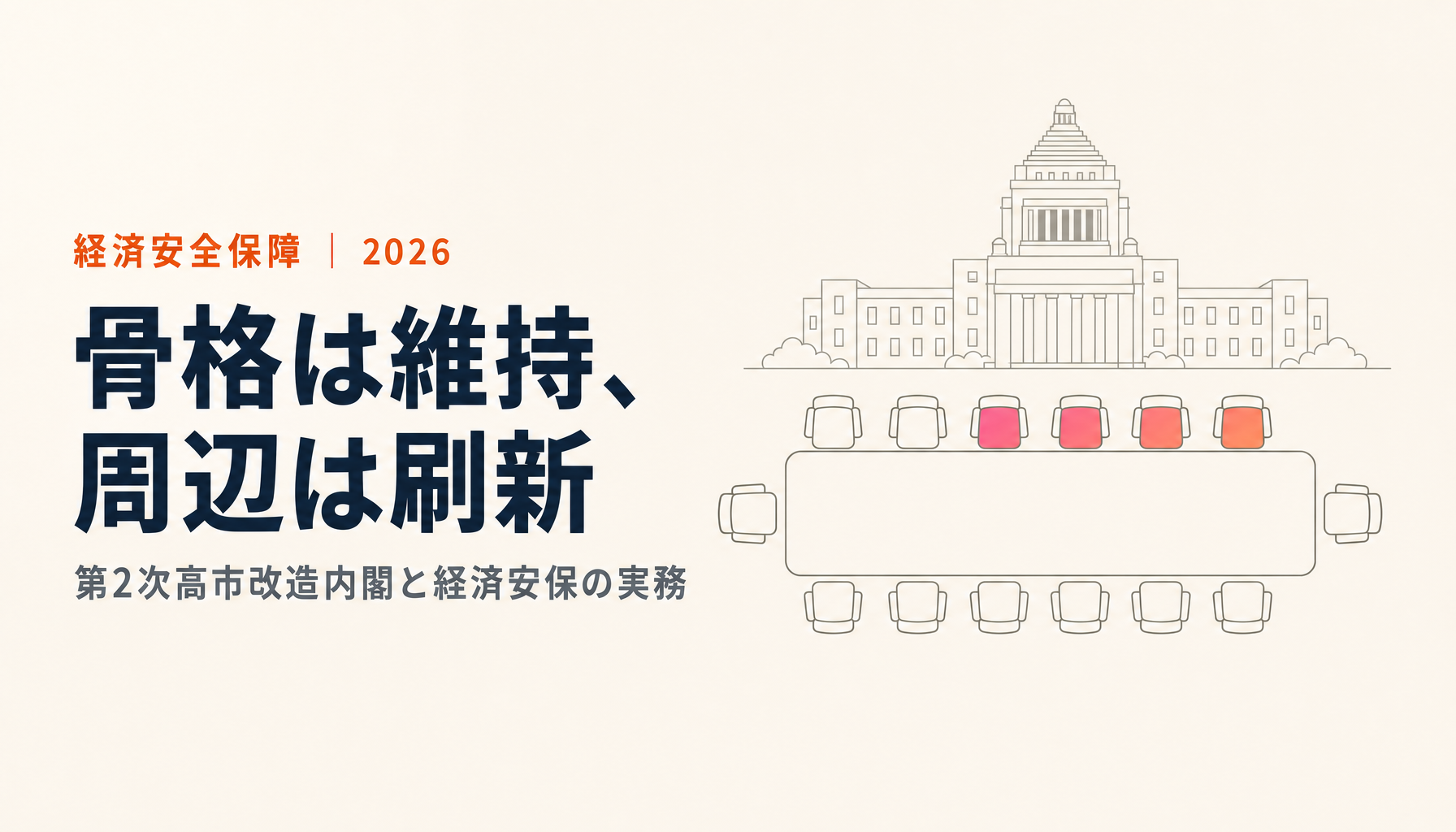
On September 17, 2026, Japan's second Takaichi cabinet was reshuffled. The first thing I checked on the Prime Minister's Office roster was the line for the Minister in charge of Economic Security. Kimi Onoda, retained. Defense Minister Shinjiro Koizumi, Foreign Minister Toshimitsu Motegi, and Minister of Economy, Trade and Industry Ryosei Akazawa, all retained1. If your job touches export controls or economic security, the fact that those four seats did not move is the biggest piece of news in this reshuffle. The core stays, the edges change. Ten ministers were replaced and seven entered the cabinet for the first time, but the part that matters to our work reads as continuity.
Stopping at "nothing changed" would waste the story, though. The basic policy the cabinet adopted the same day says the economic security minister will lead efforts to "continuously conduct supply chain surveys and build an economic structure resilient to exchange rate fluctuations and economic coercion"2. With the portfolio reshuffle, Onoda drops her AI strategy and other side briefs and puts her weight on economic security. When you read what the retained ministers said on their first day, the tone is closer to "accelerate" than "continue." In this article I work from primary sources, the official roster, the basic policy, and the ministries' press conference records, to sort out what changes and what does not, from a practitioner's point of view. If you want a quick read on how your own products and counterparties sit under export controls first, try the export compliance self-check.
The reshuffle in numbers: the core stays, the edges change
Start with the count. Of 18 ministers, eight stayed and ten were replaced. The ten break down into seven first-timers (Hisayuki Fujii, Yoshihiro Seki, Kazuo Yana, Tatsunori Ibayashi, Hiroyoshi Sasagawa, Toshiharu Furukawa, and Hiroshi Nakatsuka) and three returning ministers (Takashi Yamashita, Goshi Hosono, and Yasuhiro Hanashi). Two women serve in the cabinet, Finance Minister Satsuki Katayama and Onoda, the same number as before13. The eight who stayed are Chief Cabinet Secretary Minoru Kihara, Motegi, Katayama, Health Minister Kenichiro Ueno, Akazawa, Koizumi, Growth Strategy Minister Minoru Kiuchi, and Onoda. Beyond the government's spine of chief cabinet secretary, foreign, finance, and defense ministers, not a single economic policy or economic security post changed hands.
This is the first reshuffle since the government took office in October 2025. Opening her press conference, the prime minister said the LDP had won 316 seats and Ishin 36 in the February general election, calling it a "great mandate"4. After that election, the second Takaichi cabinet was formed on February 18 with every minister reappointed5. This reshuffle did not involve a cabinet resignation, so the formal name is the "Second Takaichi Reshuffled Cabinet."
The most-reported departure was that of Internal Affairs Minister Yoshimasa Hayashi. Hayashi, who ran against Takaichi in last year's LDP leadership race, left the cabinet, while Motegi and Koizumi, who also ran, stayed. At her press conference the prime minister gave three selection criteria. She read through a questionnaire sent to LDP lawmakers and weighed "each person's expertise, awareness of the issues, and motivation"; she chose people who are "strong in elections" and can settle down to implement policy; and she kept in place "ministers whose duties require continuity," such as diplomacy, trade, and economic and fiscal policy. Of the rivals from last year's leadership race who stayed, she said she "confirmed that the post was their first choice before making the appointments," and she flatly said the reshuffle had "nothing whatsoever to do" with next year's leadership race. On Hayashi, she said she would "refrain from commenting on individual ministers' appointments"4.
The other change is the shape of the coalition. Since joining the coalition in October 2025, the Japan Innovation Party (Ishin) had cooperated from outside the cabinet without holding a ministerial post. On September 16, Takaichi and Ishin leader Hirofumi Yoshimura formally agreed to move to cooperation inside the cabinet, and on September 17 former Ishin secretary-general Hiroshi Nakatsuka entered the cabinet as Minister of State for regulatory reform and related portfolios6. At her press conference the prime minister said reviewing the rules and systems that bottleneck growth is a major pillar of the growth strategy and asked Nakatsuka to "deliver bold regulatory reform," calling his appointment "a symbol of the LDP-Ishin coalition moving to a new stage"4.
On the operational side, Yusuke Nakanishi of the Upper House became a deputy chief cabinet secretary, while Masanao Ozaki and Yasuhiro Tsuyuki kept their posts. New special advisers to the prime minister include Kenji Wakamiya for national security and nuclear disarmament and non-proliferation, Hajime Sasaki for regional future strategy, and Hisashi Matsumoto for cost-of-living measures, "responsible proactive fiscal policy," and digital policy7.
The basic policy adopted by the cabinet the same day rests on three pillars: a "strong economy" through "responsible proactive fiscal policy," "strong Japanese diplomacy," and delivery of election pledges. Closer to our work, it spells out continuous supply chain surveys led by the economic security minister, stronger cybersecurity measures led by the Digital Minister, stronger intelligence functions with the National Intelligence Council as command center, and the review of the "three strategic documents"2.
Public reaction is cool. A Jiji Press poll conducted September 11 to 14 put cabinet approval at 44.1 percent, down 4.3 points from the previous month, and 68.6 percent opposed appointing lawmakers disciplined over the factional political funds problem to the cabinet. Note that the poll predates the reshuffle and does not rate these specific appointments8.
Replace siloed classification work with AI.
METI's FY2024 data shows 52% of foreign exchange law violations stem from classification errors. Download the TRAFEED product catalog covering features and rollout.
What the four retained ministers said on September 17: same direction, faster
The faces in the four posts that matter for export controls and economic security did not change. But listen to what each said on September 17 and you hear less "steady as she goes" and more "the deadlines are close."
Kimi Onoda stays as Minister in charge of Economic Security. Before the reshuffle she also held the Minister of State briefs for Cool Japan strategy, intellectual property strategy, science and technology policy, space policy, and artificial intelligence strategy. After it, her portfolio narrows to economic security, infectious disease crisis management, and orderly coexistence with foreign nationals1. AI strategy, science and technology, space, and intellectual property moved to the Digital Minister. At her press conference the prime minister said that since taking office her government had "strengthened intelligence functions," citing the legislation for the National Intelligence Council and National Intelligence Agency and the creation of the Japan Foreign Investment Committee, then added: "This is no more than a first step in reform. Further development of economic security policy, including the establishment of data sovereignty, is indispensable." Through the "review of portfolios," she said, Onoda will "concentrate" on economic security policy and on orderly coexistence with foreign nationals4. Sankei Shimbun reported that the prime minister's written instructions directed Onoda to "continuously conduct supply chain surveys and build an economic structure resilient to exchange rate fluctuations and economic coercion"9. That sentence appears verbatim in the cabinet's basic policy2. As of this writing, on the morning of September 18, the Cabinet Office has not posted any post-reshuffle remarks from Onoda. I will add them when the transcript appears.
Shinjiro Koizumi stays as Defense Minister. The prime minister pointed to the emergence of "new ways of fighting," such as the mass use of drones, and the need to "prepare for protracted conflict," said Japan would pursue a fundamental strengthening of defense capability "on its own initiative," and told Koizumi to "fully discharge the heavy responsibility of the review of the so-called three documents to be carried out within the year"4. Koizumi's own remarks to reporters on the 17th were the most concrete of the four. "In year two we have the revision of the three documents, and with a year-end deadline there is not much time left. This strategic revision bears heavily on Japan's security and on the whole region," he said, adding that "the Ministry of Defense and the Self-Defense Forces must bring everything together and move with even more speed and intensity than in year one." Asked about the prime minister's instructions, he said the main one was "to see the three documents through"10. That same afternoon, the Cabinet Secretariat held the fourth meeting of the Advisory Panel on Security from the Perspective of Comprehensive National Power, with "cross-government efforts to strengthen comprehensive deterrence and response capability" on the agenda11. The three documents are due for revision by year-end, and Koizumi will see that final stretch through.
Ryosei Akazawa, Minister of Economy, Trade and Industry, looked back at his year at the post-cabinet-meeting press conference on the morning of the reshuffle. He described three "emergency responses": implementing the Japan-US tariff agreement, responding to the Middle East situation, and responding to the Kumamoto earthquake. On Japan-US, he explained that the "Japan-US strategic investment initiative" underpins the deal that cut tariffs the US had planned to impose, from more than 5 trillion yen down by more than 2 trillion yen, and that six projects contributing to economic security and other goals have already been announced. On the Middle East, he said emergency fuel price relief, stockpile releases, and alternative procurement secured "the volume Japan as a whole needs"12. His post-reshuffle portfolio adds two new briefs: securing stable supplies of critical goods amid the Middle East situation, and social implementation of AX (AI transformation)1. Interviewed after being retained, he said he understood the prime minister's instruction as "finish the work you started," and on raising small business productivity and physical AI he said he would work "with the resolve that Japan will lead the world"13. The prime minister's side of the explanation is specific too. She said she created the "AX social implementation" brief and gave it to Akazawa to accelerate AI use in fields such as medical and nursing care, transport, and construction and to spread AI among small businesses; that she had already instructed him to compile a "Power GX strategy" by year-end, built on the "two resiliences" of more stable fossil fuel procurement and faster GX; and that she reappointed him precisely because he had been the minister in charge of GX implementation4.
Toshimitsu Motegi stays as Foreign Minister. The prime minister said that since taking office she had visited 10 countries, attended 12 international conferences, and held talks with 47 countries and organizations, and that she would build on those relationships to "evolve" the Free and Open Indo-Pacific, asking Motegi to "deepen still further" Japan's relations with allies, like-minded countries, and others4. According to Sankei Shimbun, Motegi and Koizumi were retained because the prime minister prioritized continuity in foreign and security policy amid the tense international situation and ahead of the year-end revision of the three documents; the paper reports that Motegi has held more than 80 meetings, including phone calls, on the Middle East situation14. I could not confirm the Foreign Ministry's press conference record as of this writing, so Motegi's own remarks rest on press reports.
What the four have in common is that each is carrying work in progress that would be lost in a mid-term handover. The revision of the three documents, the Japan-US investment initiative, securing goods disrupted by the Middle East, and the operation of the amended Economic Security Promotion Act. These are the kind of tasks that would have to be explained from scratch if the person changed, and I think the prime minister's choice of continuity was the rational one.
The ten new and returning ministers: careers and records, as far as I could verify
None of the ten new ministers holds a post directly involved in export controls. Even so, who now holds AI strategy, and who runs public safety, counterterrorism, and justice, feeds indirectly into corporate information management and compliance. From the official roster, past cabinet biographies on the Prime Minister's Office site, and profile articles in the press, here is what I could verify11516.
| Post | Name (status) | Career and record |
|---|---|---|
| Minister of Internal Affairs and Communications; regional revitalization, regional future strategy, second capital promotion | Hisayuki Fujii (first time) | Joined the Ministry of Home Affairs (now Internal Affairs) in 1995. Deputy mayor of Hikone, then first elected in Hyogo 4th district in 2012, six terms. Parliamentary vice-minister for land and transport, state minister at the Cabinet Office, first-ever state minister for digital, state minister for foreign affairs, chair of the Lower House agriculture committee |
| Minister of Justice; gender equality, women's empowerment, legal system review and reform | Takashi Yamashita (returning) | Former prosecutor, including the Tokyo District Public Prosecutors Office special investigation unit and the embassy in Washington. First elected in Okayama 2nd district in 2012, six terms. Minister of Justice in the fourth Abe reshuffled cabinet, October 2018 to September 2019. Chair of the Lower House cabinet committee, LDP deputy secretary-general |
| Minister of Education, Culture, Sports, Science and Technology | Yoshihiro Seki (first time) | Former Sumitomo Bank (now SMBC) employee. First elected in Hyogo 3rd district in 2005, seven terms. Parliamentary vice-minister for METI, state minister for the environment, state minister for METI. Received a reprimand from the LDP disciplinary committee in April 2024 over the factional political funds problem |
| Minister of Agriculture, Forestry and Fisheries | Kazuo Yana (first time) | Former parliamentary secretary and researcher at the Japan Economic Research Institute. First elected from Tochigi 3rd district in 2012, six terms. Parliamentary vice-minister for land and transport, state minister for education, chair of the Lower House security committee. Suspended from party posts for six months in April 2024 over the same problem |
| Minister of Land, Infrastructure, Transport and Tourism; water cycle policy, international horticultural exposition | Tatsunori Ibayashi (first time) | Joined the Ministry of Land, Infrastructure, Transport and Tourism in 2002, serving in the Road Bureau and the Chubu Regional Development Bureau. First elected in Shizuoka 2nd district in 2012, six terms. Parliamentary vice-minister for the environment, state minister at the Cabinet Office, chair of the Lower House financial affairs committee |
| Minister of the Environment; nuclear disaster prevention, bear damage countermeasures | Hiroyoshi Sasagawa (first time) | Two terms in the Gunma prefectural assembly, then first elected in Gunma 3rd district in 2012, six terms. Parliamentary vice-minister and state minister for the environment, chair of the Lower House agriculture committee, state minister for agriculture. The bear damage brief is new |
| Digital Minister; AI and digital reform, cyber security, intellectual property, science and technology, space, AI strategy, ocean policy | Toshiharu Furukawa (first time) | Surgeon and lawyer. Professor at Keio University's School of Medicine and Law School, MBA from the University of Oxford. First elected to the Upper House from Saitama in 2007, four terms. Chair of the Upper House financial affairs committee, among others. AI strategy transferred from Onoda |
| Minister for Reconstruction; disaster management, Disaster Management Agency preparation, national resilience | Goshi Hosono (returning) | First elected in the former Shizuoka 7th district in 2000, ten terms. Under the DPJ government, served as Minister of the Environment and minister in charge of nuclear damage compensation in 2011 to 2012, handling the Fukushima accident response. Joined the LDP in 2021. Also responsible for preparing the Disaster Management Agency planned for November |
| Chair of the National Public Safety Commission; territorial issues, CBRNE counterterrorism, Okinawa and Northern Territories, consumer affairs | Yasuhiro Hanashi (returning) | Joined the National Police Agency in 1982, served as first secretary at the embassy in Indonesia, first elected in Ibaraki 3rd district in 2003. Parliamentary vice-minister of finance, state minister of justice several times, state minister for agriculture, chair of the Lower House judicial affairs committee. Minister of Justice in the second Kishida reshuffled cabinet from August 2022, resigned in November that year |
| Minister of State for children's policy, declining birthrate, youth, regulatory reform, coexistence; administrative reform, civil service system | Hiroshi Nakatsuka (first time, Japan Innovation Party) | Former Sankei Shimbun reporter, two terms in the Osaka prefectural assembly, then mayor of Hirakata for four terms from 1995 to 2007. First elected in Osaka 11th district in 2021, three terms. Ishin secretary-general from August 2025 to September 2026. The first Ishin minister |
A note on the two disciplined lawmakers. The sanctions on Seki and Yana were part of the LDP disciplinary committee's April 4, 2024 decision covering 39 Diet members and others; Yana was suspended from party posts for six months and Seki received a reprimand17. Those are categories under party rules, and I do not intend to add any meaning beyond that. At her press conference the prime minister said, "Some ministers were disciplined in the past over political funds, but they are people with the necessary policy ability." Having been through elections "does not mean the past is treated as if it never happened," she said, but both had given their explanations and faced the voters' judgment in two elections, and she asked them to "straighten their collars and take up their weighty public duties"4. Seki himself was reported as saying, when asked about accountability on his first day, that "it will continue for the rest of my life"18.
The pattern that stands out is the matching of portfolios to careers. A former Home Affairs official at Internal Affairs, a former prosecutor at Justice, a former transport ministry official at Land and Transport, a former police official at the National Public Safety Commission, someone who handled the Fukushima accident at Reconstruction, and a physician-lawyer on AI and digital. At his press conference after the first cabinet meeting, Kihara cited the prime minister's basic policy of "drawing on expertise and experience to bring out the full strength of the government," and said Hosono is expected to apply his Fukushima and Tohoku reconstruction knowledge with the November launch of the Disaster Management Agency in view, while Furukawa is expected to position AI as indispensable in the digital reform of government and the quasi-public sector19. At the same press conference, Kihara said a minister for Russia economic cooperation was not appointed because the invasion of Ukraine continues19.
The prime minister herself assigned concrete tasks to each new minister at her press conference. Fujii gets the new "second capital development" brief and the industrial cluster plans under the regional future strategy (more than 50 already drawn up and published). Furukawa gets "AI and digital reform promotion" and "AI strategy" on top of science and technology, space, ocean policy, cyber security, intellectual property, and a newly created "content strategy" brief. Ibayashi gets strategic fields such as national resilience and shipbuilding, plus aging infrastructure. Seki gets university reform and support for technical colleges and industrial high schools toward a "new technology nation." Yana gets agricultural export growth and the social implementation of food tech. Hosono gets the disaster management brief with the Disaster Management Agency in view and a new "international disaster cooperation" brief. Hanashi gets the eradication of "tokuryu" organized crime and territorial issues. Yamashita gets gender equality and a review and reform of the legal system as a whole. Sasagawa gets the new "bear damage countermeasures" brief. On method, she said that apart from Upper House members and Ishin, who were not surveyed, almost everyone got the post they asked for in the questionnaire, and that "the balance among former factions was not considered at all"4.
For export control and economic security practice: what changes and what does not
Now the main point. Keep institutions and personnel separate.
Start with what does not change. The institutional framework does not move with a reshuffle. The amended Economic Security Promotion Act passed on June 10, 2026 and was promulgated on June 17, adding support for services essential to supplying critical goods, duty-of-effort and cooperation-request provisions for stable supply, an overseas economic security business promotion scheme, a public-private council, and a think tank function2021. The December 2025 cabinet order added ship hulls and unmanned aircraft among others, bringing the number of critical goods to 1621. The Act on the Protection and Utilization of Critical Economic Security Information, Japan's security clearance system, has been in force since May 202522, and the Japan Foreign Investment Committee (JFIC), which screens inbound direct investment, launched on June 29, 202623. On export controls under the Foreign Exchange and Foreign Trade Act, the February 2026 amendment to the Export Trade Control Order added FPGA-embedded equipment and other items (my article on the amendment). With every responsible minister retained, the direction of enforcement is the same as it was on September 16. My complete guide to the Economic Security Promotion Act and explainer on the security clearance system still describe the rules as they stand.
Three things do change. First, the economic security minister's portfolio has been narrowed. Before the reshuffle Onoda carried AI, science and technology, space, intellectual property, and Cool Japan on top of economic security. Read her September 4 press conference and most of it is about AI diplomacy, the science and technology budget, space, and intellectual property24. That has now been consolidated into economic security and foreign national policy. A change in how a minister's time is allocated feeds straight into policy speed. My reading of the basic policy's "continuous supply chain surveys" line is that it signals an intent to actually operate the cooperation-request framework added by the amended act. For companies, that makes the need to be able to explain where you sit in the supply chain, and which goods and services you connect to, more concrete than before.
Second, AI and cyber now have a single command center in the Digital Minister. Furukawa's portfolio lists AI and digital reform, cyber security, AI strategy, and science and technology policy side by side1. In economic security practice, preventing technology leakage, research security, and the control of deemed exports overlap with AI and science and technology policy. How Onoda and Furukawa divide that boundary is something to confirm in their coming press conferences.
Third, the industry minister's portfolio now includes securing stable supplies of critical goods amid the Middle East situation. Transit through the Strait of Hormuz has not fully recovered since the 2026 closure; I track daily ship counts in my transit data analysis. The basic policy's very first policy item says "monitor the Middle East situation"2. For companies that source energy or petrochemicals, METI's handling of critical goods has an effect as direct as export controls.
The points of contact with foreign regulation are unchanged too. According to material the Cabinet Secretariat submitted to the expert panel in August, China tightened export controls aimed at Japan three times in 2026, on January 6, February 24, and June 29, and the re-export and deemed export controls it announced in October 2025 are suspended for one year25. At her press conference the prime minister called China "an important neighbor," said the policy of "comprehensively promoting a mutually beneficial strategic relationship while building a constructive and stable relationship" is unchanged, and declined to speculate on a summit on the sidelines of APEC in November4. In the US, the suspension of the Affiliates Rule, which automatically brings entities 50 percent or more owned by Entity List parties under control, is expected to expire in November 2026 (my explainer). In every case, placement on a list is a regulatory designation, not a judgment on the merits of the company listed. What Japanese companies need is a setup that lets them re-check counterparty ownership and their own products' classification every time the rules change. Our TRAFEED is an AI agent that supports export classification and counterparty screening, and it is designed on the premise that the final classification decision rests with your company's export control officer.
What to watch over the next three to six months
Here are the dates that belong in a practitioner's calendar, as far as I could confirm them.
An extraordinary Diet session is expected to convene in early October. At her press conference the prime minister said of the bill to cut the consumption tax on food to 1 percent for two years from April 2027 that, based on the outline the cabinet approved on September 1526, she would "prepare and deliberate the bill carefully so that as many parties as possible can support it," and that the funding would be "secured without relying on deficit-financing bonds, so as to win the market's confidence," adding that "the outlook is firmly in place"4. Jiji Press puts the funding needed for the cut and the accompanying benefits at roughly 5 trillion yen a year27. The Lower House seat reduction bill is a members' bill carried over from the previous session; the prime minister said that since it is in the coalition agreement and the election manifesto, it is "something to work on sincerely to realize"4. Diet time is finite, and if the consumption tax bill takes up a large share, it affects the order of questions and bills on economic security too.
The three security documents are to be revised by year-end. At the fourth expert panel meeting on September 17, members reportedly argued for advancing AI research and development and warned against any retreat in securing the budget for strengthening defense capability, with the next meeting reported for late October28. The third meeting took up economic security, and the government's material used the phrase "production capacity is deterrence." I read the primary documents in my article on the panel. How the year-end cabinet decision treats the defense production base and critical technologies concerns not only defense suppliers but companies handling general-purpose goods.
November brings the planned launch of the Disaster Management Agency19. The same month, the expiry of the US Affiliates Rule suspension and the expiry of China's suspension of its October 2025 measures coincide25. My view is that the outcome of the US-China summit scheduled for September 24 will decide whether both suspensions are extended or lifted. I cannot say more until primary information is out.
Year-end is budget season for fiscal 2027. At her September 4 press conference, Onoda said budget requests for science and technology came to 10.9983 trillion yen, up 73.7 percent from the initial fiscal 2026 budget, and cited funding to strengthen critical technologies for economic security and to develop rare earth mud off Minamitorishima24. The portfolio has moved, but where economic security money lands will be fixed in the year-end budget draft.
And then the first press conferences by Onoda and Furukawa under the new division of duties. How the two ministers talk about supply chain surveys, research security, and the line between AI and economic security will sketch the outline of corporate compliance work for the first half of next year. I will add to this article when the Cabinet Office and Digital Agency transcripts are posted.
My view
What follows is my own opinion, in three parts.
First, for economic security practice this reshuffle means stability. But stability does not mean there is nothing to do. The minister's portfolio has been narrowed, the basic policy commits to continuous supply chain surveys, and the amended act has entered its operating phase. The rules stay put while the intensity of enforcement rises. That is the direction I read from these appointments.
Second, for export control practitioners this autumn will be a season of overlapping foreign rule changes. Domestic personnel have settled, but the November expiry of both the US and Chinese suspensions has not moved. Precisely because Japanese policy is stable, I think now is the time to free up capacity to respond to changes in foreign regulation.
Third, splitting AI from economic security means the counterpart on the corporate side splits too. Where to bring questions about research security or technology leakage prevention is something to confirm by watching the coming press conferences and the division of labor between ministries. Honestly, I suspect the government is still drawing that line itself.
To sum up: the second Takaichi reshuffled cabinet kept all four ministers relevant to export controls and economic security, narrowed the economic security minister's portfolio, and wrote continuous supply chain surveys and the review of the three documents into its basic policy. Same direction, higher speed. On that premise, I recommend reviewing your classification setup and counterparty checking process once before the October Diet session and the November foreign regulatory deadlines. If you want to talk through how these personnel and regulatory changes translate into your own export control work, talk to us about TRAFEED.
Footnotes
-
Roster of the Second Takaichi Reshuffled Cabinet (Prime Minister's Office, September 17, 2026, in Japanese). Portfolios and house affiliations are from this roster; pre-reshuffle portfolios were compared against the Takaichi Cabinet roster of October 21, 2025 ↩ ↩2 ↩3 ↩4 ↩5 ↩6
-
Basic Policy (cabinet decision of September 17, 2026, Prime Minister's Office, in Japanese) ↩ ↩2 ↩3 ↩4
-
Second Takaichi reshuffled cabinet launched: key ministers retained, disciplined lawmakers appointed, Hayashi out, first Ishin minister (Jiji Press, September 17, 2026, in Japanese). The first-time and returning classification, selection criteria, and the prime minister's remarks are from this article ↩
-
Prime Minister Takaichi's press conference (Prime Minister's Office, September 17, 2026, in Japanese). Full text of the opening statement and Q&A. The election seat counts, selection criteria, tasks assigned to each minister, remarks on economic security and intelligence, the three documents, consumption tax funding, seat reduction, and China are from this transcript. As the office's own note records, the prime minister said "AI social implementation" where the correct title is "AX social implementation" ↩ ↩2 ↩3 ↩4 ↩5 ↩6 ↩7 ↩8 ↩9 ↩10 ↩11 ↩12
-
Second Takaichi cabinet launched with all ministers reappointed (Jiji Press, February 18, 2026, in Japanese) ↩
-
LDP and Japan Innovation Party formally agree to cooperation inside the cabinet (Nikkei, September 16, 2026, in Japanese). The September 17 coalition leaders' meeting was held with Ishin co-leader Fumitake Fujita (Prime Minister's activities, Prime Minister's Office) ↩
-
Chief Cabinet Secretary press conference, afternoon of September 17, 2026: announcement of the cabinet roster (Prime Minister's Office, in Japanese) ↩
-
Cabinet approval 44 percent, a new low; 70 percent oppose appointing "slush fund" lawmakers (Jiji Press poll, September 17, 2026, in Japanese). Survey of 2,000 people aged 18 and over nationwide, September 11 to 14, valid response rate 57.1 percent ↩
-
Full picture of Prime Minister Takaichi's instructions to ministers: portfolios reorganized to strengthen economic security (Sankei Shimbun via Yahoo! News, September 17, 2026, in Japanese). As reported ↩
-
Retained Defense Minister Koizumi: "we must move with even more speed and intensity than in year one" (ABEMA TIMES, September 17, 2026, in Japanese). The Ministry of Defense transcript could not be confirmed as of this writing; as reported ↩
-
Advisory Panel on Security from the Perspective of Comprehensive National Power, fourth meeting agenda (Cabinet Secretariat, September 17, 2026, in Japanese) ↩
-
Summary of Minister Akazawa's post-cabinet-meeting press conference (METI, September 17, 2026, in Japanese) ↩
-
Retained METI Minister Akazawa: "make full use of physical AI, with the resolve that Japan will lead the world" (ABEMA TIMES, September 17, 2026, in Japanese). As reported ↩
-
Motegi and Koizumi retained: continuity prioritized ahead of the three documents revision and amid the international situation (Sankei Shimbun via Yahoo! News, September 17, 2026, in Japanese). As reported ↩
-
The lineup of the second Takaichi reshuffled cabinet (nippon.com, September 17, 2026, in Japanese). Ages, terms, districts, and career summaries are from this article ↩
-
Official biographies on the Prime Minister's Office site: Kimi Onoda, Shinjiro Koizumi, Ryosei Akazawa, Toshimitsu Motegi (Takaichi Cabinet roster), and Yasuhiro Hanashi (second Kishida reshuffled cabinet roster), all in Japanese ↩
-
Disciplinary committee decides sanctions on 39 Diet members and others (Liberal Democratic Party, April 4, 2024, in Japanese). Yana's sanction is from Shimotsuke Shimbun, April 4, 2024; Seki's from Nikkei's list of the 39 sanctioned, April 4, 2024 ↩
-
Seki, appointed education minister despite the non-disclosure problem: "I apologize from the heart," "the responsibility will follow me for life" (ABEMA TIMES, September 17, 2026, in Japanese). As reported ↩
-
Why so many concurrent briefs? Kihara explains the new and combined portfolios for disaster management, AI, and bear countermeasures (ABEMA TIMES, September 17, 2026, in Japanese). As reported ↩ ↩2 ↩3
-
Economic Security Promotion Act (Cabinet Office, in Japanese). The passage and promulgation dates and the pillars of the amendment are from this page ↩
-
Supply chain resilience measures (Cabinet Office, in Japanese) ↩ ↩2
-
Act on the Protection and Utilization of Critical Economic Security Information (Cabinet Office, in Japanese) ↩
-
Inward direct investment screening system (Ministry of Finance, June 29, 2026, in Japanese) ↩
-
Summary of Minister Onoda's press conference (Cabinet Office, September 4, 2026, in Japanese) ↩ ↩2
-
Future direction of "economic security" within national security (National Security Secretariat, material for the third panel meeting, August 4, 2026, in Japanese) ↩ ↩2
-
Prime minister says she will deliberate the consumption tax cut bill carefully (Kyodo News via Yahoo! News, September 17, 2026, in Japanese). The outline of the tax cut is from NHK, September 15, 2026: cabinet approves outline of food consumption tax cut to 1 percent for two years from next April (in Japanese) ↩
-
Prime minister confident of funding for the consumption tax cut: "no need to worry"; also keen on Lower House seat reduction (Jiji Press, September 17, 2026, in Japanese) ↩
-
Expert panel on the three security documents stresses AI for deterrence, also discusses defense spending (Kyodo News via Chunichi Shimbun, September 17, 2026, in Japanese). The next meeting date is as reported ↩