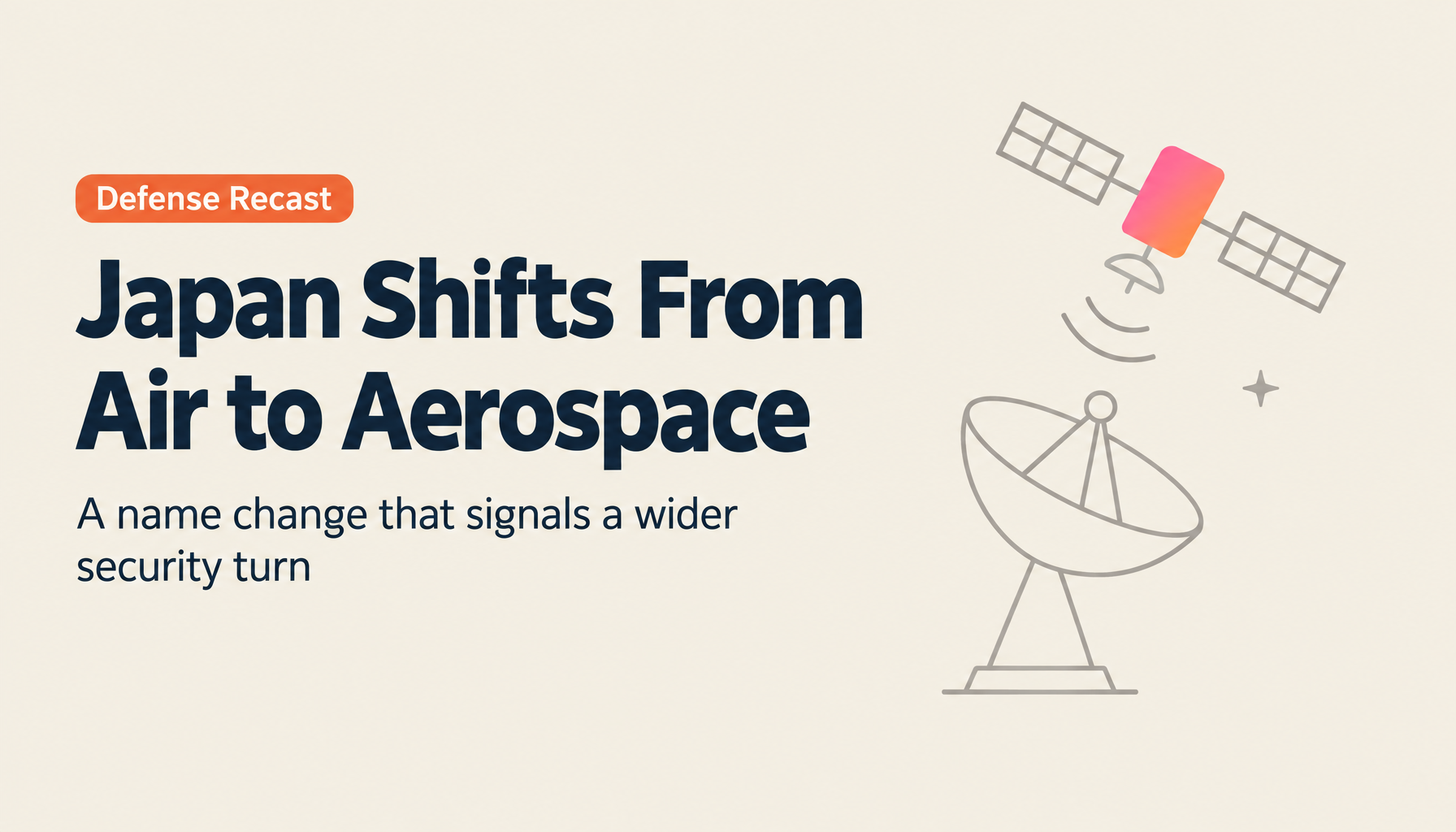
Hello, this is Ryuta Hamamoto from TIMEWELL. Japan's Prime Minister posted an explanation on X of a reorganization of the Ministry of Defense and the Self-Defense Forces. Reading it, my reaction was that the content matters but the post assumes a great deal: "Aerospace Self-Defense Force", "Space Operations Group", "SDA satellite", "upgrading the 15th Brigade to a division". None of it is explained.
This article takes that post as a starting point and rewrites it for readers without the background. And at the end I want to add something the government post does not say: in this field Japan is clearly behind. Japan's own defense ministry documents say so.
What was actually decided
On 26 June 2026 the amended Defense Ministry Establishment Act passed the House of Councillors. Three things follow.
First, the Air Self-Defense Force becomes the Aerospace Self-Defense Force. This takes effect during fiscal 2026, and is the first name change in the service's 72 years. A new Space Operations Group will be stood up, commanded by a general officer.
Second, the Ground Self-Defense Force's 15th Brigade becomes the 15th Division. The GSDF fields nine divisions and six brigades nationally; the 15th Brigade is stationed in Okinawa with its headquarters in Naha. Upgrading it adds an infantry regiment and brings the garrison units on Miyako and Ishigaki islands under its command. Personnel rise from about 2,300 to about 3,900, close to a 1.7-fold increase.
Third, the number of State Ministers of Defense rises from one to two. The stated reasons are the steady growth in overseas travel by the minister and deputies as defense cooperation expands, and the risk that when the Defense Minister is abroad, the acting minister has to run two portfolios if an emergency or major disaster occurs.
For readers unfamiliar with the distinction, a division is larger than a brigade and covers a wider area. Moving from one to the other means thickening the posture in that region.
These measures sit under the current three security documents. Revision of those documents themselves is planned within the year.
Replace siloed classification work with AI.
METI's FY2024 data shows 52% of foreign exchange law violations stem from classification errors. Download the TRAFEED product catalog covering features and rollout.
Why "space" joins "air"
Because space became a place where operations happen.
Japan now treats space, cyber and the electromagnetic spectrum as domains alongside land, sea and air. The unit handling space grew inside the Air Self-Defense Force, and the growth curve tells the story. From defense ministry material:
| Stage | Unit | Size |
|---|---|---|
| Initial | Space Operations Squadron | approx. 20 |
| Space Operations Group | approx. 70 → 120 → 200 → 310 | |
| Space Operations Wing | approx. 670 | |
| End of FY2026 | Space Operations Group (new) | approx. 880 |
From about 20 people to about 880. A 44-fold increase, with the commander now a general officer. At that point renaming the service becomes the natural step.
What does it actually do? The 1st Space Operations Group runs space situational awareness systems and the 2nd runs satellite jamming detection equipment. Laser ranging equipment enters service in fiscal 2026, and an SDA satellite launches in fiscal 2026. SDA stands for space domain awareness, and this will be the first satellite the ministry owns and operates itself, tracking debris and other countries' satellites around Japan's geostationary assets.
These are not weapons. They are equipment for seeing. If you cannot tell what is next to your satellite, whether it is closing, or whether you are being jammed, you can neither defend nor avoid.
In Ukraine, communications went first
Why the urgency? There is a clear example.
Russia's invasion of Ukraine began on 24 February 2022. About one hour before it, the US satellite communications company Viasat suffered a cyberattack on its KA-SAT service. Tens of thousands of modems were targeted and organisations across Ukraine and Europe lost satellite broadband.
Ukraine's forces depended on that service for command and control. They lost critical communications at the moment the war started.
The blast radius is instructive. In Germany, remote control of more than 7,800 wind turbines using the same modems was disrupted. An attack on communications propagated across borders into energy infrastructure. The two look like separate systems until one of them stops.
Starlink filled the gap, beginning emergency service shortly after the invasion started, and has since been assessed as indispensable to Ukraine's defence. Japan's own Air Staff College published an analysis treating commercial space companies as a decisive factor in the conflict.
A note of care. People often say Ukraine would have lost without Starlink. That is a counterfactual and cannot be proven. What can be stated is that communications were targeted an hour before the invasion, and that a private satellite constellation came to play a decisive military role. Those two facts alone carry the argument.
Japan is behind, by its own account
This is the part I most wanted to write.
Assessing Japan's position through foreign commentary invites argument. Fortunately, Japan's Ministry of Defense publishes the comparison itself, drawing on the 2025 Defense White Paper and Military Balance 2026.
On commercial satellite constellations:
| Country/region | Status |
|---|---|
| Japan | None held. Uses Starlink; trialling OneWeb and others |
| United States | Starlink (SpaceX) with approx. 10,000 satellites in operation |
| China | Guowang used as dual-use, more than 10,000 planned |
| Europe | OneWeb (Eutelsat, France) with approx. 650 in operation |
Japan's cell is empty. It does not have one, so it uses another country's private service.
In fairness, Japan is not empty-handed in space. It operates the X-band Kirameki defense communications satellites, now a three-satellite constellation after Kirameki 3 launched in fiscal 2024, is acquiring a next-generation satellite using Ka-band and optical links, and is developing a "tactical AI satellite" with onboard processing.
The gap is specifically in commercial constellations of thousands to tens of thousands of satellites. Numbers matter because redundancy matters: lose one of ten thousand and nothing stops. That redundancy is much of why Starlink worked in Ukraine. A small number of exquisite satellites can be shot out.
On space domain awareness, Japan is acquiring, launching its first SDA satellite in fiscal 2026. The United States already operates GSSAP and others while developing on-orbit refuelling and rendezvous and proximity operations. China operates SSA satellites on orbit and has flown numerous demonstrators with RPO capability.
A country about to launch its first, next to countries already operating theirs and testing what comes after. The gap is not small.
I raise this not to assign blame but because it bears on deterrence. Deterrence means convincing an adversary that acting is not worth it. Not being able to see your own satellites, and depending on a foreign company for communications, looks from the other side like a cheap place to apply pressure. This reorganization is the entry point to reducing that.
Space is not only communications
The uses run wider. Intelligence collection: optical and radar imaging, signals collection. Radar satellites work through weather and darkness, so changes on the ground can be tracked continuously. How many ships entered a port, whether a facility is expanding.
Warning and monitoring: detecting missile launches, detecting a satellite closing on yours, detecting jamming. The SSA systems, jamming detection equipment and SDA satellite all sit here.
Positioning: GPS and its equivalents now underpin logistics and agricultural automation. Lose it and economic activity, not just military operations, gets disrupted.
All of these support commerce in peacetime and carry military weight in a crisis. That dual-use character is why space-related technology and components attract export control, which puts suppliers in scope whether or not they think of themselves as defense firms. To check whether your own products touch those regimes, our export control check is a free place to start.
Closing: what a name change signals
The record. The amended act passed on 26 June 2026; the Air Self-Defense Force becomes the Aerospace Self-Defense Force during fiscal 2026, its first renaming in 72 years. The Space Operations Group will number about 880 under a general officer, and the first SDA satellite launches in fiscal 2026. The 15th Brigade becomes the 15th Division, growing from about 2,300 to about 3,900. State Ministers of Defense go from one to two. And by the ministry's own comparison, Japan holds no commercial constellation while the US operates about 10,000 satellites and China plans more than 10,000.
Renaming an organisation looks like minor news, and on its own it changes nothing. But organisations usually get renamed when what they deal with has changed. An air service adding space to its name reflects that when something happens in space, the Self-Defense Forces are no longer the only ones with a problem.
Stop communications and payments and logistics stop too. Ukraine, where communications were hit first and the damage reached German wind turbines, is the concrete case. Space is not a distant subject.
To work through how your supply chain sits within economic security frameworks, get in touch.
References
Facts are confirmed against Japanese Ministry of Defense publications and reporting. Counterfactual claims are flagged as such in the text.