Hello, this is Hamamoto from TIMEWELL.
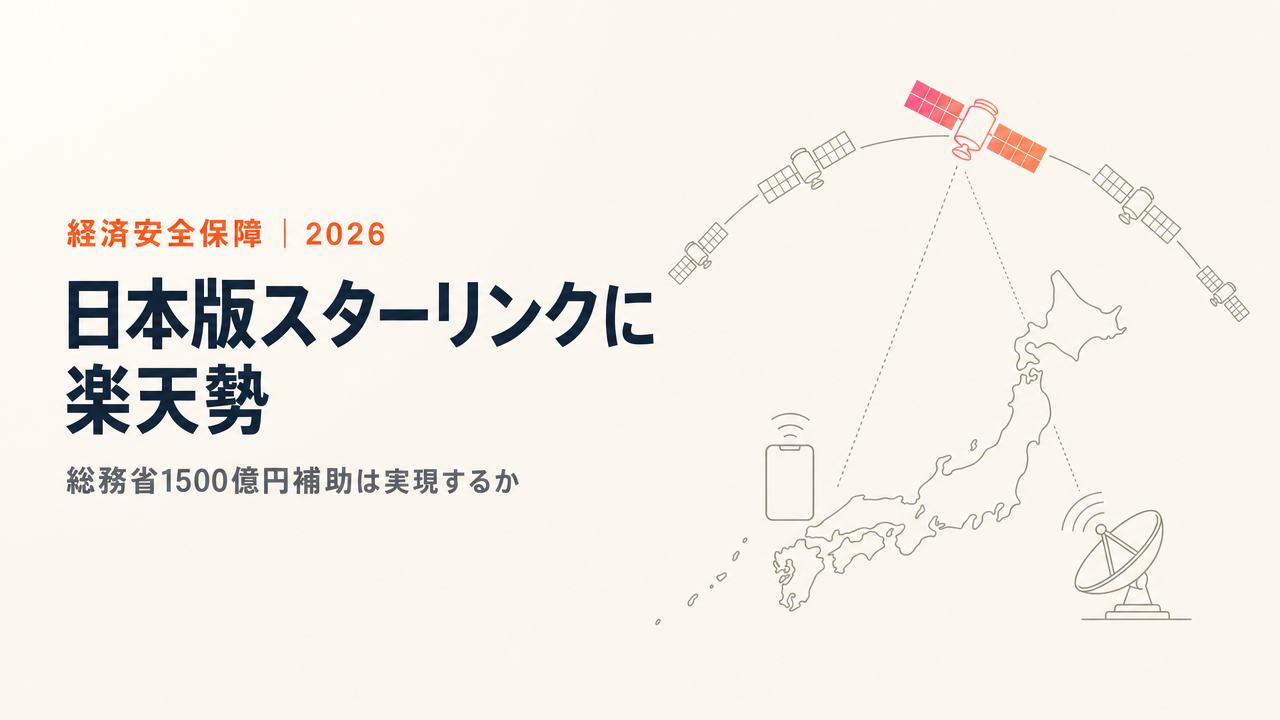
In June 2026, the Nikkei reported "A Japanese Starlink led by Rakuten," and the news spread that Japan's Ministry of Internal Affairs and Communications would subsidize up to 150 billion yen for building a communications network using low-earth-orbit satellites1. When people hear "Starlink," most picture the swarm of satellites that Elon Musk's SpaceX has launched around the world, beaming internet down directly from the sky. Even deep in the mountains or out at sea, even with no ground base station nearby, the signal reaches you. This is a plan for Japan to hold that kind of system on its own.
I see this news not as a single episode in the telecom industry but as a security issue, because communications are critical infrastructure on par with water and electricity. If a large earthquake topples the ground towers and cables, a network in the sky keeps smartphones connected. Conversely, if you rely on a single overseas company for that network in the sky, a single decision by that company could sway Japan's communications. The question of who holds the lines becomes, directly, a question of national autonomy. In this piece I will separate the facts that can be confirmed from press reports from the parts that are still undecided, and then write frankly, as the author's analysis, about whether this plan can really be achieved. Let me state my position up front: I have high hopes for this challenge, but I think a cool-headed view is also needed on two points — the amount of money and the launch means.
What is the Ministry's 150 Billion Yen J-LEO Subsidy?
First, let us pin down what the program actually is. The Ministry calls this the "Low-Earth-Orbit Satellite Infrastructure Development Project for Securing Autonomy," or J-LEO from its English initials2. A low-earth-orbit satellite is one that circles at a relatively low altitude of roughly several hundred kilometers; because it is closer to the ground, the communication delay is small, which suits direct communication with smartphones. According to the Ministry's official page, this project aims for domestic companies to manufacture, operate, and manage the satellites and to provide direct-to-cell service to commercially available smartphones. The subsidy covers the satellite system and the ground facilities, and as a requirement for securing autonomy, it demands that the gateway and control stations that command the satellites be placed inside Japan2.
The funding comes from the FY2025 supplementary budget, with the total subsidy capped at 150 billion yen13. According to press reports, the subsidy rate is capped at one-half of the total project cost, with the remainder borne by the operator4. The public solicitation closed on May 29, 2026, and the design is reported to select a single operator around the end of June 202645. Among the main targets imposed by the government are: making direct satellite communication via commercially available smartphones usable nationwide by the end of March 2029; securing quality good enough for video calls during roughly 70 percent of the hours in a day across certain areas nationwide; and, during disasters, connecting via full roaming with the mobile carriers to provide voice, data, and SMS free of charge45. The fact that even free provision during disasters is written into the requirements shows that this project is not merely support for a communications business.
Let me add one note here for readers new to the topic. Direct communication to commercially available smartphones is known by the English initials DTC, for direct-to-cell. Rather than preparing a dedicated large terminal or a parabolic antenna like a conventional satellite phone, it is a method in which the ordinary smartphone you use every day exchanges signals directly with a satellite in the sky. Even where the ground base stations are out of range, the signal reaches you as long as the sky is open. The reason J-LEO places this DTC at its core can be read as an emphasis on letting ordinary people who carry no special equipment use the service as-is, even during a disaster.
As for the crux — "who will be selected" — the press had narrowed the leading contenders to two camps. One was the alliance of Rakuten Mobile and the US firm AST SpaceMobile; the other was KDDI and the US firm SpaceX, that is, the Starlink camp45. Because the 150 billion yen is designed to go to just one operator, the two were effectively in a head-to-head contest. Then in June 2026, the Nikkei and the Yomiuri reported that the Rakuten camp was likely to be selected16. What I want to emphasize here is that these are expressions at the stage of "likely to be decided." As far as I have been able to confirm, I have not been able to trace a formal selection or a finalized grant decision in the Ministry's primary sources. As of June 2026, it is accurate to read this as report-based information.
Replace siloed classification work with AI.
METI's FY2024 data shows 52% of foreign exchange law violations stem from classification errors. Download the TRAFEED product catalog covering features and rollout.
Why Is the State Putting 150 Billion Yen Into Satellite Communications?
The reason the state is investing this much public money in one company's communications business is that this is not pure business support but security policy. What the government and the ruling party reportedly regard as a problem is the risk of depending wholly on a single overseas operator for the satellite communications network7. In reality, Starlink has become a dominant presence in the world's satellite communications, and the scene in which the course of the war in Ukraine swung on whether Starlink was available is still fresh in memory. Convenient as it is, if a foreign company decides whether to stop or continue those lines, then communications in an emergency are left in someone else's hands.
The reason J-LEO makes placing the gateway and control stations inside Japan a requirement is precisely a guard against this point2. Even if the satellites themselves are in the sky, if the ground-based brain that controls them is inside Japan and operation can continue on Japan's judgment, communications can be maintained when it matters. This is exactly the idea spoken of with the term communications sovereignty. The mandate of free full roaming during disasters is also not to be overlooked4. Even if ground base stations are lost to a tsunami or earthquake, if a commercially available smartphone connects directly to a satellite, safety confirmation and rescue requests are not cut off. It can be read as a design that positions satellite communications not as a convenient tool for some people but as a lifeline for all citizens.
The themes of satellites, space, and critical infrastructure sit directly at the center of economic security. Because technologies for semiconductors, communications equipment, and space can be diverted to military use, they tend to fall under export control, which manages who they are sold to and into whose hands they pass. The more seriously a company tackles economic security, the more it is pressed to judge, day by day, whether its products and components touch the regulations and whether its counterparties are safe. Our export control AI agent TRAFEED is used to lighten the practical load of this kind of classification work, counterparty screening, and matching against sanctions lists. The more the domestic production of satellite communications advances, the more complicated the export control of the related equipment and technology is likely to become. The full picture of economic security centered on semiconductors is laid out in the full map of semiconductors and economic security, so reading them together should make the background easier to grasp.
[Analysis] How Will the Launches Be Handled — Japan Without Its Own Rockets?
From here, I move into the author's analysis. The first point at issue is how to carry the satellites into space. At the core of the Rakuten camp is AST SpaceMobile, a US company that Rakuten Mobile invested in back in 2020. Press reports put the investment at around 30 billion yen with an initial stake of about 20 percent, but I have not been able to confirm the exact current ratio after subsequent dilution8. AST's strength lies in its direct-communication technology, which connects an ordinary smartphone in hand to a satellite as-is, without using a dedicated antenna or terminal. In 2024, Rakuten Mobile announced it aimed to provide domestic service within 20269, and in April 2025 it disclosed that it had succeeded in a video call via direct communication between a low-earth-orbit satellite and a commercially available smartphone — a first inside Japan10. The commercial service is reported to be planned to start around the year-end shopping season of 20269.
The problem is the launches. AST's satellites are large units called BlueBird; units 8 through 10 were placed into orbit on June 17, 2026, with a plan to line up 45 to 60 units by the end of 202611. However, these are being launched on US rockets. Japan's mainstay rocket, the H3, was developed by Mitsubishi Heavy Industries and JAXA; in its minimum configuration the target launch cost is around 5 billion yen, and it is at the stage of aiming for six launches a year. The sixth unit flew in June 2026, but the view has been put forward that its price competitiveness will only come into view somewhere around the tenth to fifteenth units12. Moreover, the H3 is expendable and does not reuse its airframe. Turning to the private sector, Interstellar Technologies' small rocket ZERO is still at the stage of repeated combustion tests in 2026 and has not yet flown into space13. Japan's launches account for less than 1 percent of the world's share, and the reality is that more than 90 percent of domestic satellites go up on overseas rockets13.
J-LEO's autonomy requirements rest squarely on domestic operation and control, and do not bind the launch means to domestic rockets2. That is exactly why it is a realistic program, but turned around, it means that even when we say "our own satellite communications," the satellite bodies use US technology and the launches will for the time being rely on overseas rockets — that structure remains. In my assessment, the autonomy that can be secured here lies not in the power to launch satellites but in the control layer that keeps the orbiting satellites operating on Japan's judgment. The broad current in which AI's compute demand is spilling over even into space and energy is dealt with in AI's power, data centers, and space, but when you think about the question of who can grasp space infrastructure and how far, I believe that, for the time being, launches will remain a weak point for Japan.
[Analysis] Is 150 Billion Yen Enough — the Order-of-Magnitude Gap With Starlink?
The next point at issue is money. Please read this, too, as the author's analysis. The figure of 150 billion yen looks large as a single-shot subsidy from the state. But in the world of satellite communications, sums one or even two orders of magnitude larger are in motion. Converting at roughly 150 yen to the dollar, 150 billion yen is about 1 billion dollars. Starlink, on the other hand, was reported in 2018 to carry a build-out estimate of around 10 billion dollars — a press-reported figure that we have not been able to confirm against a primary source — and the actual investment that followed has swelled further. According to CNBC, the connectivity business has reached a scale of over 10 billion dollars in annual revenue14. Lined up simply, Japan's subsidy comes to only about one-tenth of Starlink's initial estimate.
There is also a large gap in launch cost efficiency. SpaceX's Falcon 9 can reuse its booster, and is planned to carry out around 140 launches a year in 202615. In December 2022 the FCC granted SpaceX authority to deploy 7,500 second-generation Starlink satellites — a partial grant out of the 29,988 it had applied for — on top of the 4,408 first-generation satellites it was already licensed to fly16. That scale holds together precisely because of the vertical integration of spinning reusable rockets at high frequency and continuing to put its own satellites up on its own rockets. There is, it must be said, a structural gap with Japan, which can fly expendable rockets only a few times a year.
So is 150 billion yen meaningless? The interesting thing is that you cannot quite conclude that, either. What J-LEO aims for is not Starlink-style general-purpose broadband with tens of thousands of satellites; it narrows its purpose to direct-to-cell service and to covering Japan's national land. Because AST's approach uses large single units and is oriented toward operating a small number of satellites, the number of satellites needed and the total cost may come out smaller than a general-purpose mega-constellation. On top of that, if the subsidy rate is capped at half, then the total project cost is assumed to be on the order of 300 billion yen, with the remaining half borne by Rakuten and AST4. The point that Rakuten Mobile carries accumulated losses has been flagged as a financial risk in the press as well7, and how that is shored up will be the key to feasibility. In my assessment, completing a full-spec network of one's own in one go with 150 billion yen is tough on the numbers, and in reality the design will inevitably have to be premised on a phased build narrowed to specific uses, combined with partnerships using overseas rockets and technology. This is not a definitive judgment but a prospect drawn from the materials visible at present.
My Hopes for Rakuten, and What Will Be Asked Going Forward
Finally, let me write my own frank hopes. Rakuten is a challenger that originally barged into Japan's mobile market as the fourth carrier and rewrote the conventional wisdom on pricing. It is also a company that stepped into the bet — initially called reckless — of building base stations cheaply with its own virtualization technology. That same company is now trying to extend a communications network into the sky. In the very structure of a private-sector challenger raising its hand head-on to a theme bound up with national autonomy — whether Japan can hold communications that do not depend on a single overseas company — I place my hopes.
Of course, hope and feasibility are separate matters. As we have seen, both the satellite bodies and the launches must rely on overseas sources for the time being, and the 150 billion yen subsidy is an order of magnitude smaller than Starlink's scale. Questions remain over whether the requirement4 to make direct communication usable nationwide by the end of March 2029 can really be met while repeatedly revising the plan5, and whether the financial stamina will hold. Even so, the design of placing operation and control inside Japan and securing the core of communications sovereignty is, I think, a step that makes sense for Japan today. Who holds communications in the sky bears directly on our lives — in disasters, in emergencies, and in the economy of ordinary times alike.
Satellite communications, space, and critical infrastructure are continuous with the practical work of economic security, such as export control and counterparty screening. If you are at a company whose products or technologies touch on these areas and you are unsure how to run your classification work or counterparty screening, please get in touch via an individual consultation. Rather than scrambling once the press starts moving, pinning down the points at issue ahead of time tends, in the end, to make it easier to move forward.
If you are reviewing export-control operations or classification workflows, download the TRAFEED product catalog (PDF) or contact us.
References
Footnotes
-
A Japanese Starlink led by Rakuten — own satellite communications, the Ministry to subsidize 150 billion yen — Nikkei — June 2026 ↩ ↩2 ↩3
-
Low-Earth-Orbit Satellite Infrastructure Development Project for Securing Autonomy (J-LEO) — Ministry of Internal Affairs and Communications — accessed June 29, 2026 ↩ ↩2 ↩3 ↩4
-
The Ministry to put 150 billion yen into "low-earth-orbit satellite infrastructure development," toward domestic production of LEO constellations — BUSINESS NETWORK — 2026 ↩
-
"Japanese Starlink" J-LEO, public solicitation closes — 150 billion yen toward a satellite network that stays connected even in disasters — Tokyo News Media — 2026 ↩ ↩2 ↩3 ↩4 ↩5 ↩6 ↩7
-
The "Japanese Starlink" nears selection, who gets the nod? The Rakuten-AST camp has substantially revised its plan — ITmedia NEWS — June 9, 2026 ↩ ↩2 ↩3 ↩4
-
Rakuten to build a "satellite communications network" not dependent on overseas players, countering Starlink — Yomiuri Shimbun (reposted on Yahoo! News) — June 24, 2026 ↩
-
Rakuten enters its own satellite communications, breaking free of Starlink dependence via a joint venture with AST, with up to 150 billion yen in government support in view — BigGo Finance — 2026 ↩ ↩2
-
AT&T and Google also invest in "AST SpaceMobile," the satellite communications firm Rakuten Mobile has invested in — Ketai Watch (Impress) ↩
-
Announcing a plan aiming to provide domestic service via direct satellite-to-mobile communication with AST SpaceMobile within 2026 — Rakuten Mobile — February 16, 2024 ↩ ↩2
-
Success in a video call via a direct communication test between a low-earth-orbit satellite and a commercially available smartphone — a first inside Japan — Rakuten Mobile — April 23, 2025 ↩
-
AST SpaceMobile Announces Successful Orbital Launch of BlueBirds 8, 9, and 10 — AST SpaceMobile — June 17, 2026 ↩
-
H3 rocket toward more launches, "changing boldly" says Mitsubishi Heavy Industries' launch site director — Nikkei — 2025 ↩
-
Rocket ZERO development and launch status — Interstellar Technologies — 2026 ↩ ↩2
-
SpaceX is heavily reliant on Starlink for growth and profit as it marches toward Nasdaq listing — CNBC — May 21, 2026 ↩
-
Falcon 9 Specs & Launch Stats (reuse and launch count) — Orbital Radar — 2026 ↩
-
Space Exploration Holdings, LLC, Request for Orbital Deployment and Operating Authority for the SpaceX Gen2 NGSO Satellite System — Order and Authorization (FCC 22-91), adopted November 29, 2022, released December 1, 2022 — Federal Communications Commission. Grants in part SpaceX's application for 29,988 Gen2 Starlink satellites by authorizing up to 7,500, alongside the 4,408 Gen1 satellites already licensed. ↩