Hello, this is Ryuta Hamamoto from TIMEWELL.
On July 21, 2026, Japan's Cabinet approved the "Basic Policy on Economic and Fiscal Management and Reform 2026" — the document everyone calls the honebuto, or "Big-Boned Policy." It sets the country's broad economic and fiscal direction, but this year it also writes defense into fairly concrete language.
From where I sit at TRAFEED, working on export control day to day, this document does not stop at "defense." Right next to the defense buildup sit the practical pieces of economic security — export control, investment screening, management of critical technology — and those reach ordinary manufacturers and trading companies too. The government also published a figure-based deck, so I'll read it through those figures, from a company's point of view.
Summary first
- The policy states Japan will transform its defense capability within five years, across both equipment and structure. Data and AI, unmanned assets, and stand-off defense capability that can also serve a counterstrike role are used to adapt to a "new way of fighting."
- It accelerates review of the "three documents" (starting with the National Security Strategy) and strengthens total national power, extending into space, cyber, and intelligence.
- Alongside defense, it sets out economic security: strengthening export control, an inward-investment review committee, operation of the amended Foreign Exchange and Foreign Trade Act (Act No. 30 of 2026), management of critical technology, and research security.
- This reaches beyond defense firms — straight into the day-to-day of companies handling materials, chemicals, medical devices, or semiconductors: classification and counterparty screening.
Replace siloed classification work with AI.
METI's FY2024 data shows 52% of foreign exchange law violations stem from classification errors. Download the TRAFEED product catalog covering features and rollout.
What was actually decided
The full title is "Basic Policy on Economic and Fiscal Management and Reform 2026." The Cabinet approved it on July 21, 20261.
Defense appears in Chapter 2, "Strengthening Japan's growth potential and securing safety," under section 2, "Establishing strong diplomacy and security," which splits into (1) strengthening diplomacy, security and intelligence, and (2) strengthening economic security. Let's start with the whole picture, using the Cabinet Office's own PR figure.
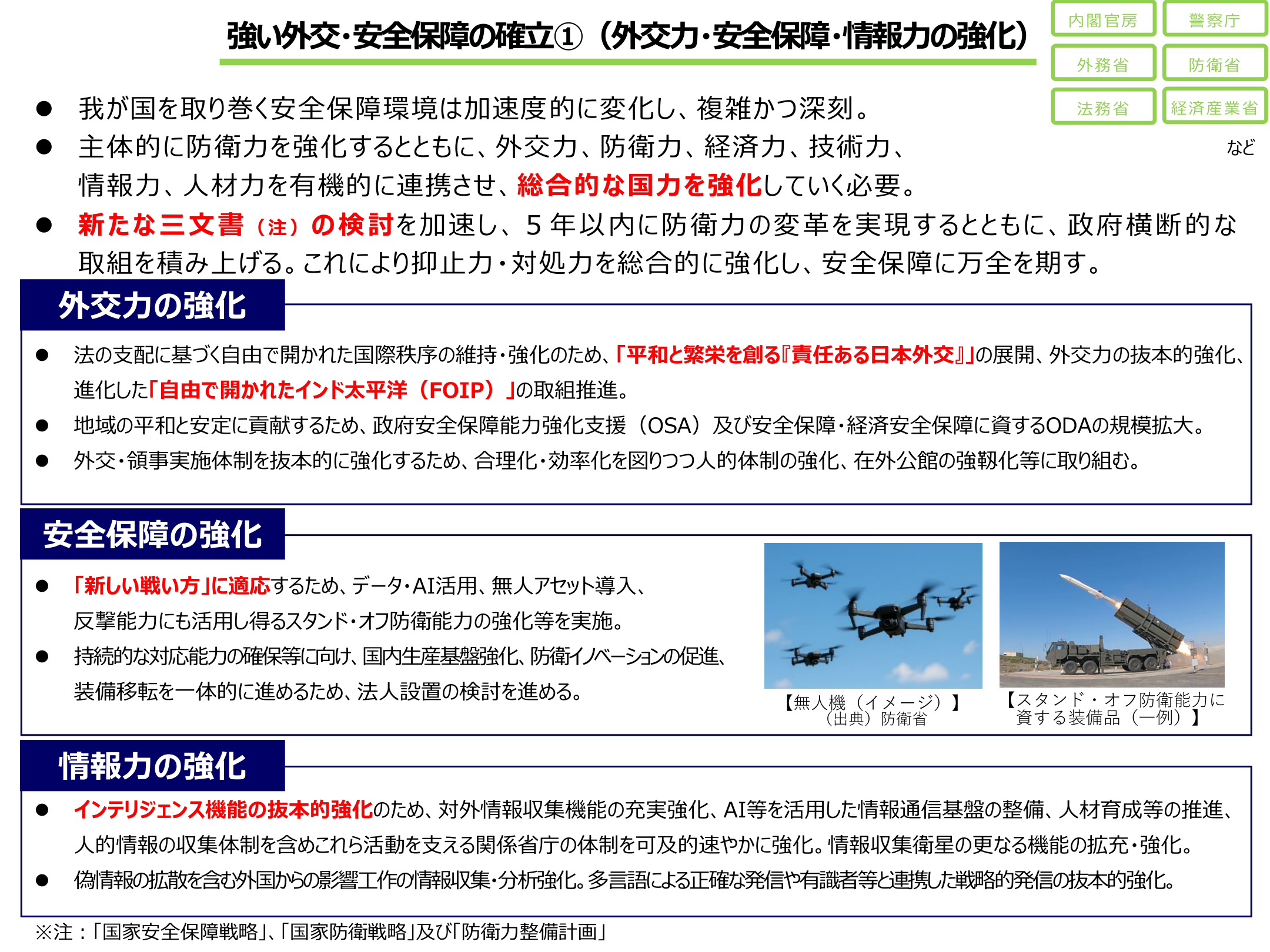
Source: Cabinet Office, "Big-Boned Policy 2026 PR material (policy file)" (Cabinet decision, July 21, 2026)2
The keyword sitting in the middle of the figure is "strengthen total national power," linking diplomacy, defense, economic power, technology, intelligence, and human resources. Rather than carving out defense on its own, it treats defense as one strand woven together with the economy and technology. That tone is what stands out this year.
The defense pillar: a "new way of fighting" within five years
The policy text (under "strengthening security") reads: "To exercise highly autonomous and resilient capability, transform defense within five years across both equipment and structure. Adapt to a 'new way of fighting' through the use of data and AI, the introduction of unmanned assets, and stronger stand-off defense capability that can also be used for a counterstrike capability"3.
In plainer terms:
- Unmanned assets: drones, uncrewed vessels — equipment without people on board. The figure even carries an image of an unmanned aircraft (source: Ministry of Defense).
- Stand-off defense capability: the ability to respond from outside the opponent's range, from a distance. The text explicitly says it can also serve a counterstrike role.
- Data and AI: not just the equipment, but the foundation of how one fights.
The people side is concrete too. Facing intensifying competition for talent, it lists pay-scale revision and other improvements to the treatment of Self-Defense personnel, support for retired personnel and their families (including consideration of a new agency), and a fundamental strengthening of the Ministry of Defense's organization3.
The "base" that builds and keeps equipment running also gets attention. With a review of the Defense Production Base Strengthening Act in view, it considers state involvement — such as GOCO (government-owned, contractor-operated) — for critical equipment that is hard to supply reliably, and stronger surge-production capacity in peacetime. On equipment transfer, it advances state-led transfer, financing, and hands-on support. And through greater use of startups and the build-out of defense research bases at national R&D institutes and universities, it aims to take in cutting-edge technology quickly — with consideration of a corporation to drive all this with assured state involvement3.
That last part is quietly a big shift, I think. A doorway for startups and universities — long distant from defense research and equipment transfer — has been opened as government policy.
The surrounding measures line up too: strengthening the deterrence and response of the Japan-U.S. alliance and cooperation with like-minded countries; realignment of U.S. forces in Japan; reinforcing the Japan Coast Guard's patrol vessels and its use of unmanned craft; securing shelters under the "shelter policy," and civil-protection drills for evacuating residents of the Sakishima Islands; building satellite constellations for space security; and, on cyber, steady implementation of the Active Cyber Defense laws and a conclusion within 2026 on introducing cloud that can handle highly confidential information3.
Intelligence became its own pillar. It writes in the establishment of a National Intelligence Council and National Intelligence Service, stronger collection and analysis, more imagery-intelligence satellites, and countering foreign influence operations — including the spread of disinformation (cognitive-domain response)4.
This is the part where I honestly thought, "that's the era we're in." The weight has clearly moved from purely physical equipment toward the harder-to-see domains: data, space, cyber, intelligence.
Economic security: this is what reaches ordinary companies
Now the part I care about most at TRAFEED — section (2), economic security. It opens, continuous with defense: "economic security is two sides of the same coin as crisis-management investment and growth investment"5.
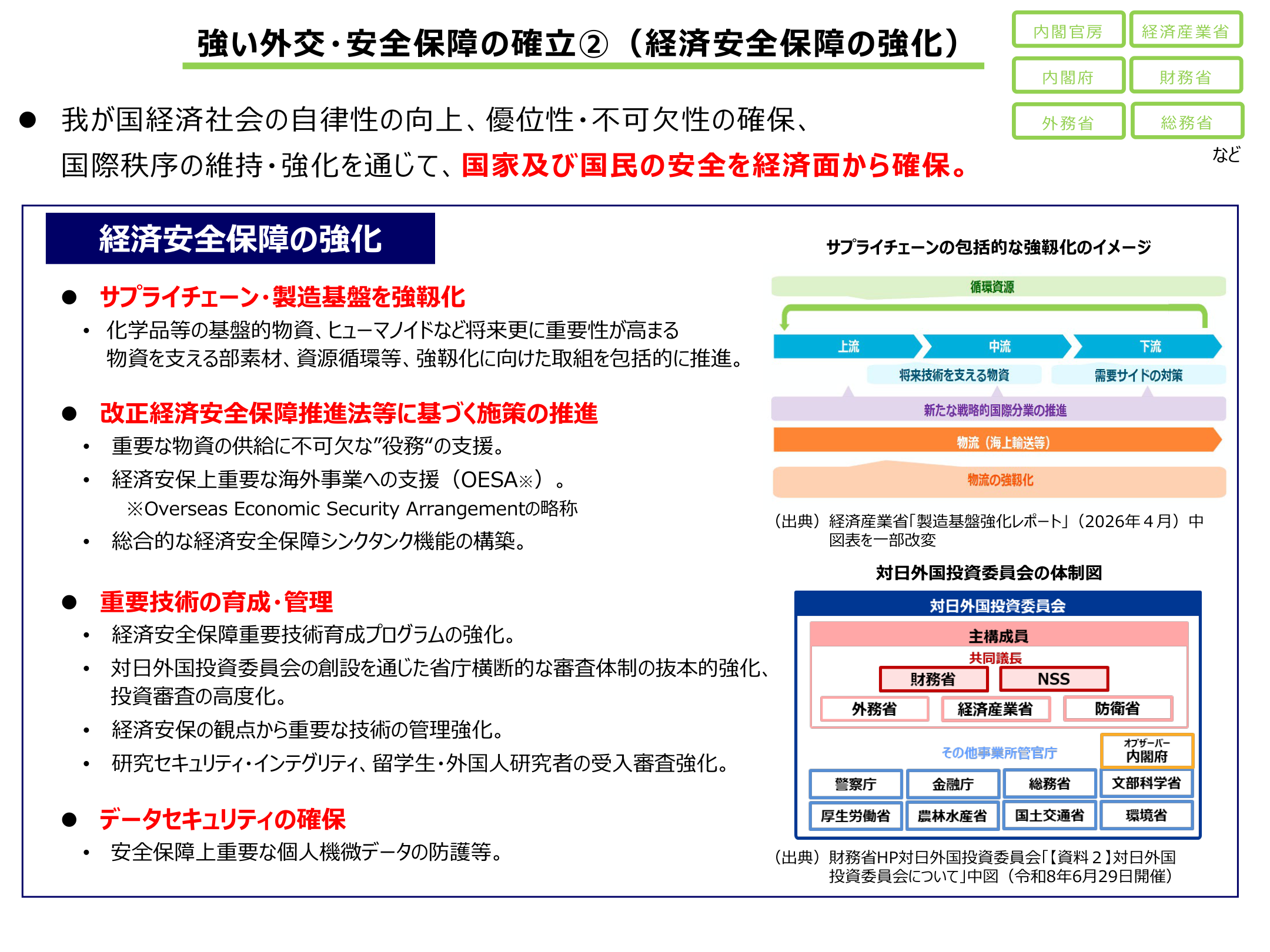
Source: Cabinet Office, "Big-Boned Policy 2026 PR material (policy file)" (Cabinet decision, July 21, 2026)2
On the right of the figure are an "image of comprehensively strengthening the supply chain" (source: METI "Manufacturing Base Strengthening Report," April 2026) and an "organization chart of the inward-investment review committee" (source: Ministry of Finance). Here are the points from the text, pulled toward company practice.
- Strengthening supply chains and the manufacturing base: a comprehensive risk review — including maritime logistics — of goods needed to sustain daily life and industry, such as energy, food, pharmaceuticals, medical devices, and daily necessities. Support is widened to essential base materials (including general-purpose goods), components and materials, and resource circulation5.
- Amended Economic Security Promotion Act / OESA: on top of securing stable supply of critical goods, support for economically security-critical overseas projects (OESA: Overseas Economic Security Arrangement), aiming to build a comprehensive economic-security think-tank function within FY20265.
- Developing and managing critical technology: strengthening the "Key and Advanced Technology R&D through Cross Community Collaboration Program," promoting international joint research, and — via an inward-investment review committee — a fundamental strengthening of cross-ministry screening and more sophisticated investment review under the amended Foreign Exchange and Foreign Trade Act (Act No. 30 of 2026)6.
- Research security: ensuring research security and integrity, and tighter admission screening for international students and foreign researchers6.
- Strengthening export control: alongside stronger responses to economic coercion and various sanctions, it states plainly that Japan will "work to strengthen export control"6.
That last sentence is one I can't overlook, given what I do. When "strengthening export control" is written into the top-level government policy, it signals that practices like classification and counterparty screening will be asked of an ever-wider set of companies.
The "inward-investment review committee" is worth watching too. Many readers will picture the U.S. CFIUS; Japan has now brought a cross-ministry structure for screening investment to the front. For companies that take in foreign capital, it's a point you can't ignore.
What companies should keep in mind
Plenty of companies feel defense has nothing to do with them. But read the Big-Boned Policy 2026 as a whole, and the line keeps blurring. Here are three things I'd keep in mind, in practice.
- Check once whether your product or technology is "dual-use." Pharmaceuticals, medical devices, chemicals, materials, semiconductors, aerospace parts — even civil goods can touch export controls depending on spec or composition. The starting point is confirming and recording the classification, including a "not controlled" result.
- Make counterparty and investor screening a system. Stronger export control and more sophisticated inward-investment review both push you to verify who you deal with and who provides your capital. Better a repeatable procedure than a person-by-person check.
- Set up research and technology management as "defense." Companies with joint research with universities or startups, or that host international students or foreign researchers, will face research-security expectations from the regulatory side.
TRAFEED is an AI agent that supports export-control classification, matching against control lists, and counterparty screening. Chasing every regulatory move by hand is, frankly, a real burden. As a way to run this without it hinging on one person, I'd be glad if it were one of your options. Treat the current legal text and your own export-control officer as authoritative for final classification and licensing.
Wrap-up
- The Big-Boned Policy 2026 (Cabinet decision, July 21, 2026) writes in a five-year transformation of defense and accelerated review of the three documents, clearly showing the shift toward unmanned, stand-off, data/AI, space, cyber, and intelligence.
- Together with defense, economic security is set out: strengthening export control, an inward-investment review committee, the amended FEFTA, management of critical technology, and research security.
- This reaches beyond defense firms — into the everyday classification, counterparty screening, and research management of a wide range of industries.
- Start by checking whether your product or technology is dual-use, and keep that check as a record. That's the realistic place to begin.
The language of policy is stiff, but the task is simple: confirm your own position, once and properly. This year's policy simply put the government's weight behind why that matters.
Sources (primary)
Footnotes
-
Cabinet Office, "On the Basic Policy on Economic and Fiscal Management and Reform 2026" (Cabinet decision, July 21, 2026). https://www5.cao.go.jp/keizai-shimon/kaigi/cabinet/honebuto/2026/decision0721.html ↩
-
Cabinet Office, "Big-Boned Policy 2026 PR material (policy file)" (July 2026). The figures here reproduce the relevant pages ("Establishing strong diplomacy and security (1) and (2)"), with the source cited. https://www5.cao.go.jp/keizai-shimon/kaigi/cabinet/honebuto/2026/seisakufile_ja.pdf ↩ ↩2
-
Cabinet Office, "Basic Policy on Economic and Fiscal Management and Reform 2026," Chapter 2, section 2(1), "(Strengthening security)." https://www5.cao.go.jp/keizai-shimon/kaigi/cabinet/honebuto/2026/2026_basicpolicies_ja.pdf ↩ ↩2 ↩3 ↩4
-
Same text, Chapter 2, section 2(1), "(Strengthening intelligence)." ↩
-
Same text, Chapter 2, section 2(2), "Strengthening economic security." ↩ ↩2 ↩3
-
Same text, Chapter 2, section 2(2), based on the passages on the inward-investment review committee, the amended Foreign Exchange and Foreign Trade Act (Act No. 30 of 2026), and strengthening export control. ↩ ↩2 ↩3