Community Manager Workflow Reform: Building Systems for Efficiency and Consistent Content
Hello, I'm Hamamoto from TIMEWELL. Today I'll walk through how to reform the community manager's workflow — building operational efficiency and creating the systems that make consistent publishing sustainable.
"I'm buried in tasks from morning to night." "I have things I want to do, but there's never enough time." "My posting schedule keeps slipping."
These are the realities I hear regularly. This guide covers efficient work practices and the systems that make continuity possible — in substantial detail.
Chapter 1: The Community Manager's Reality
A Wide-Ranging Job
The community manager's responsibilities span a lot of ground: content creation, SNS management, member communication, event planning, analysis and improvement. Trying to handle all of it alone means time is always the constraint.
Primary tasks and time allocation (before optimization):
| Task | Time per day | Challenge |
|---|---|---|
| Message handling | 2 hours | Answering the same questions repeatedly |
| SNS posting | 1.5 hours | Ideation takes too long |
| Banner/image creation | 1 hour | Design skills gap |
| Analysis and reporting | 1 hour | Manual data collection |
| Content creation | Remaining time | Never enough of it |
Table 1: Task time allocation before optimization
A Day Before Optimization
9:00–12:00 (Morning) Start with email and DM review. Responding to each message one by one takes until 11am. Attempt to plan an SNS post, but ideas aren't coming — rush something out just before noon.
13:00–18:00 (Afternoon) Create an event banner in a design tool — struggles with the interface eat up two hours. Write announcement copy and post manually to each platform. Put together a retrospective report.
Result: The work that should generate the most value — content creation — gets almost no time.
Looking for AI training and consulting?
Learn about WARP training programs and consulting services in our materials.
Chapter 2: A Day After Optimization
What Changes With AI Tools
9:00–12:00 (Morning) Check today's tasks on the BASE dashboard. AI has already suggested recommended post themes and reply templates. Message handling done in 30 minutes. SNS posting done in 5 minutes. Use the remaining time to build next month's content calendar.
13:00–18:00 (Afternoon) Event banner AI-generated in 5 minutes. Announcement copy AI-generated and batch-posted in 30 minutes. Dedicated content creation time: 2.5 hours. Analytics: check the dashboard, done.
Time comparison before and after optimization:
| Task | Before | After | Reduction |
|---|---|---|---|
| Message handling | 2 hours | 30 min | 75% |
| SNS posting | 1.5 hours | 15 min | 83% |
| Banner creation | 1 hour | 5 min | 92% |
| Analysis/reporting | 1 hour | 15 min | 75% |
| Content creation | Remaining | 3+ hours | Significant increase |
Table 2: Before and after comparison
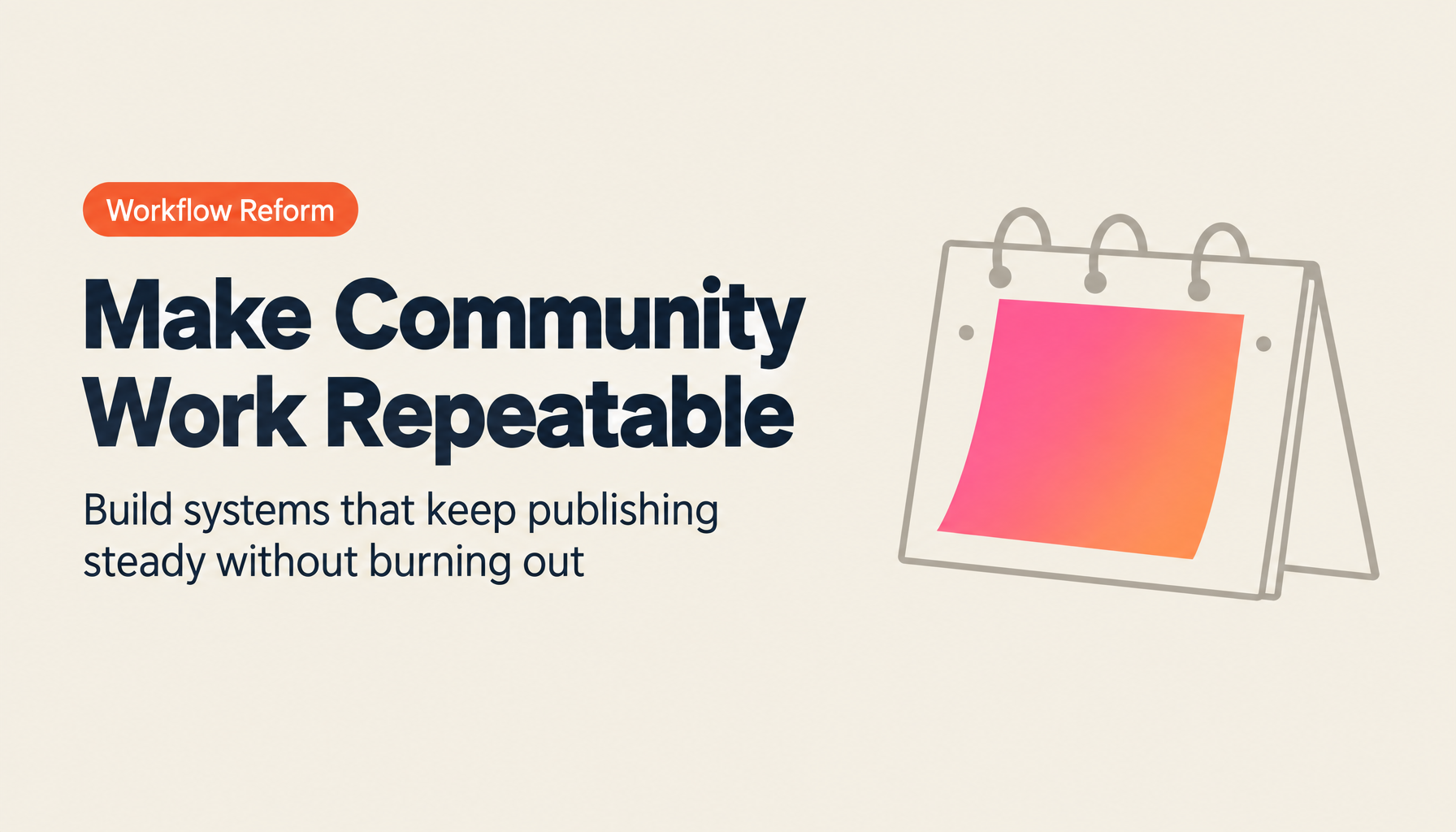
Chapter 3: Building a Content Calendar
Why a Content Calendar Is Essential
Deciding "what should I post today?" from scratch every single day eventually leads to burnout. Planning ahead — making visible what you'll publish and when — is how consistent publishing becomes a system rather than a daily struggle.
Calendar benefits:
- Planned publishing improves content quality and consistency
- Prevents content drought and enables sustained output
- Clarifies role division when working with a team
- Seasonal events can be planned and incorporated in advance
- Easier to review results and drive improvement
Five Steps to Building a Content Calendar
Step 1: Map your publishing channels Take stock of where you publish — inside the community (Slack, Discord), SNS (X, Instagram), email newsletter, blog — and organize what you're working with.
Step 2: Set publishing frequency Decide how often you'll publish on each channel. Setting a sustainable frequency is essential — ambition that can't be maintained is worse than a lower but reliable cadence.
Recommended frequency guidelines:
| Channel | Recommended Frequency |
|---|---|
| X | Daily to 3x/week |
| Instagram feed | 2–3x/week |
| Instagram Stories | Daily |
| Community (internal) | 2–3x/week |
| Email newsletter | Weekly |
Table 3: Recommended frequency by channel
Step 3: Define your content pillars Establish categories — "pillars" — for what you publish.
Pillar examples:
- Knowledge sharing
- Member features
- Event announcements
- Q&A
- Industry news
- Behind-the-scenes
Assigning pillars to specific days creates pattern: "Monday = knowledge, Wednesday = Q&A, Friday = event announcement."
Step 4: Add annual and monthly events Incorporate seasonal events, industry events, and your own events into the calendar in advance. This makes timely publishing possible rather than reactive.
Step 5: Fill in specific content Start with 1–2 weeks out; once you're comfortable, extend to a month ahead. You don't need to define everything in detail — a rough plan is better than no plan.
Chapter 4: Operational Practices
Build in Flexibility
The calendar is a plan, not a contract. If something timely comes up, adapt. Build in flex days and buffer slots from the start.
Protect Buffer Time
Filling every day with planned content eliminates your margin. Keeping some buffer lets you absorb delays without the whole schedule collapsing.
Regular Review and Improvement
Review regularly — weekly or monthly — and apply what you learn.
Review checkpoints:
- Which content generated the best response?
- Which days and times had the highest engagement?
- What caused updates to slip?
- What should change in the next cycle?
Chapter 5: What to Do With the Time You Save
Elevate Content Quality
Use the time efficiency creates to produce content worth producing. Not "good enough for today" under time pressure — but content you've actually thought through.
Invest in Member Relationships
A community's value is determined by the depth of relationships within it. Listening to individual members, understanding their situations, and offering genuine support — this "human connection" work is the part that can't be systematized.
Efficiency creates the time for this essential work.
Strategic Thinking
When you're perpetually buried in execution, there's no space to step back and ask "is this working?" or "is there a better approach?"
Efficiency preserves the time to think strategically. Community direction, new initiatives, long-term vision — this level of thinking is what drives actual growth, not just maintenance.
Continuous Learning
Community managers need to keep learning — industry trends, new tools, case studies from other communities. Protecting input time makes better operations possible.
Chapter 6: How BASE Supports Efficiency
AI Content Suggestions
BASE's AI recommends what to post on specific days — drawing on past posting patterns, seasonal events, and current trends. The "what should I post?" anxiety is significantly reduced.
Calendar Feature
BASE has a built-in content calendar — planning and execution connect seamlessly. Content scheduled on the calendar converts directly to scheduled posts. Team sharing is simple.
Message Templates
The AI suggests reply templates for frequently asked questions. Review and send — that's it. Only the messages requiring individual attention need to be written from scratch.
Analytics Dashboard
Member activity, post engagement, and churn rate trends are automatically aggregated and visualized. No more manual data collection.
Conclusion: Choose Consciously What You Spend Time On
A community manager's work is never fully done. That's precisely why it matters to be intentional about where time goes.
Delegate what can be delegated to tools. Reserve human time for what only humans can do. This distinction is the key to producing the most value within limited time.
Plan with a content calendar, systematize with AI, and use the time created to deepen relationships with members. Building this positive cycle is what makes sustainable community operations possible.
BASE is a platform designed to support community manager efficiency — streamlining the daily work so you can spend your time on what actually matters. Let us help.
References [1] CMX, "Community Manager Productivity Report," 2025 [2] Content Marketing Institute, "Content Calendar Best Practices," 2026