¥2,000 in Fees on a Single Ticket — Why Japan's Ticketing Giants Get Away with Stacking Charges
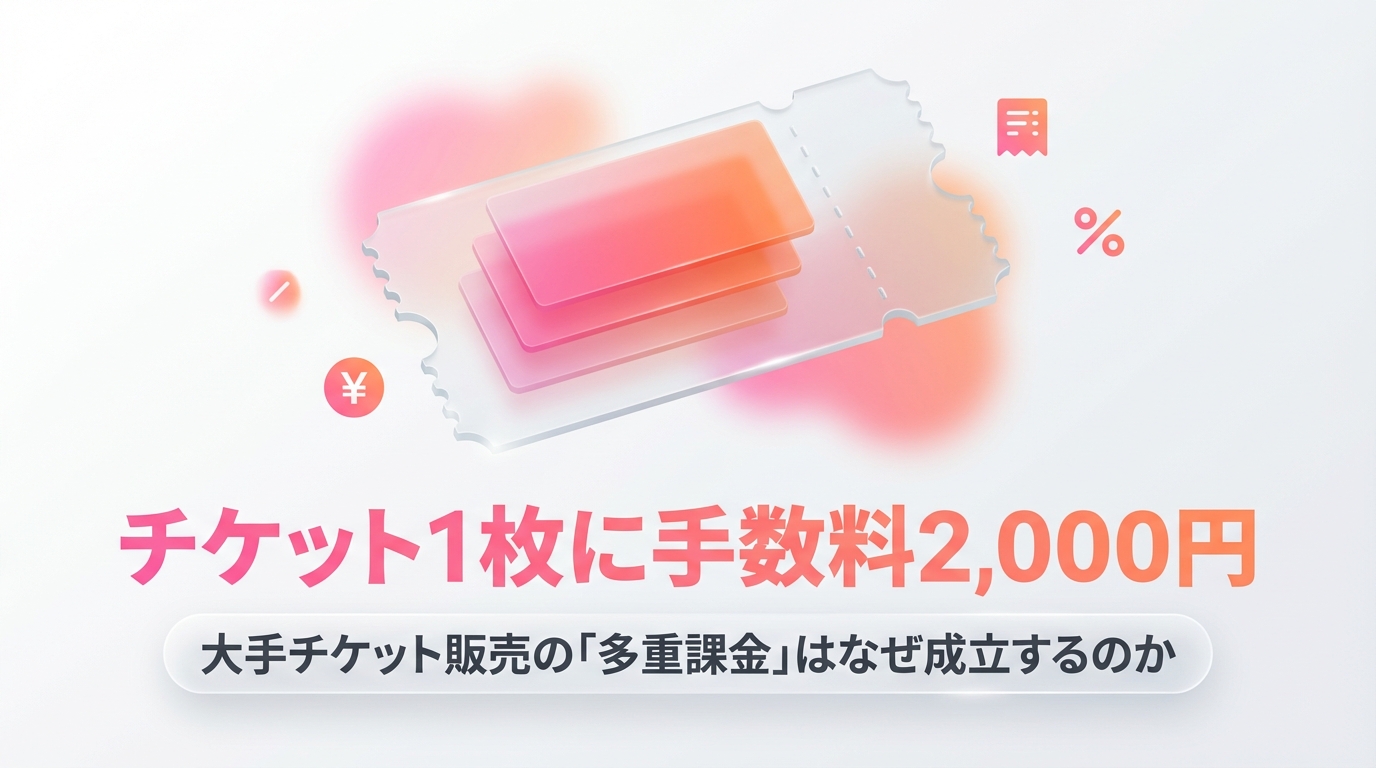
You buy a ¥5,000 concert ticket, but the checkout screen shows ¥6,600. The ¥1,600 gap is made up of a system usage fee, a ticket issuance fee, a payment processing fee, and something called a "special sales fee." Vaguely named charges that add up to over 30% of the ticket price. The Nikkei reported on this issue in June 2025 under the headline "Ticket fees hit ¥2,000 — the heartless cost of being a fan" [1], and in March 2026 it blew up again. An ITmedia Business Online article titled "From a ¥6.66 billion loss to record profits in four years — what did Pia change?" [2] went viral on X (formerly Twitter). "What they changed was the fees," quipped one user, and the backlash snowballed into thousands of posts. Honestly, we share the frustration. But outrage alone changes nothing. In this article, we examine why Japan's major ticketing platforms (called "play guides" in industry parlance) have this fee structure, what each fee actually covers, and a hidden revenue stream most consumers don't know exists — all backed by publicly available data.
Four Layers of Fees Stacked on a Single Ticket
Let's start with the numbers. The table below is compiled from Ticket Pia's official "Fee Schedule" page and a J-CAST News interview with Pia's PR team, reflecting the October 2024 pricing revision [3][4].
| Fee Name | Amount (tax incl.) | Varies by Payment | Pia's Official Explanation |
|---|---|---|---|
| System usage fee | ¥330/ticket | Flat | System operation, development, service maintenance, security |
| Issuance fee | ¥165/ticket | Flat | Fees to partner convenience stores/e-ticket operators, special paper, distribution costs |
| Payment fee | Credit card: ¥0 / Convenience store: ¥330/order | Varies | Convenience store payment processing, communications, payment system operation |
| Special sales fee | ¥550+/ticket (varies by show) | Pre-sale only | Sales plan setup, lottery system operation, staffing for pre-sale logistics |
With credit card payment on a standard sale, the total fee is ¥495 per ticket (¥330 system + ¥165 issuance). Switch to convenience store payment and it jumps to ¥825. Add a pre-sale and the special sales fee pushes the total to ¥1,375 or more [3]. For example, in a Pia pre-sale lottery for sumo wrestling, the breakdown is: special sales fee ¥550 + system fee ¥330 + issuance fee ¥165 + convenience store payment ¥330 = ¥1,375 total [5].
One widely shared case on X: a ¥1,900 outfield seat with ¥825 in convenience store payment fees — 43% of the ticket price [6]. A standard sale with convenience store payment, but it perfectly illustrates how cheaper tickets get hit hardest. A ¥13,000 theater ticket absorbs ¥825 at just 6%, but ¥1,900 at 43% is a different story. The flat-per-ticket fee design places a disproportionate burden on casual fans and younger audiences.
Lawson Ticket and e+ follow the same pattern. In April 2025, Lawson Ticket raised its system fee from ¥220 to ¥330 and its in-store issuance fee from ¥110 to ¥165 [7]. e+ raised its bank transfer fee by ¥110 in November 2024 [7]. With all three majors hiking prices in lockstep, users on X mockingly dubbed them the "Reiwa Price-Fixing Trio."
If you run events yourself and want to see where your event or community operations stand, we offer a free community health check that takes just a few minutes.
Looking to optimize community management?
We have prepared materials on BASE best practices and success stories.
What Each Fee Actually Covers — Checking the Claims Against Reality
This is the core of the article. We take Pia's PR team's explanations from the J-CAST News interview [4] and check them against industry data, one by one.
System Usage Fee (¥330/ticket): What System Costs ¥330?
Pia's official explanation: "Costs for operating and developing the overall ticket sales system, maintaining services, and strengthening security" [4]. The plausible costs include server infrastructure for handling hundreds of thousands of simultaneous connections, 24/7 system monitoring, anti-scalping bot and fraud prevention investment, and ongoing site and app development [8]. Popular on-sale dates can see tens of thousands of requests per second, so the need for this level of infrastructure investment is technically understandable.
However, there's a fact that can't be overlooked. As we'll detail below, Pia also collects a 5–10% sales commission from event organizers [9]. On a ¥5,000 ticket, that's ¥250–500. Shouldn't system development and maintenance costs be covered by that commission? The rationale for charging consumers an additional ¥330 on top is not adequately explained. Collecting system costs from both organizers and consumers — at minimum, this structure lacks transparency toward consumers.
Issuance Fee (¥165/ticket): Why the Same Price for E-Tickets?
Pia's explanation: "Fees paid to partner convenience stores, e-ticket operators, and other vendors, plus special paper costs, distribution costs, and costs related to ticket issuance systems" [4]. For paper tickets, this has some basis — convenience store terminal operation costs (Loppi, FamiPort, etc.), special thermal paper, printing, and shipping are real physical costs.
The problem is with e-tickets (QR codes). No physical paper, no printing, no shipping. Pia explains this as "fees to e-ticket operators" [4] — meaning the e-ticket system is outsourced to companies like MOALA, incurring API license and system fees. That external cost likely exists. But charging ¥165 identically for both paper and e-tickets raises questions. Sumo wrestling tickets actually differentiate — ¥110 for QR, ¥165 for paper [5] — yet most shows don't. The cost savings from digitization aren't reaching consumers.
Payment Fee (Convenience Store ¥330 / Credit Card ¥0): Gap with Industry Benchmarks
Pia's explanation: "Fees paid to convenience stores, e-context, and others, plus communications costs and payment system operation" [4]. So what does convenience store payment processing actually cost in the industry? According to payment service comparison sites, the market rate for convenience store payment processing is ¥120–300 per transaction [10]. Specifically, the typical pricing tiers are ¥150 for transactions under ¥1,999, ¥170 for ¥2,000–2,999, and ¥200 for ¥3,000–4,999 [10]. Pia's ¥330 exceeds the upper end of the market range. Given Pia's transaction volume, they likely receive volume discounts — meaning the actual amount paid to convenience stores could be well below ¥330, with the difference becoming Pia's margin.
Credit card payments are likely ¥0 because card brand merchant rules prohibit surcharging as a general rule. Visa's rules state that a merchant "must not add any amount over the advertised or normal price to a Transaction, unless applicable laws or regulations expressly require" that the merchant "be permitted to impose a surcharge," and region-specific surcharge provisions exist only for Australia, New Zealand, Canada, Europe, and the US — none for Japan [11]. Pia absorbs the card processing fee (typically 2–3%), but this can be covered within the 5–10% commission from organizers [9].
As a side note, choosing deferred payment (atone) drives fees even higher: ¥330 per order for ticket totals of ¥5,000 or less, and ¥616 per order for totals above ¥5,001, as clearly stated on Pia's official site [3].
Special Sales Fee (¥550+/ticket): The Least Transparent Fee
Pia's PR team describes this as "setup costs for sales plans, lottery system operation and management, staffing and operational costs for pre-sale logistics — operational costs that differ from standard sales methods," adding that "the amount varies by show depending on organizer agreements and scale" [4]. Of the four fees, this special sales fee is the least transparent in its justification.
The development and operation of a lottery system certainly costs something. But if the same system is reused across shows, it's hard to believe that ¥550+ per ticket is incurred each time. In practice, this looks more like a premium charge — paying for the right to buy tickets before the general public. The explanation that "pricing varies by organizer agreements" also suggests negotiation-based pricing rather than cost-based calculation. Some shows reportedly charge up to ¥1,100 per ticket [6].
The Hidden Fee Consumers Never See — The Dual Revenue Structure
Everything above covers fees consumers pay directly at checkout. But to understand the full picture, you need to know about another fee that consumers never see.
A corporate analysis report on Pia published by the financial research platform Shared Research states [9]:
"From transaction volume, Pia receives a sales commission of approximately 5–10% from event organizers. Separately, it receives several hundred yen per ticket from end consumers as payment for settlement and system usage."
In other words, Pia's revenue model is a two-sided structure that charges both event organizers and consumers. On a ¥5,000 ticket, Pia collects ¥250–500 from the organizer, plus ¥495–1,375 from the consumer. Per ticket sold, Pia's take is at least ¥745, and up to nearly ¥1,875 for a pre-sale with convenience store payment.
This dual structure isn't illegal per se. Two-sided fee models are common in platform businesses. The issue is that consumers are almost entirely unaware that organizers are also paying fees. Consumers pay ¥330 thinking "system maintenance costs are unavoidable." But those system costs should already be coverable by the 5–10% commission from organizers. Pia's FY2025 ticket sales volume was approximately ¥270 billion [9]. The organizer commission alone generates ¥13.5–27 billion. Consumer fees are stacked on top.
Here's what the structure looks like:
[Event Organizer]
  └→ Sales commission to Pia: 5–10% (¥250–500 on a ¥5,000 ticket) [9]

[Consumer (Ticket Buyer)]
  ├→ System usage fee:    ¥330/ticket [3][4]
  ├→ Issuance fee:        ¥165/ticket [3][4]
  ├→ Payment fee:         ¥0–330/order (varies by payment method) [3][4]
  └→ Special sales fee:   ¥550+/ticket (pre-sale only) [3][4]
Why This Pricing Persists
Beyond the emotional reaction, the real question is: why does this work? We see three structural factors.
First, consumers have no choice of ticketing platform. We believe this is the biggest problem. In normal e-commerce, multiple retailers sell the same product and consumers choose based on price and service. In ticketing, each show is locked to a single platform. If an artist's tour is exclusive to Pia, consumers buy from Pia. If it's exclusive to Lawson Ticket, they buy from Lawson Ticket. With no market competition, there's no incentive to lower fees. One X post nailed it: "This is going viral, but customers will just pay anyway." Choosing not to buy means choosing not to see your favorite artist. This is effectively an oligopoly with almost no downward pressure on fees.
Second, there's a business convention of keeping the face value low. From the organizer's perspective, pricing a ticket at ¥4,400 plus ¥825 in fees feels less painful to consumers than a ¥5,225 sticker price. Fees are added incrementally during checkout, keeping the initial number low. This is known in consumer psychology as "drip pricing," and the OECD flagged it in a 2022 report on dark commercial patterns [12]. The UK banned hidden drip pricing fees outright in 2025 [13]. Japan has no equivalent regulation, though the Consumer Affairs Agency has acknowledged drip pricing in its behavioral insights research [14]. In other words, behind the high fees may be organizers' desire to keep ticket prices looking low. Whether organizers receive a share of the fees, however, could not be confirmed from public information. This remains an industry transparency question for future investigation.
Third, legacy system maintenance costs are genuinely high. This isn't a defense, but major ticketing platforms must handle millions of simultaneous users, defend against scalping bots and fraud, and integrate with convenience store terminals nationwide. Pia's PR team noted that their fee structure, established in 2006, was only revised for the first time in October 2024 [4]. They cited "infrastructure expansion costs," "security investment," and "rising distribution costs" as reasons. Whether those costs justify the fee amounts, however, is something consumers have no way to verify. That is the core of the problem.
Meanwhile, outside this oligopolistic structure, new services are emerging — such as BASE, an AI-native event and community platform built without additional buyer fees as a premise. We cover this in detail below.
Pia's Profit Surge and Its Relationship to Fees
How does this fee structure show up in the financials? In FY2021, hit hard by COVID, Pia posted an operating loss of ¥6.23 billion and a net loss of ¥6.66 billion [2][15]. But as the live entertainment market recovered, so did Pia's results — dramatically. FY2025 brought record revenue of ¥45.36 billion and operating profit of ¥2.63 billion [15]. Through Q3 of FY2026 (April–December 2025), revenue reached ¥39.49 billion (+23.7% YoY) with operating profit of ¥3.94 billion (+147.9% YoY), tracking well ahead of the full-year forecast of ¥4.2 billion in operating profit (revised upward from the initial ¥3.4 billion) [16][17].
From a ¥6.6 billion loss to record profits in just a few years. Pia credits structural business reforms, but given that the October 2024 fee increase immediately preceded these results, consumers suspecting "they got rich off fees" isn't unreasonable. The overall recovery of the live entertainment market and Osaka Expo-related business are clearly major factors too — fee hikes alone don't explain record profits. But arguing that a dual revenue structure — 5–10% from organizers [9] plus several hundred yen per ticket from consumers [9] — played no role in margin improvement would be hard to sustain.
Can Technology Break the Fee Status Quo? — TIMEWELL BASE's Challenge
You might be thinking, "Is there no way to fix this?" But if you widen the lens, things are starting to shift.
We noted that legacy fee structures persist because of "high infrastructure maintenance costs" and "an oligopolistic market structure." Flip that around: cloud infrastructure has made system construction orders of magnitude cheaper than it once was, and those two pillars are starting to crack.
Here's where we'd like to talk about TIMEWELL BASE, the event platform we operate. It may be self-serving, but we believe we have a real answer to this fee problem.
TIMEWELL BASE's defining feature is that ticket buyers pay zero additional fees [18]. No "system usage fee," no "issuance fee," no "payment fee," no "special sales fee." Buy a ¥5,000 ticket and you pay ¥5,000. Buy a ¥1,900 ticket and you pay ¥1,900. The face value is the total. That might sound obvious, but as we've shown, it's not the norm at major platforms.
How does the platform sustain itself? On TIMEWELL BASE, event organizers pay a 4.8% fee on paid ticket transactions [18]. Credit card processing costs are included, giving organizers a simple, predictable cost structure. The current payment method is credit card, but we plan to expand payment options going forward.
The difference in concrete numbers is stark. For a single ¥5,000 ticket purchase:
- Ticket Pia (standard sale, credit card): Buyer fees of ¥495 (9.9% of ticket price)
- Ticket Pia (pre-sale, credit card): Buyer fees of ¥1,045+ (20.9%+)
- TIMEWELL BASE: Buyer fees of ¥0
For a ¥1,900 outfield seat, the gap is even more striking:
- Ticket Pia (standard sale, credit card): Buyer fees of ¥495 (26.1%)
- TIMEWELL BASE: Buyer fees of ¥0
From the organizer's side, TIMEWELL BASE's 4.8% is also attractive. On a ¥5,000 ticket, the organizer pays ¥240. Compare that to major platforms collecting 5–10% (¥250–500) from organizers while simultaneously charging consumers ¥495 or more [9] — the total ecosystem cost is dramatically lower. Ticketing, attendee management, email campaigns, QR check-in, and post-event surveys all in one platform, starting from a free plan at ¥0/month [18] — a welcome setup for small and mid-sized event organizers.
This pricing is possible because we built the system from scratch on cloud-native architecture. We carry none of the legacy costs of paper ticket printing/shipping infrastructure or nationwide convenience store terminal integrations — only the costs that are truly necessary: payment processing and development operations. As of March 2026, we've surpassed 100,000 monthly page views and 20,000 unique users [19], and we supported approximately 1,200 family registrations and day-of check-in operations at "Dream Day at the Zoo 2025" at Adventure World in Shirahama, Wakayama [20].
We won't claim our platform suits every event. Major ticketing services have convenience store pickup networks nationwide, multi-million subscriber email lists, and decades-long relationships with major promoters. Could we handle a 50,000-seat Tokyo Dome show tomorrow? The bar is still high. But we intend to close these gaps one by one, including convenience store payment support. We'll prioritize developing the features users want most, and steadily expand the platform's capabilities while maintaining the principle of "zero buyer fees."
Not every event fills 50,000 seats, though. Japan's live entertainment market is dominated by small and mid-scale events of a few hundred to a few thousand attendees. Local venue shows, indie band tours, corporate seminars, academic conferences, fan meetups. For organizers of these events, major platform fee structures are overkill — and an outsized burden. TIMEWELL BASE provides end-to-end support from event page creation to ticketing, attendee management, and day-of check-in, aiming to go beyond simple ticket sales replacement. Our selection as the official event platform for approximately 110 side events at TechGALA (a major tech event in Aichi Prefecture) [21] is one example of this direction gaining traction. If you are looking for a new home after Yahoo! PassMarket, see our guide on how to choose and migrate after PassMarket shuts down.
"Buyers should pay the face value of the ticket and nothing more." We want to make that obvious truth actually obvious. When organizers start choosing their platforms, consumers will indirectly benefit from lower-fee services. That's when market forces will finally start working on ticket fees.
Beyond the Outrage
Social media outrage is fleeting. Next week it'll be something else, and ticket fees will be forgotten. Six months later, someone will post "fees are insane" and the cycle repeats. It happened in August 2025 when J-CAST ran an investigative piece [4]. It happened again in March 2026. We believe the only thing that breaks this loop is not consumer anger, but organizer choice.
High ticket fees can't be explained by technology costs alone. Legacy system maintenance, oligopolistic markets, drip pricing conventions, a dual fee structure charging both organizers and consumers, and the absence of regulation against it. These factors intertwine to create a world where consumers pay over ¥1,000 in fees on a single ticket.
But technology is steadily undermining that structure. Falling cloud costs, technology-driven operational efficiencies, and the demonstrated viability of a business model where buyer fees are zero. These show that the "inevitability" of stacked fees was never a technical necessity — it was the inertia of business convention. When organizers step past the assumption that "the majors are the safe choice" and start choosing platforms with their attendees in mind, that small shift in decision-making becomes the most realistic path to changing the landscape of the ticket market. TIMEWELL BASE aims to be one of those options.
If you are reviewing ticket fees or operational costs for your own events, feel free to book a consultation.
References
[1] Nikkei. "Ticket fees hit ¥2,000 — the heartless cost of being a fan." https://www.nikkei.com/article/DGXZQOUB3086O0Q5A530C2000000/ (2025-06-02)
[2] ITmedia Business Online. "From a ¥6.66 billion loss to record profits in four years — what did Pia change?" https://www.itmedia.co.jp/business/articles/2603/23/news020.html (2026-03-23)
[3] Ticket Pia. "Fee Schedule." https://t.pia.jp/guide/charge.jsp (accessed 2026-03-24) — Payment fees: credit card ¥0, convenience store ¥330/order, deferred payment (atone) ¥330 for totals ≤¥5,000 / ¥616 for totals >¥5,001. Refund scope covers ticket price, system fee, issuance fee, and special sales fee; payment fees are non-refundable
[4] J-CAST News. "Ticket Pia fees: what each charge covers and why. Are they raising fees incrementally? Pia denies social media claims." https://www.j-cast.com/2025/08/29507155.html (2025-08-29) — PR team response: fee structure established in 2006, first revised in October 2024. Prior changes were only for consumption tax increases in 2014 and 2019
[5] Japan Sumo Association. "Fee Schedule (Ticket Ozumo / Ticket Pia)." https://www.sumo.or.jp/pdf/ticket/ticket_tesuryo2501.pdf (accessed 2025-01) — QR ticket issuance fee ¥110, paper ticket ¥165
[6] Kurumi Cat. "Play guides are raising fees across the board!" https://kurumicat.com/commission20250401 (2025-04-01)
[7] Kurumi Cat. Same source — Lawson Ticket: April 2025 increase (system fee ¥220→330, in-store issuance ¥110→165); e+: November 2024 increase (transfer fee +¥110)
[8] Diamond V. "Why are ticket fees so high? Structure and comparison." https://www.diamondv.jp/article/mdEAsJeGFGH9uAHAxKym52 (accessed 2026-03) — Hundreds of thousands of simultaneous users on major sale dates, 24/7 monitoring, security investment as fee justification
[9] Shared Research. "Pia Corporation Report." https://sharedresearch.jp/ja/companies/4337 (accessed 2026-03-24) — "Pia receives approximately 5–10% in sales commissions from event organizers. Separately, it receives several hundred yen per ticket from consumers." FY2025 ticket sales volume: approx. ¥270 billion
[10] imitsu (Imitsu SaaS). "Convenience store payment processing fee benchmarks." https://saas.imitsu.jp/cate-payment/article/l-512 (accessed 2026-03) — Market rate: ¥120–300 per transaction. Examples by amount: ≤¥1,999 at ¥150, ¥2,000–2,999 at ¥170, ¥3,000–4,999 at ¥200
[11] Visa. "Visa Core Rules and Visa Product and Service Rules" (18 April 2026 edition), Section 1.5.5.2 Surcharges, pp.117–118 (ID# 0006948 / Edition: Apr 2026, Last Updated: Oct 2025). https://usa.visa.com/dam/VCOM/download/about-visa/visa-rules-public.pdf (retrieved 2026-07-30) — "A Merchant, Agentic Payment Enabler, or Agentic Payment Provider must not add any amount over the advertised or normal price to a Transaction, unless applicable laws or regulations expressly require that a Merchant, Agentic Payment Enabler, or Agentic Payment Provider be permitted to impose a surcharge. Any surcharge amount, if allowed, must be included in the Transaction amount and not collected separately." Region-specific surcharge provisions appear only for the AP Region (New Zealand), Canada Region, Europe Region, and US Region and US Territories within this section, and for the AP Region (Australia), Canada Region, and US Region and US Territories in Section 5.5.1; there is no Japan-specific provision, so the general rule applies
[12] OECD. "Dark Commercial Patterns." https://www.caa.go.jp/policies/policy/consumer_research/international_affairs/assets/consumer_research_cms209_230327_01.pdf (2022) — Japanese translation by the Consumer Affairs Agency
[13] Dark Patterns JP. "UK government enacts new law banning hidden fees and fake reviews." https://darkpatterns.jp/news/20250411-uk-hidden-fees-ban/ (2025-04-11)
[14] Consumer Affairs Agency (Japan). "Behavioral Insights in Consumer Policy." https://www.caa.go.jp/policies/policy/consumer_policy/international_affairs/pdf/international_affairs_190628_0001.pdf
[15] Pia Corporation, via ITmedia Business Online. FY2021: operating loss ¥6.23 billion, net loss ¥6.66 billion. FY2025: revenue ¥45.36 billion, operating profit ¥2.63 billion. https://www.itmedia.co.jp/business/articles/2603/23/news020_3.html
[16] Pia Corporation. "FY2026 Q3 Earnings Report (Japanese GAAP, Consolidated)." https://corporate.pia.jp/ir/finance/data/pdf/2025_3q_tanshin.pdf (2026-02-12) — Revenue ¥39.49 billion (+23.7% YoY), operating profit ¥3.94 billion (+147.9% YoY)
[17] gamebiz. "Pia Q3 operating profit surges 147.9% to ¥3.9 billion." https://gamebiz.jp/news/420838 (2026-02) — FY2026 full-year forecast: operating profit ¥4.2 billion (revised upward)
[18] TIMEWELL BASE. "Pricing." https://base.timewell.jp/pricing (accessed 2026-03-24) — All plans: 4.8% transaction fee on paid tickets (organizer-paid), zero additional buyer fees
[19] PR TIMES. "TIMEWELL BASE surpasses 100,000 monthly PV and 20,000 unique users." https://prtimes.jp/main/html/rd/p/000000112.000119271.html
[20] PR TIMES. "TIMEWELL BASE adopted for Dream Day at the Zoo 2025 at Adventure World." https://prtimes.jp/main/html/rd/p/000000106.000119271.html — Supported approximately 1,200 family registrations
[21] PR TIMES. "TIMEWELL BASE selected as official platform for TechGALA side events." https://prtimes.jp/main/html/rd/p/000000108.000119271.html — Supported approximately 110 side events