This is Hamamoto from TIMEWELL Inc.
Drone Delivery: A Long-Promised Future That Someone Is Actually Building
When business leaders hear "drone delivery," the reaction is usually some combination of skepticism and distant curiosity. Amazon has been working on Prime Air for years. Google's Wing has run limited pilots. The technology feels perpetually five years away.
But beneath the surface, one company has been doing something different. Zipline has not just developed drone delivery — they have operationalized it, at scale, with a safety record that the industry hasn't matched. This article examines why the major tech companies have struggled, what Zipline is doing differently, and what it means for the future of logistics.
Amazon and Google: The Limits of the Obvious Approach
Amazon's Prime Air program was built around a real insight: 85% of all packages weigh less than five pounds. Drones capable of handling that payload could theoretically handle the vast majority of deliveries. The company invested heavily in developing proprietary hardware and launched test flights in parts of California and Texas.
The problem is the delivery method. Footage from Prime Air tests shows large drones descending to about 4.5 meters above the ground and dropping packages. For anything fragile — electronics, precision components, groceries — a drop from that height is not viable. And the drone size required for this approach generates substantial noise. Frequent operations in residential areas would create a noise pollution problem that is difficult to solve.
Google's Wing subsidiary took a somewhat more refined approach: packages are lowered on a wire rather than dropped. This addresses the fragility problem to some degree. But the service area remains limited, and scaling to widespread commercial deployment has proven elusive.
Both companies face the same fundamental obstacles beyond just the technology: complex airspace regulations, urban operation permits, privacy concerns, and the challenge of building social acceptance for drones flying regularly overhead. These are not purely technical problems.
Looking for AI training and consulting?
Learn about WARP training programs and consulting services in our materials.
Zipline's Different Approach: Platform 1
Zipline's first operational system — Platform 1 — looked nothing like what most people imagine when they think "drone delivery." It was closer to a small fixed-wing autonomous aircraft than a multicopter.
The operational cycle is distinctive. Packages (initially medical supplies — blood, vaccines, medications) are loaded at a distribution hub Zipline calls a "nest." At launch, the aircraft is accelerated by a catapult launcher that goes from zero to 60 mph in 0.25 seconds. At the delivery point, the drone flies low and deploys a parachute-equipped package from the underside of the aircraft. The parachute ensures a controlled descent. The aircraft then returns to the nest and is caught mid-air by a hook that snags a recovery wire — a system precise enough to catch the aircraft reliably in varied conditions.
This system worked exceptionally well in Rwanda, where Zipline used it to deliver blood and medications to hospitals and clinics across difficult terrain. Thousands of lives are reported to have been saved. The robustness to poor weather and rough terrain that Rwanda demanded demonstrated that the system could handle real-world conditions, not just controlled test environments.
That operational success became the foundation for Platform 2.
Zipline Platform 2: The Engineering of Precision Delivery
Platform 2 addresses the limitations of Platform 1 for broader deployment — particularly in urban and suburban environments.
The system has two components. The P2 drone is a hybrid aircraft combining a fixed wing for efficient long-distance flight with articulating propellers for vertical takeoff and landing (VTOL) and hovering. It no longer requires the large catapult launcher and recovery wire infrastructure of Platform 1 — it operates from a compact docking station. The airframe uses styrofoam for the body and carbon fiber for the wings. Including motors, propellers, and articulating mechanism, the total weight is approximately 55 lbs (25 kg).
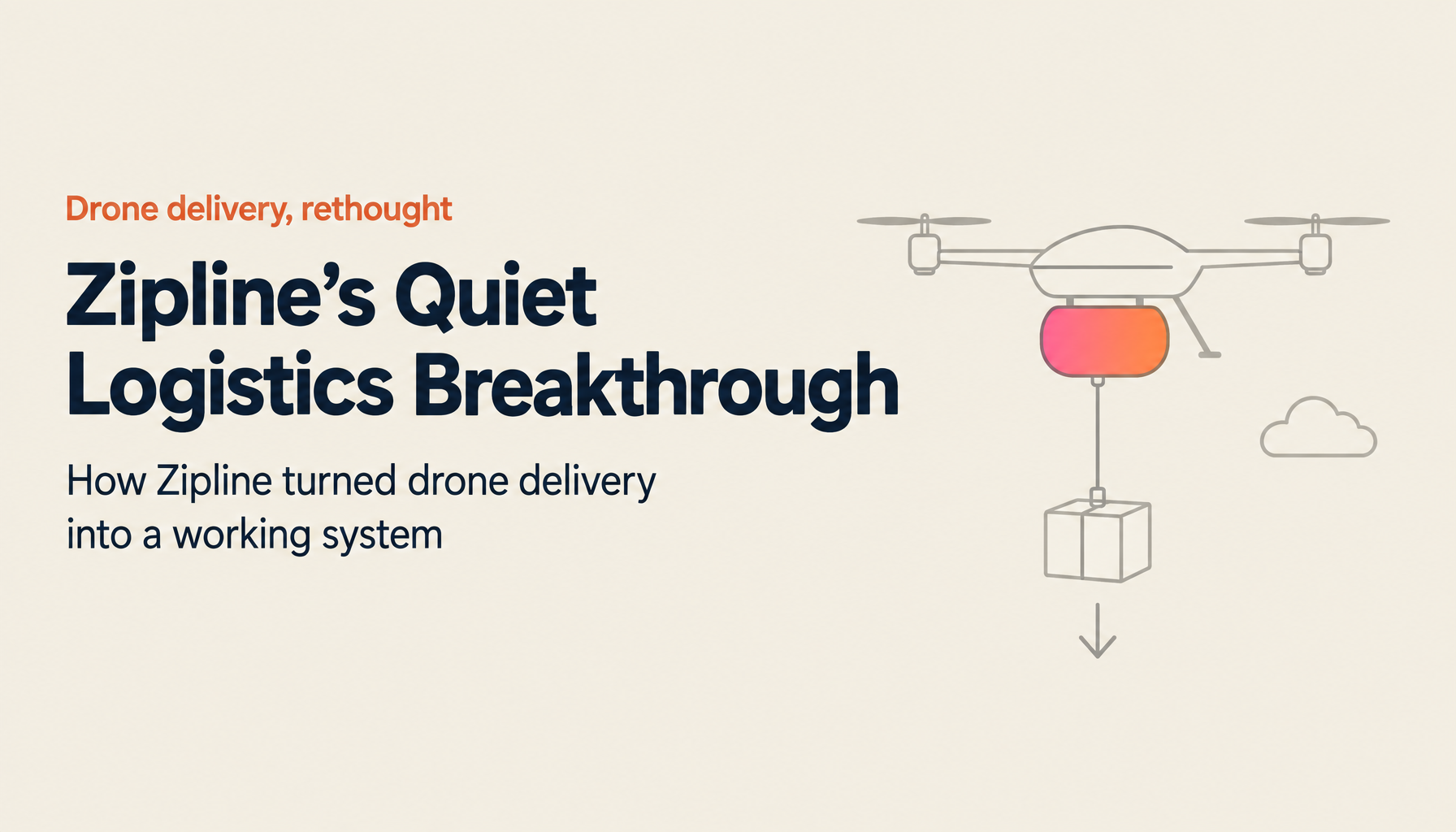
The Zip Droid is where Platform 2's key innovation lives. When approaching a delivery point, the P2 drone hovers at approximately 100 meters altitude and lowers the Zip Droid on a wire. The Zip Droid itself — a 5-pound carbon fiber unit — is not just a package container. It has a sliding door for package release, landing legs, multiple sensors, and small thrusters. As it descends, it monitors the landing zone continuously. If it detects an unexpected obstacle (a person, an animal, a parked car), it uses its thrusters to autonomously adjust its position and target a clear landing point. The target accuracy is described as roughly the size of a dinner plate. When it lands, the door slides open, the package is placed gently on the ground, and the Zip Droid is rapidly retracted back to the drone.
What Platform 2 Solves
Noise: The P2 drone maintains altitude above 100 meters throughout the delivery. At that height, ground-level noise is dramatically reduced. Unlike consumer drones, which create a high-pitched buzz at close range, the Platform 2 system was described by observers at demo events as surprisingly quiet.
Delivery time: The P2 drone cruises at 70 mph. For the 3-5 mile distances that cover most food delivery use cases, the theoretical delivery window after pickup is 3-5 minutes. The current integration challenge is the pickup process — Zipline is developing unobtrusive wall-mounted dropoff points for restaurants and standalone structures for shops that enable fast handoffs without requiring complex infrastructure investment.
Weather resilience: The system is rated for operation in all conditions short of hurricane-force winds. The entire aircraft is waterproofed to automotive standards. Live demos of food delivery in strong nighttime wind have been completed successfully. The goal is to match the conditions under which a delivery truck would operate — and then offer the advantages of being cheaper, quieter, faster, fully electric, and available 24/7.
Safety: This is the area Zipline treats with the most seriousness. All critical internal systems are redundant — losing two propellers still allows safe return. Safety checks run 500 times per second. Onboard sensors and AI detect and avoid obstacles autonomously. All Zipline drones in a given airspace share real-time position data to prevent collisions. An emergency parachute is available for worst-case scenarios. If the Zip Droid wire is intentionally pulled or catches on an obstacle, the system automatically severs the wire and releases the Droid to prevent the drone from being pulled down.
The result: over 100 million miles of total flight with zero human safety incidents. This is not a test environment number — it includes operational missions in Rwanda and other markets.
Regulatory Reality
The technology, impressive as it is, is not the only challenge. In the United States and most developed countries, the regulatory framework for drone operations is complex. Airspace classification, Beyond Visual Line of Sight (BVLOS) operation permits, urban flight approvals, and privacy regulations all require navigation that takes time and specialized expertise.
Zipline's early success in Rwanda was partly enabled by the Rwandan government's willingness to work collaboratively with the company on a regulatory framework suited to the technology. Replicating that in the U.S. and Europe requires regulatory engagement that is more incremental.
Zipline has a dedicated regulatory affairs function and has been making progress, but scaling to the coverage areas that would make the service commercially significant in major markets remains a multi-year process.
What This Means for Logistics
Drone delivery via platforms like Zipline is not positioned to replace all truck-based delivery. It is positioned to address the specific use cases where speed, precision, and on-demand availability create unique value:
- Time-critical medical supplies: The use case Zipline started with, and where the value proposition is clearest
- On-demand food and consumer goods: Delivery measured in minutes rather than hours
- Emergency parts supply: A memory card or component needed immediately at a job site
- Remote or difficult-to-reach locations: Areas where road infrastructure is poor or unreliable
For these cases, the combination of speed, cost, zero emissions, and 24/7 operation creates a genuinely different value proposition than existing delivery methods.
Summary
- Amazon and Google have invested heavily in drone delivery but face fundamental challenges with delivery method, noise, and regulatory complexity
- Zipline's Platform 1 delivered medical supplies in Rwanda across difficult terrain, saving thousands of lives
- Platform 2 introduces the Zip Droid — a sensor-equipped, self-correcting delivery device that achieves dinner-plate precision from 100 meters altitude
- The system addresses noise (high altitude cruising), fragility (gentle landing), and weather (automotive-grade waterproofing and 70 mph cruise speed)
- Safety architecture: redundant systems, 500 checks/second, AI obstacle avoidance, emergency parachute, 100M+ miles zero incidents
- Regulatory approval for broad commercial deployment in the U.S. and Europe remains the key constraint
- Most compelling use cases: medical supply, on-demand food, emergency parts, remote access
Zipline shows that a smaller company with a strong technical vision and genuine commitment to solving hard problems can build something that larger, better-funded competitors have not. The future of last-mile logistics will likely include drone delivery for specific use cases — and the evidence suggests Zipline is the closest to making that future operational at scale.
Reference: https://www.youtube.com/watch?v=88yQTzlmsiA