This is Hamamoto from TIMEWELL Inc.
Tesla's Mission in Musk's Own Words
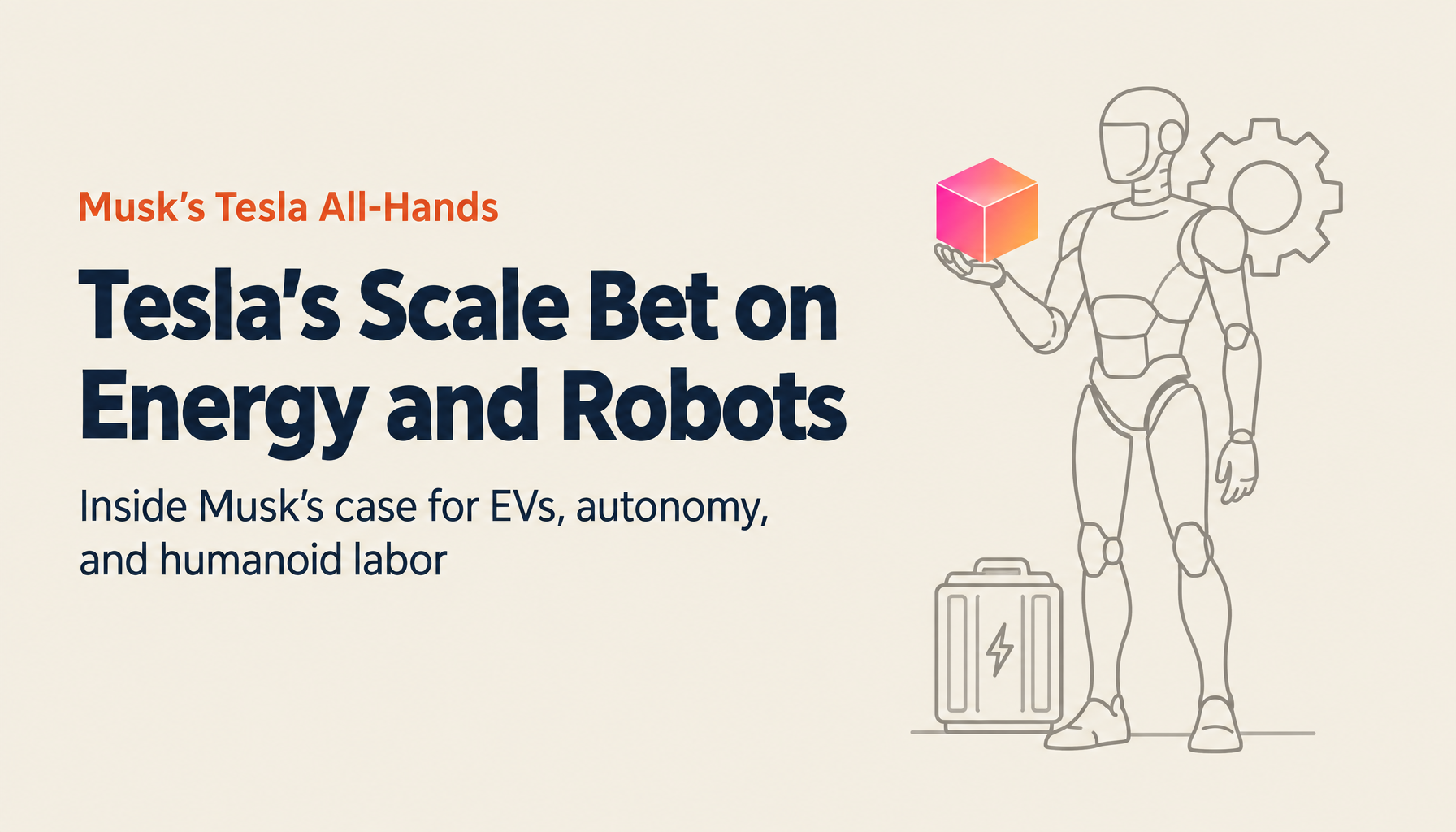
Elon Musk addressed Tesla employees in an all-hands meeting that covered the company's progress, factory performance, and long-term ambitions. The core message: Tesla's mission — "to accelerate the world's transition to sustainable energy" — is not just a tagline. It shapes every product decision, every factory investment, and every long-term bet the company is making.
This article covers the substance of what Musk said, what the numbers mean, and where the company is heading.
The Production Numbers: Where Tesla Stands Today
Tesla has now produced more than 7 million electric vehicles — a milestone that Musk framed not as a celebration but as a proof of concept. The argument: if you can build EVs at this scale and this quality, the underlying case for sustainable transportation is proven. The question is no longer whether it's possible. It's how fast the transition can happen.
The 2026 target: 10 million vehicles. That figure — if achieved — would represent meaningful growth from a production base that was already considered one of the most efficient automotive manufacturing operations in the world.
Looking for AI training and consulting?
Learn about WARP training programs and consulting services in our materials.
Model Y: The World's Best-Selling Vehicle
The Model Y held the title of the world's best-selling vehicle — across all categories, not just EVs — for two consecutive years. This is a result that few in the automotive industry predicted when the vehicle launched.
Additional market data Musk cited:
- Tesla is the #1 EV brand in Europe
- Tesla is the fastest-growing auto brand in South Korea
- The Cybertruck broke EV pickup truck sales records immediately after launch — in a segment that many analysts had written off as incompatible with EV technology
These aren't incremental improvements. They represent a structural shift in consumer preferences across geographies.
Factory Performance: Berlin, Fremont, Shanghai
Berlin (Gigafactory Europe): Producing 660,000 drive units per year. Musk described Berlin as a benchmark for manufacturing efficiency, and the drive unit volume reflects a facility operating at high utilization.
Fremont (California): Tesla's original U.S. factory has launched an Optimus humanoid robot production line — the first time the factory is producing not just vehicles but autonomous physical systems.
Shanghai (Gigafactory China): Reached 3 million cumulative vehicles produced, cementing its position as Tesla's highest-volume facility globally.
Autonomous Vehicles: The Next Five Years
Musk's stated timeline: autonomous vehicles — meaning Tesla's full fleet of 10+ million vehicles operating in self-driving mode — within five years.
The logic here is cumulative: every Tesla produced adds to a data-gathering fleet. Every mile driven in autopilot or FSD mode improves the underlying model. The argument is that at sufficient fleet scale, the feedback loop accelerates in a way that competitors without comparable fleets cannot replicate.
The implication for owners: vehicles sold today may become autonomous systems over time through over-the-air software updates — changing the economics of vehicle ownership in ways the traditional automotive industry is not equipped to match.
Optimus: 5,000 Units in 2025, 50,000 the Year After
The Optimus humanoid robot is Musk's bet on what comes after the vehicle transition. His numbers: 5,000 units in 2025, scaling to 50,000 in the following year.
The product logic mirrors Tesla vehicles: build the first generation at high cost, iterate rapidly, scale manufacturing, drive unit economics down. The underlying argument is that a general-purpose humanoid robot — capable of performing physical labor across any domain — represents a larger economic opportunity than EVs.
Musk's framing: if Optimus can perform physical tasks at human-comparable capability, the cost of production across virtually every goods and services category approaches near-zero over time. He described this as "sustainable abundance" — a condition where basic material needs are accessible to everyone, not just those in wealthy countries.
Solar, Batteries, and the Full Stack
The full Tesla vision isn't just vehicles. Musk described the combination of solar panels + battery storage + electric vehicles + Optimus + AI as a complete system for sustainable living. Each element reinforces the others:
- Solar generates energy; batteries store it
- EVs consume clean energy and feed back into the grid
- Optimus performs physical labor that would otherwise require fossil-fuel-based processes
- AI optimizes the entire system in real time
His conclusion: "We can transition to a sustainable energy economy in our lifetimes." He framed this not as idealism but as physics — the resources exist, the technology exists, the question is execution speed.
What This Means for Business
The competitive implications of Tesla's trajectory extend beyond the automotive sector:
Manufacturing: Tesla's production efficiency — particularly in battery cell manufacturing and drive unit production — sets a benchmark that traditional manufacturers are struggling to match. The introduction of robotics (Optimus) into the factory floor will compress unit costs further.
AI and autonomy: Tesla's FSD development is an AI training operation at enormous scale. The data advantage compounds with fleet size in a way that pure AI companies without physical products cannot replicate.
Energy infrastructure: As solar and battery products scale, Tesla becomes an energy infrastructure company — competing with utilities and grid operators in addition to traditional automakers.
Talent and innovation: Musk's framing of Tesla's mission as something larger than profit — a physics-driven project to solve climate and energy — is a talent strategy as much as a product strategy. It attracts engineers who want to work on problems of civilizational significance.
Summary
Musk's all-hands covered significant ground:
- Mission: "Accelerate the world's transition to sustainable energy" — and the metrics suggest the mission is on track
- Production: 7M+ EVs delivered; targeting 10M in 2026; Shanghai at 3M cumulative
- Market position: Model Y world's best-selling vehicle two years running; #1 EV in Europe; Cybertruck EV pickup record
- Factories: Berlin at 660K drive units/year; Fremont launching Optimus production; Shanghai continuing to scale
- Autonomous vehicles: Full fleet self-driving within five years
- Optimus: 5,000 units in 2025; 50,000 in the following year
- Vision: Solar + batteries + EVs + Optimus + AI = sustainable abundance accessible to everyone
The scale of Tesla's ambition — and the degree to which it is being executed against real production milestones — makes it one of the more important companies to track for anyone working at the intersection of technology, energy, and manufacturing.