A Dream That Has Come Around Before
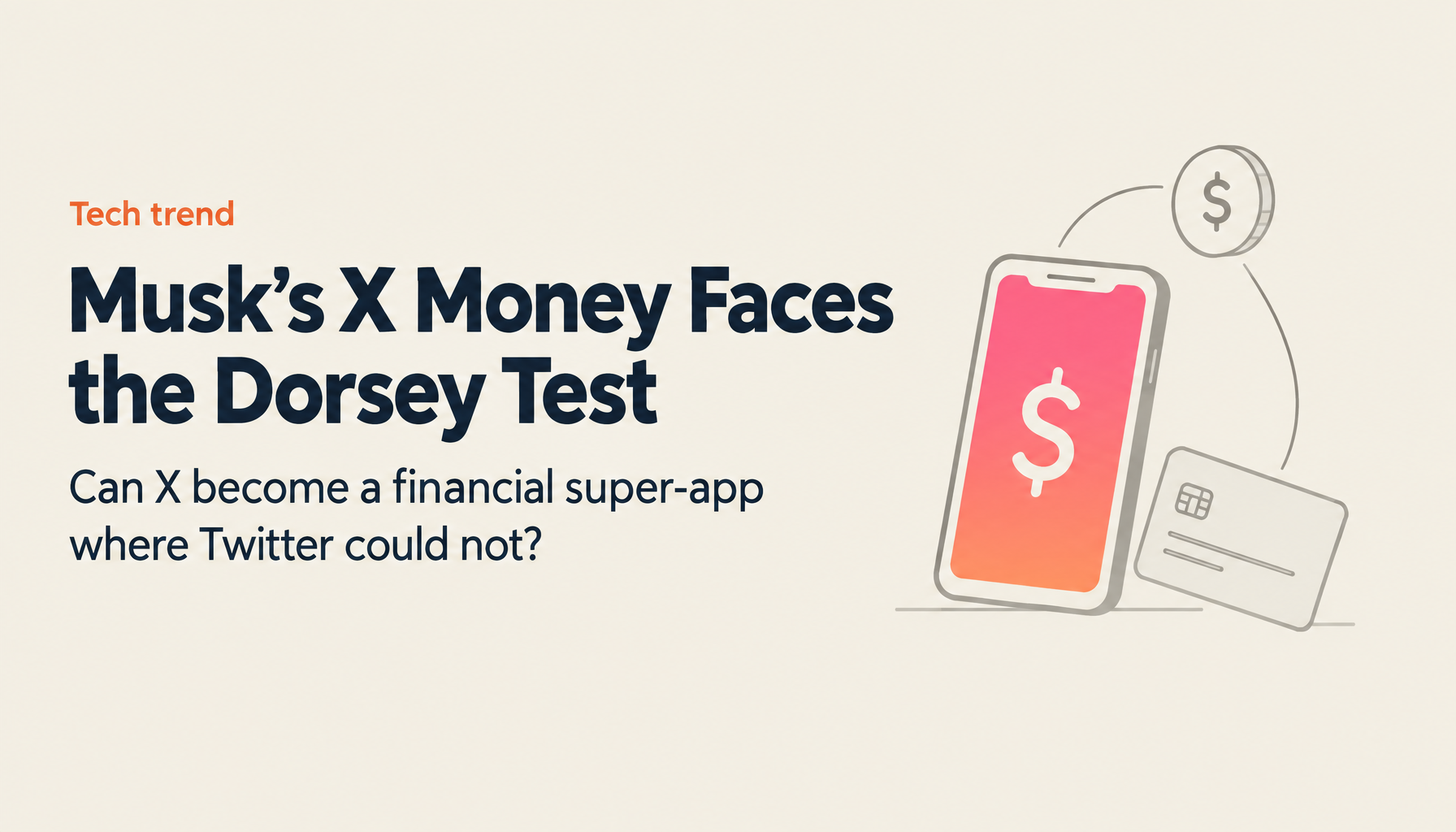
Elon Musk's ambition for X Money — to make X "the source of all transactions" — is not a new idea. It is a refined version of a vision that Jack Dorsey pursued with Twitter in its early years and eventually abandoned as the complexity became apparent.
The question worth asking is not whether the vision is bold or interesting. It clearly is both. The question is whether the conditions that made it impossible before have changed enough to make it viable now.
What Dorsey Tried and Why It Stopped
When Jack Dorsey launched Square in 2009, the initial thesis included an assumption that eventually Twitter — the other company he ran — could integrate financial services. A social network with hundreds of millions of users was, in principle, a remarkable distribution platform for financial products.
The reality turned out to be more complicated.
Regulatory fragmentation meant that operating as a money transmitter required individual state licenses in the United States — a process that takes years and requires significant compliance infrastructure. Banking partnerships required institutional relationships and acceptance of terms that constrained product design. Consumer trust for financial services was harder to establish than trust for social interaction.
Dorsey pivoted. Square became Cash App, which built its own regulatory framework over years of careful effort. Twitter remained a social network. The integration never happened.
Take AI-driven development all the way to production
WARP is a hands-on program for teams who want more than headlines. Former enterprise DX and data strategy leads work alongside you until it runs.
What Musk Is Actually Proposing
The X Money announcement describes ambitions that go beyond what was technically or regulatorily feasible when Dorsey considered the same territory.
The core product includes peer-to-peer payments, a high-yield savings account, and debit card functionality — all integrated with the X social experience. The aspiration beyond that includes investment products and credit, though the timeline for those features is unclear.
X has reportedly applied for money transmitter licenses in multiple US states and has been acquiring them steadily. This suggests Musk is pursuing the regulatory infrastructure seriously, not treating it as a detail to be worked out later.
The AI angle is also different from the Dorsey era. X has access to xAI's Grok, and integrating AI into financial management — spending analysis, savings recommendations, fraud detection — is more technically feasible than it was in 2010.
The Arguments For
The user base is real. X has hundreds of millions of active users, with concentrated activity among demographics that are attractive for financial product adoption.
The super-app model has worked in other markets. WeChat Pay in China and similar integrations in Southeast Asia demonstrated that social networks can become financial platforms when the conditions are right. The Western market has been resistant to this model, but that resistance is not necessarily permanent.
Musk's track record with payments is not nothing. He was a co-founder of X.com, which became PayPal — one of the most successful consumer fintech companies in history. He understands the mechanics of consumer payments better than most social network operators.
The competitive landscape for fintech has also matured. The infrastructure for payment processing, compliance, and banking partnerships is better developed than it was in 2010, which reduces the time required to build the necessary foundations.
The Arguments Against
Regulatory fragmentation in the United States is still real. Money transmitter licenses are only part of the compliance picture — banking regulations, securities regulations for investment products, and state-level consumer protection requirements create a complex matrix that requires sustained operational investment.
Consumer trust for financial services follows different rules than consumer trust for social networks. People choose banks and payment services based on perceived security and reliability. X's recent history — account verification changes, content moderation controversies, the transition from Twitter — has created uncertainty about platform stability that may work against trust-building in financial services.
The timing in the banking relationship market is also complicated. The current interest rate environment has changed the economics of high-yield savings accounts in ways that affect how attractive those products are to offer.
The Jack Dorsey Comparison Revisited
The most instructive thing about the Dorsey comparison is not the similarity of the visions — it is the different paths the two men took when they encountered the same obstacles.
Dorsey built the regulatory and compliance infrastructure at Square/Cash App over years, accepting the constraint that this meant building it as a separate business from the social network. He did not try to integrate the social and financial products until the financial product was independently viable.
Musk appears to be attempting the integration earlier — building the financial product inside X before X's position as a platform is fully stable. Whether that sequencing works depends heavily on execution in a domain where execution complexity is high and room for error is limited by regulatory requirements.
What It Means for the Industry
If X Money succeeds — even partially — it changes the expectations for what social platforms are in the US market. It creates competitive pressure on standalone payment applications. It establishes the super-app model as viable outside Asia.
If it struggles, it validates the conventional wisdom that Western markets are more resistant to the super-app model than Asian markets, and potentially creates regulatory and reputational challenges that affect X's other product areas.
The outcome is genuinely uncertain. The vision is coherent and the execution resources are substantial. The obstacles are real and not fully within Musk's control to remove.