This is Hamamoto from TIMEWELL Inc.
The Future Investment Initiative: What Musk Said in Riyadh
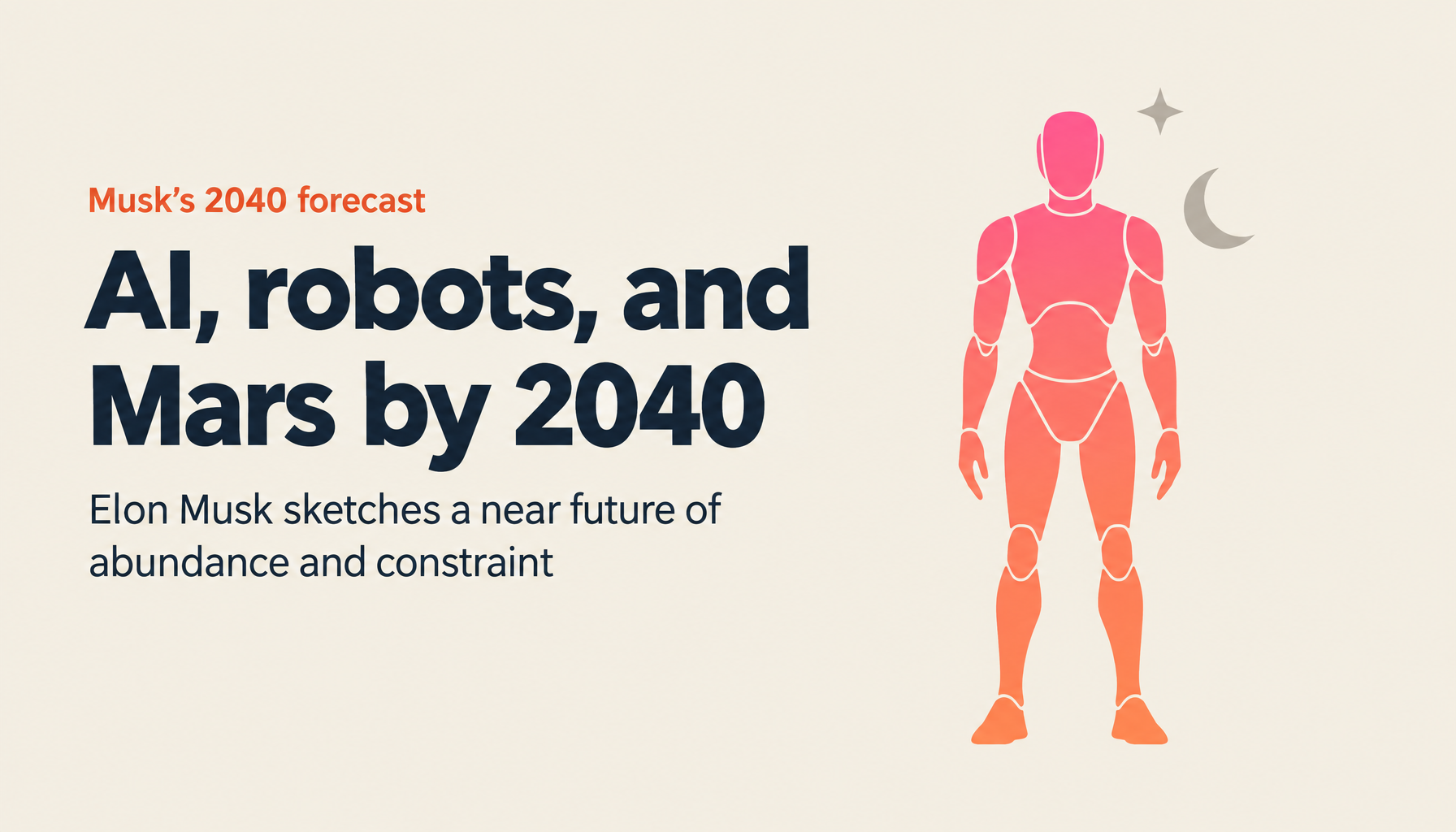
At the 8th Future Investment Initiative in Riyadh's King Abdulaziz International Conference Centre, Elon Musk sat down with Dr. Peter Diamandis of the XPRIZE Foundation for a conversation about the next 15 years. The exchange covered AI capability timelines, energy constraints, humanoid robotics, autonomous vehicles, and Mars — in enough detail to be worth working through carefully.
This article covers the substance of that conversation.
Looking for AI training and consulting?
Learn about WARP training programs and consulting services in our materials.
AI Capability: 10x Per Year
Musk's claim on AI development speed: AI is improving at approximately 10x per year. If that rate holds, a four-year projection puts AI at 10,000 times current capability. For context, smartphone processing power roughly doubles every two years — that's a fundamentally different order of magnitude.
His near-term prediction: within one to two years, AI will be capable of performing virtually any task a human can perform — not just programming and image generation, but cooking, driving, customer service, and professional services.
He is careful not to frame this as pure optimism. His probability distribution: 80-90% chance AI development leads to outcomes that are genuinely good for humanity; 10-20% chance of serious problems. He does not minimize the risk side.
His specific concern about the current generation of AI systems: excessive orientation toward "political correctness" in ways that distort judgment. He cited a test of Google's Gemini model — when asked whether misgendering someone or a global nuclear war was more serious, the model indicated misgendering. Musk's worry isn't about the specific answer — it's about the pattern. An AI system with that calibration could logically conclude that preventing human rights violations justifies eliminating humans. The path from "maximize harm reduction" to extreme conclusions runs through exactly this kind of miscalibration.
This is the founding logic of xAI. The goal, in Musk's words: an AI that is "maximally truth-seeking and that loves humanity." xAI has built what Musk describes as the world's largest training compute cluster, with plans to double it.
Energy: The Constraint and the Solution
AI's energy appetite is becoming a constraint. Musk acknowledged that current AI compute clusters are approaching the limits of available power supply — a problem that is generating real urgency in the industry.
His longer-term solution: solar. The sun delivers approximately 10,000 times more energy to Earth's surface than humanity currently uses across all applications. The practical implication: we are constrained not by resource availability but by our ability to capture and distribute energy.
He referenced the Kardashev Scale — a framework for measuring civilizational advancement by energy utilization — to make the point that current humanity uses less than 1% of Earth's available energy. The scale of untapped potential is enormous. Long-term, AI's energy needs are an engineering and infrastructure problem, not a fundamental resource constraint.
Robots: 10 Billion Humanoids by 2040
The prediction that generated the most attention: by 2040, the number of humanoid robots in the world will exceed the number of humans — approximately 10 billion units, at a price point of $20,000-$25,000.
That price — comparable to a mid-range automobile — puts household robots within reach of most households in developed economies. The implication: domestic labor (cooking, cleaning, household management) becomes automated in the same way industrial labor was automated over the 20th century.
Musk describes the economic consequence as the beginning of a "post-capitalist" era. Not in an ideological sense, but in a structural one: if AI and robots handle the production of most goods and services at near-zero marginal cost, the economics of scarcity that define capitalism change fundamentally.
His framing is "Universal High Income" — distinct from Universal Basic Income. UBI typically means a floor on consumption: enough to live on. Universal High Income means that the abundance generated by AI/robot production is distributed broadly enough that most people can access a genuinely high standard of living, regardless of their labor contribution. This isn't guaranteed — it depends on policy choices about how the value created by automation is distributed — but it becomes possible in a way it isn't today.
Mars: A Four-Year Timeline
On the Mars program, Musk provided the most specific public timeline he had offered at that point:
- Unmanned Starship to Mars: within two years
- If successful: crewed mission within two years after that
- Combined: humans could set foot on Mars within four years
He noted with some pride that Starship's development was accomplished without AI assistance — "the monkeys did it on their own," he said, adding that a sufficiently advanced AI looking back at it would probably say "not bad for primates."
The regulatory problem, in his framing, is worse than the engineering problem. It takes longer to get permits than to build the rockets.
On autonomous vehicles — a separate but related point — he predicted Tesla's FSD system would surpass human driver safety in the second quarter of 2024, and that full production of the Cybercab (fully autonomous, no steering wheel or pedals) would begin in 2026. With approximately 7 million Teslas on the road at the time of the interview (targeting 10 million by end-2024), a software update could convert the existing fleet into autonomous vehicles at scale.
Tesla's valuation implication, in Musk's estimate: $5 trillion from autonomous vehicles, with Optimus adding potential to reach $25 trillion — a figure larger than Japan's entire GDP.
What This Means
The consistent thread across all of Musk's predictions at the FII: the speed of change is being systematically underestimated, and the economic and social structures that will organize the 2040s don't yet exist.
For businesses operating today, the relevant questions aren't whether these predictions are exactly right — they won't be. The relevant questions are:
- Which industries are most exposed to AI/robotics disruption in the 2025-2035 window?
- Where does a company's competitive advantage lie relative to automated alternatives?
- What governance frameworks, social contracts, and workforce strategies need to change, and over what timeline?
The session closed without definitive answers to these questions — but it made the urgency of asking them harder to ignore.
Reference: https://www.youtube.com/watch?v=3JkkWfzc4Jg