Hello, this is Ryuta Hamamoto from TIMEWELL.
Three questions show up almost every time we help with Japan export classification. A counterparty asked for an item-specific comparison table and nobody on the team knows how to fill it in. Which edition is current, and where do you buy it? Can you download the Excel form for free? Then, once someone sits down to fill it in, they stall on the determination column: four kinds of brackets, each with a different job.
I first wrote this guide in February 2026 and revised it on October 4, 2026 against the primary sources. The short version: the form to use is still CISTEC's February 2026 edition. Since the amendment that took effect on February 14, 2026, nothing has changed the contents of Appended Table 1. What has changed is smaller and easier to miss. The February edition has had two corrections, and an amendment to the reporting regime for transferring certain technologies abroad took effect on August 16. I also found three places where an earlier version of this article was wrong, and I have fixed them below.
The guide covers what the comparison table is, how to get the current edition, what the electronic version requires, how to read the determination brackets, and what a completed sample looks like, following CISTEC's own completion guide and FAQ. Multinational teams that already know U.S. ECCN worksheets still need this if Japan is the export jurisdiction, and so do overseas suppliers whose Japanese customers send them this form. The form is Japan-specific, and there is no English edition. The accountability logic should feel familiar, though: the exporter owns the classification, and the worksheet has to let a third party reconstruct the reasoning.
Key points in 30 seconds The item-specific comparison table is a classification worksheet published by CISTEC that covers every list-control entry (Items 1 through 15) in Appended Table 1 of the Export Trade Control Order and the Foreign Exchange Order table. Completed and stamped by the responsible classifier, it serves as a classification report for customs and license applications in Japan. In the determination column, only the final box carries the verdict; a circle anywhere else does not mean "controlled." The current edition, as of October 2026, is the February 2026 edition. There is no free blank Excel version and no official English version.
If you want a quick read on your broader export control posture before diving into the form, try the free export compliance check. It takes about three minutes.
What the comparison table is, and how it differs from parameter sheets and in-house forms
The item-specific comparison table is a worksheet for checking whether goods you export, or technology you provide, fall under Appended Table 1 of the Export Trade Control Order or the Foreign Exchange Order table. CISTEC publishes it under the full title "Item-Specific Comparison Table for Appended Table 1 of the Export Trade Control Order and the Foreign Exchange Order Table." For each entry in the cabinet orders, the matching text of the goods ordinance is printed line by line, and the exporter writes a determination against each line based on the product's specifications1.
CISTEC calls forms of this kind classification forms and describes them as documents used mainly at customs clearance and in license applications2. The intended workflow is to photocopy the pages you need, fill them in, stamp them, and use them as they are1. The completion guide asks you to write so that METI and customs officers can follow the reasoning at a glance3. In other words, this is not an internal scratch sheet. It is the classification report itself.
The book has four parts. Part 1 covers Items 1 through 15 of Appended Table 1 (goods). Part 2 covers Items 1 through 15 of the Foreign Exchange Order table (technology). Part 3 is reference material on catch-all controls (Item 16), and Part 4 holds miscellaneous material1. So you can check every list-control entry from both the goods side and the technology side, with catch-all controls included for reference. Terms in the ordinance text that have an official interpretation in METI's operational circulars are underlined, which saves you from hunting for the interpretation separately3.
The parameter sheet is the form people compare it with most. CISTEC's FAQ says both count as classification reports and lays out the differences roughly as follows4.
| Aspect | Item-specific comparison table | Parameter sheet | In-house classification report or certificate |
|---|---|---|---|
| Coverage | Every list-control entry, goods and technology | By field: computers, telecom and information security, electronics, acoustic sensors and radar, advanced materials, chemical agent precursors, Appended Table 2 items | Depends on the form |
| Structure | The ordinance text itself, same structure in every field | Flowchart format, usable without deep familiarity with the legal text | No statutory format |
| Typical use | Classification report for customs and license applications | Same | Internal sign-off, communicating a conclusion to a counterparty |
| Where to get it | CISTEC (paid) | CISTEC (paid) | Prepared in-house |
On which to use, CISTEC is direct: it recommends the comparison table to beginners2. I agree. Reading raw ordinance text is hard going at first, but the reading method is identical across every field, so once you learn it, it transfers. Parameter sheets are faster for products squarely inside one field, because specialists have already turned the text into a flowchart. The trouble starts with products that straddle fields. A telecom product can also touch Item 7 (electronics) and Item 8 (computers), and deciding which sheets to use, and how many, gets harder rather than easier. In practice, the pattern that works is a full first classification on the comparison table, then a parameter sheet for the delta when a model changes. Validity of the result does not depend on which form you used.
There is no statutory format for a classification report in Japan. CISTEC's FAQ notes that homemade reports often contain errors in the legal text or specifications, or leave out wording that should not be dropped, which means someone has to verify the form itself as well as the answer. For that reason it recommends its own forms4. A non-applicability certificate is a different document: it communicates a conclusion, reached with the comparison table or similar, to a counterparty. See our complete guide to classification reports and non-applicability certificates for that side. If you want the overall process first, from identifying the item through internal sign-off, start with Japan export classification and its five steps.
One premise matters more than any form. Whichever form you use, the party responsible for classification is the exporter. METI will explain how to interpret the regulations. It will not classify your specific product for you. The comparison table is not a service that classifies on your behalf. It is a tool for preserving, in a form a third party can verify, how the exporter reached its own determination. Once that sinks in, the detail in the completion rules stops looking pedantic.
A free worksheet for the groundwork Our item check sheet for Appended Table 1 and the Foreign Exchange Order table is an Excel workbook (Japanese-language) built for pasting candidate rows from METI's matrix table, comparing each control parameter with your own specifications, and keeping the reasoning. Any of Items 1 through 15 with no rows checked shows up as "not yet checked" on the summary tab, so a blank never passes for "not controlled." It is our own original format, with a different name and a different symbol system from CISTEC's comparison table. It is meant for the screening and evidence work you do before filling in the comparison table, not as a replacement for it, and it reflects the amendments effective February 14, 2026. Download the item check sheet (free; company name and work email required).
Replace siloed classification work with AI.
METI's FY2024 data shows 52% of foreign exchange law violations stem from classification errors. Download the TRAFEED product catalog covering features and rollout.
Current edition, how to buy it, and the Excel question
As of October 4, 2026, the current edition CISTEC distributes is the February 2026 edition. The sales page states that it reflects the partial amendment of the Export Trade Control Order and the related ordinance amendments that took effect on February 14, 20261.
| Purchase category | Listed price (before Japanese consumption tax) |
|---|---|
| Supporting members | 4,000 yen |
| General and university members | 8,000 yen |
| Via Amazon Japan | 8,000 yen |
These are the prices listed on October 4, 2026. Revisions can change them, so confirm on the CISTEC site before you buy.
CISTEC has corrected the February edition twice. On February 5, 2026, following a January 30 amendment to METI's operational circulars, pages 153 and 154 replaced the wording "sterilization or microbial killing" with "sterilization or disinfection." On June 15, page 46 (Item 2 (15) of Appended Table 1 and Article 1, item 20 (a) of the goods ordinance) replaced a statute's former name with its current one5. Neither correction changes a classification outcome. If you work from the printed book, print the corrected pages and insert them anyway. When an auditor asks whether your form is current, you want a one-word answer.
Search traffic loves "comparison table Excel free download." That path is a dead end. There is no free blank Excel version. CISTEC holds the copyright. A purchaser may photocopy the pages they need, fill them in, and use them for customs clearance or license applications. Reproducing the table electronically in Word, Excel, or PDF without CISTEC's permission infringes copyright, and the completion guide says so explicitly3. Copied files floating around online are risky on that count, and they are often old editions that miss amendments.
The legitimate electronic route is the classification section of CISTEC's online database, which offers the blank comparison table in Excel along with every parameter sheet, updated whenever the regulations change67. The terms matter, especially if you are outside Japan:
- It is a monthly subscription, and the registration cannot be cancelled during its first year. It renews automatically until you cancel.
- It is open only to Japanese corporations that export on their own account. Multiple staff within the same corporation may use it.
- Only the subscriber may use the electronic files. When a completed form goes to a counterparty, it has to go as a printout or a PDF.
- After cancelling, the subscriber must delete the blank electronic formats (completed records are excepted).
In practice, a foreign supplier will not get the Excel file. What you receive from a Japanese customer is a printed or PDF form, and what you send back should be the same. A sample of the Excel file is posted on CISTEC's classification section page if you want to see what it looks like6.
Learning materials are free. The sales page offers three PDFs: an explanation and completion guide, a sample of a completed table, and a note on the asterisk columns in Item 2 (12) and Item 6 (2) of Appended Table 11. CISTEC also publishes quick-reference tables showing which regulations each form reflects, for goods and for technology6. The sample in the completion guide still carries the header for the May 2025 edition, but the bracket rules and completion conventions have not changed, so it works fine as a teaching aid.
Now the English question. CISTEC does not produce English versions of the comparison table or the parameter sheets4. When you need input from an overseas manufacturer, its FAQ suggests pointing to the English text of the international regime behind the Japanese entry: the Nuclear Suppliers Group for Item 2, the Australia Group for Items 3 and 3-2, the Missile Technology Control Regime for Item 4, and the Wassenaar Arrangement for Items 5 through 15. A participating country's list, such as the corresponding U.S. ECCN, also helps. The FAQ adds two cautions. Regime changes reach Japanese law with a time lag, and operations can differ by country, so the same item may be classified differently. Get the supplier's reasoning, not just its conclusion, and keep it on file4.
Edition history is worth knowing too. The previous edition was the May 2025 edition, which reflected the ordinances effective May 28, 2025. When catch-all control amendments took effect on October 9, 2025, CISTEC did not publish a new edition. It released free replacement pages for three pages, including the catch-all material in Part 3, and said the effective-date header in the top-left corner of the forms did not need to change because list controls were untouched8. An earlier version of this article described that as a new edition; it was a correction by replacement pages. Then came the February 2026 edition, followed by the February and June corrections. New editions track the regular list-control amendments, and circular changes or typo fixes arrive as replacement pages in between. Knowing that rhythm makes it easier to set an internal rule for who checks the current edition, when, and who swaps the forms.
For CISTEC as an organization and what supporting membership gets you, see our guide to CISTEC and its membership benefits. If you run several classifications a year, membership usually costs less overall than repeated general-price purchases.
Determination-symbol rules from CISTEC's guide
This is the section I most want classification staff to read carefully. Many explainers stop at "circle means controlled, cross means not controlled, dash means out of scope." That is incomplete. CISTEC's completion guide assigns different roles to different brackets, and the same circle means different things depending on where it sits3.
| Bracket | Name | Role |
|---|---|---|
| Final determination box | Closed double brackets | Filled last after weighing partial and exclusion determinations. Circle here means controlled. Cross means not controlled. |
| Partial determination box | Square brackets | Step-by-step determination on the way to the final call |
| Exclusion determination box | Double angle brackets | Judgment on an "except for …" exclusion. When this box is a circle, the partial determination in the same section normally becomes a cross |
| Exclusion partial box | Single angle brackets | Step-by-step determination leading to the exclusion call |
Enter a circle when the product meets what the regulation specifies, but a circle anywhere other than the final determination box does not by itself mean "controlled." It is an interim mark: this stage's condition was met. A cross goes where the product does not meet the specified figure or function. A dash goes where the product is plainly different from what is specified and could never be in scope.
The difference between cross and dash trips people up. CISTEC's guide uses a measuring-instrument example. If the item being classified is not a measuring instrument at all, enter a dash. If it is a measuring instrument but its figures fall short of the control threshold, enter a cross. One case never entered the ring. The other entered and failed the bar. Because the two marks look so alike, the guide insists that you also write briefly why you chose dash or cross, so an officer can tell which situation you meant.
Exclusion reading is the other place outcomes reverse. Where the text says "provided that … is excluded," use the exclusion box to judge whether the exclusion applies. When it applies and the exclusion box becomes a circle, the partial determination under the same section marker normally becomes a cross3. The product drops off that branch of control. If the exclusion conditions are not met, keep judging under the main conditions. Get this backwards and you will classify as controlled a product that should be excluded, or the reverse.
The word "except" in the text comes in three patterns in the guide. "Except for other goods" means the item is judged under a different entry, so not here. "Except (iii)" means it is judged under sub-item (iii) of the same entry number. "Except Article 5, item (x)" means refer to that ordinance provision. Do not short-circuit to "excluded, therefore not controlled." Follow through to where the item is actually judged.
How conditions connect also follows symbol rules. Section markers that stand for "and" are AND conditions: you advance toward controlled only when every condition in that section is met. Markers that stand for "or" are OR conditions: you advance if even one applies. Before anything else, check which marker you are looking at, because "meets all of the following" and "meets any of the following" lead to very different places.
And the principle the completion guide repeats: do not stop at the symbol. In each entry box, write the reasoning or figures that let any ordinary reader judge the classification. For a numerical control, answer with a number. Where you mark something not controlled or out of scope, state the reason unless it is already obvious from other entries3. Customs or METI officers should be able to reconstruct why the determination was reached from the form alone. A table that is only a row of circles and crosses invites the question "did you really check?" even when the conclusion is right, and it will not hold up in an audit.
Six-step completion workflow and a filled-in sample
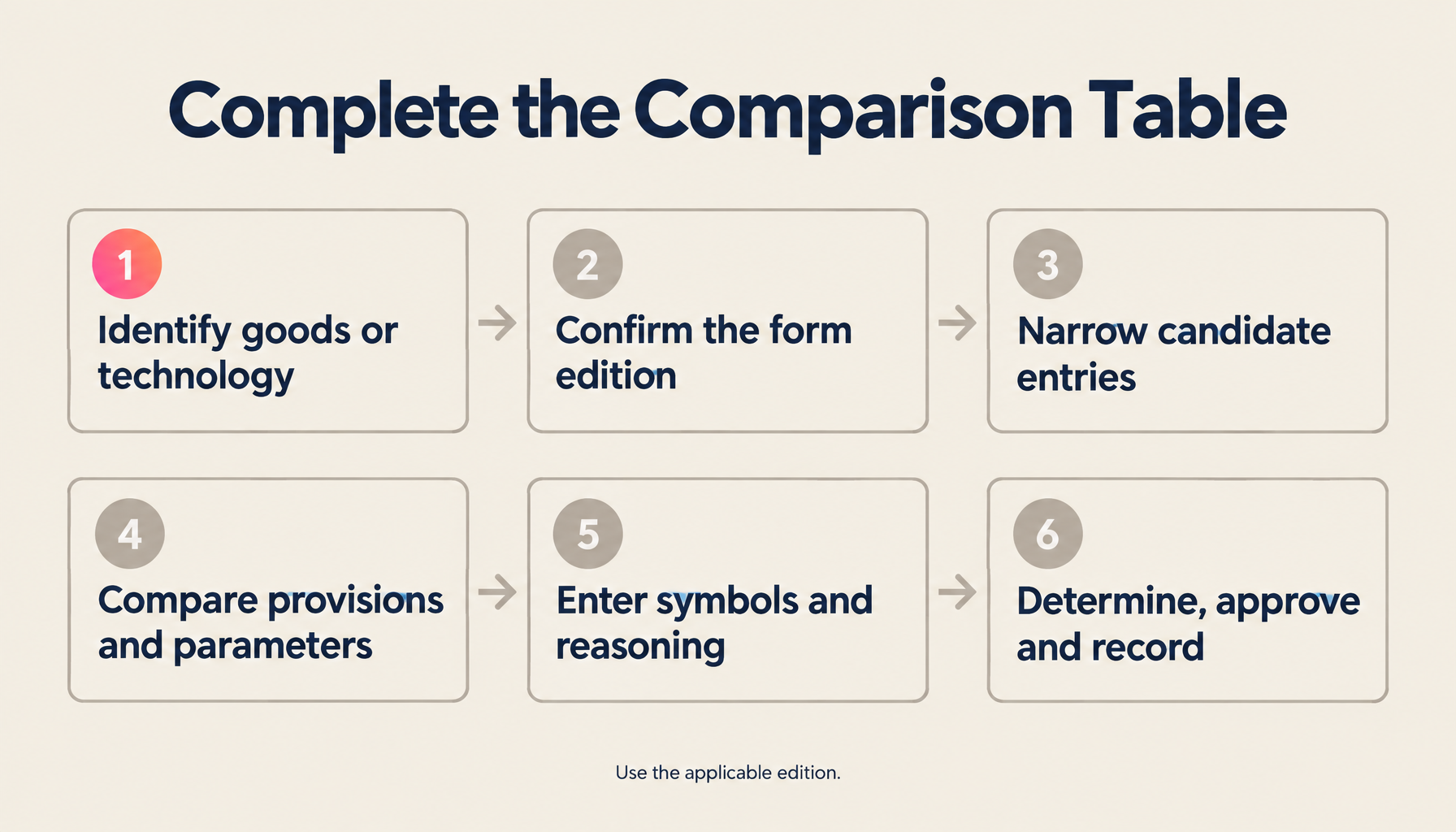
- Identify what you are classifying. Distinguish goods from technology first, and pin down product name, model number, and revision. The header of the form asks for the item name (for technology, the content and a control number), the manufacturer, and the model and brand3. Design drawings, software, and manuals that travel with the hardware need separate technology classifications.
- Confirm the edition of the form. Check that you have the February 2026 edition with the February and June correction pages inserted. Swap older forms before anyone starts.
- Narrow candidate entries. Before scanning Items 1 through 15 in order, use METI's goods and technology matrix to keyword-search likely entries9. See our guide to using the METI matrix. If the layout of the list is still unfamiliar, keep our overview of Appended Table 1 of the Export Trade Control Order open next to the form.
- Compare ordinance provisions against your parameters. Match control thresholds in the goods ordinance against product specifications one by one10. Watch "not more than" versus "less than," and unit conversions. For underlined terms, check the interpretation in the operational circulars; where no interpretation exists, CISTEC points to the commentary in its export control item guidance books4.
- Enter determination symbols. Fill partial and exclusion determinations first, the final determination last, and write reasoning and figures next to every symbol. If one entry runs across several pages, copy and complete all of them.
- Record the result, sign, and file it. Mark the result as controlled or not controlled; if controlled, add the Appended Table 1 entry and the goods ordinance provision. The preparer block takes the name and contact details of a classification lead who knows the product (the guide's example is a head of engineering), with a name seal and the date3. Obtain internal approval and store the form with the supporting evidence.
What does a completed table look like in practice? Take an industrial image-processing module carrying two FPGAs. The real CISTEC form breaks rows down to individual ordinance wording, so treat the table below as a simplified structural image.
| Entry (Appended Table 1) | Goods covered | Ordinance provision | Classification criteria | Product specification | Determination |
|---|---|---|---|---|---|
| Item 7 (1) | Integrated circuits | Article 6, item 1 of the goods ordinance | Specified characteristics such as radiation hardening | Commercial-grade FPGA; does not meet specified characteristics | Cross |
| Item 7 (10-2) | Modules, assemblies, or equipment incorporating FPLDs | Article 6, item 10-2 of the goods ordinance | One or more user-configurable FPLDs, aggregate LUT input count of 1,800,000 or more | Two FPGAs; aggregate 1,440,000, below threshold | Cross |
| Item 8 (1) | Computers and the like | Article 7 of the goods ordinance | Criteria such as adjusted peak performance | Contains no computer meeting the criteria | Dash |
| Item 10 | Sensors and the like | Article 9 of the goods ordinance | Criteria such as specified photodetectors | Contains no covered photodetector | Dash |
| Overall determination | Not controlled |
Open the Item 7 (10-2) branch to the determination-box level and the bracket rules become visible.
| Determination box | Type | What the text or interpretation requires | Determination | Entry box (reasoning and figures) |
|---|---|---|---|---|
| Partial | Partial determination | Being a module, electronic assembly, or piece of equipment | Circle | Qualifies as an industrial image-processing module |
| Partial | Partial determination | Incorporating one or more user-configurable FPLDs | Circle | Carries two commercial-grade FPGAs |
| Partial | Partial determination | Aggregate LUT input count of 1,800,000 or more | Cross | 120,000 LUTs × 6 inputs × 2 devices = 1,440,000, below threshold |
| Exclusion | Exclusion determination | Embedded FPLD fixed to perform a specific function (per the operational circular) | Cross | Users can still rewrite the logic after shipment, so the exclusion does not apply |
| Final | Final determination | Overall for Item 7 (10-2) | Cross | Aggregate LUT input count below 1,800,000, so not controlled |
Partial circles for "is equipment" and "incorporates an FPLD" do not make the product controlled. The numerical partial determination was a cross, so the final determination is a cross. The exclusion box is also a cross, because this product is not fixed to a single function. Non-applicability here comes from the numerical threshold, not from an exclusion. The entry box keeps the concrete figure 1,440,000, which is exactly what the completion guide means by reasoning any reader can check.
The calculation is the sum of number of FPLDs × LUTs per device × inputs per LUT. In this example, 2 × 120,000 × 6 = 1,440,000, short of 1,800,000. METI's explanatory material shows a worked case where 2 × 150,000 × 6 lands exactly on 1,800,00011. The same material makes two further points. Equipment whose FPLD is fixed to perform a specific function is not "user-configurable," and an item designed for use in other goods is still covered if it is user-configurable11. "It's only a component for someone else's machine" does not get you out of this entry. Pull LUT and input counts from the FPGA vendor's datasheets before you classify.
The form covers technology as well as goods. If you provide design drawings, control software, or maintenance manuals overseas with the equipment, finish the corresponding technology entries on the Foreign Exchange Order side. Goods not controlled and technology controlled is a combination that comes up routinely. On the technology side, CISTEC's guide has you write the technical content and a control number in the item-name box, for example "design drawings for the XYZ pump, No. T00012"3.
Templates for turning the result into documents Once the comparison table is done, you still need a classification report for internal sign-off and a certificate for the counterparty. Our classification template pack includes Word forms for the classification report and the non-applicability certificate, a fill-in Q&A, and Excel sheets such as a catch-all check sheet and a classification log. The forms are in Japanese, since that is what Japanese customs and counterparties expect, and they reflect the amendments effective February 14, 2026. Download the classification template pack (free; company name and work email required).
This cross-referencing is slow, careful work: hundreds of control entries against product specs, a symbol and a reason for each bracket. TRAFEED, the export control AI agent we build, supports extracting candidate entries from product specifications and drafting the threshold comparisons, with the evidence on file.
What changed in February 2026, and what has changed since
On November 11, 2025, the Cabinet approved an order partially amending the Export Trade Control Order. It was promulgated on November 14, and the portions implementing international regime agreements took effect on February 14, 202612. The February 2026 comparison table reflects that amendment. METI's overview highlights three added items that matter for table work13.
| Added goods | New or added entry | Summary |
|---|---|---|
| Equipment for synthesizing peptides | Item 3-2 (2) 10 | Partly or fully automated, able to produce peptides at a system synthesis scale of 1 millimole or more (goods ordinance Article 2-2, paragraph 2, item 10) |
| High-entropy alloy powders and refractory metal powders | Item 5 (20) | Powders of alloys made of several elements in roughly equal proportions, or of refractory metals such as niobium and molybdenum, whose surface is coated with an inoculant (goods ordinance Article 4, item 17) |
| Modules, assemblies, or equipment incorporating FPLDs | Item 7 (10-2) | Aggregate LUT input count of 1,800,000 or more and user-configurable |
The largest practical impact is FPGA-embedded equipment. Standalone FPGAs as integrated circuits were already controlled under Item 7. This amendment extends control to the equipment level. Article 6, item 10-2 of the goods ordinance covers modules, electronic assemblies, or equipment incorporating one or more user-configurable FPLDs with an aggregate LUT input count of 1,800,000 or more10. The exclusion for equipment whose embedded FPLD is fixed to perform a specific function comes from METI's operational circular11. Whether the design lets the user rewrite the logic is the practical dividing line, and it is why the exclusion box in the sample above was a cross.
From the comparison table's standpoint the change is blunt. Old editions have no row for Item 7 (10-2). Keep classifying on an old edition and this control never enters the field of view. FPGAs sit in industrial machinery, measurement instruments, and communications gear, so electronics companies should swap in the February 2026 edition and inventory FPGA-bearing products at the bill-of-materials level. For the full amendment, including transitional arrangements, see our guide to the partial amendment of the Export Trade Control Order (effective February 2026).
So what moved between February and October? Here is what matters to anyone using the comparison table.
| Aspect | First version (February 2026) | Now (October 4, 2026) |
|---|---|---|
| Comparison table edition | February 2026 edition just released | Still the February 2026 edition, with corrections dated February 5 and June 155 |
| Export Trade Control Order (including Appended Table 1) | Version effective February 14, 2026 | e-Gov shows the version effective June 5, 2026. Only an article number cited in Article 14 and the supplementary provisions changed; Appended Table 1 is identical14 |
| Goods ordinance | Version effective February 14, 2026 | Unchanged, with no promulgated amendment awaiting effect10 |
| Parameter sheets | February 2026 editions by field | The Appended Table 2 chemicals sheet moved to a June 2026 edition2 |
| Reporting regime for technology transfers | Not applicable | A METI notice amendment was promulgated on June 16 and took effect on August 16, adding critical managed technologies15 |
The last row corrects something I got wrong in the July revision, where I described a "June 16, 2026 amendment on deemed-export reporting." Rechecking the original text, June 16 was the promulgation date and the change took effect on August 16. It is also not about deemed exports. METI Notice No. 71 revises the items METI asks companies to report when they plan a transaction to provide "critical managed technology" under Article 10, paragraph 3 of the Ministerial Ordinance on Trade-Related Invisible Transactions. Critical managed technology means technology falling under Item 16 of the Foreign Exchange Order table that the notice lists because concerns could arise if the recipient does not manage the information properly. The amendment added design and manufacturing technology for, among others, film-type solder resist for circuit boards, liquid solder resist used in semiconductor manufacturing, gallium nitride semiconductor substrates and ingots, permanent magnets, perovskite solar cells and the laser processing machines used to make them, and scintillators for X-ray detection15. It does not change any row of the comparison table, but if your company transfers technology in these areas abroad, check this reporting regime separately from the table.
What about the next amendment? The 2025 list-control amendment was promulgated in November 2025 and took effect three months later12. As of October 4, 2026, e-Gov shows no promulgated amendment to the Export Trade Control Order or the goods ordinance that is still waiting to take effect1014. Until a draft appears, the February 2026 edition is the baseline. From autumn on, I would check METI's and CISTEC's amendment pages about once a month. Japan's list controls domesticate agreements from international regimes, so as agreements accumulate, the order, the ordinances, and the comparison table revise together. Buying a comparison table once and using it for years simply does not work in this field.
These checks tell you whether reclassification is needed:
- Does your product line include any module or equipment carrying an FPGA or FPLD?
- Checking datasheet LUT and input counts, does any product's aggregate reach 1,800,000 or more?
- Do you ship any product in a state where the user can rewrite the logic circuit?
- Do you handle peptide synthesizers, high-entropy alloy powders, or refractory metal powders?
- Are any past classification reports based on a form or regulation predating February 14, 2026?
Common failures, reclassification checklist, and close
Four failure patterns show up repeatedly in classification consultations.
First, misreading brackets. A circle outside the final box does not mean controlled, and an exclusion circle normally flips the partial determination in the same section to a cross. Confusing "meets all of the following" with "meets any of the following" is the same root mistake. On numerical criteria, "not more than" and "less than" treat the boundary differently, and slips between micrometers and millimeters sound trivial until they turn up in a real audit file.
Second, writing only the symbol. Skip the reason and you cannot explain yourself at customs or in an audit, even if the conclusion is right. Half the value of the table is the trail.
Third, checking too narrow a range. "We make telecom gear, so the transmission part of Item 9 is enough" is a dangerous assumption. Telecom products can also fall under Item 7 (electronics) and Item 8 (computers), and within Item 9 itself you still need to check the encryption equipment provisions (Item 9 (7)). Finishing the goods determination and forgetting the technology that travels with it is just as common. And a clean result across the list controls does not by itself clear the shipment. Depending on destination, end user, and end use, catch-all controls still apply; our plain guide to catch-all controls explains how.
Fourth, over-relying on someone else's determination. A component maker's non-applicability certificate is important input, but final classification responsibility sits with the exporter. Check that the model number matches and which version of the regulations the maker used. An unlicensed export triggered by a wrong determination violates the Foreign Exchange and Foreign Trade Act, with penalties and the risk of public disclosure. METI's analysis attributes the majority of Act violations to classification failures. Details are in our analysis of violation cases and our guide to penalties under the Act.
If you want fewer person-dependent mistakes, AI drafting is a realistic option for candidate extraction and threshold comparison. TRAFEED drafts the Japan export classification with the evidence on file, and its classification technology holds a Japan patent (No. 7862062). Your export control officer still makes the final call. That line is fixed under the law, and I think it should stay fixed. If you also need U.S. EAR cross-checks, start with EAR99: how to confirm whether an item qualifies.
To summarize the operating points:
- The item-specific comparison table is CISTEC's classification report format, reproducing the ordinance text for every list-control entry. It, not the parameter sheet, is what CISTEC recommends to beginners.
- Read each bracket type on its own terms, and write reasoning and figures beside every symbol.
- Use the February 2026 edition with the February 5 and June 15 corrections inserted.
- There is no free blank Excel file and no English edition. The electronic version is a subscription limited to Japanese corporations that export themselves.
- Reclassify FPGA-bearing products after the February 14, 2026 amendment, and check the separate technology-transfer reporting change that took effect on August 16.
If I had to pick one change to make on Monday morning, it would be this: add a column to your classification log that records which version of the regulations and which edition of the form each determination used, for example "February 14, 2026 regulations, February 2026 edition." When the next amendment lands, you will be able to pull every determination that needs review in one pass. For concrete questions about restructuring your classification flow, starting FPGA reclassification, or standardizing bracket reading across sites, tell us in a 30-minute TRAFEED consultation. The feature overview is in the TRAFEED product catalog (PDF), and other whitepapers are in the resource library.
References (primary sources)
Footnotes
-
CISTEC, sales page for the Item-Specific Comparison Table, February 2026 edition (price, coverage of the amendments effective February 14, 2026, table of contents, free PDFs; checked October 4, 2026) — https://www.cistec.or.jp/publication/shoseki/b01_taihihyou.html ↩ ↩2 ↩3 ↩4 ↩5
-
CISTEC, classification forms page (current editions of the comparison table and parameter sheets, recommendation for beginners; checked October 4, 2026) — https://www.cistec.or.jp/publication/gaihi.html ↩ ↩2 ↩3
-
CISTEC, Explanation of the Comparison Table and Completion Guide (brackets, marks, entry boxes, preparer block, copyright) — https://www.cistec.or.jp/publication/shoseki/sample/b-01koumoku_kinyurei/3-taihihyou_kinyuyouryou.pdf ↩ ↩2 ↩3 ↩4 ↩5 ↩6 ↩7 ↩8 ↩9
-
CISTEC, FAQ on export control (Q2-4 homemade classification reports, Q2-5 comparison table vs parameter sheet, Q2-7 terms without an interpretation, Q2-8 English forms) — https://www.cistec.or.jp/export/faq/faqansers.html ↩ ↩2 ↩3 ↩4 ↩5
-
CISTEC, publication corrections for the comparison table (corrections dated February 5 and June 15, 2026) — https://www.cistec.or.jp/publication/teisei_koumoku.html ↩ ↩2
-
CISTEC, classification section page (terms of use for the electronic files, Excel sample, quick-reference tables) — https://www.cistec.or.jp/about/sdintro/koumokuIndex.html ↩ ↩2 ↩3
-
CISTEC, overview of the online database (classification section subscription, one-year minimum term, limited to Japanese corporations that export on their own account; checked October 4, 2026) — https://www.cistec.or.jp/about/sdintro/internetservicehyou.html ↩
-
CISTEC, partial correction of the Item-Specific Comparison Table (May 2025) following the catch-all control amendments (October 10, 2025) — https://www.cistec.or.jp/publication/251010kaisei_taihihyo.html ↩
-
METI, introduction page for the goods and technology matrix — https://www.meti.go.jp/policy/anpo/matrix_intro.html ↩
-
e-Gov Law Search, Ministerial ordinance specifying goods or technologies under Appended Table 1 of the Export Trade Control Order and the Foreign Exchange Order table (current version effective February 14, 2026, METI Ordinance No. 72 of 2025; checked October 4, 2026) — https://laws.e-gov.go.jp/law/403M50000400049/ ↩ ↩2 ↩3 ↩4
-
METI, explanatory material on the security export control amendments under the Foreign Exchange and Foreign Trade Act (operational-circular interpretation and worked example for Item 7 FPLDs) — https://www.meti.go.jp/policy/anpo/20251114koufu_setsumeishiryou.pdf ↩ ↩2 ↩3
-
METI, Cabinet Decision on the Order Partially Amending the Export Trade Control Order (November 11, 2025) — https://www.meti.go.jp/press/2025/11/20251111001/20251111001.html ↩ ↩2
-
METI, Overview of the Amendments to the Export Trade Control Order and Related Ordinances (November 2025) — https://www.meti.go.jp/policy/anpo/law_document/seirei/20251114_gaiyo01.pdf ↩
-
e-Gov Law Search, Export Trade Control Order (Cabinet Order No. 378 of 1949), amendment history and the texts effective February 14, 2026 and June 5, 2026 (checked October 4, 2026) — https://laws.e-gov.go.jp/law/324CO0000000378/ ↩ ↩2
-
CISTEC, partial amendment of the items to be reported by persons planning transactions to provide critical managed technology under Article 10, paragraph 3 of the Ministerial Ordinance on Trade-Related Invisible Transactions (promulgated June 16, 2026, effective August 16, 2026; includes the text of METI Notice No. 71) — https://www.cistec.or.jp/export/express/260616/260616.html ↩ ↩2