This is Hamamoto from TIMEWELL.
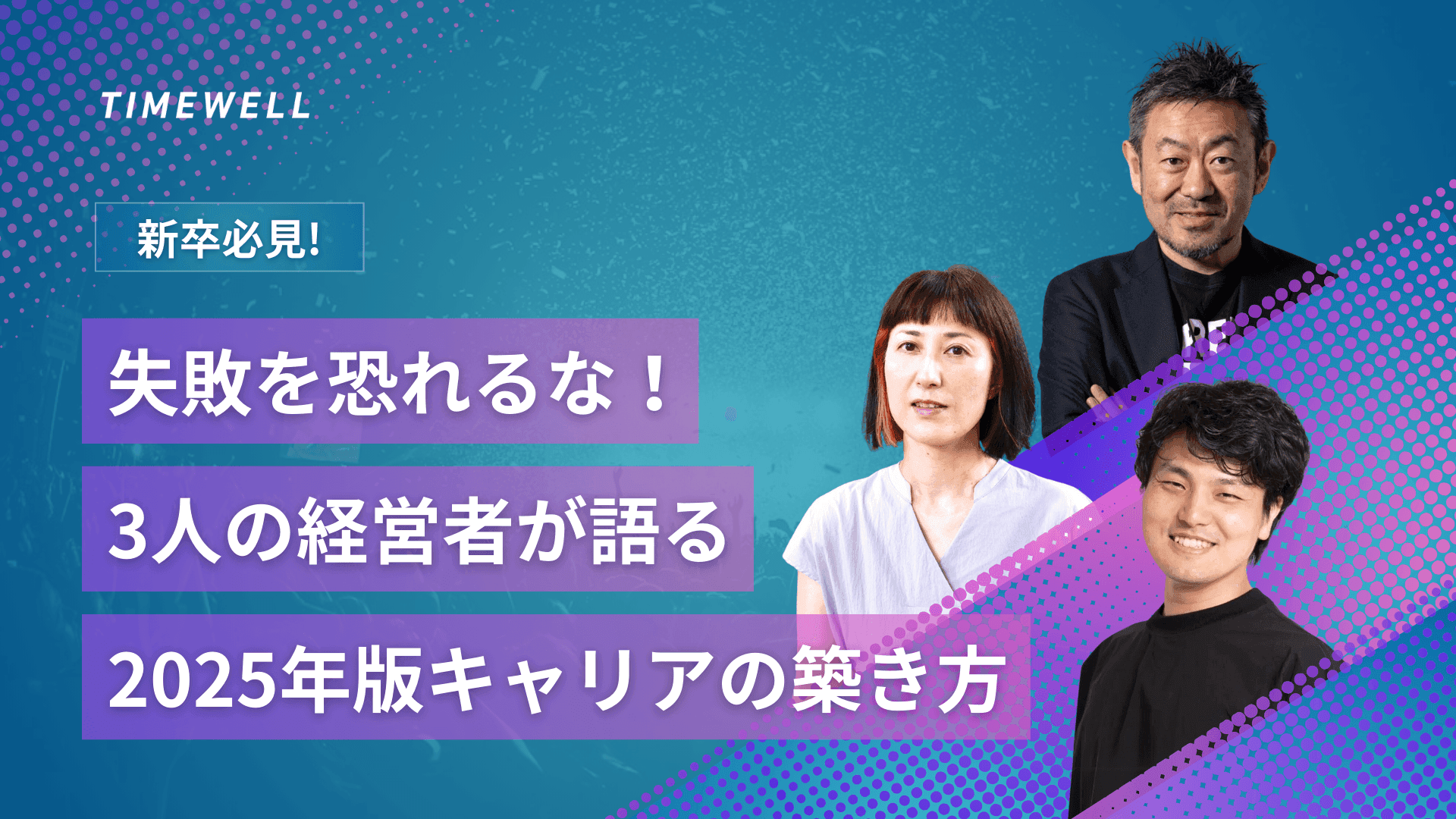
On January 24, 2025, the FUTURE CAREER PARTY was held as part of the YOXO Festival, organized by the Yokohama Future Organization and the City of Yokohama. The opening panel session featured TIMEWELL CEO Ryuta Hamamoto as moderator, with Yoichi Ito (Musashino University Entrepreneurship Faculty) and Hazuki Hiramatsu (CEO, Can't Wait Inc.) as panelists. The topic: building careers through self-understanding and challenge. Below is a summary of the session.
Hamamoto: Can you start by telling us how you arrived at your current careers?
Ito: In my student years, I had severe social anxiety and was essentially a shut-in. I couldn't even attend my coming-of-age ceremony. At 26, I hit a point where the mental difficulty was severe enough that I couldn't work for a period. But from 27 I threw myself into work, and at 48 I got involved with Yahoo! Academia, which led me into education. From there I was part of launching Musashino University's Entrepreneurship Faculty. The goal of that faculty is to support each student in building the life that's genuinely theirs.
Hiramatsu: My childhood dream was to be a designer, but in high school I followed the expected path to a standard private university instead. I studied psychology there, aimed at becoming a clinical psychologist, dropped out of grad school preparation partway through, and eventually enrolled in a design school while working part-time jobs. I became a graphic designer, but then became interested in how marketing thinking could be integrated with design. I moved from a design firm to a business company — Round One — where I spent nine years doing everything from planning to advertising to PR. Eventually I realized what I actually love is creating points of connection between people.
Hamamoto: Both of you built careers around your genuine interests. Looking back, what should students be thinking about during their university years?
Ito: Everything in daily life becomes material — studying, meeting people, hobbies. If you're moved by a live performance, ask yourself why you were moved. What can you take from that and apply to your work? That habit of reflection, accumulated over time, is how you grow.
Also: don't be afraid to fail, and don't only choose "mild" options. Sometimes you need a "wild" choice. You can start with lunch — instead of ordering the same thing you always get, try something completely different. Small challenges build the muscle for bigger ones.
Hamamoto: I actually do something similar — I always take a different route home. (laughs)
Ito: That's exactly it. Changing your route home is a genuine challenge. Small challenges compound into large changes.
Hiramatsu: When I'm feeling stuck or uncertain, my approach is the same: act on something small. Even when you're doing something unpleasant, find at least one thing you're taking away for yourself.
I also have a personal hashtag: "#AwayIsHome." Away feels uncomfortable by definition. But if you deliberately enter the away zone, it becomes home. Jump into the uncomfortable space and make it yours. I'd also recommend that students start building relationships with working adults while still at university — that exposure changes your sense of what's possible.
Hamamoto: Generative AI is getting a lot of attention. How do you see technology changing how we work?
Ito: AI is useful, but you can't just hand things over to it. The cycle matters: think for yourself first, then use AI, then review the output yourself. If you rely completely on AI, your own thinking capacity weakens. But if you use AI with intention, you eliminate routine work and free up more time to think and talk with people.
Hiramatsu: The analogy I keep coming back to is the washing machine. When washing machines became widespread, people didn't stop doing laundry — they just stopped spending all their time on it. Generative AI works the same way. It's not about delegating everything; it's about becoming the era where you "control and master AI through your own intent."
Hamamoto: How you relate to AI is going to be one of the defining differences going forward. For what it's worth — I'm probably in the more intensive AI user category. I subscribe to multiple AI services and spend time each week comparing how each has evolved and how to apply them. In a way, I've deliberately chosen to depend on them — which is exactly why I've come to understand each model's personality. Each one has distinct characteristics, and knowing those helps me direct my work more effectively.
Hamamoto: What kind of person will be needed in the years ahead?
Hiramatsu: Someone who clearly understands what they want to do and can communicate that to others. I work under my own name — "Hazuki Hiramatsu" — not under a company brand. People who can put up their own sign and connect with others around it are the ones who'll fit this era.
Ito: Being able to say "this is what I want to do" and "this is what I can offer" is increasingly what matters. There's no single standard answer anymore. It's about individual character. Cultivate what only you can do — the things you care about, the things you enjoy. Even if you fail at first, keep going. Eventually that becomes a strength no one else has.
Hamamoto: Thank you both for a remarkable conversation. To everyone who attended — I hope you're leaving with at least one thing that will serve you as you build your own path forward.
Hiramatsu: Thank you for being here. If anything today gave you a spark, I'm glad. Before you leave, find one thing to take with you. And if you have questions, please come talk to us — we're happy to continue the conversation.
Ito: You don't need to aim for something huge. Take care of what you value, what you love, and keep at it — even if you feel uncertain. One day you'll look back and realize it became something irreplaceable. When your path forks, have the courage to choose the wilder option. I'm cheering for you.