This is Hamamoto from TIMEWELL.
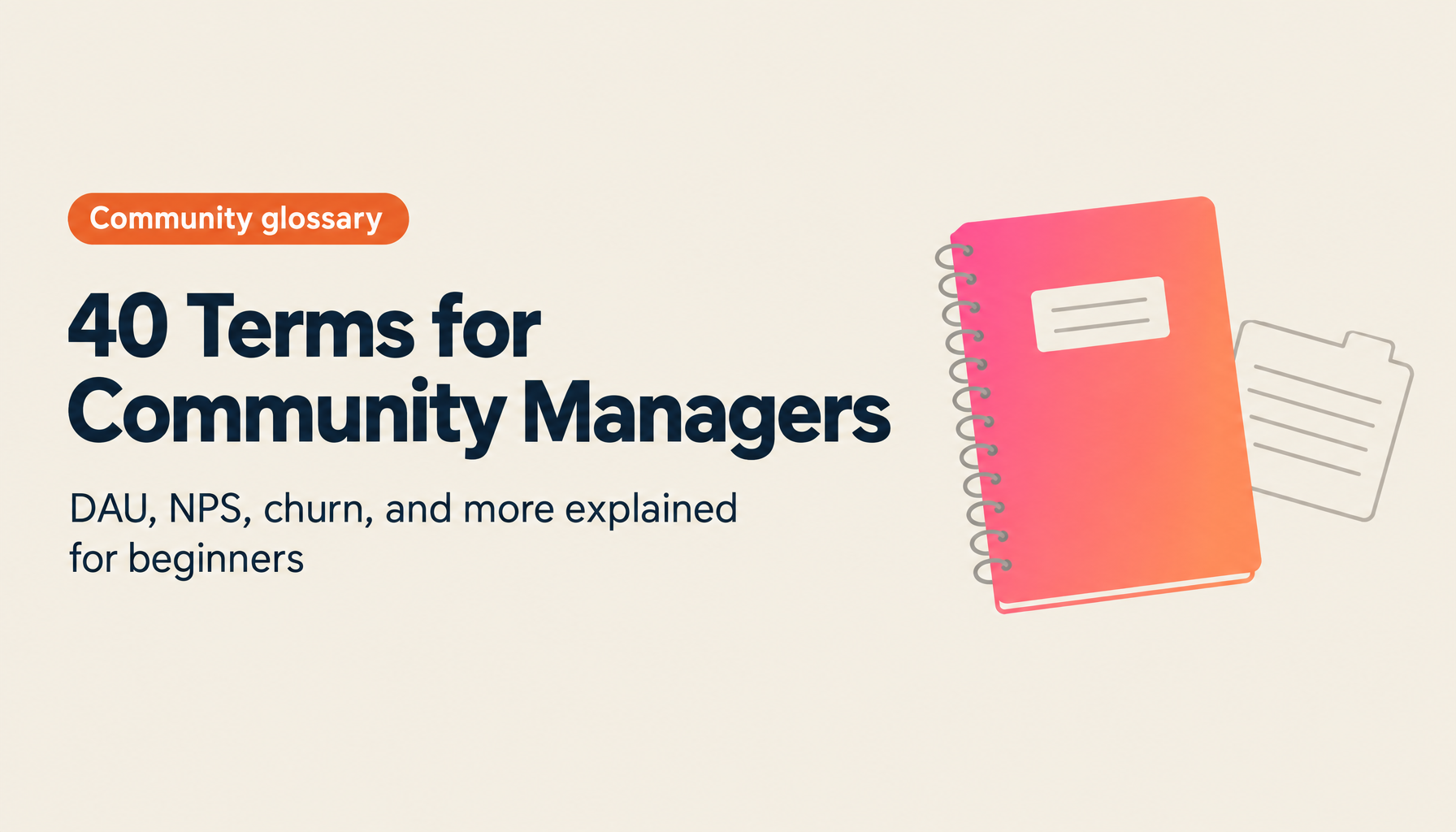
If you've been put in charge of community management and found yourself overwhelmed by terms like "DAU," "churn rate," and "gamification" — you're not alone. Community management has grown into a significant discipline for deepening member relationships and building brand value. This glossary covers 40 essential terms across the full arc from community launch to growth phase, with concrete examples throughout.
Contents
- Metrics and KPIs
- Member Management and Growth
- Engagement Tactics
- Operations and Strategy
- Platforms and Technology
- Summary
Looking to optimize community management?
We have prepared materials on BASE best practices and success stories.
Metrics and KPIs
DAU (Daily Active Users) — The community's thermometer. The number of users who took any action (viewed content, posted, reacted) in a given day. DAU is the most sensitive indicator you track daily. A sudden drop in DAU is a signal that something has changed.
WAU (Weekly Active Users) — The number of users who were active in the community during a given week. When day-of-week variation makes DAU noisy, WAU gives a cleaner view of weekly trends.
MAU (Monthly Active Users) — The standard metric for monthly reports. "Last month's MAU was 5,000" is the typical use. MAU is the most common reference point for measuring the impact of campaigns and events.
DAU/MAU Ratio (Stickiness) — DAU divided by MAU. Shows how frequently monthly users return on a daily basis. A 30% DAU/MAU ratio means roughly 30% of monthly users visit every day. The higher this ratio, the more the community has become a habitual destination.
Engagement Rate — The proportion of members who take active actions — posting, commenting, reacting — rather than passively viewing. Tells you whether your members are participating or just watching. BASE makes this visible in real-time on the dashboard.
Churn Rate — The percentage of members who left (unsubscribed or became inactive) in a given period. No matter how many new members you acquire, high churn means you're filling a bucket with a hole in the bottom.
Retention Rate — The inverse of churn rate: the percentage of members still active in the community after a given period. "What percentage of members from three months ago are still participating?" is the typical tracking question.
NPS (Net Promoter Score) — One question: "How likely are you to recommend this community to a friend?" on a scale of 0-10. Subtract the percentage of detractors (0-6) from the percentage of promoters (9-10). Deceptively simple, but consistently accurate as a reflection of overall member satisfaction.
CSAT (Customer Satisfaction Score) — Directly asking members to rate their satisfaction with a specific event or support interaction. Where NPS measures overall recommendation likelihood, CSAT focuses on individual experiences.
LTV (Lifetime Value) — The total value a member generates from joining to leaving. For paid communities, cumulative subscription revenue; for free communities, a proxy like post count or referrals. Knowing where your highest-LTV members come from clarifies acquisition priorities.
Numbers covered, let's shift to relationships. What ultimately determines whether a community lives or dies is the people in it.
Member Management and Growth
Onboarding — First impressions are close to everything. The introduction process for new members immediately after they join — a self-introduction space, a how-to guide, a welcome message. The quality of the initial experience has an outsized effect on retention in the following weeks.
Activation — The moment a new member moves from "registered but not doing anything" to taking their first meaningful action: first post, profile completion, first reaction to another member's content. Activation rate is one of the strongest predictors of long-term retention.
Retention — Members staying in the community and continuing to participate over time. Improving retention is generally more impactful than increasing acquisition because the cost of retaining an existing member is a fraction of acquiring a new one.
Churn — Any form of member departure, including formal unsubscription but also "silent churn" — stopping engagement without formally leaving.
Ambassador — An enthusiastic member who proactively promotes the community to people outside it. Can be formally designated. Ambassadors share activities on social media, invite acquaintances, and represent the community to new audiences.
Evangelist — Similar to ambassador, but with a broader reach: writing blog posts, speaking at events, appearing in media. Where ambassadors bring in individuals, evangelists create awareness at scale.
Super User (Power User) — The community's engine. About 5% of any community, these members help others, surface interesting topics, and maintain the energy of the space. When this 5% disengages, the community quiets surprisingly fast.
ROM (Read-Only Member) — Members who read without posting. Also called "lurkers." Most community members are in ROM mode, and this isn't inherently a problem. The challenge is ROM members leaving before they ever participate. Lowering participation barriers — single-tap reactions, anonymous Q&A — to convert ROM members into contributors is one of community management's core design challenges.
A common mistake: making everyone post a required introduction to combat high ROM rates. This often reduces participation further because the barrier to entry goes up before any value has been established. The better approach: start with the lowest possible action (one emoji reaction), and raise the bar gradually as comfort builds.
Engagement Tactics
Gamification — "10 posts earns a bronze badge." Applying game mechanics — points, badges, leaderboards — to increase participation motivation. Most community platforms now include these features as standard, making gamification a baseline practice rather than a differentiator.
UGC (User Generated Content) — Posts, reviews, photos, and videos created by members themselves. Generally considered more credible than operator-produced content, and one of the strongest drivers of community value.
Moderation — Monitoring community posts and comments, and managing content that violates community rules or is otherwise harmful — removing disruptive posts, filtering spam, responding to emerging conflicts. Essential for maintaining a safe and valuable space.
Community Guidelines — A written statement of the rules members are expected to follow. Effective guidelines include not just prohibitions but positive guidance: "here's the behavior we welcome." Clarity here reduces moderation burden significantly.
Fan Marketing — Using existing fans and loyal members as the starting point for word-of-mouth and referral growth. Communities are the natural environment for fan marketing in practice.
Community Event — Online or offline gatherings where members interact: study sessions, networking events, hands-on workshops. BASE lets you create an event page in 60 seconds, with participation management in the same interface.
Welcome Series — A sequence of messages sent to new members over their first days and weeks. Typical structure: welcome email on day one, how-to guide on day three, popular content highlights at one week. Automated but personalized in tone.
Re-engagement — Tactics to bring back members whose activity has stopped. Sending a notification — "We haven't seen you in a while; here's what's been happening" — is the standard approach. Personalization and relevance determine whether it works.
Tactics covered — now the question of who manages all this and how.
Operations and Strategy
Community Manager — Both the public face and the invisible hand of the community. Member communication, content planning, data analysis, event management — the scope is wide and the role typically wears many hats simultaneously.
Community of Practice (CoP) — A community formed around a shared area of interest or professional domain, where members voluntarily gather to share knowledge. Internal engineering communities and cross-industry study groups are common examples.
Community Strategy — "Why does this community exist?" If you can't answer that immediately, the strategy isn't clear enough. A documented strategy covers purpose, target membership, operating principles, and success metrics. Communities started without this clarity tend to drift.
Persona — A detailed profile of the typical community member. "Third-year marketing professional, age 30, joining primarily for information and networking" gives you a concrete reference point for content and initiative decisions.
Customer Success — Proactively supporting members in achieving their goals, rather than waiting for problems to arise. Where support is reactive, customer success is anticipatory.
Health Score — A composite metric combining multiple activity indicators — login frequency, post count, event attendance — to assess each member's overall engagement level. Used to identify at-risk members before they churn.
Cohort Analysis — Grouping members by when they joined and tracking how their behavior changes over time. "Members who joined in December had 65% 90-day retention; January joiners had 72%" — this comparison reveals which initiatives are working and which onboarding periods perform differently.
Finally, platform and technology — directly relevant to operators because your tool choices shape your community's capabilities and member experience.
Platforms and Technology
Community Platform — The software or service that provides the operating infrastructure for a community — discussion features, member management, analytics dashboards. TIMEWELL's BASE is an AI-native community platform designed to create pages in 60 seconds.
CRM Integration — Connecting community data with a CRM (Customer Relationship Management) system. Linking member activity data with sales and support information enables more tailored responses to each member.
Push Notification — Direct notifications delivered to members' smartphones or browsers: new post alerts, reply notifications. A powerful channel but easily overused. Too many notifications lead members to disable them entirely, cutting off the channel permanently. Treat push notifications as a high-value, limited resource.
A common failure pattern: increasing notification frequency to boost DAU, only to have members revoke notification permission for the app, making them unreachable going forward. Design notifications like you'd use a last resort.
SSO (Single Sign-On) — Allowing members to access the community using an existing account — company credentials, Google login, Slack ID. Reduces signup friction and is especially useful for workplace communities.
API Integration — Connecting a community platform with external tools (Slack, email services, CRM) programmatically. Eliminates manual data transfer between systems and improves operational efficiency significantly.
Summary
Community management terminology falls into three broad categories: metrics, tactics, and structure. Keeping these three distinct helps prevent the terminology from blurring together.
Key points to take away:
- DAU/MAU ratio is the most basic measure of community stickiness
- Onboarding quality has an outsized effect on subsequent retention
- Gamification and UGC promotion are the primary engines of engagement growth
- Moderation and community guidelines maintain a space worth being in
- Data-driven improvement — cohort analysis, health scores — accelerates sustainable growth
Communities aren't built and then left. They need to be grown and adapted continuously. AI is now available to assist with moderation and to identify the optimal timing for engagement initiatives based on member behavior data. The metrics and tactics covered in this glossary are the foundation for that more sophisticated phase. TIMEWELL's BASE is designed to let you take the first step in 60 seconds.