Our Lives Are Supported by an Invisible Chain — the Supply Chain
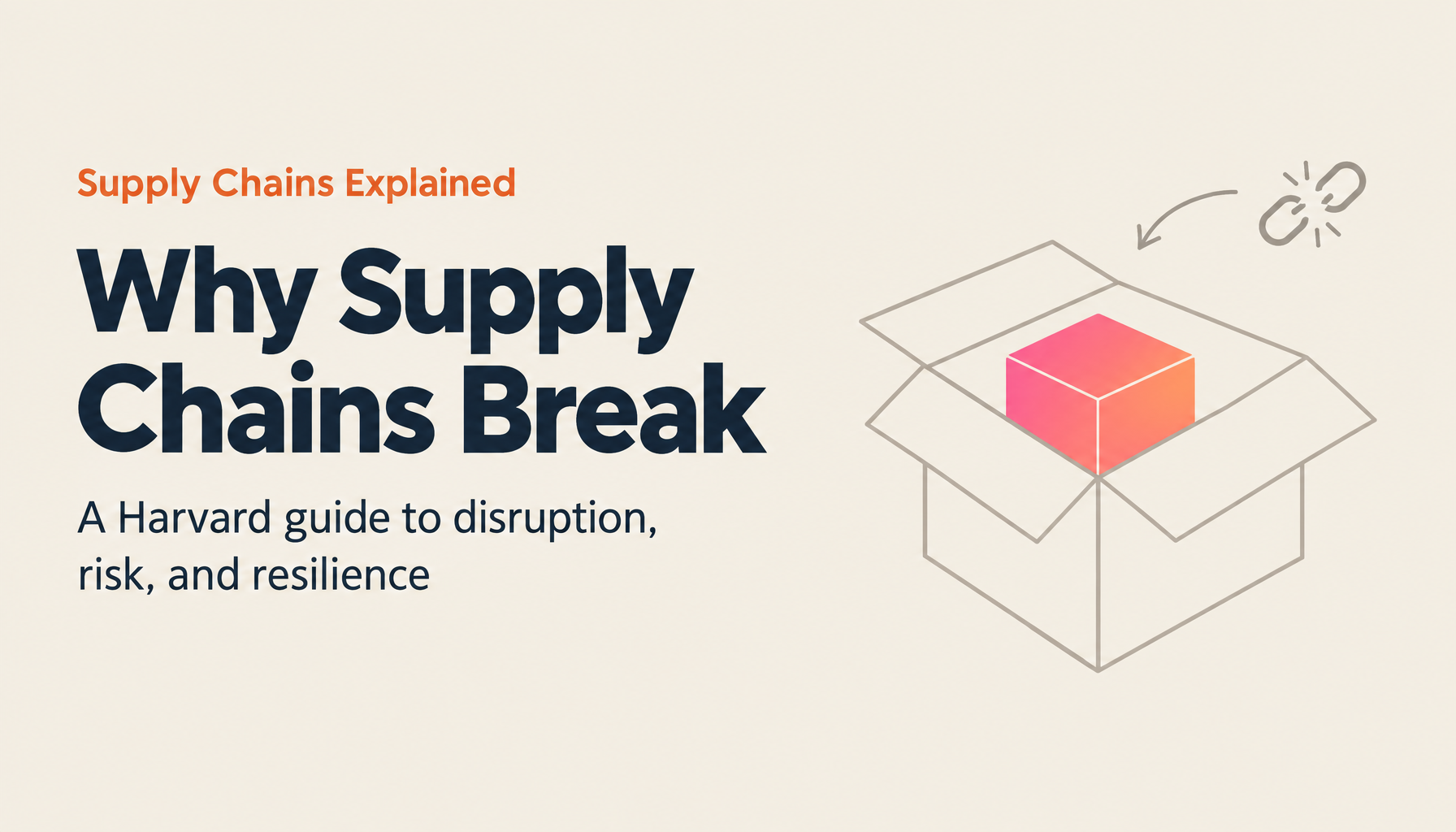
Our lives are supported by an invisible "chain" — the supply chain. From the eggs at breakfast, to the car on the commute, to the laptop at work, to the sofa we relax on at night, every product reaches us through a complex global supply chain. Yet in recent years, this vital lifeline has been hit by unprecedented disruption on a scale never seen before — pandemics, geopolitical tensions, extreme weather. Surging egg prices, toilet paper vanishing from shelves, new car deliveries delayed by months: these events laid bare just how intimately supply chains are woven into our daily lives — and how vulnerable they are. How should companies manage risk and maintain stable supply in conditions like these?
This article digs deep into the challenges facing modern supply chains, the mechanisms behind them, and the outlook ahead, drawing on a Q&A-format explainer by Professor Willy Shih of Harvard Business School. From how tariffs work, to the realities of trade wars, geopolitical risk, and the evolution of supply chain management, we cover everything business professionals need to know — with practical insight for navigating a turbulent era.
- The Reality of Supply Chain Disruption: From Eggs and Toilet Paper to Semiconductors and Tariffs
- Geopolitical Risk and Supply Chains: Trade Friction, Chokepoints, and Resource Dependencies
- The Evolution and Future of Supply Chain Management: From Optimization to Resilience
- Summary
Looking for AI training and consulting?
Learn about WARP training programs and consulting services in our materials.
The Reality of Supply Chain Disruption: From Eggs and Toilet Paper to Semiconductors and Tariffs
The supply chains that underpin modern society are sometimes severed by unexpected factors, with significant impacts on our lives and economic activity. From the price spike of everyday goods to international trade friction — let's look at specific examples and the mechanisms behind them.
Start with the egg price surge that has affected many households. As Professor Shih points out, the supply chains for chicken meat and eggs are different. The direct cause of tightening supply was bird flu hitting laying hens hard — with large numbers culled. When supply falls, prices rise: that's basic economics. But the problem goes deeper. A critical nutrient in laying hen feed — biotin — is largely imported from China. If the US-China trade war intensifies and China restricts biotin exports, the productivity of US laying hens could fall sharply, further destabilizing egg supply. This is a significant food security issue, pointing to the risk of excessive dependence on specific countries.
Next, the toilet paper shortage that threw so many people into confusion in the early pandemic. Professor Shih notes that toilet paper demand is relatively stable year-round with little seasonal variation — and as an economic "non-tradable" good, it doesn't ship well over long distances. Toilet paper consumed in New York is unlikely to come from China; it's typically produced in relatively nearby regions like the Northeast or Mid-Atlantic. Because of these characteristics, the toilet paper supply chain is optimized to run lean — at high utilization rates of 90–95%. But this "optimized" tight supply network means there is little slack. When consumers simultaneously hoard in an unprecedented event like a pandemic, demand surges and supply can't keep up. Producers ramp up production, but when demand exceeds capacity, products disappear from shelves. This case perfectly illustrates why the balance between efficiency and stable supply (resilience) matters so much.
The semiconductor shortage delivered an even more severe blow — particularly to the automotive industry. In the early pandemic, as auto sales plummeted, many automakers cancelled orders for semiconductors and other parts. But when demand recovered faster than expected, manufacturers tried to reorder — only to find that semiconductor makers had already shifted the production capacity freed up from cancelled automotive lines over to booming consumer electronics and computer demand. Automakers couldn't secure the chips they needed and were forced to halt production lines. Complex products like pickup trucks can't be completed when just one part is missing. Modern vehicles are assembled from parts sourced worldwide — power steering assemblies from Mexico, castings from India and China — and the globalization and complexity of supply chains amplifies the impact of a single parts shortage.
On top of these concrete shortages, tariffs are a major variable in international trade. As Professor Shih explains, tariffs are an additional charge — a tax — added to the price of imported goods. For example, an imported product worth about $90 hit with a 25% tariff means the importer pays roughly $22.50 to the US government — and that cost ultimately gets passed on to consumers. The Trump administration imposed high tariffs on Chinese goods in particular, intending to make imports more expensive and encourage domestic production. The Biden administration maintained most of them and added some of its own. But there are limits to the idea that tariffs can foster domestic production. As Professor Shih notes, US domestic production costs — especially labor — remain very high. Compared to Mexico or China, the gap is 4 to 5 times. iPhone assembly in China requires roughly 4 hours of labor at about $5.50/hour — roughly $22. Doing the same work in the US at roughly $36/hour costs about $144. With that kind of cost gap, moving simple assembly back to the US is not realistic. Even with tariffs, the sectors where cost-competitive domestic production is feasible are limited to those where labor costs represent a relatively low share of total product value — like jet engines. Trade wars are a complex problem: intended to protect domestic industry, they bring side effects like higher production costs and increased burdens on consumers.
Geopolitical Risk and Supply Chains: Trade Friction, Chokepoints, and Resource Dependencies
Global supply chains constantly face "geopolitical risk" — the influence of international political and economic conditions and geographic constraints — even as they pursue efficiency and cost reduction. Conflict or rising tensions in specific regions can instantly paralyze global logistics networks and inflict serious economic damage.
A recent striking example is the Houthi attacks on merchant vessels in the Red Sea. As Professor Shih explains, the Houthis seized and attacked a strategic position facing the Bab-el-Mandeb Strait — the critical passage connecting the Suez Canal to the Indian Ocean. This route is the primary trade lane connecting Asia and Europe, heavily used by container ships heading from China to Europe in particular. As attacks intensified, many shipping companies were forced to abandon Suez Canal transit. Those vessels instead chose to route around the Cape of Good Hope at the southern tip of Africa — adding 10 to 12 days of sailing time. This detour did more than just lengthen transit times — it effectively trapped roughly 12% of global container shipping capacity in extended voyages. The result was a direct increase in shipping costs and supply delays that delivered a major shock to the global economy. Somali piracy (depicted in the film Captain Phillips) presented similar vulnerabilities in major trade lanes. Narrow maritime chokepoints are always at risk of being shut down by conflict, terrorism, or piracy — with cascading effects across global supply chains.
China itself is deeply aware of its own geopolitical vulnerabilities. The "Malacca Dilemma" that Professor Shih references is a major energy security concern for Beijing: most of China's oil imports must pass through the Strait of Malacca between Malaysia and Indonesia (off Singapore). If that strait were blocked for any reason, China's economy would suffer a devastating blow. China also feels geographically constrained from Pacific access by the island chains stretching from Japan through Taiwan to the Philippines (the "first island chain") — a perception that helps explain China's naval expansion and massive investment in port infrastructure.
Professor Shih also touches on the strategic importance of the Panama Canal and Greenland. The Panama Canal has long served as a shortcut connecting the Pacific and Atlantic, a cornerstone of global maritime trade. Greenland, as Arctic sea ice retreats with climate change, is attracting new attention. Arctic shipping routes could dramatically shorten distances between Asia and Europe — trial voyages have already taken place. Greenland also holds reported reserves of rare earth elements and other mineral resources, making its strategic importance grow. Former President Trump's interest in the Panama Canal and Greenland can be understood through the lens of trade routes and resource security.
Resources — particularly lithium essential for battery manufacturing, and rare earths (neodymium and others) used in high-performance motors — are closely tied to geopolitical risk. Much lithium is mined in Chile and elsewhere in South America, but China holds a dominant share of global refining capacity. The same is true of rare earths: the world's largest rare earth mine was once in Mountain Pass, California — but as China invested in refining technology, it came to dominate the global rare earth supply chain. US-mined rare earths are often refined in China and sold back to the world. As vehicle electrification accelerates, securing stable supplies of these critical minerals has become a matter of national economic security. The delivery delays for hybrids like the RAV4 Prime and electric vehicles are also partly driven by these rare earth and battery component supply problems.
The relationship with neighboring Canada also matters greatly for US supply chains. As Professor Shih notes, the US imports potash, oil, aluminum, steel, and many other resources and products from Canada. Potash in particular is an essential fertilizer for US agriculture — with a large dependence on Canadian supply. If the US imposed tariffs on Canadian goods and Canada retaliated by restricting potash exports, US agriculture would take a serious hit (though Canadian exporters would also suffer). Canadian aluminum is produced cheaply using Canada's abundant hydropower. On oil, heavy crude from Alberta's oil sands is piped to refineries along the US Gulf Coast for processing — those refineries have been optimized for the characteristics of Canadian crude, creating a very strong mutual dependency. The seemingly stable neighbor relationship can also affect supply chains through trade friction and policy changes.
The Evolution and Future of Supply Chain Management: From Optimization to Resilience
Supply chains are not simply about moving goods — they operate according to the concept of "supply chain management": how to efficiently and stably match demand with supply. The field has a long history and has continuously changed and evolved to the present day.
Professor Shih frames the development of the global economy against a historical timeline. In ancient Rome, goods like salt were traded; in medieval times, Venetian merchants and Marco Polo brought silk and ceramics to Europe via the Silk Road. The 1700s saw the age of sail and oceanic trade — goods flowing from the East via Africa, gold and rum from the Americas. Between the world wars, inward-looking economic policies with high tariff barriers stalled trade. After World War II, trade expanded again, and from the late 1990s through around 2010, globalization accelerated. In this era, factories for textiles, apparel, consumer goods, and toys relocated en masse from the US to low-cost regions like China — where labor costs were reportedly one-twentieth of US levels. But from around 2016, the US-China trade war began, with tit-for-tat tariffs and companies starting to move production out of China to other countries ("China Plus One").
Across this historical evolution, how has "supply chain management" been understood? Professor Shih defines its essence as "matching demand with supply" — accurately understanding what customers want, when, and how much, and optimizing every step from production to delivery to match that. Supply chain professionals must consider and plan across a wide range of elements:
- Supplier network management: Where to source the parts and materials a product needs, and what are the reliability and risks?
- Transportation and logistics optimization: How and by what route to move parts and products most efficiently?
- Inventory management: Maintaining appropriate inventory levels considering demand variability and lead times — balancing stockout risk with inventory cost.
- Demand forecasting: Analyzing historical data, market trends, and seasonal variation (back-to-school season, holiday season, Halloween candy surges) to predict future demand.
- Production planning: Planning what to produce, when, and how much based on demand forecasts.
For many years, "Just-in-Time (JIT)" — prioritizing cost reduction and efficiency — was the dominant model. Born at Toyota in resource-scarce postwar Japan, JIT aims to supply "what is needed, when it is needed, in the amount needed." Eliminating unnecessary inventory to reduce costs became the manufacturing standard for decades. But Professor Shih points out the limits of JIT. The 2011 Great East Japan Earthquake hit a factory that held 45% of the global market share for microcontrollers used in engine management systems, halting Toyota's production lines for an extended period. This experience led Toyota to rerecognize the risk of important components like semiconductors being concentrated in geopolitically and geographically unstable regions. The lesson: hold inventory not just for "when needed" but accounting for "the lead time to secure alternative supply if an unexpected interruption occurs" — in other words, "JIT + lead time." Toyota's ability to continue production longer than competitors in the early pandemic is attributed to this lesson — having sufficient inventory based on that revised philosophy.
The UK KFC chicken supply stoppage a few years back is also a good illustration of the efficiency-resilience tradeoff. KFC revamped its logistics network, consolidating its delivery provider to DHL and centralizing chicken distribution at a single warehouse. Cost savings came — but one day, a large traffic accident near that warehouse meant no trucks could get in or out. The result: many KFC locations across the UK couldn't serve chicken. Multiple warehouses would have allowed coverage if one went down. A classic example of pursuing cost efficiency at the expense of supply chain resilience.
Underpinning modern global supply chains are enormous port facilities and container shipping systems. Professor Shih notes how China's ports dwarf their US counterparts. Shanghai and Ningbo on China's east coast — backed by the enormous manufacturing hub of the Yangtze River Delta and massive government infrastructure investment since the late 1990s — boast world-leading scale and efficiency. At the Shenzhen port Professor Shih visited, 20,000 trucks deliver containers daily. The Port of Shanghai was so determined to maintain depth for large vessels that an artificial island was built in the East China Sea, connected by a massive bridge. In contrast, US port facilities have limited berths for simultaneously docking large vessels. Even Los Angeles-Long Beach, the largest US port, diverts cargo to Canada's Prince Rupert during peak congestion. Container ships themselves have grown from carrying around 50 containers to the largest vessels today carrying 24,000 — with overall lengths reaching 400 meters. While vessel efficiency has improved, port infrastructure has struggled to keep pace. The grounding of the giant container ship Ever Given in the Suez Canal, paralyzing global logistics, was a symbolic illustration of infrastructure limits.
Hundreds of millions of shipping containers are estimated to exist worldwide, most manufactured in China where steel costs are low. Containers carry products from China to the US and Europe, but because there is less to ship on the return leg, large quantities of empty containers accumulate in destination countries. Used containers no longer in service sell for roughly $900 each and are repurposed as warehouses — or, as Professor Shih joked, potentially as mobile apartments.
Online marketplaces Temu and Shein — rapidly growing in recent years — have an interesting supply chain model. According to Professor Shih, these companies own no factories; they are "pure supply chain companies" directly connecting consumer demand to Chinese suppliers. One reason they achieve low prices is a US import regulation exception: the "de minimis exemption." Imports valued at under roughly $800 are exempt from the burdensome tariff procedures and paperwork. Most Temu and Shein goods fall within this threshold, enabling fast and low-cost direct delivery to consumers. Currently, small packages using this exemption flood into the US at 3–4 million per day, comprising a large share of air freight volume. Sending lightweight, low-price goods directly by air is a supply chain model that overturns conventional wisdom.
The shortage of GPUs — especially those indispensable for AI development — is also a serious issue. This stems primarily from explosive growth in AI-related demand, combined with the fact that approximately 95% of production capacity for these high-performance GPUs is controlled by a single company: Taiwan's TSMC. Building a fabrication plant capable of manufacturing cutting-edge GPUs requires roughly $20 billion in investment and about two years. TSMC manufactures not just GPUs but chips for iPhones, PCs, and data center servers, with orders flooding in from around the world for limited production capacity. This is a classic example of dependence on a specific company and region increasing supply risk.
Finally, the challenge of reshoring manufacturing deserves mention. Against the backdrop of rising tariffs and geopolitical risk, there are movements in the US and elsewhere to bring manufacturing back home. But as Professor Shih points out, this is not easy. First, to be competitive in high-cost countries like the US, focus needs to be on sectors that are not labor-intensive, or where high productivity through automation can be achieved. Moreover, industries that once moved offshore (like North Carolina's furniture industry) have seen skilled workers move to other jobs — rebuilding the workforce takes time and cost. And the biggest challenge is investment recovery. When factories moved to low-cost countries, the cost benefits — primarily labor cost savings — allowed relatively quick payback. But moving production from low-cost to high-cost countries brings no cost savings — product prices rise instead. The fundamental challenge of what will fund the initial investment in factory construction and workforce development remains. The revival of domestic manufacturing is a complex problem that cannot be achieved by proclamation alone.
Summary
This article, drawing on Harvard Business School Professor Willy Shih's explanations, explored the diverse challenges facing modern global supply chains and the mechanisms behind them — from the supply anxiety around everyday goods like eggs and toilet paper, to the semiconductor shortage, tariffs, trade wars, geopolitical risk, and the evolution of supply chain management.
Supply chains are no longer simply "the flow of goods." They are dynamic, ever-changing ecosystems intimately intertwined with international politics, economics, technology, the environment, and people's lives themselves. Unexpected "shocks" like pandemics and conflicts exposed the vulnerabilities of supply chain models that had prioritized efficiency above all else. Excessive dependence on specific countries, regions, or companies can become a major risk.
What is now required of companies and nations is building supply chains with the "resilience" to balance cost efficiency and stable supply — and adapt flexibly to change. As Professor Shih suggests, adding "lead time" thinking to "just-in-time" — holding appropriate inventory as insurance against unexpected disruptions — along with diversifying supply sources and regionalizing production, are the concrete approaches.
That said, imagining that global supply chains will completely collapse and every country will produce everything domestically would be overly pessimistic, as Professor Shih also notes. We are already deeply mutually dependent, and maintaining modern economic activity without international cooperation is difficult. Going forward, more complex strategies will be required: strengthening partnerships with like-minded countries (the US, Europe, Japan, South Korea), while managing risk in the relationship with China.
Reshoring manufacturing is also an important theme, but overcoming the challenges of cost and workforce development will require strategic initiatives — investing in automation technology, focusing on high-value-added products.
In conclusion, supply chain management is a field whose importance will only grow. Companies must continuously gather the latest information, assess risk, and build structures that can respond quickly to change. Monitoring geopolitical trends, technological innovation, and shifts in consumer behavior — strengthening supplier relationships and making data-driven decisions — will be the keys to navigating an era of high uncertainty. The future of global supply chains is anything but smooth, but by understanding the challenges and executing appropriate strategies, it is possible to build a more resilient and sustainable system.
Source: https://www.youtube.com/watch?v=uDGkkqllQa8
Streamline Event Management with AI | TIMEWELL Base
Struggling to manage large-scale events?
TIMEWELL Base is an AI-powered event management platform.
Proven Results
- Adventure World: Managed a Dream Day event with 4,272 attendees
- TechGALA 2026: Centrally managed 110 side events
Key Features
| Feature | Benefit |
|---|---|
| AI Page Generation | Event page ready in 30 seconds |
| Low-Cost Payments | 4.8% transaction fee (among the lowest in the industry) |
| Community Features | 65% of attendees continue engaging after the event |
Feel free to reach out to discuss how we can make your event operations more efficient.
Related Articles
- Accelerating Growth in the AI Semiconductor Market: Latest 2026 Trends and Strategies from TSMC and NVIDIA
- ElevenLabs 2026: Valuation Reaches $11 Billion, ARR Surpasses $330 Million, Dominating the Voice AI Market
- From 2026 to 2027: The Reality of AGI's Arrival, Anthropic CEO Confident It's "Within a Few Years"