Hamamoto, TIMEWELL.
You've deployed RAG, but the answers are off-target. It keeps pulling irrelevant documents. Hallucinations aren't going down. If you're an engineer dealing with this, you're not alone. RAG — Retrieval-Augmented Generation — is a system where an LLM generates responses based on retrieved information, but simply "putting it in" often doesn't deliver the accuracy you need.
In 2025, DeNA's engineering blog published a detailed account of their journey improving RAG accuracy for an internal AI help desk. They struggled with answer accuracy in the early stages, and worked through iterative improvements — chunk design revisions, reranking implementation — before reaching production-ready quality.
Here are seven concrete techniques for improving RAG response accuracy, along with a chunk design pattern comparison and evaluation metrics for measuring progress quantitatively.
First: Isolate the Source of Low Accuracy
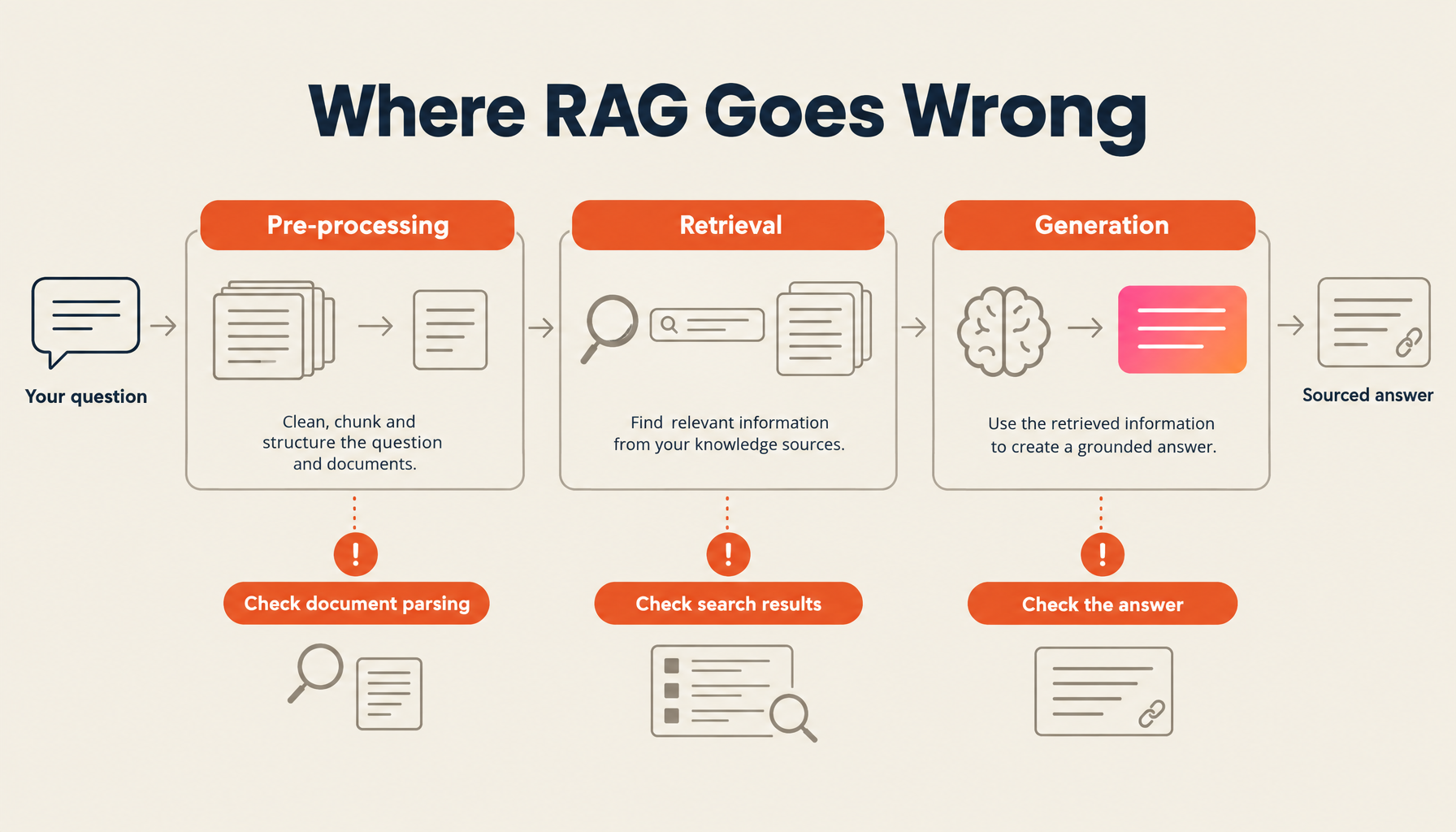
Before working on improvements, identify where the problem actually is. RAG systems have three potential bottlenecks:
| Stage | Processing | Common Problems | How to Verify |
|---|---|---|---|
| Pre-processing | Document loading and chunk splitting | PDF parsing failures; inappropriate chunk granularity | Visually compare source document against chunks |
| Retrieval | Vector search and keyword search | Relevant documents not surfacing; too much noise | Manually review the top 10 search results |
| Generation | LLM response creation | Hallucinations; poor information selection | When retrieved documents are correct but responses are wrong |
In my experience, the highest-impact improvements come from the retrieval stage. When the right information reaches the LLM, response quality improves naturally. Conversely, if retrieved documents are off-target, even the best LLM can't produce accurate answers.
Struggling with AI adoption?
We have prepared materials covering ZEROCK case studies and implementation methods.
7 Techniques to Improve Accuracy
Technique 1: Redesign Your Chunk Strategy
How you chunk — how you split documents — directly affects RAG accuracy. Research from ai-market.jp found that appropriate chunking reduced hallucination generation by 42%. That's a significant number.
Comparing major chunking approaches:
| Chunking Method | Overview | Typical Chunk Size | Best For | Implementation Cost | Accuracy |
|---|---|---|---|---|---|
| Fixed-length | Mechanical split by character count | 500–1,000 chars | Uniform documents | Low | Low–Medium |
| Paragraph/heading | Split based on document structure | Paragraph units | Manuals, specifications | Low | Medium |
| Semantic | Split based on meaning units | Variable | Diverse documents | Medium | Medium–High |
| Late Chunking | Embed entire document, then split | Variable | Long-form documents | High | High |
| Parent-child chunks | Small chunks nested inside large chunks | Parent: 2,000 chars; Child: 500 chars | Hierarchical documents | Medium | High |
| Overlapping chunks | Add overlap between consecutive chunks | Body: 500 chars + 100-char overlap | Documents prone to context breaks | Low | Medium–High |
The best starting point is overlapping chunks. Low implementation cost, and it mitigates the context-cut problem at chunk boundaries. Start with chunk size 500 characters, overlap 100–150 characters, and adjust based on evaluation results.
The chunk size tradeoff is clear: smaller chunks make each unit's content more explicit and improve retrieval hit rate, but risk missing the context needed for good answers. Larger chunks preserve context but introduce noise that hurts retrieval precision. The right answer is "depends on your data and use case" — which means measurement is the only real answer.
Technique 2: Implement Hybrid Search
Vector search alone has limits. It's weak on product codes, internal terminology, and proper nouns — things that are hard to capture semantically. Searching for "Model ABC-1234" and getting a semantically similar but different model number is a typical failure pattern.
The fix: combine keyword search (BM25) with vector search in a hybrid approach. Reciprocal Rank Fusion (RRF) is commonly used to integrate the two result sets.
Hybrid Search Flow

User query
  ├── Vector search ... ranks documents by semantic similarity
  ├── Keyword search (BM25) ... ranks documents by term matching
  └── Merged with RRF ... final ranked result list
According to Redis's technical blog, adding hybrid search improved search recall (the percentage of relevant documents retrieved) by an average of 15–25%. If you're only using vector search, this is the first place to look.
Technique 3: Add a Reranker
Reranking takes the initial retrieval results and re-ranks them using a higher-precision model. Cross-Encoder-based reranking is low-cost and delivers fast results. On projects I've worked on, adding a reranker alone produced accuracy improvements users could feel immediately.
The flow is straightforward:
- Initial retrieval: get 20–50 candidate documents
- Cross-Encoder: re-score each candidate against the query for relevance
- Pass top 5–10 by score to the LLM
Initial retrieval is fast but coarse. Reranking is slower but more precise. Combine these characteristics for a two-stage approach: cast wide, then narrow.
Technique 4: Use Metadata Filtering
Add metadata to chunks (creation date, department, document type, product name, etc.) and use them as filters at search time.
For example, searching for "the latest warranty terms for Product A": first filter by product=Product A and document_type=terms, then run vector search. Narrowing the search target reduces the risk of irrelevant documents appearing as noise.
Recommended metadata fields:
| Metadata Field | Type | Use | Example |
|---|---|---|---|
| source_type | string | Filter by document type | manual, faq, policy, meeting_notes |
| department | string | Filter by department | sales, engineering, hr |
| product | string | Filter by product | product_a, product_b |
| created_at | date | Prioritize recent information | 2026-01-15 |
| updated_at | date | Track update frequency | 2026-02-10 |
| language | string | Multi-language support | ja, en |
Technique 5: Improve Accuracy with Query Transformation
Using a user's raw query directly as the search input can hurt accuracy — it may be too conversational or too vague.
Three common query transformation approaches:
- Query Decomposition: Break complex questions into multiple sub-queries. "What are the differences in price and warranty period between Product A and Product B?" becomes four separate queries.
- HyDE (Hypothetical Document Embeddings): Have the LLM generate a "hypothetical ideal answer document," then embed that document for search. A document resembling an answer is closer in vector space to target documents than the question itself.
- Step-Back Prompting: Raise the abstraction level before searching. "What were January 2026 sales results?" becomes "sales results report."
Technique 6: Use GraphRAG to Leverage Information Relationships
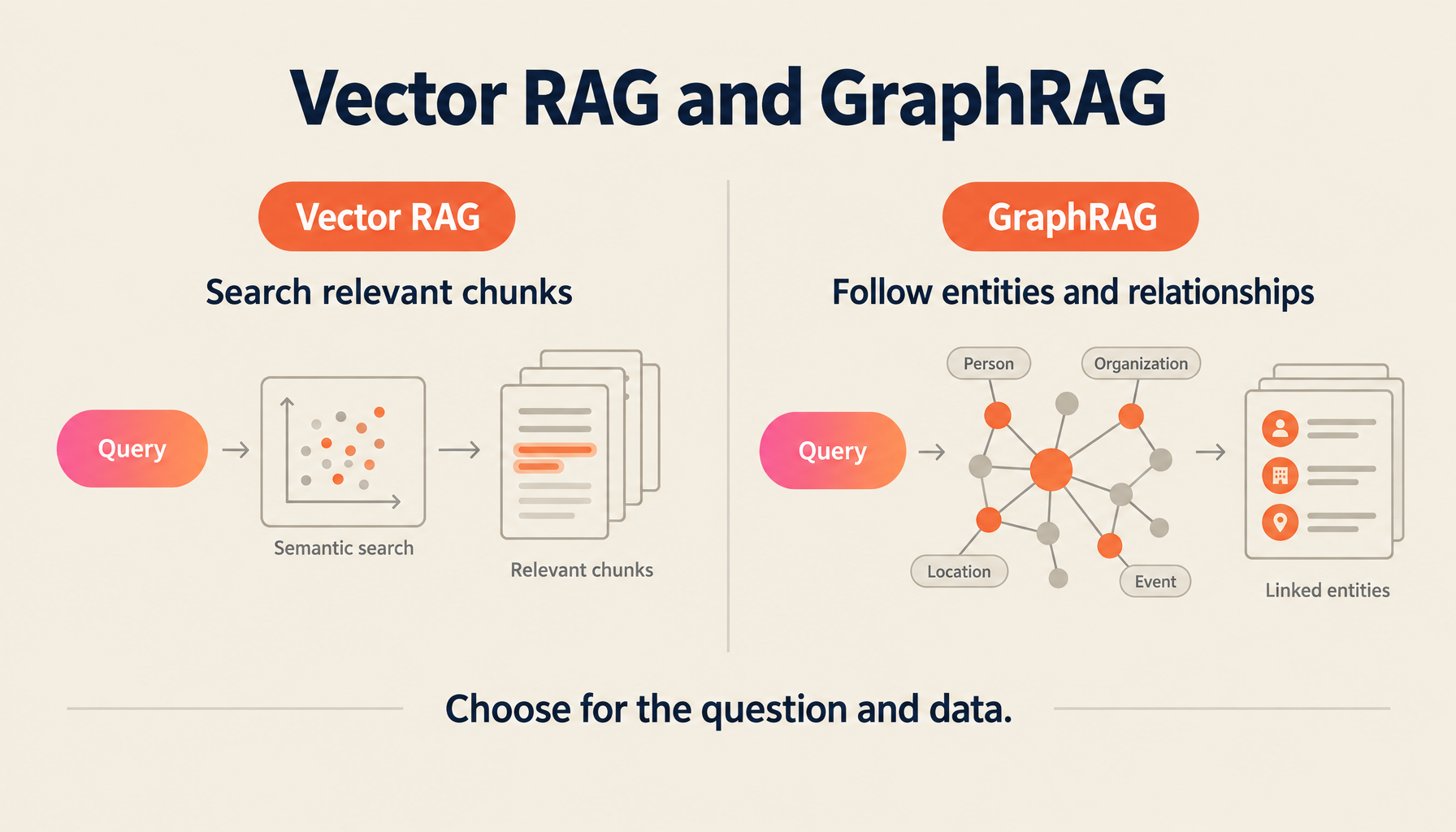
Traditional vector search RAG treats each document as an isolated chunk. But real internal information is complexly interrelated — "this policy applies to that business process," "this product specification is based on that design document." Searching at chunk level while ignoring these relationships is why complex questions produce poor accuracy.
GraphRAG explicitly manages the relationships between chunks as a graph structure (nodes and edges). A February 2025 evaluation paper on arXiv reported that for queries involving more than 5 entities, vector RAG accuracy dropped sharply — while GraphRAG maintained stable performance even at 10+ entities.
In a FalkorDB benchmark, GraphRAG outperformed vector RAG by 3.4x on accuracy in some cases. That said, GraphRAG isn't superior for every task — simple FAQ-type responses achieve adequate accuracy with vector RAG.
Cases where GraphRAG delivers real value:
- Questions requiring reasoning across multiple documents ("Who has experience with Product A and is assigned to Project X?")
- Situations requiring understanding of causal relationships or chronological sequences
- Cases where you need to detect contradictions between documents
ZEROCK has GraphRAG built in as standard. When documents are uploaded, entities and relationships are automatically extracted. If you want to improve answer accuracy on complex questions, test the search precision in a demo environment.
Technique 7: Build an Evaluation and Improvement Cycle
Without quantitative measurement after applying improvements, you won't know what worked. A 2025 GetMaxim survey found that 60% of new RAG deployments built in systematic evaluation from day one — up from under 30% earlier in 2025. The industry has recognized that "you can't operate RAG without evaluation."
Key RAG accuracy evaluation metrics:
| Metric | What It Measures | Calculation | Target Range |
|---|---|---|---|
| Retrieval Recall | How few relevant documents are missed | Proportion of correct documents that are retrieved | 80%+ |
| Retrieval Precision | How little noise is in results | Proportion of retrieved documents that are relevant | 70%+ |
| Answer Faithfulness | Accuracy of answer's basis | Proportion of answer grounded in retrieved documents | 90%+ |
| Answer Relevancy | How well answers match questions | Proportion of answers that directly address the question | 85%+ |
| Answer F1 | Overall answer accuracy | Harmonic mean of precision and recall | 75%+ |
| Hallucination Rate | Frequency of hallucinated content | Proportion of answer not grounded in retrieved documents | 5% or less |
The RAGAS framework can automatically calculate these metrics. Prepare an evaluation dataset (50–100 question-answer pairs) and run weekly accuracy monitoring. That's a realistic operational cadence.
Prioritization Guide
You don't have to implement all seven techniques at once:
| Priority | Technique | Expected Impact | Implementation Effort | Notes |
|---|---|---|---|---|
| 1 | Chunk design revision | High | Low–Medium | Start here |
| 2 | Add reranking | High | Low | Cross-Encoder addition alone shows results |
| 3 | Hybrid search | Medium–High | Medium | Add keyword search |
| 4 | Metadata filtering | Medium | Medium | Data preprocessing takes effort |
| 5 | Query transformation | Medium | Medium | Adds LLM costs |
| 6 | GraphRAG | High | High | For when fundamental accuracy improvement is needed |
| 7 | Build evaluation cycle | Measurement foundation | Medium | Essential for measuring effectiveness of all other techniques |
One exception: Technique 7, the evaluation cycle, should be set up in parallel from the very beginning. Running improvement initiatives without a way to measure their effect is like navigating without a map.
Summary
Honestly, there's no silver bullet for RAG accuracy improvement. The optimal combination depends on your data characteristics, user query patterns, and required accuracy levels.
That said, one universal truth: starting with chunk design revision and adding a reranker delivers reliable accuracy improvements at low cost. When improvements plateau after that, expand into hybrid search and GraphRAG. Leaving "we deployed RAG but accuracy is poor" unaddressed causes users to stop using the system — and the entire AI adoption project can collapse. Accumulate small improvements, consistently.
ZEROCK's Approach to RAG Accuracy
ZEROCK is an enterprise AI platform that uses GraphRAG to automatically extract relationships between documents, delivering high-accuracy responses even to complex questions. Multi-LLM support allows model selection by use case. Data is managed in AWS Tokyo region.
If you're wrestling with RAG accuracy, try ZEROCK's search precision in a demo.
References
- Redis "Improving RAG accuracy: 10 techniques that actually work"
- arXiv "RAG vs. GraphRAG: A Systematic Evaluation and Key Insights" (2502.11371)
- DeNA Engineering Blog "The Journey of Improving RAG Accuracy for an Internal AI Help Desk"
- ai-market.jp "How to Improve RAG Accuracy? Chunking and Other Methods Explained"
- arpable.com "2025 Definitive Edition: 8 Keys to Dramatically Improving RAG Accuracy"