This is Hamamoto from TIMEWELL.
"A single classification takes half a day or more." "The ordinance text is so hard to read that I re-research it every time." "I'm not confident in the result and lose days waiting for a superior's sign-off." These complaints come up constantly in export-control teams.
Export classification is the starting point of export control. Yet in many companies it has become over-reliant on a few experts and chronically inefficient. METI's fiscal 2024 analysis of FEFTA violations shows that "no classification performed / assumed not controlled" was the single most common cause pattern1. Speeding up the work matters — but so does making sure the classification step is never skipped.
This article explains a five-step system, five common error patterns, a manual vs. AI time comparison, and the 2026 regulatory updates you should bake into the process.
Ready-to-use templates: We provide free Word/Excel packs for classification certificates, parameter sheets, item-by-item comparison tables, catch-all checklists, and classification logs. → Download the 2026 classification template pack
What You Will Learn
- A concrete five-step flow for export classification
- Time and accuracy comparison between manual and AI-assisted work
- Five real-world error patterns and how to prevent them
- How the February 2026 list amendments affect documentation and audits
1. What Export Classification Is
Export classification determines whether goods you intend to export or technology you intend to provide fall under list-controlled items in Annex 1 of the Export Trade Control Order. It is the starting point of FEFTA-based export control. Getting it wrong can mean an unlicensed export.
METI's Security Trade Control Guidance (Introductory Edition) Version 3.0 (March 2026) describes the exporter process as classification, transaction screening, licensing, and shipment control2. Classification is the first gate.
Two capabilities are required: understanding the structure of the control ordinances, and understanding the product's technical content. People who have both are scarce, so work concentrates on a few individuals in almost every company. For a one-page overview first, see the export classification procedure guide.
Replace siloed classification work with AI.
METI's FY2024 data shows 52% of foreign exchange law violations stem from classification errors. Download the TRAFEED product catalog covering features and rollout.
2. The Five-Step Flow
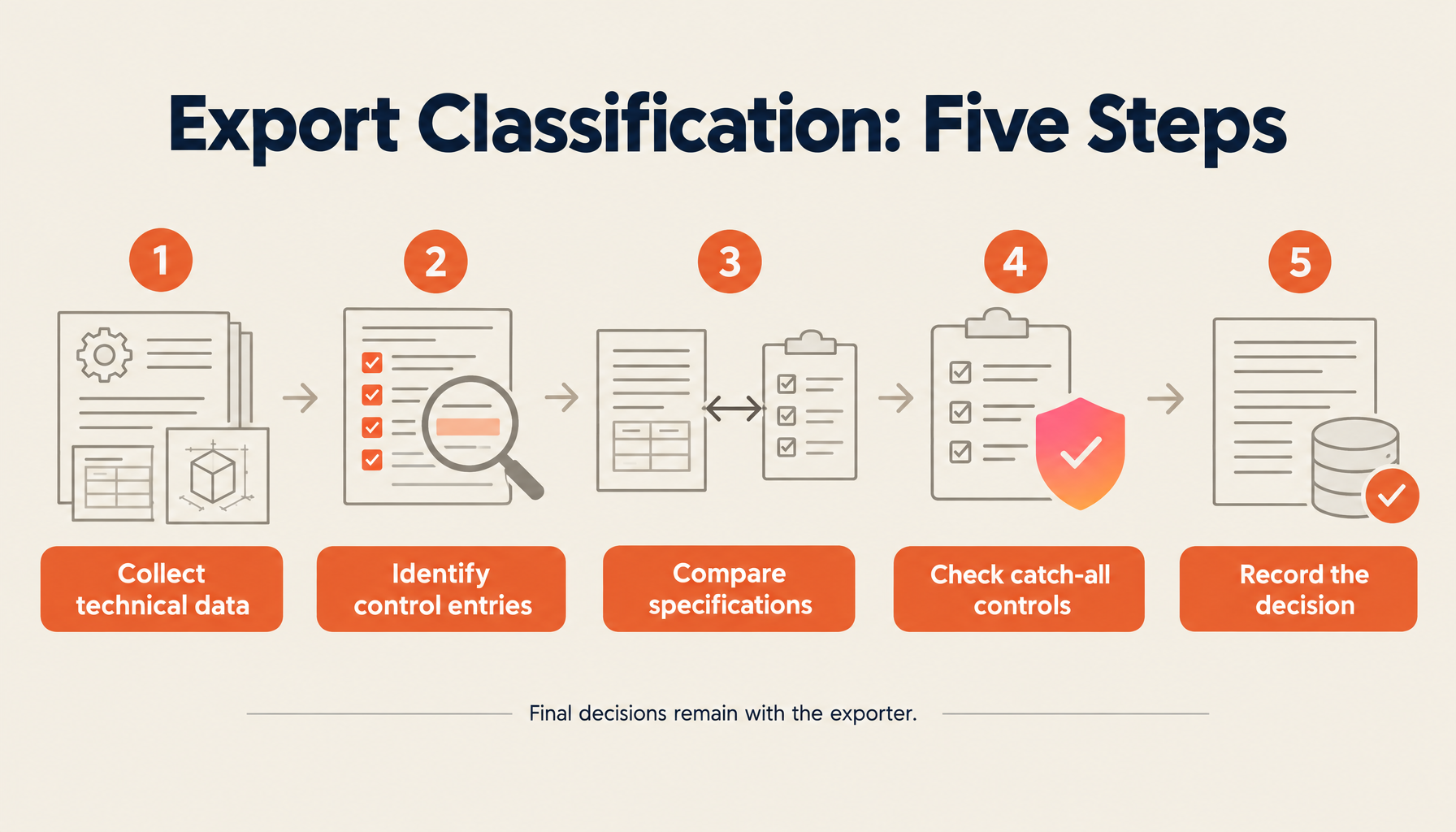
Step 1: Compile technical information
Classification quality is only as good as the input data. Catalog specs are not enough. Collect design drawings, test reports, and detailed specifications.
Check intended function and use, technical specs (precision, performance, capacity, frequency bands), components and materials, and any software. Skipping this step creates rework later. Engineering must be involved.
Step 2: Identify candidate control entries
Use METI's goods/technology matrix to narrow candidate entries by product type. CISTEC's item-by-item comparison tables are also useful. Confirm you are on the February 14, 2026 edition3.
| Product type | Entries to check first | What to verify |
|---|---|---|
| Machine tools | 6-2, 6-3 | Positioning accuracy, NC axes |
| Electronics / semiconductors | 7, 8, 9, 10 | Frequency, processing power, FPGA modules |
| Sensors / instruments | 14 | Sensitivity, resolution |
| Chemicals | 3-2, 3-3 | CAS numbers, composition |
| Software | D columns of related entries | Link to controlled goods |
| Crypto products | 9-1 | Key length, algorithms |
A single product can hit multiple entries. Do not stop when you find one plausible match — list all related entries. Skipping this leads directly to Error 2 below.
Step 3: Compare specs against the ministerial ordinance
For each candidate entry, compare the technical parameter thresholds in the Ministerial Ordinance on Goods with actual product specs.
Read the provision, extract parameters, compare numbers, decide controlled or not.
Prefer measured data over catalog nominal values. If the nominal value is just under the threshold but measured performance exceeds it, the item is controlled. For comparison worksheets, see the item comparison table guide.
Step 4: Check catch-all controls
A "not list-controlled" result is not the end. Catch-all still applies.
Check destination (whether outside Group A), end use related to WMD or conventional weapons development, whether the end user is on the Foreign User List, and whether METI has issued an inform notice.
The October 9, 2025 amendments expanded catch-all toward conventional weapons concerns and grew the Foreign User List to roughly 835 entities4. Some products that previously needed little review now do. For the relationship between list and catch-all, see the list vs. catch-all guide.
Step 5: Record the result and issue a classification certificate
Document the outcome as an internal record. A classification certificate should include:
| Field | Content | Notes |
|---|---|---|
| Product name | Official name, model | List catalog and internal names if different |
| Technical specs | Parameters used | Prefer measured values |
| Entries checked | All entries reviewed | Per-entry outcomes if multiple |
| Result | Controlled / not controlled | Per entry |
| Rationale | Why you decided that way | Cite ordinance provisions |
| Date | Classification date | Shows which amendment version applied |
| Classifier | Name and unit | Include approver |
"Not controlled" results need more explanation, not less. Customs post-clearance audits ask not only whether you classified, but whether you kept a rationale1. If you need templates, use the 2026 classification pack.
3. Then vs. Now
| Topic | At first publication (Feb 2026) | Now (July 2026) |
|---|---|---|
| Guidance | Intro edition 2.4 (Jan 2025) | Version 3.0 (Mar 2026)2 |
| List amendments | Transition around effective date | Feb 14, 2026 edition in force; old certificates risky3 |
| Catch-all | Right after Oct 2025 reform | Operate with expanded conventional-weapons scope and ~835 Foreign User List entities4 |
| Violation patterns | Over-reliance on experts | FY2024 analysis: "no classification / assumed not controlled" is #11 |
The efficiency agenda has shifted from "go faster" to "prevent skips and keep audit trails."
4. Manual vs. AI-Assisted Classification
Times vary by product complexity and skill, but manufacturing teams often see patterns like these:
| Item | Manual | AI-assisted |
|---|---|---|
| Time per case | 2–8 hours (complex cases: a full day+) | Minutes to ~30 minutes |
| Batch of 100 | 2–4 weeks | 1–2 business days |
| Rationale documentation | Written by hand | Auto-generated report draft |
| Following amendments | Manual tracking | System updates within ~2 weeks |
| Missed multi-entry hits | Common | Reduced via cross-check |
| Coverage when staff away | Stalls | System keeps running |
| Audit retrieval | Hard in paper/Excel | Central history |
AI does not replace human judgment. The practical model is AI drafts the analysis; a person confirms and decides. That division of labor is still the most balanced approach today.
5. Five Common Errors and How to Prevent Them
Error 1: Classifying from catalog specs alone
Catalogs show nominal values. Actual performance can be higher. Prevention: always pull measured data from engineering; if catalog and measured diverge, use measured values.
Error 2: Checking only one entry
Finding one "not controlled" entry and stopping. Machine-tool hardware may be fine while embedded control software hits another entry. Build a checklist of all matrix candidates.
Error 3: Treating "civilian use" as "not controlled"
List control turns on technical parameters, not marketing use cases. Civilian applications can still be list-controlled. End-use analysis belongs in catch-all, not list classification.
Error 4: Reusing old certificates after amendments
A prior "not controlled" result can become wrong when thresholds change. Japan Chemical Exporters and Importers Association near-miss collections flag this pattern5. Always date certificates and re-run related products after amendments — at least annually.
Error 5: Data-entry mistakes in internal systems
Correct classification, wrong system flag. Separate enterer and reviewer.
6. Systems That Keep Quality Stable
- Ongoing training (CISTEC basics courses, METI outreach for SMEs)
- Classification databases with amendment flags (never "same as last time" alone)
- SOPs updated whenever ordinances change
7. How TRAFEED Helps
TIMEWELL's export-control AI agent TRAFEED supports classification with multi-LLM cross-checks, rationale reports suitable for audits, and batch processing for 100–200 cases. Systems are updated within about two weeks of regulatory changes. Final decisions stay with your export-control officer.
See the TRAFEED product catalog (PDF) or contact us.
Closing
Streamlining classification is not only about speed. It is about quality, less dependence on single experts, less rework, and durable records. Tools help; training and ownership still matter. Companies that invest in both people and process build the strongest programs.
Related: What is export classification? / List vs. catch-all / Building an export-control program / Non-applicability certificates
Sources
- METI classification case examples; METI post-export review page; CISTEC classification handbooks; JETRO Q&A on classification
Footnotes
- METI, Analysis of FEFTA Violations (Security Trade), FY2024 (Dec 2025) https://www.meti.go.jp/policy/anpo/gaitameho_document/ihanjireigaitamehou6.pdf ↩ ↩2 ↩3
- METI, Security Trade Control Guidance (Introductory Edition) Version 3.0 (Mar 2026) https://www.meti.go.jp/policy/anpo/guidance/guidance.pdf ↩ ↩2
- Nov 14, 2025 promulgation / Feb 14, 2026 effective list amendments (Annex 1, ministerial ordinance; FPGA modules, etc.) ↩ ↩2
- METI Foreign User List amendment (amended Sept 29, 2025; effective Oct 9, 2025; ~835 entities) ↩ ↩2
- Japan Chemical Exporters and Importers Association, near-miss case collection ↩