In the Action Camera Market, Miniaturization and Performance Are Constantly Pursued
In the action camera market, miniaturization and performance improvements are constantly pursued. The Insta360 Go 3S — released approximately eight months ago — condenses 4K shooting capability into a thumb-sized body, a truly pocket-sized innovation. Until now, ski filming was dominated by comparatively large cameras like the GoPro series, but the Go 3S's astonishing lightness at just 39 grams has the potential to overturn conventional action camera wisdom.
This article focuses on the Go 3S's distinctive appeal — particularly the new filming experiences made possible by its portability and flexibility — examining its real-world performance on ski slopes and exploring its potential in business contexts. For business professionals who prioritize not absolute maximum image quality but "capturing the moments you want, more freely and reliably," this small camera may be impossible to ignore. Here is a detailed review of its capabilities.
- Insta360 Go 3S Detailed Specs: Strengths and Weaknesses Revealed Through Comparison with GoPro and Ace Pro 2
- Tested in Demanding Ski Conditions: Shooting Performance, Battery Life, and Mount Usability
- Post-Shoot Workflow: The Evolved Insta360 App and an Overall Assessment of the Go 3S
- Summary
Take AI-driven development all the way to production
WARP is a hands-on program for teams who want more than headlines. Former enterprise DX and data strategy leads work alongside you until it runs.
Insta360 Go 3S Detailed Specs: Strengths and Weaknesses Revealed Through Comparison with GoPro and Ace Pro 2
The Insta360 Go 3S packs the latest technology into an ultra-compact lightweight body. First and most striking is its size and weight. The camera weighs just 39 grams — an extraordinary lightness that nothing else approaches. This makes it easy to attach to helmets, clothing, hats, and even glasses — locations that were previously impractical for cameras — elevating Point of View (POV) shooting to a more natural, immersive experience. In business contexts, this small form factor is a major advantage for situations like recording field work, filming hands-free demonstrations, or capturing meetings and seminars unobtrusively.
However, this miniaturization involves tradeoffs. The Go 3S's image sensor is smaller than those found in GoPro Hero 13 Black and Insta360's own higher-end Ace Pro 2. Sensor size directly affects image quality — particularly low-light performance and dynamic range — so in absolute image quality terms, larger-sensor models have the edge. That said, the Go 3S advances from its predecessor Go 3's maximum 2.7K resolution to the long-awaited 4K/30fps support — roughly double the pixel count, enabling more detailed and clearer footage. According to Insta360, a new wide-angle lens and a processor 50% more powerful than the Go 3 contribute to this 4K capability and image quality improvement. In practice, footage shot in bright daytime conditions reportedly produced sharper, more color-accurate images than expected.
Multiple field-of-view (FOV) options are available, letting you choose the ideal angle for each scene. The "UltraWide" mode delivers the dynamic footage associated with action cameras, and Insta360 claims improved lens design has reduced edge distortion — a common issue with wide-angle footage. This is a welcome improvement for users seeking more natural, watchable footage.
Another important feature is the included docking station called the "Action Pod." The camera is available standalone (approximately ¥40,000), but most users will need the bundle with the Action Pod (from approximately ¥60,000). The Action Pod is far more than a charger — it features a flip-up touchscreen LCD for reviewing footage during shooting, adjusting settings, and playing back recorded content — all operations that are difficult on the camera body alone. The camera's battery capacity is a modest 310mAh, but the Action Pod houses a 1,270mAh battery that can charge the Go 3S multiple times. This compensates for the camera's short standalone shooting time (estimated at up to 38 minutes in 1080p, just under 30 minutes in 4K) and enables extended shooting sessions. Note that a full charge through the Action Pod takes approximately 35 minutes, so battery management needs to be factored into shooting plans.
For storage, the Go 3S uses built-in memory and has no external microSD card slot. You must choose between a 64GB or 128GB model at purchase, with a price difference of approximately ¥4,500. Since 4K video produces large files, users who shoot frequently or need extended recording should opt for the 128GB model — even if it means a higher upfront cost — as storage cannot be expanded after purchase.
At a bundle price starting around ¥60,000, this is not an inexpensive action camera. The same price range includes GoPro entry-level models and high-performance options from other brands. But the Go 3S's value cannot be measured by specs alone — it lies in its unrivaled compact lightness, unique mounting system, and the expandability the Action Pod provides. For users who prioritize portability, mounting freedom, and the convenience of "shoot anything, anywhere, instantly" over absolute maximum image quality — or for specific use cases like low-profile filming or unusual angles — the Go 3S has the potential to be a truly unique choice. In business contexts as well, it will show its true value in situations requiring mobility and flexible placement rather than maximum image quality.
Tested in Demanding Ski Conditions: Shooting Performance, Battery Life, and Mount Usability
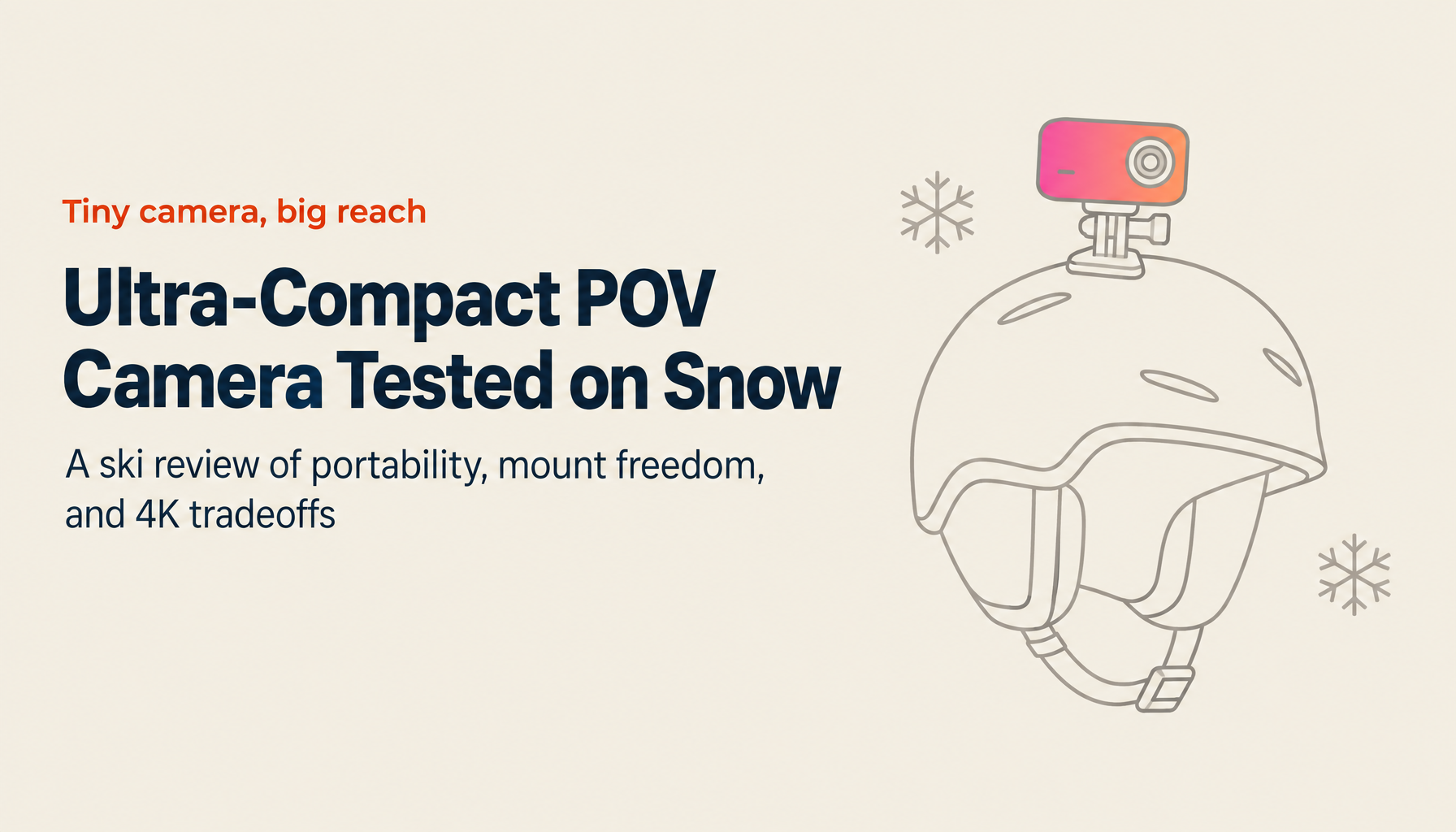
Theoretical specs are important, but an action camera's true capabilities only reveal themselves in the field. The Go 3S was brought to Big Sky Ski Resort in Montana, where it was rigorously tested. Big Sky has been actively investing in infrastructure, including state-of-the-art European lifts and a new tram accessing the Lone Peak summit. During the test period, nearly continuous snowfall created ideal conditions with excellent powder snow.
In this environment, the Go 3S's image quality and stabilization were put to the test first. Despite some concern about sensor size, the actual footage reportedly exceeded expectations. In daylight snow conditions, highlights were controlled while snow surface detail was captured and surrounding trees and sky colors were naturally reproduced. The benefit of 4K resolution is clear — detail rendering has improved significantly. Insta360's FlowState stabilization also proved highly capable, effectively absorbing everything from fine vibrations to larger shocks during ski runs, delivering smooth and stable footage. This is an indispensable element for POV footage — preventing viewer discomfort and increasing immersiveness.
Harsh conditions also exposed the camera's weaknesses. Battery performance in particular was noticeably affected by low temperatures. While the spec sheet claims up to 38 minutes of continuous shooting in 1080p, intermittent 4K shooting in sub-freezing temperatures resulted in battery indicators becoming worryingly low after roughly two hours of skiing. This was due both to the camera's small 310mAh battery and the cold slowing battery chemistry. Fortunately, carrying the Action Pod in a jacket pocket allowed recharging during lunch breaks — but since a full charge through the Action Pod takes approximately 35 minutes, battery management requires attention. The Action Pod itself is not waterproof, so care must be taken to protect it from snow and moisture. While the camera body has IPX8 rating for water resistance to 10 meters, the Action Pod must always be kept dry. For business use in outdoor environments — especially in rain or near water — this point deserves serious consideration.
The mounting system is one of the Go 3S's standout features. The magnet on the back of the camera body allows it to attach directly to metal surfaces, and the included accessories (pendant mount, clip mount, pivot stand, etc.) can be used easily. This opens up shooting angles that were previously impossible with conventional cameras.
The most effective mount during ski testing was, surprisingly, attachment to a ski pole — not a dedicated mount, but the strong magnetic force combined well with the pole's shape for a stable hold. This enabled dynamic capture of the skier and surroundings during runs.
On the other hand, a challenge emerged. The included "simple clip mount" is a convenient accessory for attaching to a jacket collar for easy POV shooting, but during testing, the camera body unexpectedly detached from the clip during a lift ride. The magnetic hold is strong, but vigorous movement or unexpected impact can cause detachment. Fortunately, the fallen camera was caught between a ski edge and the lift footrest, and was retrieved unharmed when it fell into the snow just before dismounting. Given the camera's very small size, if it were to fall into deep snow it would be extremely difficult to find.
Lessons from this test:
Magnetic mount precautions: For vigorous activities (skiing, snowboarding, mountain biking, etc.) using magnetic mounts (especially clip mounts), taking measures to prevent detachment is strongly recommended. Securing the camera to the mount, or the mount to clothing, with a rubber band, thin wire, or strap is effective. While normal walking and light activities are likely fine, preventing accidental loss from unexpected situations deserves additional consideration.
This mount caution applies equally to business use. For wearable camera applications in environments with vibration or impact — factories, construction sites — relying solely on magnetic mounts is insufficient. More secure fixation methods should be considered. Since the Go 3S's shooting freedom depends heavily on its mounting system, appropriate mount selection and drop-prevention measures for each use case are essential for reliable operation.
Bad weather conditions also merit mention. Lone Peak's summit at Big Sky is above the treeline, and the area accessible by tram is often hit by blizzards and thick fog. In such conditions, even high-performance cameras struggle to capture clear footage. The Go 3S handled conditions capably, but poor visibility is an environmental limitation rather than a camera shortcoming. In business outdoor use, some image quality degradation in bad weather or low-light conditions should be expected.
Post-Shoot Workflow: The Evolved Insta360 App and an Overall Assessment of the Go 3S
The Insta360 Go 3S's appeal extends beyond in-shooting portability and flexibility. The ease of use of the software supporting post-shoot editing and sharing — the smartphone app (iOS/Android) and desktop app (Insta360 Studio, Mac/Windows) — is also a highly rated feature. Insta360 has invested heavily in software development over the years, and the results show in the app's functionality and stability.
The smartphone app plays a central role in working with the Go 3S. Connecting via Wi-Fi allows live view preview, remote adjustment of detailed settings like shutter speed, ISO, and white balance, and switching between shooting modes — all from the smartphone's large screen. This is especially valuable when the camera is mounted in a hard-to-reach spot or at an unusual angle, making remote operation essential.
Footage and photos can be wirelessly transferred to a smartphone through the app. The app's built-in editing features let you cut unwanted sections, combine clips, add background music, apply filters, and adjust speed (slow motion or hyperlapse) — completing basic editing entirely on a smartphone. Particularly noteworthy is Insta360's AI editing feature: it automatically analyzes large volumes of footage, extracts highlight moments (jumps, fast turns, beautiful scenery, etc.), and assembles them into a short video synced to music. For users who lack time for editing or want polished-looking videos without effort, this is an extremely powerful tool. A manual editing mode is also available for detail-oriented users, supporting advanced techniques like keyframe transitions and effects.
For this review, the primary workflow was using the Insta360 Studio desktop app to transfer footage to a Mac, then to a cloud editing environment via Google Drive. Insta360 Studio offers the same editing features as the smartphone app plus more detailed settings and high-quality export options, making it suited for serious editing work. Adjusting FlowState stabilization intensity, fisheye effect correction, and color grading on a large monitor is a significant advantage. For business use cases requiring quality — such as producing documentation footage for reports or promotional videos — the desktop app is recommended.
So who and what use cases is the Insta360 Go 3S best suited for? As noted earlier, if absolute maximum image quality (especially low-light performance and dynamic range) is the top priority, models with larger sensors — the GoPro Hero series or Insta360 Ace Pro 2 — may be more appropriate. The bundle price starting around ¥60,000 is not inexpensive and may be a barrier for cost-conscious users.
That said, the Go 3S has clear advantages those models cannot match: its unrivaled compact lightness, the mounting and placement freedom this enables, and a unique POV shooting experience. On helmets, hats, clothing, glasses, pet collars, drones, RC vehicles, and ski poles — places where cameras were previously impractical to attach, or situations requiring unobtrusive filming — the Go 3S shows its true value. With 4K support, image quality has reached a level sufficient for most uses, and paired with strong stabilization, it produces highly watchable footage.
Specific business applications to consider:
Field work documentation / training: Ideal for recording work processes hands-free in construction, factory, or maintenance environments. Footage from the worker's perspective is extremely valuable as safety documentation, technical training material, and troubleshooting resources. The small, light form factor minimizes interference with the work.
Real estate / retail walkthroughs: Capture property interior tours and retail space walkthroughs from a natural walking perspective. The compact form factor works well in tight spaces, enabling immersive presentation videos.
Event / seminar documentation: Beyond wide-angle overviews, record footage close to the perspective of speakers and attendees — unobtrusively. The Action Pod enables extended recording sessions.
Product demonstrations: Clearly film product usage procedures and assembly instructions with close-up hand detail.
Inspection / survey: Potentially useful for checking conditions in tight spaces or at heights that are difficult for people to access.
In all these applications, the Go 3S's "smallness," "lightness," and "ease of use" deliver benefits unavailable from conventional cameras. For users who can clear the price threshold and understand how to leverage its unique characteristics, this is a camera that can be both genuinely enjoyable and practically useful.
Summary
The Insta360 Go 3S demonstrated its unique appeal and capabilities through rigorous testing at Big Sky Ski Resort in Montana. With 4K support, powerful stabilization, and evolved software, it delivers image quality and ease of use that exceed expectations. But the camera's true essence lies beyond what a spec sheet can capture — in its overwhelming compact lightness. At just 39 grams, it overturns conventional action camera expectations and dramatically expands where you can mount it. It has established its position as a camera you can literally "take anywhere" — on a skier's pole, clipped to a jacket collar (with drop prevention measures recommended), or anywhere else you can imagine.
Weaknesses exist, however. The image quality limits resulting from the smaller sensor compared to premium models (particularly in low light), the standalone battery life, the non-waterproof Action Pod, and precautions around magnetic mount reliability are all important points to understand before purchasing. The bundle price starting around ¥60,000 is not inexpensive given the form factor and feature set, and the cost-benefit calculation deserves careful consideration.
In conclusion, the Insta360 Go 3S is not a universal all-purpose action camera for everyone. Users who prioritize image quality above all else, or those focused on cost-performance, have better options. But for users who value portability, mounting freedom, and unique perspective filming above everything else, it is one of the most compelling options currently available — with the potential to deserve the title of "best POV camera."
In business contexts too, its compact lightness is a powerful asset. For needs like field documentation, training, facility presentations, and event filming — capturing immersive footage unobtrusively and hands-free — the Go 3S provides a compelling solution. While the initial investment requires consideration, the unique shooting experience it enables, and the potential for improved operational efficiency and information sharing quality, may well justify the price.
The Insta360 Go 3S has not merely added a new option to the action camera market — it is an enjoyable, innovative device that expands the possibilities of video documentation. For those who understand its characteristics and bring creativity to bear, it will perform across a wide range of scenes, from personal to business. Future firmware updates and accessory additions are also worth anticipating. Pay attention to how this small camera changes your perspective.
Source: https://www.youtube.com/watch?v=nCQn3jnK-4o
Streamline Event Management with AI | TIMEWELL Base
Struggling to manage large-scale events?
TIMEWELL Base is an AI-powered event management platform.
Proven Results
- Adventure World: Managed a Dream Day event with 4,272 attendees
- TechGALA 2026: Centrally managed 110 side events
Key Features
| Feature | Benefit |
|---|---|
| AI Page Generation | Event page ready in 30 seconds |
| Low-Cost Payments | 4.8% transaction fee (among the lowest in the industry) |
| Community Features | 65% of attendees continue engaging after the event |
Feel free to reach out to discuss how we can make your event operations more efficient.
Related Articles
- Accelerating Growth in the AI Semiconductor Market: Latest 2026 Trends and Strategies from TSMC and NVIDIA
- ElevenLabs 2026: Valuation Reaches $11 Billion, ARR Surpasses $330 Million, Dominating the Voice AI Market
- From 2026 to 2027: The Reality of AGI's Arrival, Anthropic CEO Confident It's "Within a Few Years"