From TIMEWELL
This is Hamamoto from TIMEWELL Inc.
Decades of Market Research, Still Constrained by Old Methods
For decades, companies have spent billions to understand their customers better — constrained by slow surveys, biased panels, and lagging insights. Despite $140 billion being spent annually on market research, software accounts for only a negligible fraction of that total. As evidence, consider that traditional human-led consulting firms like Gartner and McKinsey each carry a $40 billion valuation, while software platforms Qualtrics and Medallia top out at $12.5 billion and $6.4 billion respectively. And that is counting only external spending.
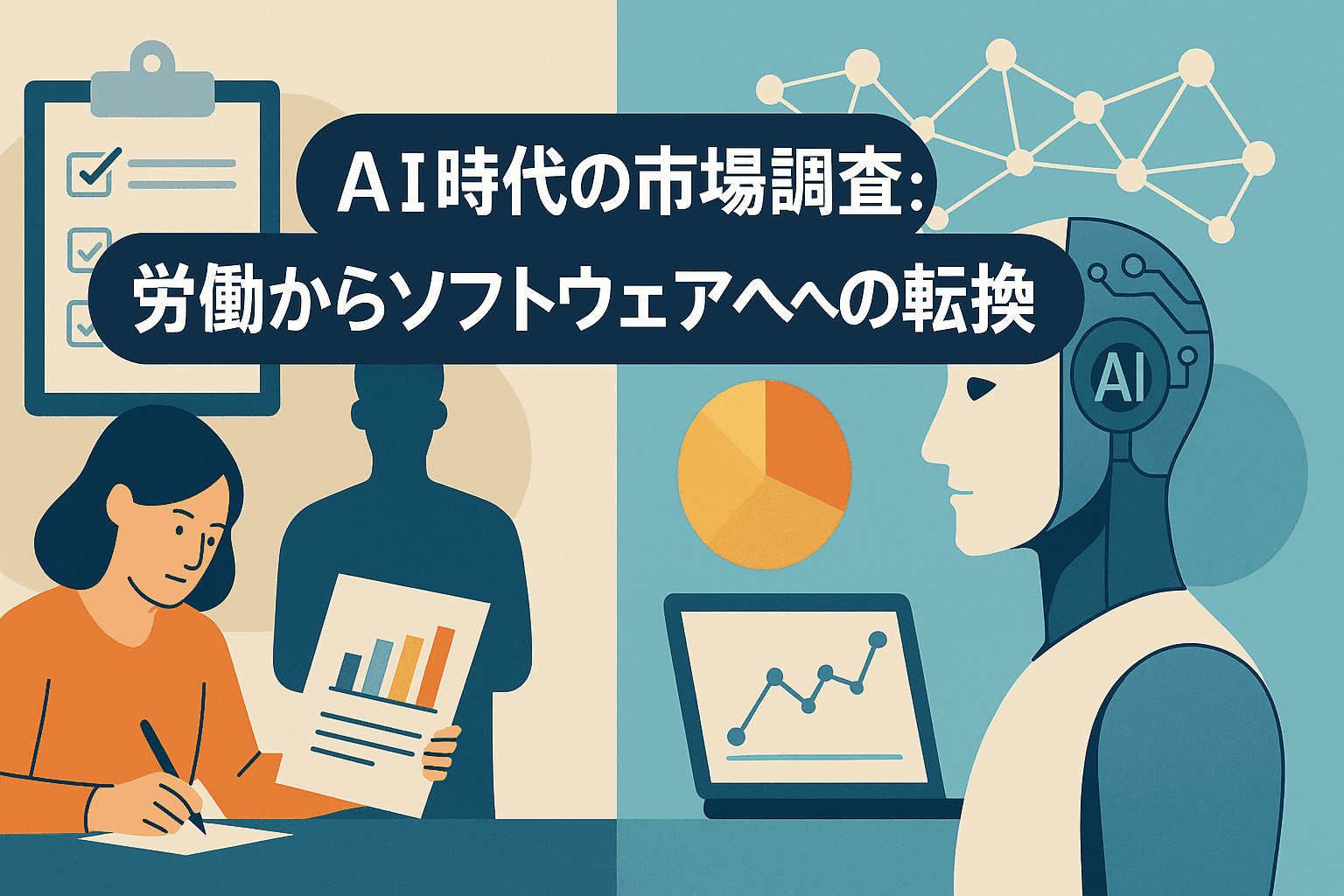
AI's emergence presents yet another case of a market primed to shift spending from labor to software. Early AI players are already building AI-native research platforms that use speech recognition and synthesis models to conduct autonomous video interviews with people, then analyze the results and create presentations using LLMs. These pioneers are growing rapidly, winning large contracts, and capturing budgets that previously flowed to market research firms and consulting companies.
In doing so, these AI-enabled startups are reshaping how organizations derive insights from customers, make decisions, and execute at scale. Yet many of these startups still rely on panel providers to source participants for their research.
A New Generation of AI Research Firms Fully Replacing Human Processes
A new class of AI research companies is now emerging that aims to completely replace costly human research and analysis processes. Rather than recruiting a panel of people and soliciting their opinions, these companies simulate entire synthetic societies of generative AI agents that can be queried, observed, and experimented with — modeling actual human behavior. This transforms market research from a one-time, lagging input into a continuous, dynamic advantage.
- The State of Market Research
- AI and Market Research: A Natural Combination
- Generative Agents: Simulated Societies That Surpass Human Panels
- Rapid Deployment, Deep Integration
- Summary
Looking for AI training and consulting?
Learn about WARP training programs and consulting services in our materials.
The State of Market Research
The customer research space has been slow to incorporate software over time. In the 1990s, surveys were primarily conducted manually — data collection and analysis done by hand with pen and paper. Qualtrics and Medallia, among others, introduced online surveys in the early 2000s, followed by real-time analytics and mobile-based survey collection. Both companies used surveys to build deeper experience management tools for customers and employees. In parallel, the rise of bottom-up self-service tools like SurveyMonkey allowed individual teams to run fast, lightweight surveys — broadening access to research but often resulting in fragmented efforts, inconsistent methodologies, and limited organizational visibility. These tools lacked the governance, scale, and integration needed to support enterprise-wide research functions.
Consulting firms including McKinsey built entire divisions dedicated to large-scale software-based survey tools for customer segmentation and consumer insights. These engagements often took months, cost millions of dollars, and relied on expensive, biased panels. The research process — recruiting participant panels, running surveys, analyzing results, producing reports — often took weeks. Findings were typically delivered to buyers in packaged form, with little opportunity to revisit the process or dig deeper into specific findings.
Most companies still rely on quarterly surveys to guide major launches, but this approach doesn't provide the continuous insights needed for quick, everyday decision-making. Because traditional research is expensive, small bets and early-stage ideas often go untested. Even companies eager to modernize find themselves stuck with outdated tools and slow processes.
A New Wave of UX Research Tools
In the late 2010s, a new wave of UX research tools appeared built directly for product teams rather than consultants or research departments. Instead of outsourcing user research, companies began integrating it into development loops. Through unmoderated usability testing, in-product surveys, and prototype feedback, tools like Sprig, Maze, and Dovetail enabled faster, more customer-informed decision-making. These research tools demonstrated just how integral integrated research is in modern business. However, such tools delivered real-time value primarily to software-driven teams and were mainly optimized for team-level rather than cross-functional organizational use. AI-native research companies are building on the advances of UX research: insights are immediately actionable and applicable across teams, products, and industries — regardless of whether the organization is software-native.
AI is already accelerating the pace of research and reducing costs. AI makes it easy to rapidly generate surveys and adapt questions in real time based on respondents' answers. Analysis that once took weeks now happens in hours. Insight libraries learn over time, uncovering patterns across projects and extrapolating early signals. This shift not only makes research accessible to smaller companies, but expands the set of decisions that can be data-driven — from early product concepts to subtle positioning questions that were once too expensive to test. AI-powered research tools are now being used by more users across marketing, product, sales, customer success teams, and leadership.
These Improvements Are Significant
These improvements are significant. But even AI-powered research is constrained by the variability and accessibility of human panels — often relying on third-party recruitment to access respondents, limiting price control and differentiation.
Generative Agents: Simulated Societies That Surpass Human Panels
Enter generative agents — a concept first introduced in the landmark paper "Generative Agents: Interactive Simulacra of Human Behavior." Researchers demonstrated that simulated characters powered by large language models — driven by memory, reflection, and planning — can exhibit increasingly human-like behavior. The idea initially attracted interest for its potential to build vivid simulated societies, but its implications extend beyond academic curiosity. One of the most promising commercial applications is market research.
A Concrete Example
If this sounds abstract, here is an example of how it might unfold: ahead of a new skincare launch in France, a beauty company could simulate 10,000 agents modeled after French Gen Z and millennial beauty consumers. Each agent would be seeded with data from customer reviews, CRM history, social listening insights (e.g., TikTok trends related to "skincare routines"), and past purchase behavior. These agents could interact with each other, watch simulated influencer content, shop on virtual store shelves, and post product opinions to AI-generated social feeds — evolving over time as they absorb new information and reflect on past experiences.
Enabling these simulations is not just off-the-shelf LLMs but a growing stack of sophisticated technology. Agents are now anchored to persistent memory architectures, often grounded in rich qualitative data such as interviews and behavioral histories, and capable of evolving over time through accumulated experiences and contextual feedback. In-context prompting provides behavioral histories, environmental cues, and prior decisions to create more nuanced, lifelike responses. Internally, methods like retrieval-augmented generation (RAG) and agent chains support complex, multi-step decision-making — resulting in simulations that mirror real-world customer journeys. Fine-tuned multimodal models trained on domain-specific tasks across text, visuals, and interactions push agent behavior beyond the limits of text alone.
Early Platforms Are Already Capitalizing on These Approaches
Early platforms are already capitalizing on these approaches. AI-powered simulation startups like Simera and ERL (which recently announced a partnership with Accenture) hint at what is coming: dynamic, always-on populations that behave like real customers and are ready to be queried, observed, and experimented with.
Agentic simulation doesn't just accelerate workflows that once took weeks — it fundamentally reinvents how research and decision-making work. It also overcomes many of the limitations of traditional research by creating research tools that can exist within workflows. This leap is not just about efficiency. It is about fidelity.
If history tells us anything, the companies that dominate this wave of AI will not just have the best technology — they will master distribution and adoption. Qualtrics and Medallia, for example, won early by prioritizing adoption, familiarity, and loyalty, embedding themselves deeply in universities and key industries.
Accuracy Is Clearly Important
Accuracy is clearly important — especially when teams measure AI tools against traditional human-led research. But in this category, without established benchmarks or evaluation frameworks, it is difficult to objectively assess how "good" any specific model is. Companies experimenting with agent simulation technology often need to define their own metrics.
Importantly, success does not mean achieving 100% accuracy. It means reaching a threshold that is "good enough" for your use case. Many of the CMOs we spoke with are satisfied with output that is at least 70% as accurate as output from traditional consulting firms — especially given that the data is cheaper, faster, and updated in real time. Without standardized expectations, this creates an opportunity for startups to move quickly, validate through actual use, and embed themselves into workflows early. That said, startups must continue refining their products: as benchmarks emerge and they charge more, customers will demand more.
At This Stage, the Risk Is Over-Engineering for Theoretical Accuracy
At this stage, the risk is not in imperfect output — it is in over-engineering for theoretical accuracy. Startups that prioritize speed, integration, and distribution can define new standards. Companies that delay in pursuit of perfect fidelity may find themselves stuck in endless pilots while others move into production.
AI-native research companies are fundamentally better positioned than legacy players to redefine expectations of market research. Legacy market research firms may have deep panel data, but their business models and workflows are not built for automation. By contrast, AI-native players are already developing purpose-built tools for AI-driven research and are structurally incentivized to push the frontier rather than protect the past. They are positioned to own both the data layer and the simulation layer. The widely cited "1,000 generative agent simulation" paper illustrates this convergence: its co-authors relied on actual interviews conducted by AI to seed agentic profiles — the same type of pipeline that AI-native companies are already running at scale.
To drive impact, insights must be applicable beyond UX and marketing teams to product, strategy, and operations. The challenge is providing sufficient service support without replicating the heavy overhead of traditional agencies.
The Long Era of Lagging Research Is Coming to an End
The long era of lagging research is coming to an end. AI-driven market research — whether through simulation, analysis, or insight generation — is transforming how we understand customers. Companies that adopt AI-powered research tools early will gain faster insights, make better decisions, and unlock new competitive advantages. As product shipping gets faster and easier, the real advantage lies in knowing what to build.
Reference: https://a16z.com/ai-market-research/
Related Articles
- The Reality of a Working Mother Returning from Two Maternity Leaves — And How Her Work Philosophy Changed | TIMEWELL
- Before Taking Paternity Leave (Part 2): Three Absolute Must-Dos for Taking Leave During a Busy Season
- A First-Class Architect Who Stays Close to the Job Site — Finding My Own Path as the Fifth-Generation Leader of a Construction Company