From Ryuta Hamamoto at TIMEWELL
This is Ryuta Hamamoto from TIMEWELL Corporation.
Looking for AI training and consulting?
Learn about WARP training programs and consulting services in our materials.
Why We Go to the Screen
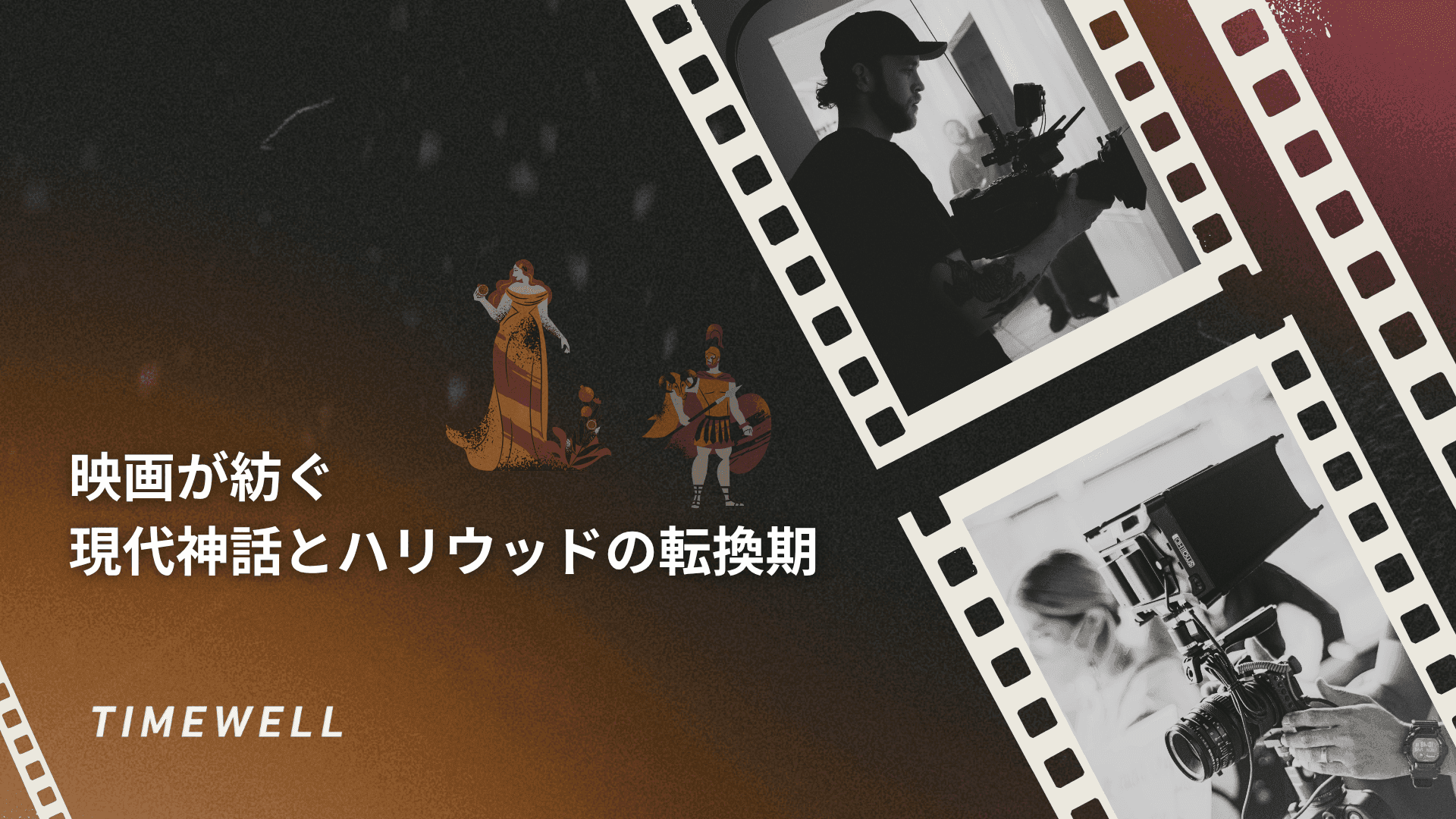
We go to the movies because film is no longer mere entertainment — it is a modern mythology that reflects humanity's culture, history, and the currents of society. Just as myths, legends, and novels from a century ago once sustained people's inner lives, cinema now carries that role.
2019 saw the birth of memorable masterpieces: 1917, Parasite, and Quentin Tarantino's Once Upon a Time in Hollywood. But since then, the COVID-19 pandemic and the streaming revolution have dramatically changed the form of filmmaking and release. As the business models and creative challenges of the film industry transform at a rapid pace, Hollywood is searching for new messages and modes of expression.
Mark, Eric, and Catherine — film aficionados who participated in this discussion — spoke passionately about the enduring legacy of cinema as cultural heritage, how contemporary political and economic upheaval affects filmmaking, and what works the next generation of creators will produce under new technological and economic conditions. They dug sharply into the gap between the era when Hollywood was at its golden apex and today's era of message-heavy storytelling — and into the possibilities of future filmmaking with AI and new technology. The multi-angled story of cinema and Hollywood that emerges from these perspectives carries the weight of a living history book, reflecting the social conditions and cultural context of our time.
In This Article
This article covers, without missing anything from the participants' discussion, the role cinema plays in the modern era, the shock that Hollywood and the streaming revolution have delivered to the film industry, and the outlook for new filmmaking including AI technology — explained in thorough detail.
- Cinema as modern mythology: film as a mirror reflecting culture
- Hollywood and the streaming revolution: the current state of the film industry and an era of transformation
- New visual expression and hopes for the future: the challenge of AI technology and new filmmaking
- Conclusion
Cinema as Modern Mythology: Film as a Mirror Reflecting Culture
In the modern era, cinema functions as a mirror — like myths and legends of old — reflecting our culture, history, and national character. Whereas epic novels and plays were once the medium for speaking of national identity, modern film has become a powerful medium that encompasses diverse themes, the spirit of the times, and messages — conveying the emotions and ideas of an era to future generations. Mark, a film enthusiast who participated in the discussion, made a forceful case: "Film is the only art form that can encapsulate culture itself and express it permanently." While touching on scenes where the real-life figure Howard Hughes plays an important role in James Bond films, he discussed how cinema intersects reality and fiction as a "mythological element" — leaving deep impressions on audiences. Scenes depicting Hughes as director or producer carry meaning beyond mere entertainment, providing the basis for generating value as cultural heritage.
The role cinema plays was also emphasized not merely as entertainment, but as the embodiment of the fundamental values of peoples and civilizations — or the "grand narrative" of an era. Mark points out that Tarantino's Once Upon a Time in Hollywood is not only a work at the pinnacle of filmmaking, but an icon symbolizing a golden era of old, while simultaneously suggesting that era's end. He expressed concern that contemporary cinema, by pushing "the message" too much to the fore, is damaging the original artistic quality and storytelling that film itself possesses.
The participants agreed on these important points:
- Cinema possesses cultural and historical value comparable to ancient myths and legends
- Contemporary film reflects its historical context and becomes an important cultural heritage passed down to future generations
- There is a risk that over-emphasizing the message causes pure cinematic appeal to be lost
The discussion went further, revealing the reality that behind the production of any film lie long production periods and economic risks. From scriptwriting to filming, post-production to marketing, enormous amounts of time and investment are required before a film reaches screens. As a result, production decisions are often heavily influenced by market pressure, political pressure, and critics' opinions — and the film itself can sometimes be swept away by the era's "message." In this context, creators are searching for a balance between tradition and innovation to make "films that truly reflect culture." As cinema continues transcending the realm of mere entertainment to play the role of a mirror of modern society, many more challenges and experiments lie ahead.
Hollywood and the Streaming Revolution: The Current State of the Film Industry and an Era of Transformation
Hollywood once had an era when it delivered a shared cinematic experience to the masses through collective consensus. But in recent years, driven by the streaming revolution and the new economic environment, the film industry has been in the midst of upheaval. While the dominant business model was once one where hit films were produced in succession and continued generating revenue over the long term, since streaming services emerged, the revenue structure of cinema has completely changed. Mark raised doubts about how Netflix and other streaming companies have suddenly exerted large financial effects on traditional production structures, and about the loss of cinema's "global shared experience."
The COVID pandemic's long theater closures also brought major disruption to the timescale of film production. Films from 2019 were effectively produced under conditions prevailing in 2015–2016, while films from 2021 onward were produced under entirely different conditions. Amid these changes, Hollywood began reviewing the recipe for traditional "blockbusters" and adopting more films that foreground social messages. Among critics and some industry figures, voices have emerged saying: "Almost every film is now dictated by political messages — the appeal of pure entertainment has faded."
Economic aspects are also a serious concern. While hit films once had mechanisms for generating profit over long periods after theatrical release, the widespread adoption of streaming services has nearly eliminated that aftermarket. The enormous funds invested in works now require rapid recovery, and the resulting risk-aversion has produced a notable trend toward relying on existing brands and proven formulas that can reliably attract audiences — rather than innovative, experimental films.
Internal critics and younger staff members have also undergone a major shift in consciousness. For a time, Hollywood saw a "reign of terror" where full-time employees faced career risk if they didn't adhere to the message — forcing cautious approaches on production floors. This eliminated traditional adventurous production attitudes, and increasingly only socially "safe" themes were chosen — a factor in the proliferation of films that audiences found lacking freshness. And as Hollywood's management layer began showing a growing tendency to fear outliers and risk, there are mounting concerns that future challenges to innovation and diverse expression in filmmaking will be even more severely constrained.
Yet a ray of hope is also visible. Within the industry, there is a reaction against the era of excessive messaging, and movements seeking pure entertainment and new creative experiments are rekindling. Signs of a reassessment of classic films from the golden era are appearing in film criticism, and there is hope that filmmakers steeped in Hollywood's rich history will once again take on adventurous projects. How the film industry going forward balances economic rationality and artistic depth will be the great key determining its future.
New Visual Expression and Hopes for the Future: The Challenge of AI Technology and New Filmmaking
In recent years, innovation in cinematic expression has accelerated alongside technological progress — the introduction of AI and digital technology in particular is dramatically changing the framework of conventional filmmaking. Among works that have emerged in the past few years, some — like director Ari Aster's new film Edington — depict the realities of the COVID era, rapid social upheaval, and the permeation of social media just as they are. Edington, set in a run-down New Mexico town, weaves contemporary local phenomena, political conflict, and the disconnection of human relationships in the digital society into a story full of humor and incisive social critique. With Washington in the lead role, this challenging work interlaces complex social phenomena from the real world — COVID's effects, George Floyd protests, citizens' lives buffeted by social media — confronting audiences with "the reality of this very moment."
This new trend in filmmaking is also having a major impact not just on traditional blockbusters but on experimental, small-scale indie films. For example, the new Naked Gun film and Marvel's new attempt Fantastic Four might be cited as examples that successfully blend elements of classic comedy and entertainment with the harsh realities of contemporary society and political messages. These works combine nostalgia with innovation, giving audiences fresh surprises while strongly evoking the historical moment. On comedy in particular, some successful examples have emerged where adding nostalgia for past successes with pointed satire of current social trends paradoxically generates new laughter. One film critic observed: "Contemporary comedy has been elevated to works with deeper meaning and resonance, because the theme of 'reality' has been added alongside mere laughs."
The rapid evolution of AI technology is also drawing attention as a factor promoting the democratization of filmmaking. Visual expressions that once could only be realized with limited budgets and technology are now being transformed into high-level visual expression at low cost. Just as early South Park, with a low budget but its own unique animation technique, generated enormous buzz, today's AI-powered video production is opening new opportunities to creators who previously had no access to Hollywood. This expands the possibility that many young artists and creators can realize their ideas — and sometimes produce works that stand shoulder to shoulder with major productions.
The possibilities of new cinema are now, truly, at a fork in the road. Pure entertainment that challenges conventional wisdom without being bound by political or social messages; works that depict the rough waves of the era just as they are; entirely new visual experiences enriched by AI — diverse options are emerging. These changes suggest that cinema will not merely be discussed as "old works from the past," but will become important clues for understanding culture itself for future generations as well. The cinema of the future will inscribe its presence for posterity not just through economic rationality, but as true "modern mythology" in the deepest sense — incorporating artistic depth and the messages of the age.
Conclusion
Cinema, as modern mythology, has become a mirror reflecting our culture, the spirit of the times, and individual emotions. The COVID pandemic, the streaming revolution, and the economic and political upheaval in Hollywood have combined to fundamentally change the way films have been made. The discussion touched multi-dimensionally on the risk of works skewed too heavily toward messaging, the difficulties facing traditional blockbuster production structures, and the possibilities for revolutionary visual expression brought by new technologies — especially AI.
While cinema carries a role as cultural heritage that encapsulates culture — in a modern era where economic rationality and political pressure influence how works are, and the form of works is being severely questioned — the possibility of films that genuinely resonate with people continues to exist. Going forward, Hollywood will search for balance between tradition and innovation to produce cinematic works that symbolize the next era. And we as audiences are also called upon not just to passively gaze at the screen, but to let our minds dwell on the grand narratives and production secrets behind it — to feel the trajectory of culture that cinema shows us.
Reference: https://www.youtube.com/watch?v=m6bkPPXHWX0