From Ryuta Hamamoto at TIMEWELL
This is Ryuta Hamamoto from TIMEWELL Corporation.
AI is reshaping how we work — not just by making existing processes faster or cheaper, but by enabling forms of value creation that simply weren't possible before. Getting there, though, requires letting go of frameworks that have been standard for decades.
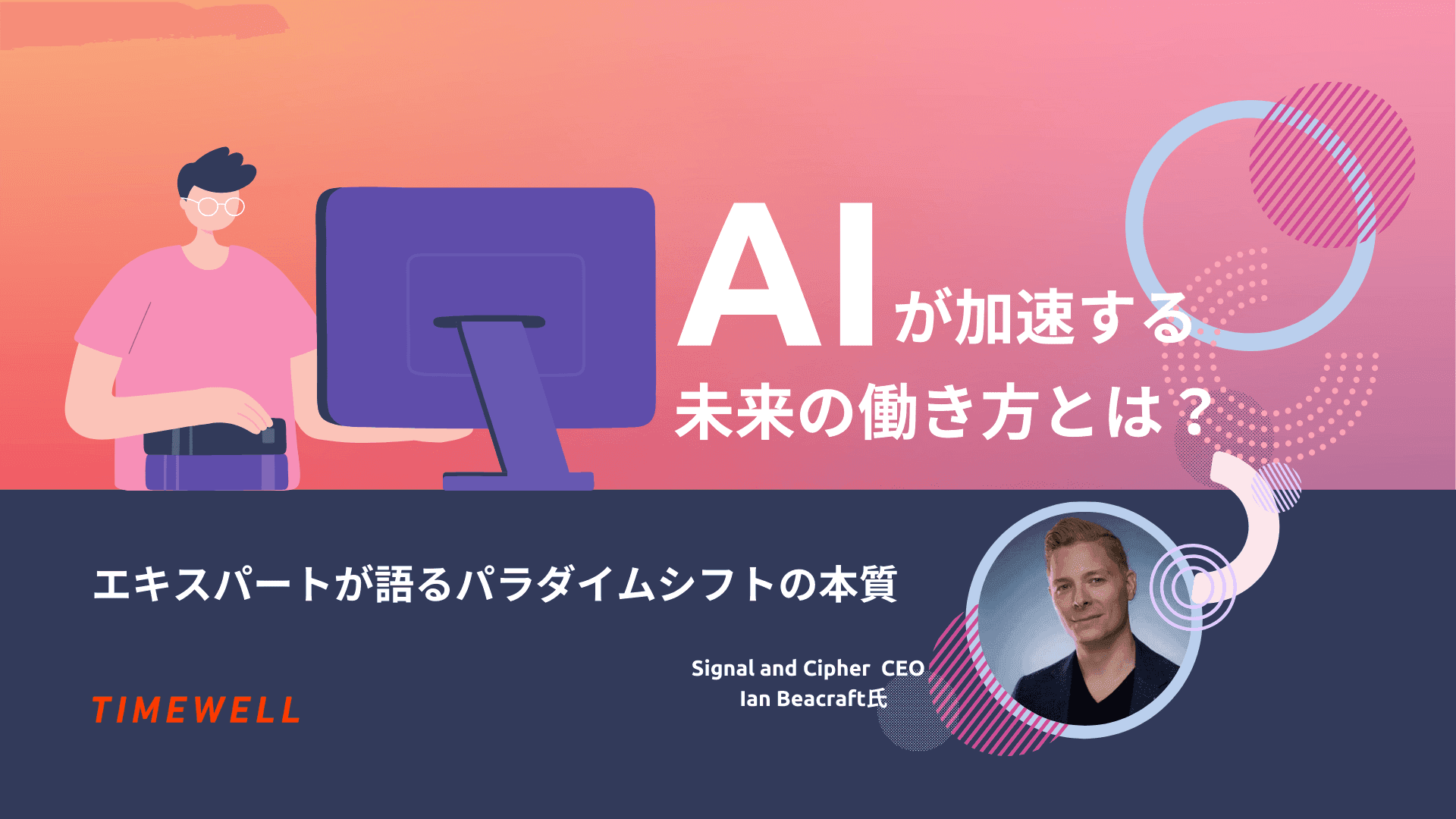
Ian Beacraft is one of the most credible voices on AI and the future of work. As CEO and Chief Futurist of Signal and Cipher, he leads a strategic foresight and development agency that guides some of the world's most innovative companies through the generative AI shift — helping them upskill staff, prototype near-future products, and build new services. This article is based on his lecture, and it covers the core of what that paradigm shift actually means in practice.
What this article covers:
- Skills are becoming obsolete faster than ever
- How to build the capacity to adapt
- Why small, high-quality data beats large generic datasets
- New metrics for measuring organizational performance
- What this all means for how we work going forward
Looking for AI training and consulting?
Learn about WARP training programs and consulting services in our materials.
Skills Have a Shorter Shelf Life Now
There was a time when mastering a skill set could sustain a career for thirty years. That era is over. AI is compressing skill lifecycles dramatically — many technical skills are becoming obsolete in two to three years.
The shift this requires isn't about learning faster. It's about changing what you value. The question moves from "what do you know?" to "how well can you adapt?" Sustained learning and the willingness to iterate become the core competency, not the knowledge itself.
In practical terms, this means skills need to be acquired quickly and applied immediately. AI-assisted adaptive learning programs can accelerate this — compressing what used to take months into weeks. For organizations, the implication is that the speed at which teams learn may matter more than what they currently know.
Adapting to Change Requires Understanding Your Own Resistance
Beacraft's lecture included a hands-on exercise with the group — a simple physical activity using hands. The point wasn't the task itself. It was to create a direct experience of the discomfort that comes when the brain encounters a new pattern.
The brain is wired to protect existing patterns. Change feels uncomfortable precisely because it's working against that bias. The people and organizations that navigate the AI transition well aren't the ones who feel no resistance — they're the ones who recognize resistance for what it is and move through it deliberately.
Building adaptability isn't a mindset adjustment. It's a skill developed through repeated practice of facing unfamiliar situations and iterating rather than retreating.
Small, High-Quality Data Beats Generic Data at Scale
One of the more counterintuitive points Beacraft makes: the real competitive advantage in AI isn't access to massive datasets. It's proprietary, high-quality data that no one else has.
The major AI models have been trained on enormous amounts of general data. Most of it is publicly available and increasingly commoditized. What isn't commoditized is the data inside your organization — the institutional knowledge, the brand voice, the customer interaction patterns, the domain-specific insights that have accumulated over years.
Most of this data remains untouched. Companies that learn to organize and leverage it gain something that can't be replicated by pointing a general-purpose model at a Wikipedia dump.
The practical approach:
- Map your proprietary assets — brand characteristics, values, product information, operational knowledge, anything that makes your organization distinctive
- Structure and prepare that data for AI model training
- Deploy models trained on it to produce outputs that reflect your organization's actual voice and knowledge base
The insight is simple but easy to miss: more data is not automatically better. More relevant, proprietary data, properly organized, is what creates durable advantage.
New Metrics for the AI Era
The evaluation frameworks most organizations use were built for a different era. Efficiency and productivity metrics made sense when the core challenge was executing established processes faster. They don't capture what AI actually makes possible.
Beacraft proposes a different set of metrics — ones that measure adaptability, resilience, and the capacity for innovation:
- Breakthrough rate: What share of the organization's outputs represent genuine advances or innovations, not just incremental improvements?
- Knowledge score: How much new knowledge is the organization actively acquiring and integrating?
- Knowledge synthesis index: How effectively are people combining insights across domains to generate new ideas?
These aren't soft metrics — they're leading indicators of whether an organization is developing the capabilities that matter in an AI-accelerated environment.
Team composition benefits from a similar rethinking. Rather than fixed structures with defined roles, AI makes it possible to assemble teams dynamically — based on who has the relevant skills and perspectives for a given problem, at a given moment. Leadership and followership roles can shift with the project rather than being locked to titles. This kind of fluid, AI-supported collaboration is where the highest-value work happens.
The Bigger Picture
What AI is bringing isn't a set of new tools to add to existing workflows. It's a genuine shift in what work is and who can do it.
Skills that once sustained careers now need refreshing in years, not decades. Proprietary data that once sat unused in company systems becomes a competitive moat when properly structured. Organizational metrics designed for efficiency need to give way to metrics designed for innovation capacity.
None of this is easy. The transition involves real discomfort, real experimentation, and real failure along the way. But the path through it is available to anyone willing to treat learning as a continuous practice rather than something that happened before you started working.
AI becomes a genuine partner in that process — not a replacement for human judgment, but an amplifier of it. The organizations that figure this out early will have a substantial head start.
Reference: https://www.youtube.com/watch?v=q6SjHZHE81s