From Ryuta Hamamoto at TIMEWELL
This is Ryuta Hamamoto from TIMEWELL Corporation.
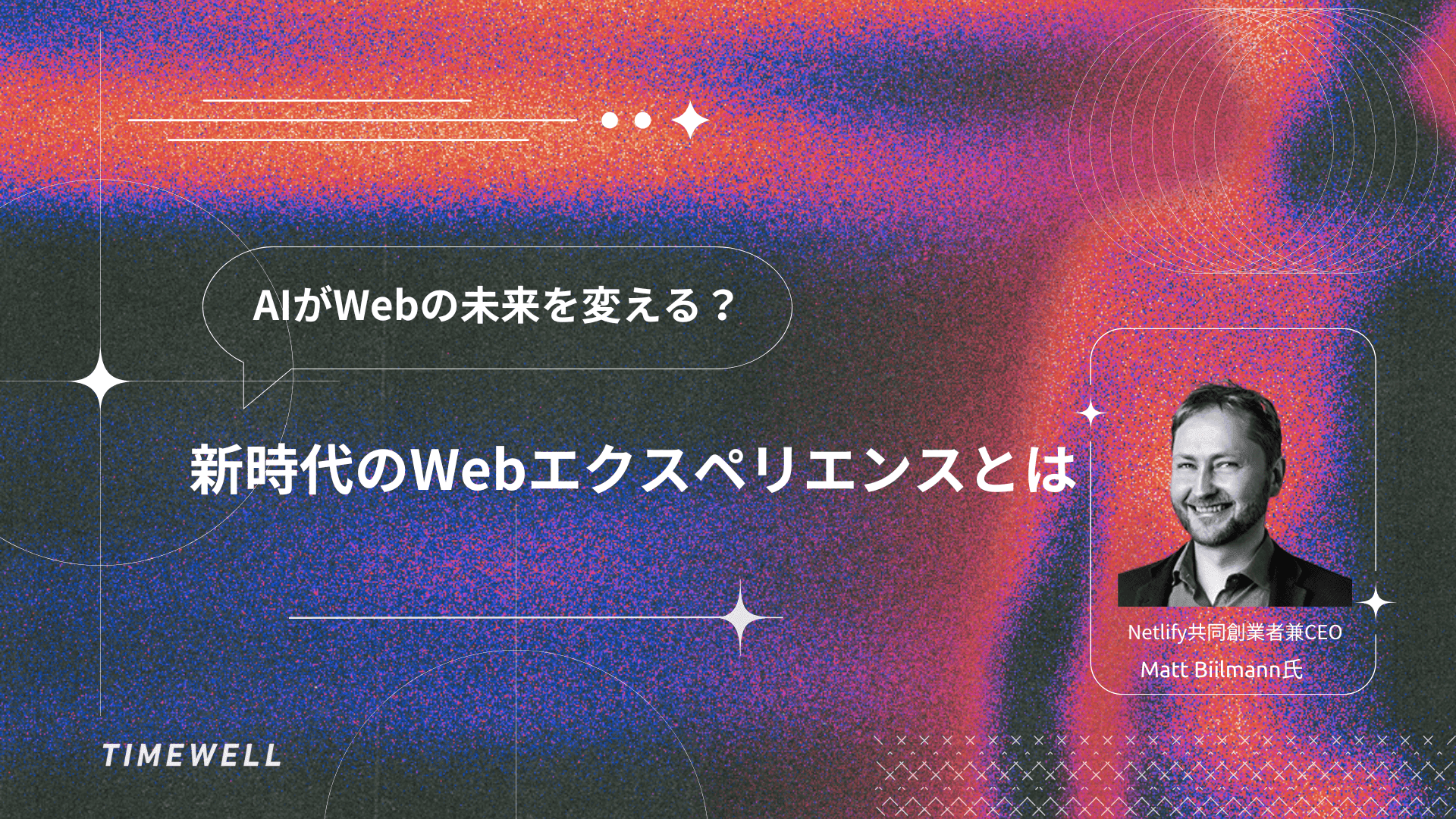
AI is spreading into every corner of daily life. The web is no exception. Netlify co-founder and CEO Matt Biilmann has a clear view: AI will change the web in ways that go well beyond what most people are currently imagining.
What this article covers:
- How AI speeds up the web and liberates creativity
- Why the web needs an "agent experience" (AX)
- The case for an open web
Looking for AI training and consulting?
Learn about WARP training programs and consulting services in our materials.
AI Brings Speed and Creative Liberation
According to Biilmann, the first change AI brings to the web is speed. Code generation, asset creation — both become dramatically faster with AI assistance. Developers can build more websites and applications in less time than ever before.
But speed is only part of it. Biilmann points out that AI opens up entirely new possibilities for user interfaces. UIs have always been designed and implemented by human developers, but AI creates the potential for revolutionary designs that weren't previously achievable.
For example, AI might enable dynamic UIs that adapt in real time to each user's preferences and behavioral patterns. 3D graphics, immersive interactions — capabilities that were technically difficult to implement at scale — could become straightforward with AI assistance.
In short, AI doesn't just accelerate what already exists. It expands the range of what's possible.
The Web Needs "Agent Experience"
Biilmann argues that unlocking AI's full potential on the web requires a new lens: Agent Experience (AX).
An agent, in this context, is an AI that autonomously executes tasks on behalf of humans. According to Biilmann, the web of the near future will be built not only by human developers, but also by AI agents operating at significant scale. This means that designing the web for agents — not just for humans — becomes a genuine architectural priority.
What AX requires:
- Code and documentation that agents can understand: Clear structure, well-documented APIs, consistent naming
- APIs designed for autonomous task execution: Agents need reliable, predictable interfaces
- Workflows that support human-agent collaboration: Processes that make it smooth for agents and people to hand off work
When these elements are in place, humans and AI agents can collaborate seamlessly to create web experiences that neither could produce alone. The web becomes a shared workspace.
The Case for an Open Web
Biilmann insists that delivering on AI's potential for the web requires an open platform. If the innovative web experiences AI enables get locked inside closed systems controlled by a handful of companies, the web's broader development stalls.
That's why Netlify and other technology companies need to drive open web standardization — ensuring that everyone can benefit from AI's capabilities, not just those inside proprietary ecosystems.
Biilmann launched a project called AEXS (Agent Experience Study) to build cross-industry collaboration toward this goal. The initiative focuses on standardizing the APIs and data formats that AI agents need to navigate the web effectively. If successful, this kind of infrastructure would make the open web the default environment for AI-powered experiences — rather than a closed garden maintained by any single platform.
Looking Ahead
AI will make the web faster and unlock creative capabilities that didn't previously exist. The emergence of agent experience will enable humans and AI to build higher-quality web experiences together. But realizing this future requires open standards and cross-industry coordination to keep the web genuinely accessible.
As Biilmann puts it: "AI will make the web more creative and more expressive." The web's potential in an AI era is not about automation replacing the current web — it's about what becomes possible when human creativity and AI capability work together on an open platform.
Reference: https://www.youtube.com/watch?v=RrNuS5Le4Ts