From Ryuta Hamamoto at TIMEWELL
This is Ryuta Hamamoto from TIMEWELL Corporation.
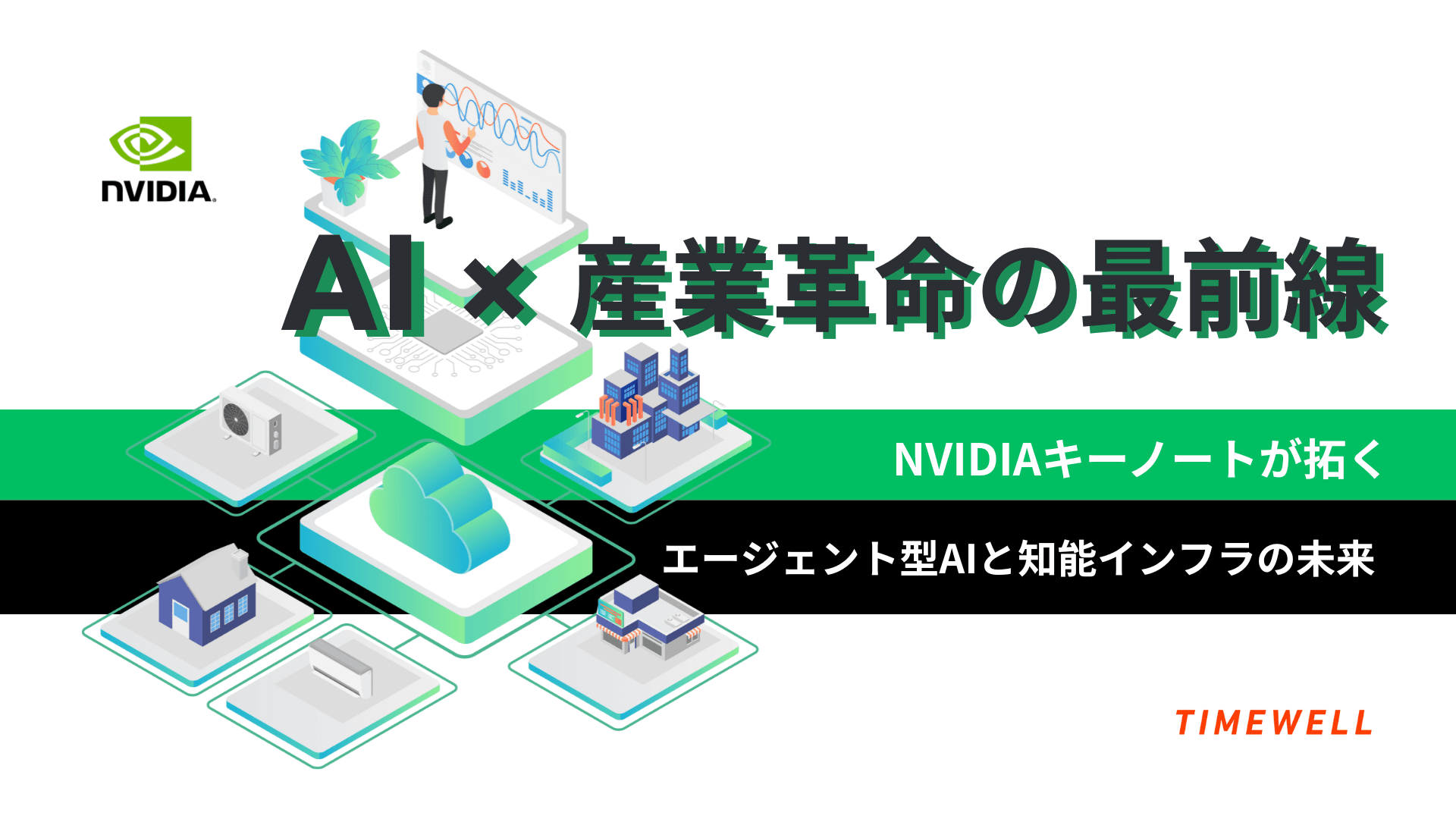
The GPU was once understood as a graphics processor. In NVIDIA's latest keynote, Jensen Huang made clear it has become something else: the engine that generates tokens — the fundamental unit of AI output. Those tokens become images, scientific simulations, early disease detection signals, robotic motion, entertainment. The GPU is now the core of what NVIDIA calls the AI Industrial Revolution.
This article covers the three main threads from the keynote: the token-based architecture and quantum computing trajectory, the Grace Blackwell GPU platform, and the emergence of agentic AI and digital twins as the foundation for a new kind of infrastructure.
Looking for AI training and consulting?
Learn about WARP training programs and consulting services in our materials.
The Token Revolution and the Path Toward Quantum Computing
From one-shot to reflective AI
Earlier AI systems operated in a "one-shot" mode: a prompt goes in, an answer comes out. Current AI models work differently. They decompose problems, reason through steps sequentially, check their own outputs, and arrive at conclusions through a process that resembles deliberation. This "reflective" or agentic approach — where the system plans, selects tools, interacts with external services, and revises — produces qualitatively different outputs.
The result is visible in scale: where early systems generated hundreds of tokens per response, current models generate thousands, sometimes tens of thousands. Each additional token represents additional reasoning capacity applied to the problem.
The token as universal converter
NVIDIA's framing: the token is the basic unit through which AI converts inputs — whether images, sensor readings, scientific data, or text — into actionable outputs. This applies to weather prediction, early disease detection, agricultural yield optimization, robotic motion control, and entertainment alike. The GPU is the factory for these tokens.
Quantum computing on the horizon
NVIDIA's keynote placed quantum computing in a specific near-term context. The logical qubit count achieved in early quantum implementations is expected to grow 10x every five years, 100x per decade. Running in parallel with physical qubit development, GPU-based quantum-classical hybrid computing is maturing — with CUDA Q (NVIDIA's quantum computing library, extending the CUDA ecosystem) enabling high-accuracy simulation and error correction in hybrid environments.
This isn't a distant scenario. NVIDIA has identified 400+ acceleration libraries covering computation areas from semiconductor design (TCAD) to sparse solvers to tensor contraction algorithms, making accelerated computing applicable across materials science, financial modeling, drug discovery, and beyond.
Grace Blackwell: Architecture Designed for Thinking Machines
The shift from single GPU to virtual unified system
Grace Blackwell is not an incremental GPU upgrade. It represents a full architectural redesign of how multiple GPUs and CPUs work together as a single virtual computing unit.
The key enabling technology is NVLink — an interconnect that directly connects GPUs and CPUs at a bandwidth of 130 terabytes per second. That number is worth holding: it exceeds peak global internet traffic. Data bottlenecks between processors — a persistent constraint in earlier GPU cluster designs — are eliminated at this bandwidth.
Each Grace Blackwell unit houses more than 144 specialized chips (Blackwell dies) distributed across 72 packages, coordinated to function as one processing entity. The CPU and system memory that were previously handled separately in Hopper-generation systems are now directly integrated with the GPU, eliminating the data transfer overhead between processing layers.
Liquid cooling and sustained performance
Grace Blackwell adopts liquid cooling to maintain performance under sustained high-load operation. This is necessary for the system to run AI inference at scale without thermal throttling. Enterprise deployment in cloud or on-premises data centers can now sustain continuous full-performance operation.
What this means for enterprise AI workloads
Grace Blackwell makes several previously impractical workloads practical:
- Large-scale simulation and real-time data analysis that required multiple separate systems
- Quantum-classical hybrid computation at the research-to-application boundary
- AI inference for complex, multi-step reasoning tasks
- Seamless migration from existing on-premises infrastructure and cloud services
The manufacturing precision involved — thousands of processing and testing steps per unit — reflects what NVIDIA is calling the "AI factory" concept: infrastructure that doesn't store data but produces tokens at scale.
Agentic AI, Digital Twins, and the AI Factory
Agentic AI as the operating model
The shift from chatbots to agentic systems changes the scope of what AI can automate. An agentic AI system doesn't just answer questions — it assesses its context, formulates a plan, selects and uses tools, interacts with external systems, and adjusts its approach based on outcomes. Applied to enterprise scenarios, this means a single agentic system can conduct market research, generate financial models, draft proposals, and refine them iteratively — tasks that previously required coordinated human teams.
Digital twins as industrial infrastructure
The AI factory concept extends beyond compute. Digital twin technology creates virtual replicas of physical systems — factories, cities, traffic networks, logistics chains — in which simulations can run before any physical change is made. This eliminates a class of expensive, irreversible mistakes in industrial and urban planning.
Auto industry applications: autonomous driving systems trained in high-fidelity virtual environments before physical deployment. Manufacturing: production line optimization simulated to find efficiency gains without stopping actual production. Healthcare: medical imaging diagnostics improved through AI trained on simulated edge cases.
The environmental fidelity of these twins is improving rapidly. Combined with agentic AI that can interact with the twin, test hypotheses, and propose optimizations, the digital-physical boundary is increasingly a design parameter rather than a fixed constraint.
National AI infrastructure
The keynote's geopolitical dimension is explicit. Countries — particularly in Europe — are building regional AI ecosystems rather than relying entirely on US-based cloud infrastructure. The combination of sovereign AI concerns (data that shouldn't leave national jurisdiction) and the geopolitical risk of concentrated AI infrastructure creates demand for regionally distributed AI factories. NVIDIA's platform is being positioned as the foundation for these national AI clouds.
Summary
NVIDIA's keynote articulated a coherent vision: GPUs have become token factories, and data centers have become AI factories. The Grace Blackwell architecture makes this factory vision technically viable at scale. Agentic AI provides the operating intelligence. Digital twins provide the simulation layer that connects virtual infrastructure to physical reality.
For enterprises, the practical implication is a strategic one: AI capability is becoming infrastructure. The companies and countries that build that infrastructure early will have structural advantages in every sector where AI capability compounds — which is now most sectors.
Reference: https://www.youtube.com/watch?v=X9cHONwKkn4