From Ryuta Hamamoto at TIMEWELL
This is Ryuta Hamamoto from TIMEWELL Corporation.
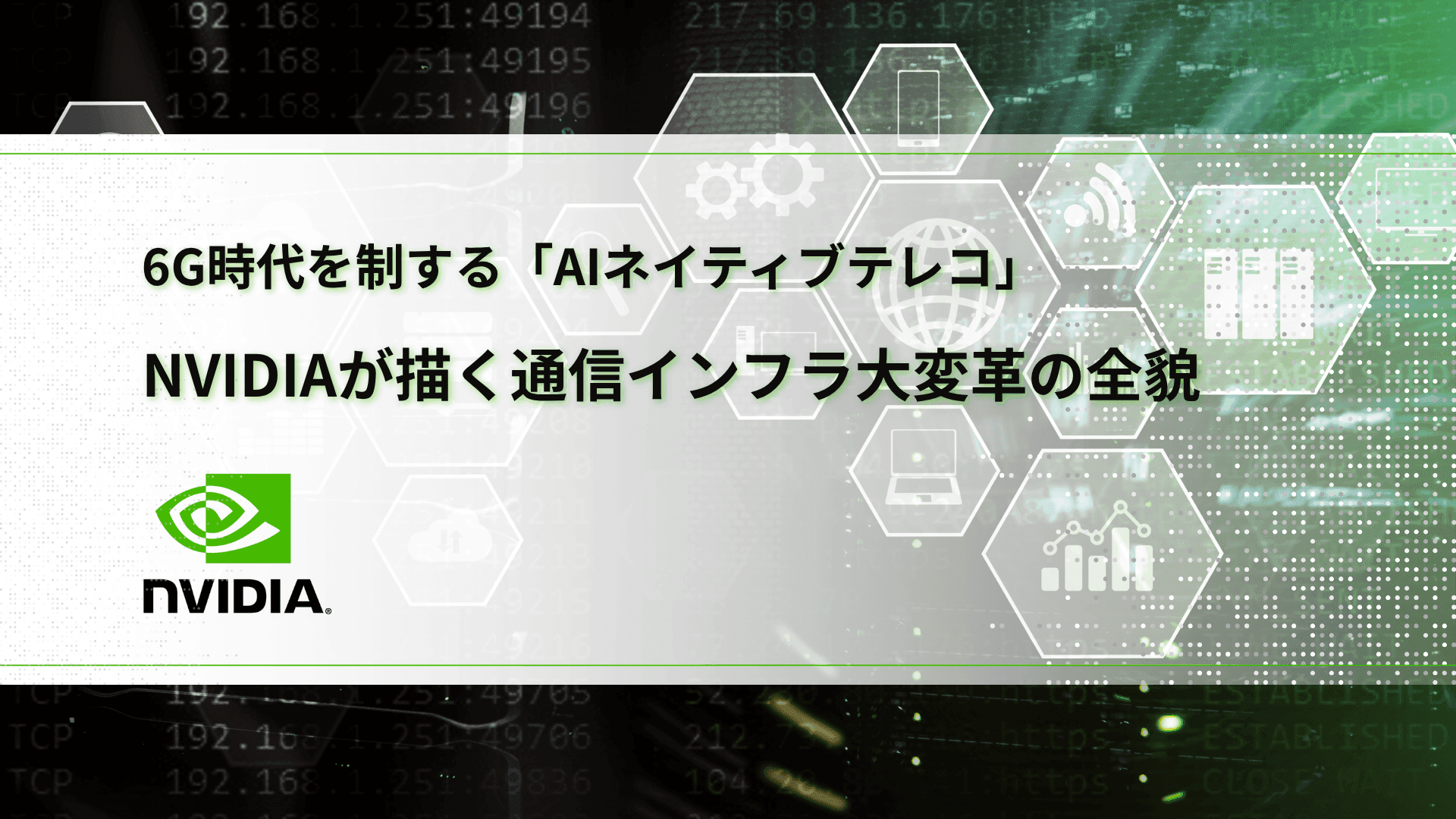
The telecommunications industry is being pushed to do something structurally difficult: operate existing networks reliably while rebuilding them for a completely different architecture. NVIDIA's Telecom SVP Ronnie Vasishta presented a framework for how AI makes this possible — and why the transition from "connectivity provider" to "intelligence fabric provider" is not optional.
This article covers the core elements of that vision: homogeneous infrastructure, autonomous agent systems, digital twins, AI-RAN, and the 6G roadmap.
The Scale of NVIDIA's Telecom Presence
- 90% of top global telecoms already work with NVIDIA
- 150+ global telecom companies participating in NVIDIA programs
- 97% of 450+ surveyed telecom professionals are positive on AI adoption
- AI-RAN Alliance: grew from 10 founding members to 75+
Looking for AI training and consulting?
Learn about WARP training programs and consulting services in our materials.
The Core Argument: Why Telecoms Must Go AI-Native
Traditional telecom networks were built for connection. AI-native telecom is built for intelligence — networks that don't just transmit data but compute, reason, and simulate in real time.
The structural challenge for telecoms has been the dual burden of running operations and driving innovation simultaneously. Every operator-hour spent maintaining a legacy network is an hour not spent on 5G-Advanced or 6G architecture. NVIDIA's argument is that AI removes this tradeoff by automating the operations layer.
What "AI-native" means in practice:
- Real-time network sensing, diagnosis, and optimization
- Parameter adjustments that used to take days now happen instantly
- Customer experience tasks (call routing, language support) automated by AI agents
- Network architecture decisions informed by digital twin simulations before physical deployment
Homogeneous Infrastructure: The Foundation
The base layer of AI-native telecom is what NVIDIA calls "homogeneous infrastructure" — a flexible, scalable platform rather than a stack of proprietary hardware from different vendors.
The key architectural shift: hardware infrastructure layers include not just power and physical equipment, but digital twin simulation capabilities built into the foundation. Applications and services run on top of this unified environment, enabling value creation beyond basic connectivity.
Real-world deployments:
- Swisscom: GPU-as-a-Service offering
- Telenor: 100+ instant translation capabilities in network operations
- The Fast Mode: local language model deployment at the network edge
Autonomous Agent Systems
Managing a modern telecom network at scale — billions of simultaneous connections — is impossible with human operators handling individual events. NVIDIA's solution is a hierarchical agent architecture:
Structure:
- Super-agents: Coordinate strategy and escalation decisions across the network
- Worker agents: Execute specific operational tasks at individual network nodes
Functions automated by agent systems:
- Network alarm management
- Fault detection and diagnosis
- End-to-end operations automation
- Customer call handling and routing
The NVIDIA AI Blueprint provides network engineers with direct parameter reconfiguration tools, giving human operators control over agent behavior rather than removing them from the loop.
Ecosystem partners with deployed agent systems: Accenture, TCS, Infosys, NTT Data, Proda — major systems integrators have built agent systems demonstrating measurable results in network alarm management and fault handling.
Digital Twins: Simulate Before You Deploy
Digital twins create physically accurate virtual replicas of network infrastructure — base stations, switching equipment, surrounding environment. The simulation includes:
- Building reflection and absorption characteristics
- Weather and temperature effects on signal propagation
- Interference patterns from neighboring cells
Applications:
- 6G network planning and optimization before physical installation
- AI algorithm training across thousands of real-world scenarios
- New service design and testing in simulation before deployment
- Base station parameter optimization — with validated configurations deployed directly to live systems
The AI channel estimation improvement NVIDIA has demonstrated: 40% better than conventional methods, achievable through digital twin-based training.
AI-RAN and 6G
The spectrum efficiency problem
6G's primary challenge is making maximum use of limited spectrum. AI-RAN addresses this through real-time dynamic spectrum management:
- Analyze spectrum utilization continuously
- Dynamically reallocate based on current demand patterns
- Differentiate urban and rural demand and optimize per base station
- Expected result: 50%+ throughput improvement over static allocation methods
The 6G standards process
Early 3GPP meetings on 6G standards are already underway, with AI integration at the center of technical discussions. NVIDIA tools participating in this process include:
- Sionna: differentiable Layer 1 simulator
- Aerial Radio framework: training and validation environment
200+ research institutions globally are using NVIDIA platforms for 6G research.
Non-terrestrial networks and semantic communication
6G architecture also incorporates non-terrestrial networks and an approach called semantic communication — transmitting the meaning of information rather than raw data, reducing bandwidth requirements while preserving communication fidelity.
Global Partnerships and the AI-RAN Alliance
NVIDIA Cloud Partner Program telecom members: Orange, STC Solutions, Telefónica — alongside T-Mobile (US field trials for AI-RAN) and IOH (Indonesia) delivering education and healthcare services to distributed island populations via AI-integrated networks.
The AI-RAN Alliance: Founded with 10 members, now 75+ organizations. Functions include:
- Joint development of next-generation network standards
- Shared operational processes and validation frameworks
- 6G innovation coordination across members
The business model shift:
The transition NVIDIA describes goes from ARPU (average revenue per user) to token-based revenue — carriers operating as AI factories that generate value from compute, not just connectivity. The sovereign AI angle is significant: carriers have existing real estate, power, and connectivity that positions them well to serve national AI infrastructure demand.
Summary
NVIDIA's AI-native telecom vision is ambitious but grounded in specific, measurable capabilities. The homogeneous infrastructure layer makes flexible deployment possible. Autonomous agent systems make network-scale operations manageable without proportional increases in human headcount. Digital twins eliminate the cost of learning by physical trial and error. AI-RAN turns the radio layer into an intelligent, adaptive system rather than a static transmission medium.
For enterprise organizations choosing telecom partners, the AI-native capability gap is becoming a meaningful differentiator — not in marketing materials, but in actual network performance, edge AI availability, and long-term 6G readiness.
Reference: https://www.youtube.com/watch?v=KN2Sg0UU-to