From Ryuta Hamamoto at TIMEWELL
This is Ryuta Hamamoto from TIMEWELL Corporation.
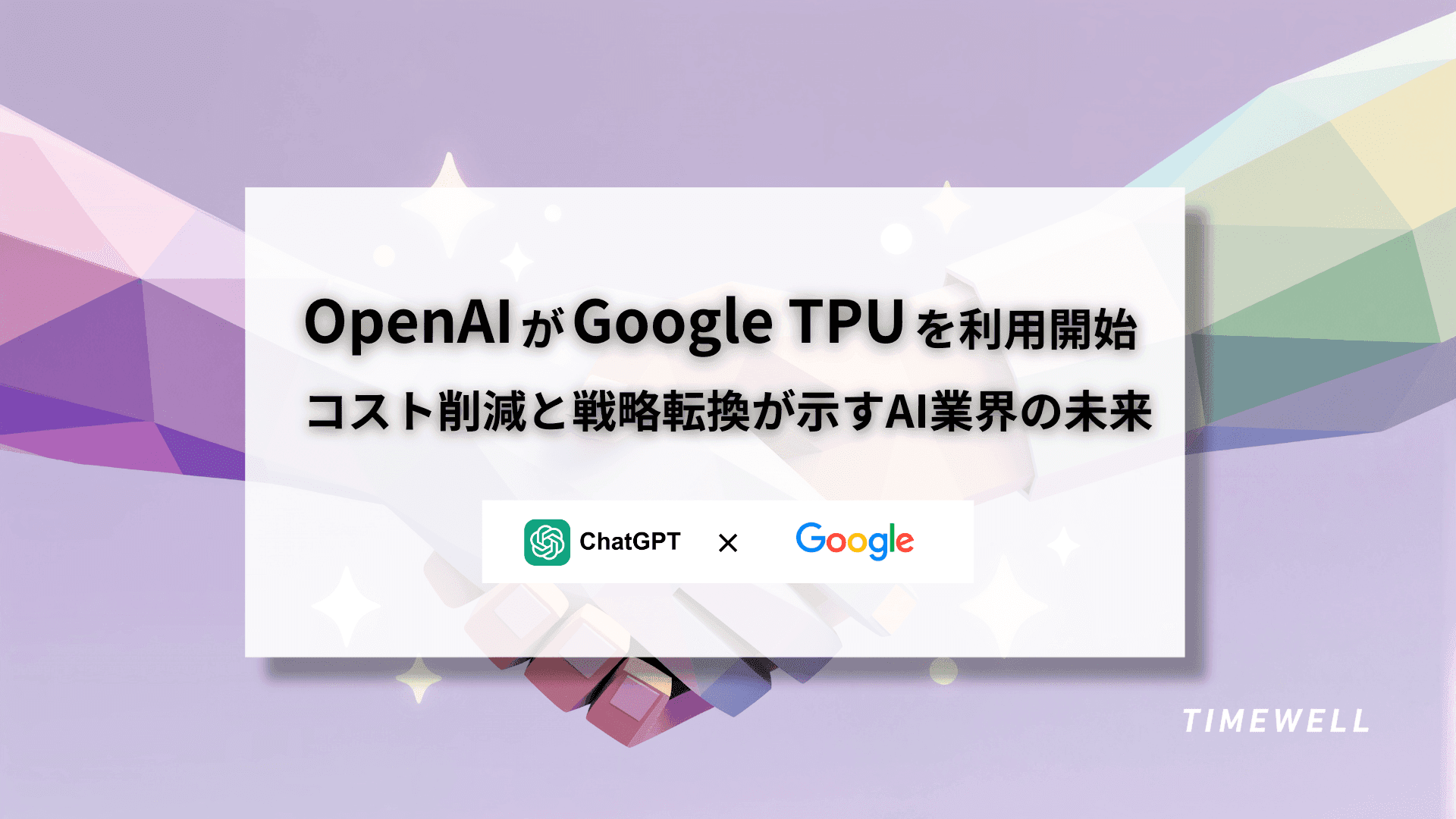
On June 27, 2025, Reuters reported that OpenAI — the dominant force in generative AI — has begun using Google's TPUs (Tensor Processing Units) for some of its AI workloads. This is notable because Google and OpenAI are direct competitors: Google Gemini and OpenAI's GPT models compete for the same users and enterprise customers. The decision to use a competitor's infrastructure reveals something important about how AI companies are thinking about compute costs and supply chain risk.
Looking for AI training and consulting?
Learn about WARP training programs and consulting services in our materials.
What TPUs Are, and How They Differ from CPUs and GPUs
Understanding why TPUs matter requires understanding the landscape of compute options.
CPU (Central Processing Unit) The standard processor in computers and smartphones. Designed by Intel and others for general-purpose computation — handling many different types of tasks efficiently. Strong at sequential processing and control logic.
GPU (Graphics Processing Unit) Originally designed for rendering graphics, GPUs became important for AI because they are optimized for parallel computation — executing many operations simultaneously. NVIDIA's GPUs became the de facto standard for AI training in the 2010s.
TPU (Tensor Processing Unit) Google began developing TPUs in the mid-2010s as a purpose-built AI accelerator. Unlike GPUs, which were adapted for AI from a graphics computing base, TPUs were designed from the start for the matrix multiplication operations that neural network training and inference require.
| Processor | Designed for | AI workload suitability |
|---|---|---|
| CPU | General-purpose | Limited — not parallelized for AI |
| GPU | Graphics rendering | Strong — adapted well for AI training |
| TPU | AI computation | Optimized — purpose-built for tensor operations |
The result: TPUs often deliver better performance per dollar for AI inference workloads than NVIDIA GPUs, particularly when running already-trained models at scale.
Google's TPU strategy
Google has historically kept its latest TPUs for internal use while making previous-generation TPUs available to external customers. This allows Google to maintain its own competitive advantage while generating revenue from hardware that would otherwise sit idle.
Why OpenAI Made This Choice
Cost pressure from NVIDIA GPU pricing
NVIDIA GPUs have been supply-constrained and expensive. For a company running inference at the scale OpenAI operates — hundreds of millions of weekly active users — even modest improvements in cost-per-inference multiply into significant savings.
The inference vs. training distinction
OpenAI's reported TPU use is for inference, not training. Training a model is the computationally intensive phase of building the model. Inference is running the trained model to generate outputs in response to user queries.
Inference workloads have somewhat different optimization profiles than training workloads. TPUs, which excel at efficient matrix operations, perform well on inference tasks. For running an already-trained model efficiently at scale, TPUs can be cost-competitive with NVIDIA's hardware.
Multi-cloud diversification
Until recently, OpenAI ran its compute primarily through Microsoft Azure and Oracle. Concentrating compute procurement with one or two providers creates risk: supply shortages, pricing leverage, and technical constraints can all limit flexibility.
By adding Google Cloud TPUs as a compute source, OpenAI reduces dependency on any single provider. If NVIDIA GPU supply tightens or Microsoft pricing changes, OpenAI has more options.
This is augmentation, not replacement
The current move is not a wholesale shift to TPUs. The practical picture is a hybrid model: existing GPU clusters remain the primary infrastructure for training and latency-sensitive inference, while TPUs supplement capacity for workloads where their cost and performance profile fits better. This is vendor diversification, not vendor switching.
The Competitive Dynamics: Cooperation Within Competition
The most interesting dimension of this story is what it reveals about how companies compete and cooperate simultaneously in technology markets.
OpenAI and Google compete directly on AI products. ChatGPT and Gemini are rivals for the same users. But OpenAI is willing to give Google revenue — and give Google data about how its hardware performs at scale — in exchange for compute cost savings.
Google is willing to sell its hardware to a competitor because:
- Revenue from TPU rentals is valuable independent of who uses it
- Making TPUs the standard for large-scale AI inference strengthens Google's position in cloud infrastructure
- Keeping previous-generation TPUs profitable while reserving latest-generation chips for internal use is a rational two-market strategy
This pattern — direct product competition coexisting with infrastructure cooperation — is increasingly common in technology. Cloud providers sell compute to companies building products that compete with the cloud providers' own services. Chipmakers sell to companies that are building competing chips. The market has become too complex for clean separation between competitors and suppliers.
What This Means for AI Infrastructure Strategy
For organizations thinking about AI infrastructure:
Compute diversity is becoming standard practice
OpenAI's move signals that even the largest AI companies are pursuing multi-cloud, multi-chip strategies. Vendor diversification reduces supply risk and improves negotiating leverage. Organizations deploying AI at scale should evaluate whether concentration in a single compute provider creates avoidable risk.
Inference costs are a real competitive factor
For AI products at consumer scale, inference cost directly affects unit economics. The search for cheaper, efficient inference — whether through hardware optimization, model distillation, or compute arbitrage — is ongoing. TPUs are one option; purpose-built inference chips from various providers are another.
The competitor-as-supplier relationship is normal
The fact that OpenAI uses Google infrastructure doesn't mean either company's competitive position is weakened. It means both companies are pragmatic about where they can create value and where buying is more efficient than building.
Summary
OpenAI's use of Google TPUs is primarily a cost and supply chain decision, not a strategic alliance. The immediate driver is inference cost reduction; the secondary driver is reducing concentration risk in compute procurement.
For the industry, the signal is that the compute layer is becoming more commoditized — not dominated by a single supplier — even as AI model development remains highly concentrated among a small number of companies. For enterprises planning AI deployments, the lesson is to evaluate compute options across providers rather than defaulting to the option with the highest name recognition.
Reference: https://www.youtube.com/watch?v=AP7AgHoquy0