This is Hamamoto from TIMEWELL.
The rapid evolution of AI technology and its application to business is reshaping corporate strategy and the way we work. ChatGPT, in particular, has moved beyond being a simple chat tool to become a revolutionary platform at the core of modern enterprise.
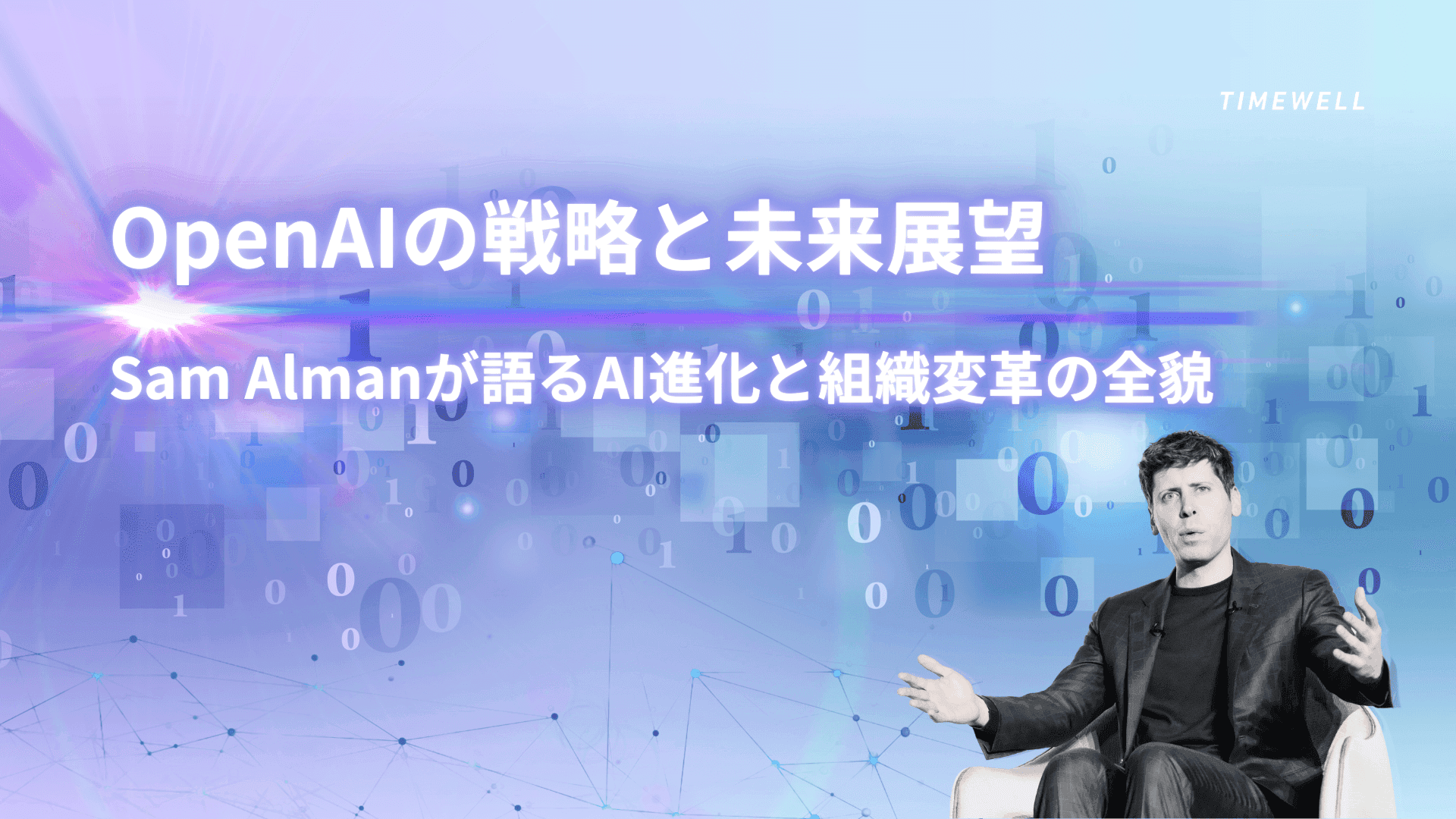
This article draws on an interview with Sam Altman — OpenAI's senior leader and a frequent presence at major AI events — to explain in detail the history of AI development, how product development has accelerated within the organization, and the vision for the future. Altman traces the journey from the experimental days of 2016 through GPT-1, GPT-2, GPT-3, and GPT-4, and the birth of ChatGPT as a consumer product. He also covers the organizational philosophy behind moving large R&D teams at speed — and the market expansion strategy enabled by a broad API and application ecosystem.
The Evolution of AI Products: A History of Experimentation
OpenAI's AI development story begins in 2016, a period of intense trial and error. At the time, Sam Altman was working with a team of roughly 14 people, holding animated whiteboard sessions to prototype new systems. AI was far from being seen as a core corporate strategy — even the idea of a large language model (LLM) as we know it today had not yet taken shape. Early projects mixed academic research with practical experimentation: video game experiments, research into robotic hand control. Small models like GPT-1 and GPT-2 were developed, and their possibilities gradually expanded.
Altman recalls that in those lab-like days, it was hard to envision what a finished "product" might look like. Yet those experimental efforts laid the essential groundwork for what became a massive leap forward. When GPT-3 was released, there was a degree of confidence in the model itself — but the question of how to put it to practical use was still being worked out. When the consumer-facing API hit the market, Silicon Valley recognized it as a technology with enormous potential, yet it had not yet achieved broad public adoption. This illustrates the reality that getting a technology accepted and widely used is never straightforward.
The pivotal turning point in product development was the arrival of ChatGPT. Rather than being offered purely as an API, ChatGPT was designed as an interface where users could engage directly in conversation. Reinforcement Learning from Human Feedback (RLHF) was introduced to improve conversational quality based on user feedback. This improvement made communication feel far more human, earning strong user approval.
The API offering also built the foundation for companies to integrate AI into their own services. What started as validation in specific domains has since expanded into broad commercial use across diverse business contexts.
Key Points in OpenAI's Development:
- Balancing experimental work for technical innovation with product development that captures consumer needs
- Rapid decision-making and flexible operations within small teams
- Market expansion through API distribution and the formation of a new ecosystem
Looking for AI training and consulting?
Learn about WARP training programs and consulting services in our materials.
Organizational Strategy: Maintaining Product Velocity at Scale
One of the key points Sam Altman consistently emphasizes is how to maintain the agility of small teams and fast decision-making even as an organization grows. OpenAI, despite scaling rapidly, has deliberately avoided the heavy organizational dynamics of large enterprises. Altman has said: "Large companies often see product velocity decline, but we remain committed to building small, high-accountability teams that keep taking on new challenges."
Concretely, OpenAI minimizes time spent in meetings and coordination, creating an environment where engineers and researchers can focus on the actual code and model improvements. Many organizations find that as they grow, decision-making becomes more complex and productivity falls — OpenAI addressed this by ensuring "everyone is busy and each member can deliver high individual impact."
Altman also points to model performance improvement as the most critical priority. Since the release of API products, users engaging with AI through Playground have found value beyond just getting answers — they discovered a personalized knowledge assistant that grows with each individual interaction. This unlocked user engagement and created new market demand that API products alone could not have generated.
As part of its strategic approach, OpenAI also embraced the Minimum Viable Product (MVP) model in early development — running market tests with minimal features and iterating continuously from user feedback. Early ChatGPT focused on the fundamentals of chat, learning from real usage patterns how people were trying to use it. This enabled rapid improvements to response quality, conversation flow, and the user interface.
Altman emphasizes that faster product delivery is not merely about efficiency — it is the very foundation of an innovative product strategy. He speaks to how each new product release increases the organization's collective commitment and energy, which in turn drives consistently high-quality output.
Future Outlook: New Business Opportunities from AI
Sam Altman's interview reveals not just a focus on the present, but a sweeping vision for the future. He speaks passionately about how AI's progress will go far beyond academic papers and experiments, fundamentally transforming life and society at large.
Voice model improvements, better mobile chat experiences, and code generation capabilities are reshaping how we work and learn. Younger users treat ChatGPT like an operating system — automating complex tasks, supporting decision-making — and are realizing entirely new approaches that go far beyond traditional search. The result is a more personal, more sophisticated information experience for users, and entirely new service models for companies.
A key to future AI adoption will be integration with diverse sensors and devices. Altman notes that sensor data, temperature readings, and other real-world information will play an important role in improving model accuracy going forward. AI is evolving from a conversational tool into a system that can interact with the physical world in real time — in smart homes, robotics, factory automation, and beyond.
OpenAI is positioning its platform as a future "core AI subscription" — enabling individuals and enterprises to use AI services customized to their own data and use cases. API and SDK offerings will accelerate, and personalized AI solutions integrating user life data and corporate data will become increasingly achievable.
Looking at a broader horizon, AI and human collaboration is expected to generate new business opportunities. As algorithms continue to advance, large language models are approaching the ability to autonomously generate programs and rewrite code. This will transform the software development process itself, with potential to dramatically improve enterprise productivity and innovation.
Altman also forecasts increased platform competition as AI becomes more pervasive. As established companies hold to conventional approaches, startups and new entrants will use AI to deliver wave after wave of innovation. He frames this as "creative destruction" — analogous to the gap between young digital natives and older generations during the smartphone era — and is confident that younger generations who can fluently operate new technology will become the engine of economic growth.
Summary
Sam Altman's interview describes OpenAI's journey from early experimental environments to a large-scale API ecosystem and core AI subscription — always maintaining innovation and rapid decision-making along the way.
Looking ahead, voice model improvements, programming and agent applications, and real-time sensor data integration all point to an expanding role for AI in future business. For companies and business leaders, these strategies and approaches represent not just technical advances but a new source of value creation and economic growth.
Sam Altman's future vision and the new business opportunities enabled by organizational agility signal a coming era of prosperity driven by AI. Watching OpenAI's progress and the market transformation it brings will be an essential perspective for anyone shaping the next chapter of business strategy.
Reference: https://www.youtube.com/watch?v=ctcMA6chfDY
Related Articles
- The Reality of a Part-Time Employee Who Worked Full-Time, Took Two Maternity Leaves, and Changed Her View of Work | TIMEWELL
- Before Paternity Leave — What You Absolutely Must Do to Take Leave Even During a Busy Period
- Pursuing a Hands-On Architecture Firm: Finding My Own Way as the 5th Generation of a Construction Company | Fujita Construction