This is Hamamoto from TIMEWELL.
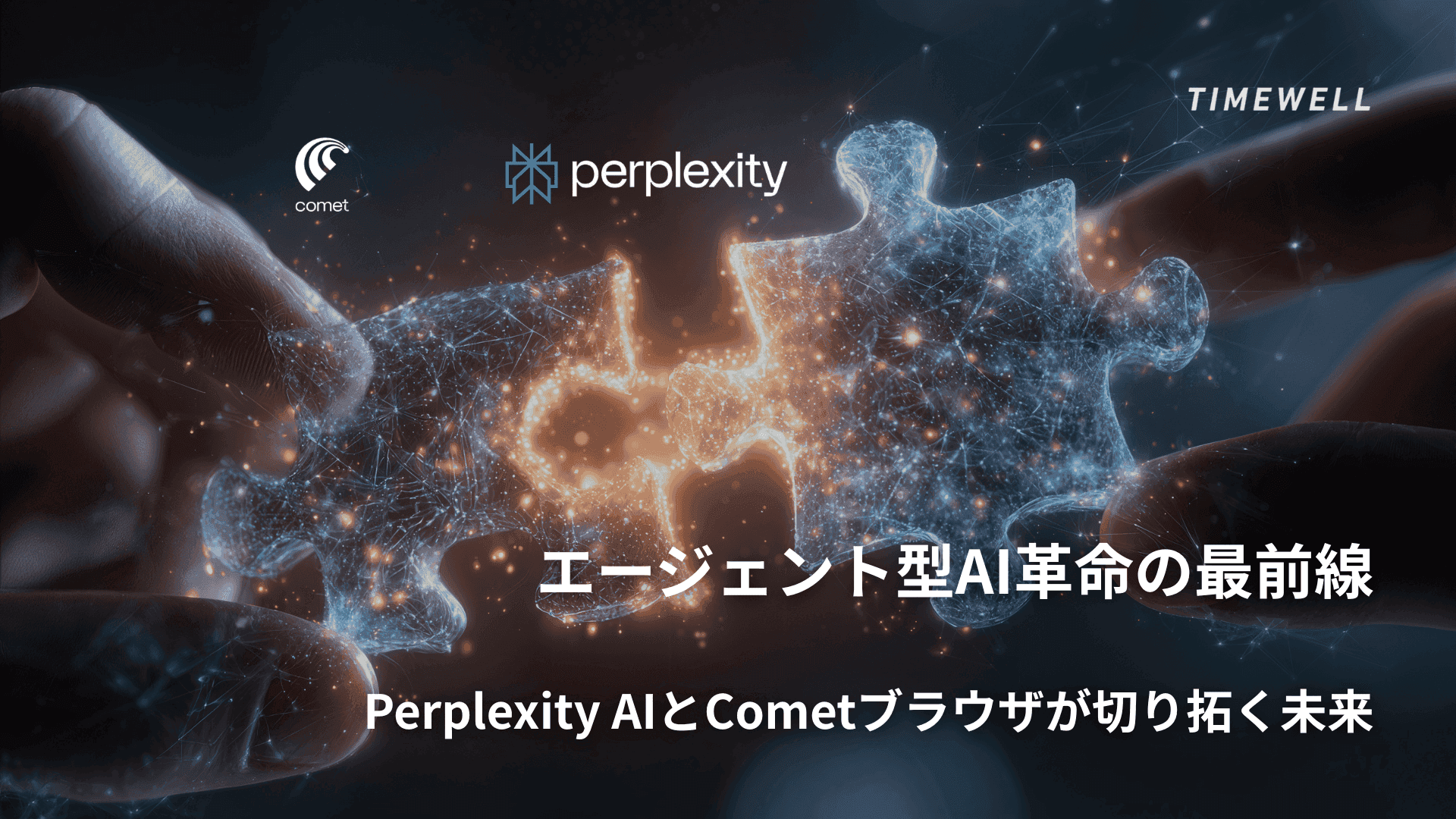
The conversation happening at the frontier of AI development is increasingly about agency — not just AI that answers questions, but AI that takes action. Perplexity AI and its Comet browser represent the clearest current example of what this shift looks like in practice. In a detailed discussion on the FYI "4-year innovation" podcast, Perplexity Chief Business Officer Dimmitri Chevalinko sat down with investors Charlie Roberts and Brett Wenton to explore the current state of agentic AI services, their commercial models, and what they mean for how people and organizations work.
Perplexity AI: Beyond Search Engine, Toward Integrated Agent
What Separates an Agentic Search Engine
Perplexity AI occupies a category distinct from conventional digital assistants and conversational AI. Its competitive strength is in information retrieval — but that framing understates what the product actually does. What executives and knowledge workers focus on is not the quality of individual answers, but the system's ability to prompt the right next action and execute it as part of a continuous workflow.
In Chevalinko's presentation on the podcast, he described use cases that illustrate this distinction clearly: financial data verification, research synthesis, code debugging. In each case, the user's goal is not a single data point but the completion of a multi-step task. Perplexity's architecture is designed to carry users through that sequence rather than stopping at each query.
Multi-Model Architecture and Proprietary Indexing
One of the points discussed in the podcast was Perplexity's use of multiple large language models in combination, selecting from them to optimize the response to each query. This allows the system to function as a unified agent that can draw on the strengths of different models — accuracy, speed, reasoning depth — depending on what the task requires.
The company has made substantial investments in its proprietary index and search algorithms, which Chevalinko describes as a core differentiator. The combination of a custom index, multi-model orchestration, and a user interface designed around action rather than retrieval is what positions Perplexity as something other than a wrapper on existing models.
Enterprise and Consumer Revenue Models
Perplexity's commercial structure spans both consumer subscriptions and enterprise solutions. Chevalinko was explicit about this dual approach: the consumer subscription builds a large user base and generates behavioral data; the enterprise offering converts that capability into organizational productivity tools.
The underlying logic is that trust is built through repeated use. Users who rely on Perplexity for daily research, financial analysis, and decision support become increasingly dependent on its accuracy and speed — which is the foundation for the kind of enterprise contract value that justifies the company's valuation trajectory.
The network effect is also worth noting. As more users generate queries, the system accumulates more data about information needs and resolution patterns, improving its ability to anticipate and address future queries. This is a different kind of moat than the content ownership advantages Google holds.
Looking for AI training and consulting?
Learn about WARP training programs and consulting services in our materials.
The Comet Browser: Agentic Action Across Services
A New Interface Paradigm
Perplexity's Comet browser was the second major topic of the FYI podcast conversation. Where conventional browsers present web pages and let users navigate between them, Comet is designed to execute actions across multiple services from within a single interface — functioning not as a document viewer but as an AI agent.
The competitive benchmark, as framed by Roberts and Wenton, is Google Chrome with Gemini integration. That combination is powerful but tied to Google's ecosystem. Comet's value proposition is platform-independent execution across services that users already rely on.
What Comet Does in Practice
The practical demonstrations discussed in the podcast illustrate the gap between Comet and conventional browsers:
LinkedIn management. Rather than manually reviewing connection requests, Comet's AI agent can evaluate incoming invitations against user-defined criteria and accept or decline them automatically. Charlie Roberts described using this capability to manage a high volume of professional requests without reviewing each one individually.
Amazon purchasing. Product research and purchase can be completed within Comet without switching applications. The browsing, comparison, and transaction steps happen in a unified flow, with the AI capable of handling the sequence based on user intent rather than explicit step-by-step instruction.
Calendar synchronization. Comet connects to calendar services and can schedule meetings or block time in natural language, without navigating away from the current workflow.
Authentication inheritance. One of the practical barriers to switching browsers is re-authenticating with every service. Comet addresses this by inheriting login state from existing services where possible, reducing the setup friction that typically makes browser transitions feel too costly.
The common thread is that Comet collapses the boundary between information retrieval and action execution. A user can ask a question, receive an answer, and act on it — all within the same interface, without the context switching that defines conventional multi-application workflows.
Commercial Model Implications
The discussion on the podcast touched on what Comet's agency model means for commercial relationships between platforms, advertisers, and users. The conventional web advertising model depends on user attention being directed to pages that carry ads. When an AI agent handles purchases, booking, and service selection on the user's behalf, the attention model changes significantly.
Chevalinko's view is that this creates an opportunity for a commission or subscription model to replace or supplement advertising revenue — with Perplexity taking a share of transactions facilitated by its agent rather than monetizing attention. For enterprise deployments, a fixed fee for productivity capabilities is the more natural structure.
Consumer and Enterprise Convergence: The Emerging Digital Ecosystem
What Enterprise Users Need
Knowledge workers and executives who use Perplexity for daily research are already experiencing a shift in how decisions get made. The ability to pull financial data, synthesize competitor analysis, and surface relevant documentation within a single session — rather than moving between five research tools — changes the speed and quality of decision-making.
Chevalinko emphasized in the podcast that the enterprise offering is positioned not as a research curiosity but as an operational infrastructure layer. Organizations evaluating Perplexity for internal deployment are considering it in the same category as search infrastructure and knowledge management systems.
Consumer AI as Personal Assistant
On the consumer side, the hotel booking example from the podcast is instructive. A Perplexity Pro subscriber can describe their travel requirements, and the agent — working through Comet — can identify candidates, apply the user's preferences, and complete a booking without the user navigating to a separate travel site. The user receives a result, not a list of links to evaluate.
The discount mechanism Chevalinko mentioned is also commercially significant: Perplexity can negotiate preferential pricing for users through commercial partnerships, creating a value proposition that is not available to individual users acting through conventional search.
Privacy and Data Security
Any system that processes this volume of user behavior and executes actions on the user's behalf raises legitimate data security questions. Chevalinko was direct about this in the podcast: Perplexity's position is that user data is not shared with third parties and is not used to train external models. The assurance of privacy control is, in his framing, a precondition for the kind of sustained trust that makes the agentic model commercially viable.
Enterprise deployments face a related question: how does organizational data processed through an AI agent remain within acceptable security boundaries? This is an active area of product development for Perplexity, as it is for all companies building enterprise AI infrastructure.
Summary
The FYI podcast conversation with Perplexity's Dimmitri Chevalinko clarifies what the agentic AI transition actually means for businesses and individuals. Perplexity AI has moved beyond the search engine category to function as an integrated agent for research, analysis, and decision support. Comet extends that capability into a browser that executes multi-service actions — purchasing, scheduling, professional network management — without the application switching that defines current knowledge work.
The commercial implications are substantial: the advertising model that has governed the web for two decades is being challenged by agent-mediated commerce, where platforms earn through facilitated transactions rather than monetized attention.
For organizations evaluating their AI strategy, the key takeaway is that the shift is not from one search engine to another — it is from a retrieval model to an execution model. The value of AI will increasingly be measured not by the quality of its answers but by what it can do on your behalf.
Reference: https://www.youtube.com/watch?v=BQe-wz4cxqI
TIMEWELL AI Consulting
TIMEWELL is a professional team supporting business transformation in the AI agent era.
Services
- AI agent implementation: Business automation using GPT-5.2, Claude Opus 4.5, and Gemini 3
- GEO strategy consulting: Content marketing strategy for the AI search era
- DX acceleration and new business development: Business model transformation through AI
In 2026, AI is shifting from "something you use" to "something you work with." Let's think through your organization's AI strategy together.
Related Articles
- The Reality of a Part-Time Employee Who Worked Full-Time, Took Two Maternity Leaves, and Changed Her View of Work | TIMEWELL
- Before Paternity Leave — What You Absolutely Must Do to Take Leave Even During a Busy Period
- Pursuing a Hands-On Architecture Firm: Finding My Own Way as the 5th Generation of a Construction Company | Fujita Construction