Most people are optimizing for the wrong thing
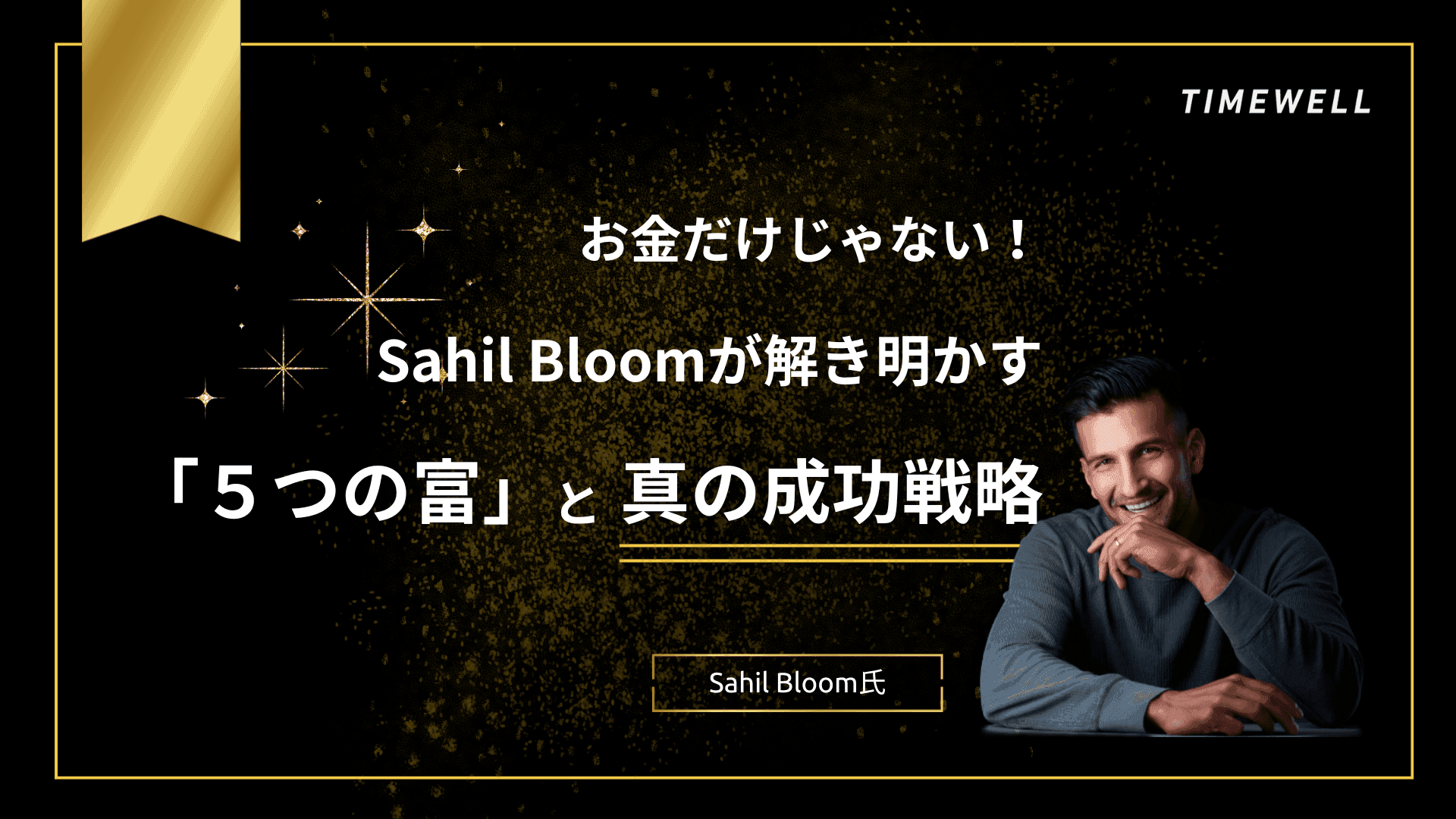
The standard definition of success — high income, status, expensive possessions — is what Sahil Bloom spent years of his finance career pursuing. He describes the experience now as "filling an internal problem with external solutions." The promotions and bonuses delivered a brief feeling of arrival, then immediately generated the next target. He was caught in what he calls the "arrival fallacy" — the belief that the next achievement will produce lasting satisfaction.
What changed his framework was a single conversation.
The moment that changed everything
In May 2021, Bloom mentioned to an old friend that he was feeling the distance from his aging parents on the East Coast. The friend asked how old his parents were. Sixty-something. How often did he see them? About once a year.
"Then you'll see them about 15 more times before they're gone."
That sentence — simple arithmetic — hit with the force of a physical shock. Time with the people who matter most is finite and countable. He had been treating it as an unlimited resource while rationing it for "later."
Within 45 days, Bloom had left his job, sold his California home, and moved 3,000 miles to be near his parents. What had been "15 remaining visits" became hundreds. He didn't wait for the right time. He made the right time.
This experience, combined with years of conversations with people across backgrounds and life stages, became the foundation of the Five Wealth framework.
The five types of wealth
Across hundreds of conversations — asking people "What advice would you give your younger self?" and "What do you want your future to look like?" — Bloom found four themes recurring consistently: time, relationships, purpose, and health. Money appeared frequently, but almost always as a means to those things, not as an end in itself.
He formalized this into five categories:
1. Time Wealth
The freedom to choose how, with whom, and where you spend your time — and the recognition that time is your most finite resource.
Bloom's test: Would you trade lives with Warren Buffett? $130 billion in assets at age 95? Almost no one says yes. The remaining time is worth more than the accumulated capital. Buffett himself, he notes, would likely give all of it to recapture the time that's already gone.
The problem: most people acknowledge time's value in the abstract while squandering it on low-return activities — passive scrolling, meetings without purpose, work that doesn't lead anywhere meaningful. Time wealth means deliberately managing this resource.
2. Social Wealth
The richness of your relationships — a small number of deep, trusted connections and a wider community both matter.
Bloom calls this possibly the most important of all, because relationships give meaning to everything else. "No one fantasizes about riding a yacht or flying a private jet alone."
The data supports it: Harvard's adult development study, tracking participants for over 85 years, found that satisfaction with relationships at age 50 was the strongest predictor of physical health at 80 — more predictive than cholesterol, blood pressure, or smoking status.
The irony: when people get busy, relationship investment is the first thing cut. Social wealth is built through consistent small actions and deteriorates through neglect.
3. Mental Wealth
A sense of purpose, ongoing self-development, and the mental space for reflection.
This includes stepping back from daily activity to ask: What actually matters to me? What am I trying to build? It can come through religion, meditation, quiet time, or structured reflection practices. The specific method matters less than the outcome: clarity about what you're working toward and why. Purpose provides energy for difficult periods and a framework for decisions that otherwise feel arbitrary.
4. Physical Wealth
Health and vitality — the capacity to fully use the other four forms of wealth.
Physical decline is inevitable, but the trajectory is significantly shaped by daily choices: nutrition, exercise, sleep, stress management. Health is the precondition for everything else. Without it, time is limited, relationships are strained, purpose is harder to pursue, and financial gains are harder to enjoy. Investing in physical health now is the most reliable investment in future capacity.
5. Financial Wealth
Money — but understood correctly: as a tool that enables the other four, not as an end in itself.
Bloom's key point: "Expectation is the greatest financial liability." If your appetite for money expands faster than your assets, no amount of accumulation will feel like enough. The goal is not maximum money but "enough" — your own definition, grounded in what you actually want your life to look like.
He cites Buffett's dictum about knowing your "enough number" — the level at which you stop letting money drive decisions and start letting values drive them instead.
The dimmer switch model
The natural response to "five types of wealth" is: how do I balance all five? Bloom argues the question is wrong.
The conventional framing is an on/off switch: "In my 20s and 30s, I focus on career and financial wealth. Other things go on hold." The problem: many of these domains can't be easily resumed after years of neglect. Health, relationships, and mental clarity don't pause while you're busy and restart cleanly when you have time. They atrophy.
The alternative is a dimmer switch model: every domain stays at some positive level all the time. The mix shifts with life's seasons — intensive career periods require different allocations than parenting young children or caring for aging parents — but no domain ever goes fully dark.
"The goal is not perfect balance every day. The goal is that every wealth type continues to grow, slowly, continuously, across your life."
The fisherman and the banker
Bloom tells a parable that illustrates the "enough" concept.
An investment banker visits a Mexican fishing village and meets a fisherman who works a few hours in the morning, then naps, and spends evenings with friends over wine. The banker explains how the fisherman could work longer, grow his operation, eventually sell for millions, and then retire to a small village — living a relaxed life, perhaps some fishing in the morning, napping in the afternoon, evenings with friends.
The fisherman listens. "But I'm already doing that."
The moral isn't about which man made the right choice. It's that they had fundamentally different definitions of "enough." The banker was projecting his own map onto someone else's terrain. Most people spend significant energy pursuing goals that belong to someone else's map.
Practical application in high-demand environments
For ambitious people in intense environments — startups, investment banking, competitive careers — Bloom offers two specific pieces of guidance:
Work-life harmony, not work-life balance: The framing of "work vs. life" creates artificial opposition. Bloom prefers "work-life harmony" — integrating professional ambition with the rest of life as part of a coherent whole. His wife and son aren't beside his ambitions; they're inside them. His children see him working intensely on things he cares about, which is itself something he wants to model.
Gratitude as active practice: Bloom describes a moment when his son interrupted focused work and his immediate reaction was irritation. Then he remembered the years of fertility treatments — the nightly prayers for a healthy child. The interrupting child was exactly what he had prayed for.
"Are you frustrated by things that were once your answered prayers?"
The pattern is common: we achieve what we once desperately wanted, habituate to it, and start treating it as an obstacle or a given. Bloom recommends environmental anchors — photos, specific music, meaningful objects — to trigger the recognition of what you already have that once felt impossible.
Summary
The Five Wealth framework reframes the question from "how do I maximize money?" to "how do I build a life I actually want?"
The five dimensions — Time, Social, Mental, Physical, Financial — are interdependent. Neglecting any of them creates problems that money can't reliably fix: a life with financial wealth but no time to enjoy it, or no relationships that make it meaningful, is not a successful life by most people's actual definition.
The practical implications:
- Treat time as your scarcest asset; the people you want to be with have a finite number of visits left
- Invest in relationships consistently, especially when you're busy — this is when most people stop
- Keep all five dimensions active; the dimmer switch, not the on/off switch
- Find your own definition of "enough" rather than using someone else's
The question Bloom leaves the reader with: "Is the mountain you're climbing one you actually chose — or one you just defaulted into?"
Looking for AI training and consulting?
Learn about WARP training programs and consulting services in our materials.
Streamline event operations with AI | TIMEWELL Base
Struggling to manage large-scale events?
TIMEWELL Base is an AI-powered event management platform.
Proven Track Record
- Adventure World: Managed Dream Day with 4,272 participants
- TechGALA 2026: Centrally managed 110 side events
Key Features
| Feature | Impact |
|---|---|
| AI Page Generation | Event page ready in 30 seconds |
| Low-cost payments | 4.8% fee — industry's lowest |
| Community features | 65% of attendees continue networking after events |
Ready to make your events more efficient? Let's talk.