Hello, I'm Hamamoto from TIMEWELL.
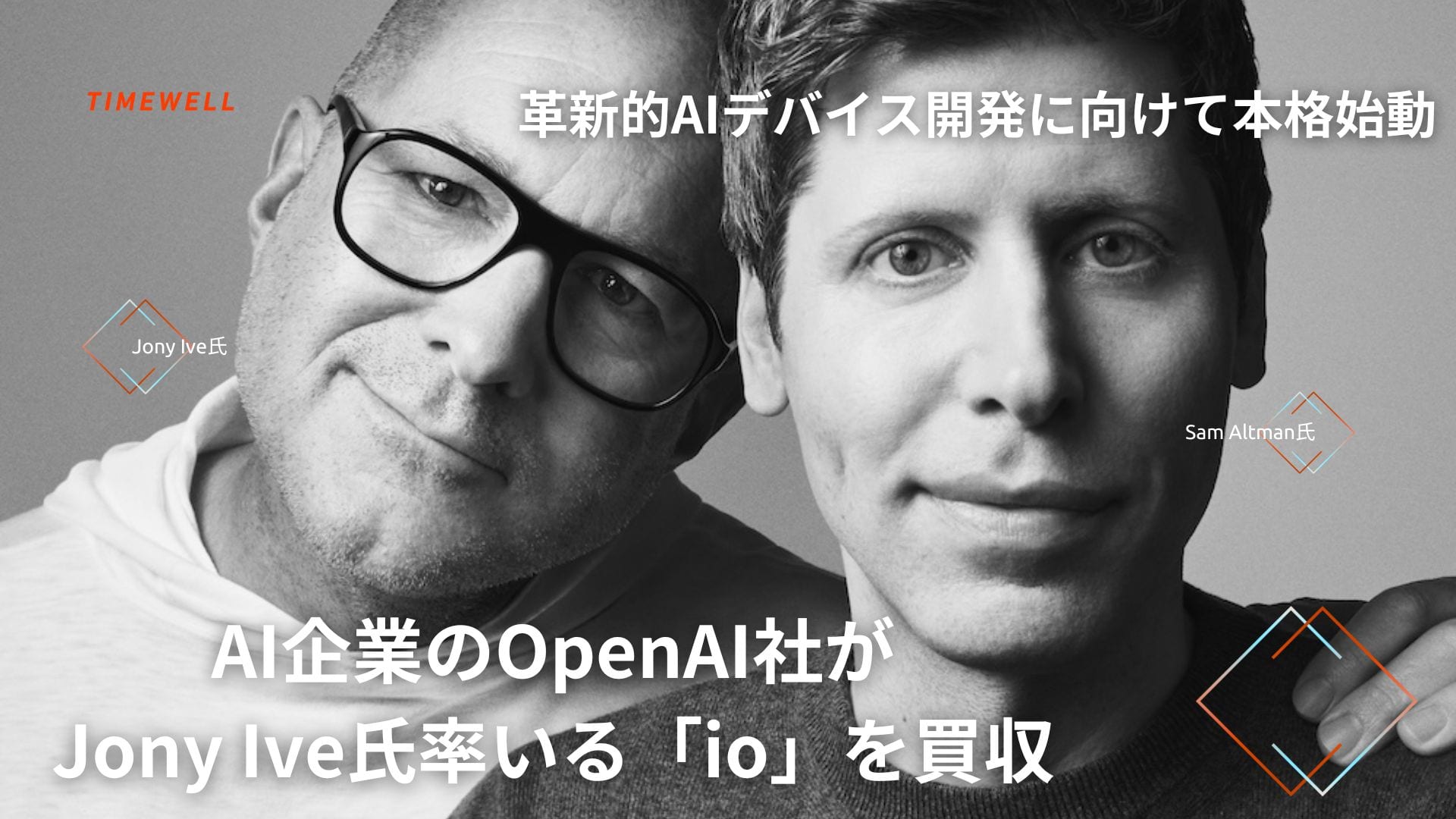
On May 21, OpenAI announced it would acquire "io" — an AI hardware startup founded by Jony Ive, the designer responsible for the iPhone, iPod, iMac, and Apple Watch. Roughly 55 hardware engineers, software developers, and manufacturing specialists will join OpenAI as part of the deal. The first device from this collaboration is expected to launch in 2026.
This article examines the thinking behind the acquisition, drawing on the public dialogue between Sam Altman and Jony Ive about what they're building and why.
Reimagining the Computer from First Principles
The starting point of Altman and Ive's collaboration is a shared belief: the computer as we know it — keyboard, display, explicit commands, windows and files — is a set of design decisions made decades ago for a world without AI. Those decisions made sense then. They don't have to be permanent.
Altman articulates it directly: "We have a chance to completely rebuild how people use computers." Not incremental improvement, but first-principles redesign. A device that uses "magical intelligence in the cloud" to enable interaction modes that never required keyboards and displays in the first place.
Ive brings 30 years of experience shaping how people relate to technology — not just what it looks like, but how it feels to use, how it fits into daily life, what emotional relationship users have with it. He describes himself as unburdened by traditional assumptions about what computers must look and feel like.
Looking for AI training and consulting?
Learn about WARP training programs and consulting services in our materials.
What They're Building
Neither Altman nor Ive has disclosed the specific form factor or feature set of the first device. What they have articulated is the design philosophy:
Intuitive over instructed. The device should understand context and intent, reducing the burden of learning command syntax or navigating UI hierarchies.
Human-centered, not screen-centered. Current computers demand that users adapt to the machine's interface paradigm. The goal is to invert that relationship.
AI as collaborator, not tool. The vision is a device that can work on complex tasks — research, medical queries, scientific analysis — rather than simply executing commands.
The implication is a significant departure from the laptop-and-phone paradigm that has defined personal computing for 15 years.
The Team Integration
The approximately 55 people joining OpenAI from io represent a deliberate blend of expertise: hardware engineering, software development, and manufacturing — the combination needed to design, produce, and scale a physical consumer device.
This isn't just adding headcount. It's adding a capability that OpenAI — a software and AI research organization — didn't have before: the institutional knowledge of how to bring a physical product to market at consumer scale.
Ive's track record at Apple is the most relevant precedent in the industry. The iPhone required not just a software vision but extraordinarily precise manufacturing coordination, supply chain management, and industrial design expertise. Bringing that knowledge set inside OpenAI changes what the organization is capable of building.
Why Hardware Now?
The timing of this acquisition reflects something important about where AI development stands.
AI capabilities — language understanding, reasoning, contextual awareness — have reached a level where new interface paradigms become viable. The bottleneck is no longer "can AI understand what I mean?" It's "what's the right physical form for interacting with AI that's capable of this?"
Altman has described the current moment as the time when rebuilding the fundamental human-computer relationship becomes possible. Every decade or two, a new device category resets the computing landscape: the PC, the web browser, the smartphone. The OpenAI-Ive collaboration is a bet that AI capabilities justify the next reset.
Implications for the Technology Industry
The acquisition signals several things for the broader technology landscape:
AI companies are moving into hardware. OpenAI, historically a software and research organization, is now committed to building consumer physical products. This is a direct competitive signal to Apple, Google, and Samsung.
The iPhone-era design paradigm is being challenged. Ive spent decades building the visual language of the touchscreen smartphone. His decision to work on something fundamentally different with AI is itself significant commentary on where he believes the next major shift is.
2026 as a milestone year. The first device expected this year will be closely watched — not just as a product, but as a proof of concept for whether AI-native hardware can reach mainstream consumers.
Reference: https://www.youtube.com/watch?v=W09bIpc_3ms
Related Articles
- The Reality of a Part-Time Employee Who Took Two Maternity Leaves and How Her View of Work Changed | TIMEWELL
- Before Taking Parental Leave — Three Things You Absolutely Must Do, Even During the Busiest Season
- Committed to Hands-On Work: How a Fifth-Generation Builder Found His Own Path at Fujita Construction