Hello, I'm Hamamoto from TIMEWELL.
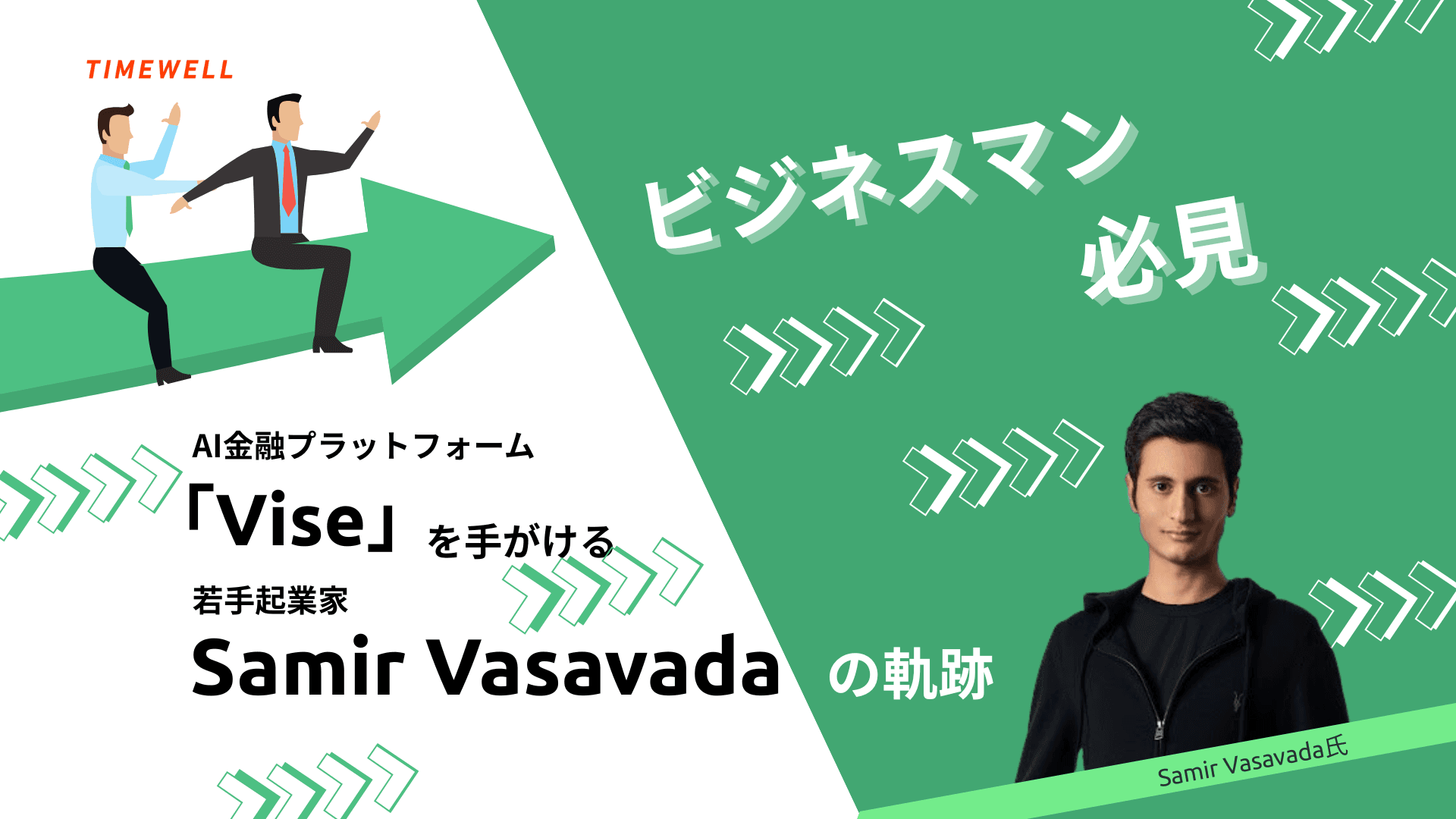
In the startup world, Samir Vasavada stands out — not just for building a company to a $1 billion valuation by age 20, but for the specific choices he made to get there. He grew up in a traditional Indian immigrant household in Cleveland, where the prescribed path was medicine or engineering. He rejected it in his early teens, taught himself iOS development at 16, built his first business, and eventually created Vise — an AI-powered investment management platform for financial advisors.
This article traces his journey, his approach to hiring, and the vision behind Vise.
Breaking the Mold: The Path Away from Convention
Vasavada's parents, like many Indian immigrant families, pushed hard for a conventional trajectory. The emphasis was on certainty: become a doctor or engineer, get a stable job, build a secure future. Vasavada remembers developing a divergent instinct early — a sense that building things, creating from scratch, was where his energy naturally went.
By the end of middle school, he had largely decided he wasn't going to follow the traditional university path. The high school graduation ceremony became a crystallizing moment: he didn't receive the academic recognition his parents expected, and the family tension at dinner that night reinforced his conviction that the formal education path wasn't his.
What he saw more clearly than most people his age was that what college actually offers — beyond credential signaling — is a network. And he believed he could build a better network himself, through direct outreach and real relationships, without paying $200,000 for the privilege.
He started teaching himself programming with a friend, focused on Swift and iOS development, built apps, and began accumulating the practical knowledge and connections that would later fuel Vise.
Looking for AI training and consulting?
Learn about WARP training programs and consulting services in our materials.
Hiring Philosophy: Barrels and Ammunition
As Vise scaled, Vasavada developed a distinctive hiring philosophy centered on a framework he calls "barrels and ammunition."
Barrels are people who can take an objective and move it forward without being managed. Given a goal, they figure out the path, identify the obstacles, and execute across all of it. They're rare and they're the rate-limiting factor for how fast any organization can grow.
Ammunition are people with strong specific skills who execute defined tasks excellently. They're essential and valuable — but they need direction to do their best work.
Most hiring processes optimize for skills and credentials. Vasavada's approach digs deeper: How has this person handled a project from beginning to end, on their own initiative? What hard thing have they done that no one told them to do? What did they learn from failure?
The signal he's looking for isn't intelligence or domain knowledge. It's autonomy and resilience — the capacity to figure things out when there's no roadmap, and to keep going when things get hard.
AI as a Force Multiplier for Small Teams
Vasavada's company reduced its customer support team from 6–7 people to 2–3 while managing a significantly larger client base — by deploying AI-driven automation for the high-volume, repeatable work. The remaining team members focused on the genuinely complex situations that required human judgment.
This isn't cost-cutting disguised as innovation. It's a specific thesis about where human attention is most valuable, and a deliberate choice to deploy it accordingly.
The company's overall headcount has at various points been around 40 people while producing outputs that peer companies with 150–160 employees struggled to match. The combination of selective hiring (prioritizing barrels), AI augmentation, and clear mission alignment is what he credits for the productivity differential.
Vise: AI-Powered Investment Management
Vise is the product Vasavada built for financial advisors. The problem it addresses: financial advisors manage large client books, each client has different goals, risk tolerances, income levels, and life circumstances, and traditional portfolio management requires enormous manual effort to truly personalize at scale.
Vise integrates all of that contextual data and uses AI to generate genuinely individualized investment recommendations — not "one risk profile" buckets, but actual portfolios calibrated to the specific person.
How It Works in Practice
When market conditions shift — say, a new tariff announcement — an advisor using Vise doesn't need to manually recalculate impacts across their entire client book. They query the system, get a real-time analysis of which clients are affected and how, and receive rebalancing recommendations for each affected portfolio.
What previously required hours of research per client event becomes a matter of minutes for the whole book. The advisor's time shifts from calculation to client relationship — the part that actually requires human judgment and trust.
Personalization at Scale
Vasavada is explicit that Vise's ambition goes beyond serving high-net-worth clients. The historical reality in wealth management is that genuinely personalized advice required significant minimums — it wasn't economically viable for smaller accounts. AI changes that math fundamentally.
A platform that can deliver the equivalent of a dedicated portfolio manager's analysis to every client, regardless of account size, democratizes access to professional investment advice in a meaningful way.
Long-Term Investment Thinking
In his own investment thinking, Vasavada applies a consistent long-horizon logic. His view: most individual investors would be better served by index investing and patience than by trying to trade around market noise.
The compounding math is simple but psychologically hard to follow in practice — which is exactly why most people don't benefit from it. His platform is built partly around helping advisors communicate this logic to clients who are tempted to react to short-term volatility.
The irony is that the most sophisticated investment system often produces the quietest portfolio — not because nothing is happening, but because the analysis is doing the work to identify that most of the noise doesn't warrant a change.
Reference: https://www.youtube.com/watch?v=s5r4wdOWLjk
Related Articles
- The Reality of a Part-Time Employee Who Took Two Maternity Leaves and How Her View of Work Changed | TIMEWELL
- Before Taking Parental Leave — Three Things You Absolutely Must Do, Even During the Busiest Season
- Committed to Hands-On Work: How a Fifth-Generation Builder Found His Own Path at Fujita Construction