Hello, I'm Hamamoto from TIMEWELL.
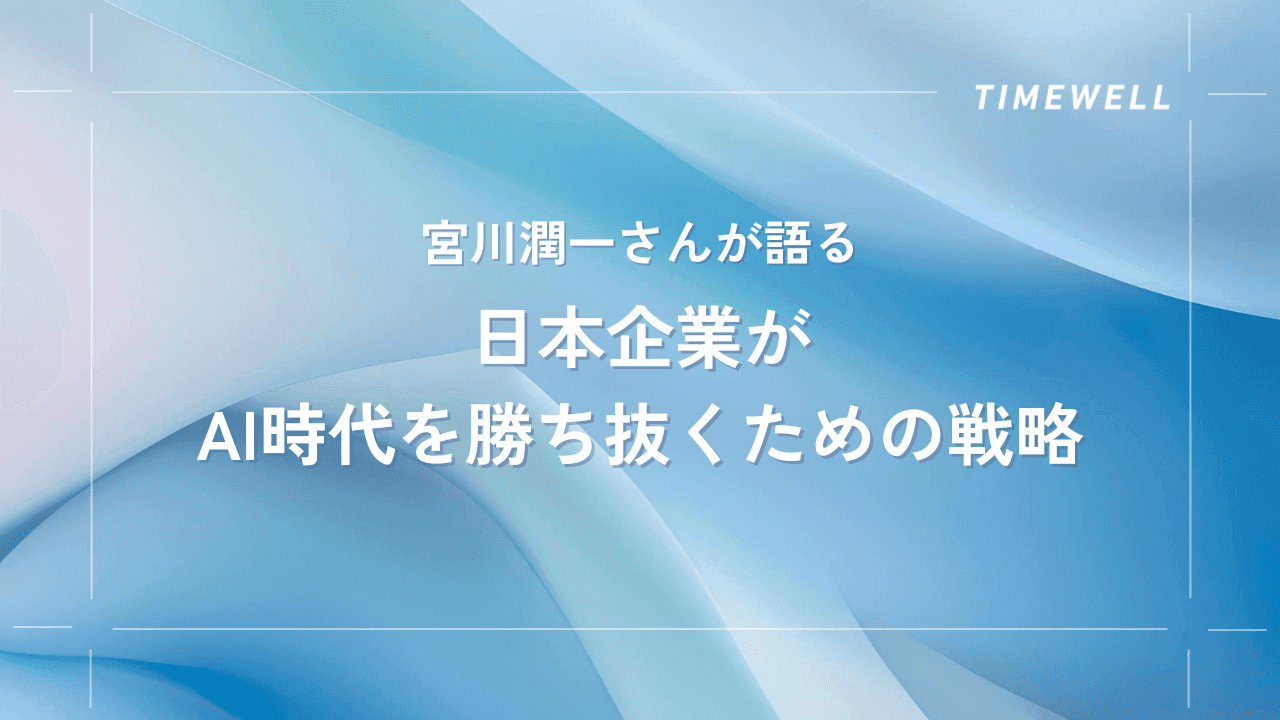
At SoftBank World 2024, SoftBank CEO Junichi Miyakawa delivered a keynote that opened with a single image: a 19th-century photograph of a man walking in front of an automobile carrying a red flag. The image was chosen deliberately.
The Red Flag Act: A Warning from History
Britain's Red Flag Act, passed in the latter half of the 19th century, required motor vehicles to travel at walking pace with a person carrying a red flag preceding the car. The law effectively strangled the British automobile industry — while other countries moved forward, Britain's automotive world market share fell to 2%.
Miyakawa's argument: Japan faces an analogous situation today with AI.
In autonomous vehicles, the comparison is already measurable. The United States and China have commercial robotaxi operations and comprehensive legal frameworks for self-driving vehicles. Japan's government only recently approved limited testing, in a small number of locations. The official target of 100+ testing sites by 2027 is far behind where the actual number stands today.
Looking for AI training and consulting?
Learn about WARP training programs and consulting services in our materials.
Japan's AI Adoption Gap
The data Miyakawa cited is stark:
- Corporate AI adoption rate in Japan: 32% — among the lowest in developed nations
- Individual AI usage rate: 9% (Japan Ministry of Internal Affairs and Communications)
- Japanese executives ranked last among nine countries surveyed for actively encouraging AI adoption
- Only 54% of Japanese executives said they encourage AI use — the lowest of any country in the survey
The pattern in Japan mirrors the country's response to the iPhone when it launched in 2008 — initial skepticism, stated concerns about necessity and reliability, and a broad cultural reluctance to commit early.
The common reasons cited for not adopting AI:
- "I don't see the need"
- "Uncertain how to use it or what the benefits are"
- "Concerned about accuracy of information"
These concerns aren't unreasonable individually, but they become a systemic risk when they represent a broad organizational posture.
AI's Acceleration Curve
Miyakawa outlined the pace of generative AI's development:
- GPT-3.5 launched approximately two years before this keynote, introducing text generation capability
- Image and video generation followed rapidly (DALL-E, Stable Diffusion)
- PaLM 2 demonstrated doctoral-level reasoning capability
Moore's Law originally described transistor doubling every 18 months. AI performance has been doubling every 3–4 months since GPU-accelerated training became standard in 2012. GPT-4 demonstrated performance at approximately 10²¹ FLOPS. At this trajectory, Miyakawa projected AI reaching IQ 135 (top 1% of human intelligence) within months to a year from the time of the keynote.
Does AI Take Jobs — or Do AI Users Take Jobs?
Miyakawa quoted NVIDIA CEO Jensen Huang: "It's not AI that will take your job. It's someone who uses AI that will take your job."
The historical examples he cited follow a consistent pattern:
- Britain's automobile industry (Red Flag Act) — regulatory hesitation → permanent market share loss
- Kodak — failed to adapt to digital photography despite inventing it
- Nokia — missed the smartphone transition
Conversely: Amazon's product recommendation system, Google's machine learning search improvements. Companies that used new technology as a value-creation tool rather than an efficiency measure grew disproportionately.
The demographic context for Japan makes this more urgent than for most countries: Japan's working population is projected to decline by 10 million by 2040. That decline, without productivity increases, would reduce GDP by over 100 trillion yen by simple calculation. AI-driven productivity improvement isn't optional in this context — it's the mechanism by which the math can work.
SoftBank's Approach
Miyakawa outlined what SoftBank is doing internally and externally:
Internal AI deployment:
- Call center automation
- Fraud detection
- Sales support systems
Infrastructure:
- Edge computing at base stations
- Fiber optic capacity expansion
- Distributed AI data center deployment
Partnerships:
- MONET Technologies (joint venture with Toyota) — AI-based mobility services
- Microsoft collaboration on zero-wait-time call center solutions
The goal Miyakawa articulated is for SoftBank to be Japan's AI infrastructure foundation — not just an AI user, but the backbone that other organizations use.
The Core Argument
Miyakawa's keynote doesn't make a nuanced case for gradual AI adoption. It makes a direct argument: the AI era is arriving regardless of whether individual companies or countries choose it, and the question is whether Japan will be in the group that shapes what that era looks like or the group that adapts to what others built.
For business leaders, the practical implication is straightforward: the executive hesitancy data (54% encourage AI — last among nine countries) represents a competitive liability. Not a risk to manage in the future. A gap that's widening now.
Reference: https://youtu.be/0FSe8c_un5E?si=gyHmPZvxwAI8ZOl5
Related Articles
- The Reality of a Part-Time Employee Who Took Two Maternity Leaves and How Her View of Work Changed | TIMEWELL
- Before Taking Parental Leave — Three Things You Absolutely Must Do, Even During the Busiest Season
- Committed to Hands-On Work: How a Fifth-Generation Builder Found His Own Path at Fujita Construction