Hello, I'm Hamamoto from TIMEWELL.
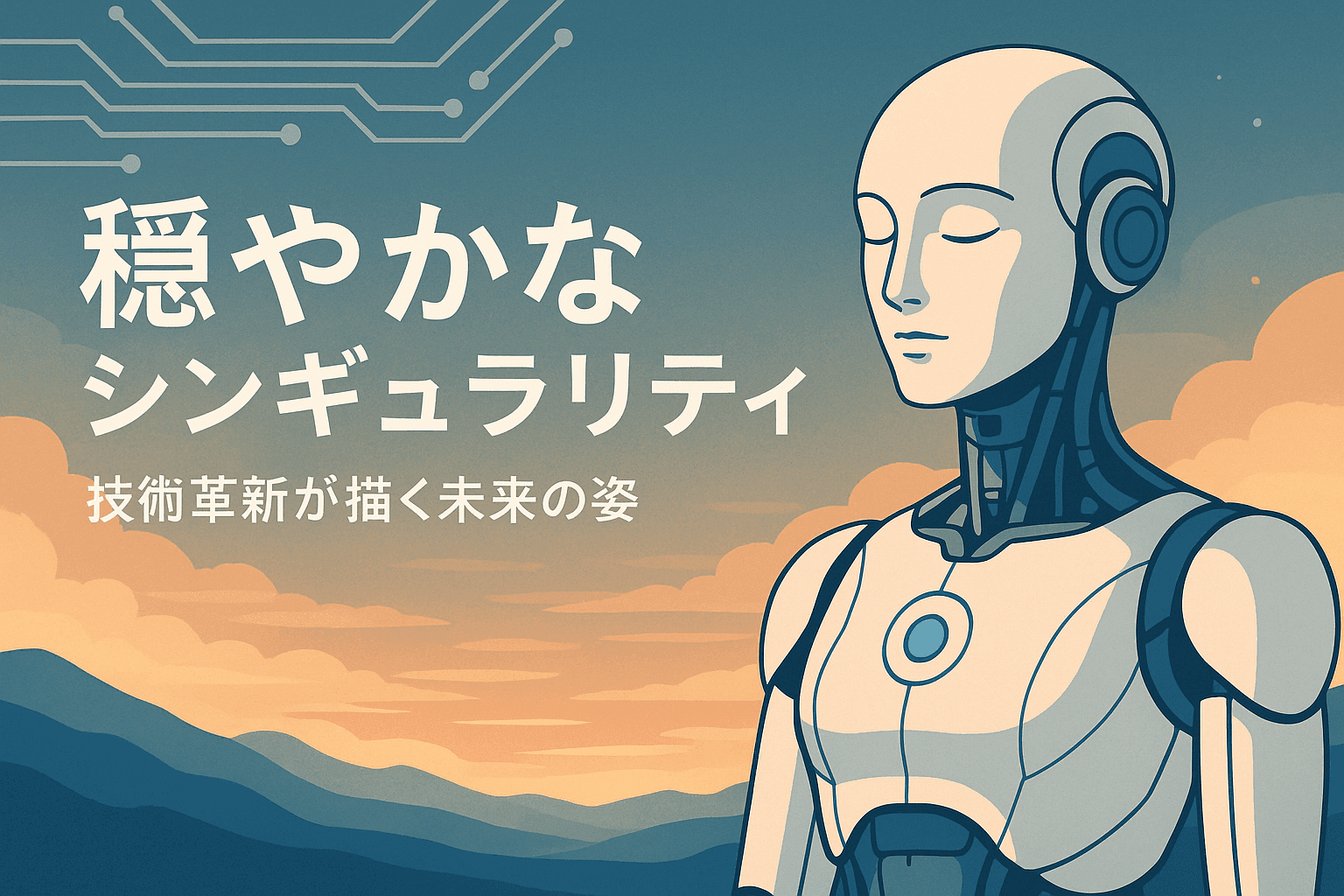
The singularity — the point at which artificial intelligence surpasses human intelligence — was supposed to be a moment. Disruptive, obvious, civilization-altering. What Sam Altman's essay "The Gentle Singularity" argues is that we may have already passed through it, and the main thing we can say is: it's quieter than expected.
Where We Are
Altman's framing: "We have crossed the event horizon. The takeoff has begun."
His evidence: we have built systems that are smarter than humans in many domains, and they're already producing measurable productivity improvements for people who use them. Scientists report 2-3x productivity gains. Hundreds of millions of people use ChatGPT daily for increasingly important tasks.
And yet, robots are not walking down streets. Most people are not talking to AI all day. People still get sick, the cosmos remains largely mysterious, and daily life for most people looks similar to how it looked in 2019.
This is the "gentle" part. The singularity — by at least some definitions — has begun, and civilization hasn't visibly restructured around it.
Current technical constraints that complicate the full picture:
- AI systems generate answers by combining learned patterns — whether this constitutes genuine understanding or sophisticated pattern matching remains unresolved
- Improving AI performance requires proportionally increasing compute, at growing cost
- Hallucination — generating plausible-sounding false information — remains a fundamental problem
Looking for AI training and consulting?
Learn about WARP training programs and consulting services in our materials.
Near-Term Projections (2025-2027)
Altman's directional forecast:
- 2025: Agents capable of genuine cognitive work are already here. "Coding will never be the same again."
- 2026: Systems capable of finding genuinely new insights are likely to emerge
- 2027: Robots capable of executing real-world physical tasks may arrive
These are directional forecasts, not guarantees. The counterpoints worth keeping in mind:
AI's strength in code generation comes primarily from training on massive code repositories — it's a domain where the training data was dense and structured. Genuine "new insight" generation requires hypothesis formation, experimental design, and causal reasoning. These remain technically difficult. The timeline to genuine scientific discovery capability may be longer than a single prediction cycle suggests.
The 2030s: Abundance of Intelligence and Energy
Altman's larger claim about the decade ahead: intelligence and energy — ideas and the ability to realize them — will become abundant in a way they have never been.
"In 2030, one person will be able to accomplish what required an entire team in 2020." This is already directionally visible. The question is magnitude and distribution.
The recursive improvement point: if AI can be used to accelerate AI research itself, the timeline for capability improvements compresses. If a decade of research can be done in a year — or a month — progress is a qualitatively different phenomenon.
Cost trajectory: As data center production becomes more automated, the cost of intelligence should approach the cost of electricity. A ChatGPT query currently uses approximately 0.34 watt-hours — about what a high-efficiency bulb uses in a few minutes, and roughly 1/15th of a teaspoon of water for cooling. At commodity energy prices, the marginal cost of AI inference trends toward near-zero over time.
Technical limits that complicate this: Current chip architectures are approaching physical efficiency limits. Further gains may require fundamentally different computing substrates — quantum computing, neuromorphic chips, or architectures not yet invented. Data center cooling and power supply infrastructure creates real constraints on scaling.
The Alignment Problem
Altman's most direct warning concerns AI systems that are highly capable but misaligned with human interests.
The social media analogy: recommendation algorithms are extremely effective at maximizing engagement (short-term preference) by exploiting cognitive patterns that work against users' long-term interests — anxiety, outrage, comparison, addiction to novelty. This is misaligned AI. It's doing what it was optimized to do, and what it's doing is harmful.
Scale that dynamic to much more capable systems, and the problem is more severe. "A small misalignment multiplied by hundreds of millions of people creates large negative effects."
Technically, alignment is unsolved. Current training methods cannot fully capture the complexity and variation of human values. Values differ across cultures, individuals, and time. Making AI behavior legible and verifiable — so humans can actually understand what a system is doing and why — requires fundamental technical advances that haven't happened yet.
The structural requirement Altman identifies: AI access cannot be concentrated in a small number of actors (companies, governments, individuals). Wide distribution of access is a prerequisite for the technology's benefits being broadly shared rather than extracted by whoever controls it.
What This Means for Business Leaders
The "gentle singularity" framing has practical implications:
The transition is already underway, not approaching. Organizations that treat AI adoption as a future planning question rather than a current operational question are falling behind in real time.
The productivity differential compounds. Altman cites 2-3x productivity gains for scientists using AI. In knowledge work generally, the gap between AI-augmented and non-augmented workers will likely widen over the next several years. Teams that establish AI-integrated workflows now will be substantially ahead of teams that defer.
Alignment matters at organizational scale too. The same principle that creates risk at the AI-system level creates risk at the deployment level. Organizations deploying AI tools without clear policies about what those tools are optimized for — what they're maximizing — create their own version of the misalignment problem.
The big picture remains uncertain. Altman is describing trends and directions, not specific outcomes. The honest position for business leaders is: pay attention, adapt incrementally, avoid both panic and over-confidence about what AI will and won't be able to do.
Reference: https://blog.samaltman.com/the-gentle-singularity
Related Articles
- The Reality of a Part-Time Employee Who Took Two Maternity Leaves and How Her View of Work Changed | TIMEWELL
- Before Taking Parental Leave — Three Things You Absolutely Must Do, Even During the Busiest Season
- Committed to Hands-On Work: How a Fifth-Generation Builder Found His Own Path at Fujita Construction